
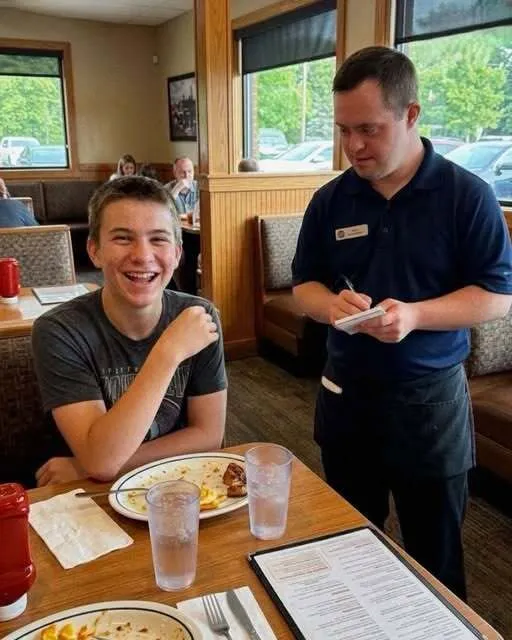
His smile disappeared before he had even finished looking inside the box.
It was small, scratched around the edges, and darker with age than I remembered.
Inside were several photographs, an old hospital bracelet, a folded newspaper clipping, and one worn card.
Leo stared at everything without touching it.
“What is this?” he asked.
I sat across from him.
“This is something I should have shown you years ago.”
The Photograph That Changed His Expression
Leo picked up the first photograph.
The colors had faded with time.
A young boy sat in a wheelchair, smiling directly at the camera. His hair was messy, one shoelace was untied, and a paper crown rested on his head.
Leo turned the photograph over.
“Who is he?”
“My brother.”
He looked at me in surprise.
“You had a brother?”
“Yes.”
Then he looked back at the picture.
“What happened to him?”
I folded my hands on the table.
“His name was Michael. He had Down syndrome.”
Leo’s expression immediately changed.
“He died when he was nineteen.”
For several seconds, neither of us spoke.
The Brother I Never Forgot
Michael had been born before me.
Because of him, I learned patience at a very young age.
He was slower to speak than other children. He also needed extra help with certain everyday tasks.
However, those things never defined him.
Michael loved music. He hated thunder. He also laughed at the same three jokes, no matter how many times he heard them.
Most importantly, he noticed people differently.
When someone entered a room, Michael did not care about their clothes or job.
He noticed whether they smiled.
Once, he told me that adults were strange because they often pretended not to be lonely.
I never forgot those words.
Leo placed the photograph on the table.
“Was he like Sam?”
I nodded.
“In some ways.”
Then Leo asked the question I knew was coming.
“Did people make fun of him?”
“Sometimes.”
He looked uncomfortable.
“Did you?”
That question hurt more than I expected.
“No,” I said.
However, there was more to the truth.
“I didn’t always know how to defend him either.”
Michael Was More Than His Disability
Next, I picked up the old newspaper clipping.
It came from a small local newspaper.
The article was about Michael volunteering at a community center.
Under the headline was a photograph of him serving lunch to other people.
“He loved helping,” I explained.
“He never cared about impressing anyone. He simply wanted to be useful.”
Leo stayed quiet.
Then I opened the wooden box wider.
At the bottom was the old card.
I handed it to him.
The director of the community center had written it years earlier.
The message explained how Michael made people feel welcome. In particular, he helped children who felt nervous or unsure.
Leo read the card twice.
Finally, he looked at me.
“What does this have to do with tonight?”
“Everything.”
What Leo Had Done
Earlier that evening, Leo had laughed at Sam.
He had copied the way Sam moved.
He had also mocked the way Sam struggled to pronounce a word.
At the time, Leo thought he was being funny.
Now, sitting across from me, he looked much less certain.
“You laughed when someone struggled with a word,” I told him.
“You copied the way he moved. You made fun of something you knew was different about him.”
Leo stared at the table.
“I know.”
“No,” I replied gently. “I don’t think you understood.”
He looked up.
“That wasn’t just a joke, Leo.”
Then I explained something I wanted him to remember.
“A joke should not depend on making another person feel small.”
Leo tried to explain himself.
“I didn’t mean to hurt him.”
“I believe you.”
That surprised him.
“But good intentions don’t erase the effect of what we do.”
Slowly, he nodded.
A Lesson Michael Had Taught Someone Else
I picked up another photograph.
This one showed Michael at a birthday party surrounded by children.
“He had a friend named Daniel,” I said.
Leo studied the picture.
“What happened to him?”
“Daniel used to avoid Michael.”
“Why?”
“He was nervous because he didn’t understand him.”
However, everything changed one afternoon.
Michael invited Daniel to play cards.
After that, they played together almost every Saturday.
Eventually, the two became best friends.
Years later, Daniel told me that Michael had taught him an important lesson.
Leo looked at me.
“What?”
“That being different isn’t the same as being less.”
Leo lowered his eyes.
For a moment, the only sound in the kitchen came from the clock.
Why I Didn’t Simply Ground Him
After a while, Leo asked another question.
“Did you bring me here just to make me feel bad?”
“No.”
“Then why are you showing me all of this?”
“Because grounding you would be easy.”
He looked up.
“I could take your phone. I could cancel your plans. I could stop you from going out for a month.”
I paused.
“But then you might only learn how to avoid getting caught next time.”
Leo said nothing.
“I want you to learn something more important.”
“What?”
I looked directly at him.
“I want you to notice another person’s dignity before deciding whether something is funny.”
His eyes began filling with tears.
He quickly looked away.
“I messed up.”
“Yes.”
“Badly?”
“Yes.”
Then he took a deep breath.
“What am I supposed to do?”
The Apology He Needed to Make
“Tomorrow, you’re going back to the restaurant.”
Leo’s eyebrows rose.
“What?”
“You’re going to apologize to Sam.”
He immediately became nervous.
“I don’t know if he’ll even want to talk to me.”
“He doesn’t owe you a conversation.”
Leo nodded.
“And if he doesn’t want to speak to you, you accept that.”
For another minute, he stayed silent.
Then he asked something completely different.
“Why didn’t you tell me about Uncle Michael before?”
That question hurt in another way.
I looked down at the old wooden box.
“Because I thought keeping those memories private meant I was protecting them.”
My fingers moved across the worn lid.
“But I was wrong.”
Memories I Had Hidden for Years
Michael had been gone for many years.
Still, I had never stopped carrying him with me.
The strange part was that I had never thought of his life as a lesson.
He was simply my brother.
However, while sitting across from Leo that evening, I realized something.
There were stories about Michael that deserved to survive.
More importantly, my son needed to hear them.
Leo Returned to the Restaurant
The next afternoon, Leo stood outside the restaurant looking terrified.
“I don’t want to mess this up,” he said.
“You’ll probably say something awkward.”
He gave me a look.
“Thanks, Mom.”
I smiled.
“But awkward isn’t the same as dishonest.”
Then we walked inside.
The hostess recognized us.
Sam was working near the front of the restaurant.
When he saw Leo, he stopped.
Leo slowly walked toward him.
For several seconds, he couldn’t find the words.
Finally, he spoke.
“I owe you an apology.”
Sam looked at him carefully.
“I made fun of the way you talked and moved yesterday,” Leo continued.
“It was disrespectful. I knew that while I was doing it.”
Sam stayed quiet.
“I thought I was being funny.”
Leo looked down.
“I wasn’t.”
Sam glanced toward me and then back at Leo.
After a moment, he answered.
“Thank you for saying that.”
Leo nodded.
Then he added one more thing.
“I shouldn’t have treated you like you were less important than me.”
Sam gave him a small smile.
“Okay.”
That was it.
There was no dramatic speech.
There was no instant friendship.
Instead, there was simply an apology and a quiet acceptance.
A Question I Didn’t Expect
On the way home, Leo barely spoke.
Finally, he looked over at me.
“Mom?”
“Yeah?”
“Do you think Uncle Michael would have liked me?”
I smiled.
“He probably would have.”
“Even after what I did?”
“Yes.”
“Why?”
“Because Michael was very good at giving people another chance.”
Leo stared out the window.
“I wish I’d met him.”
“So do I.”
He Wanted to Know Everything About Michael
A week later, Leo asked to see the photographs again.
This time, we spread them across the living room floor.
He had questions about almost every picture.
What music did Michael like?
What food did he hate?
What did his laugh sound like?
Did he ever get angry?
What were his dreams?
Did he know how much people loved him?
I answered every question I could.
Some answers made us laugh.
Others made me cry.
Then Leo picked up the photograph of Michael in his wheelchair.
He placed it beside one of his own school photographs.
After staring at the two pictures, he said something I will never forget.
“I think I was so busy trying to be cool that I forgot everyone is somebody.”
Something in My Son Had Changed
I looked at Leo differently after that.
Sometimes, there are moments when a child crosses an invisible line.
It is not the line into adulthood.
It certainly is not the line into perfection.
Instead, it is the beginning of awareness.
Leo was still fourteen.
He would make more mistakes.
He would still speak before thinking sometimes.
However, something had changed.
He was beginning to see people differently.
When We Saw Sam Again
Several months later, we returned to the restaurant.
Sam was working that day.
This time, Leo did not wait for someone else to speak first.
He greeted Sam himself.
“How’s your day going?”
Sam smiled.
“Good.”
Then Leo smiled back.
They talked briefly about school, food, and a football game.
Nothing extraordinary happened.
There was no emotional speech.
There was no dramatic music.
It was simply two people having a normal conversation.
Yet, to me, that ordinary moment meant everything.
The Box Was Never Only About Loss
As I watched them talk, I thought about the wooden box in my closet.
For years, I believed it contained memories of someone I had lost.
But now I understood something else.
The box also contained something I could still give.
A story.
A reminder.
A reason to stop before laughing at someone who seems different.
That night, Leo helped me place the photographs back inside.
Before closing the lid, he looked at Michael’s picture one last time.
“Good night, Uncle Michael.”
I smiled.
“Good night.”
Then I closed the box.
For the first time since my brother died, it did not feel like I was saying goodbye.
Instead, it felt like I was passing something forward.