
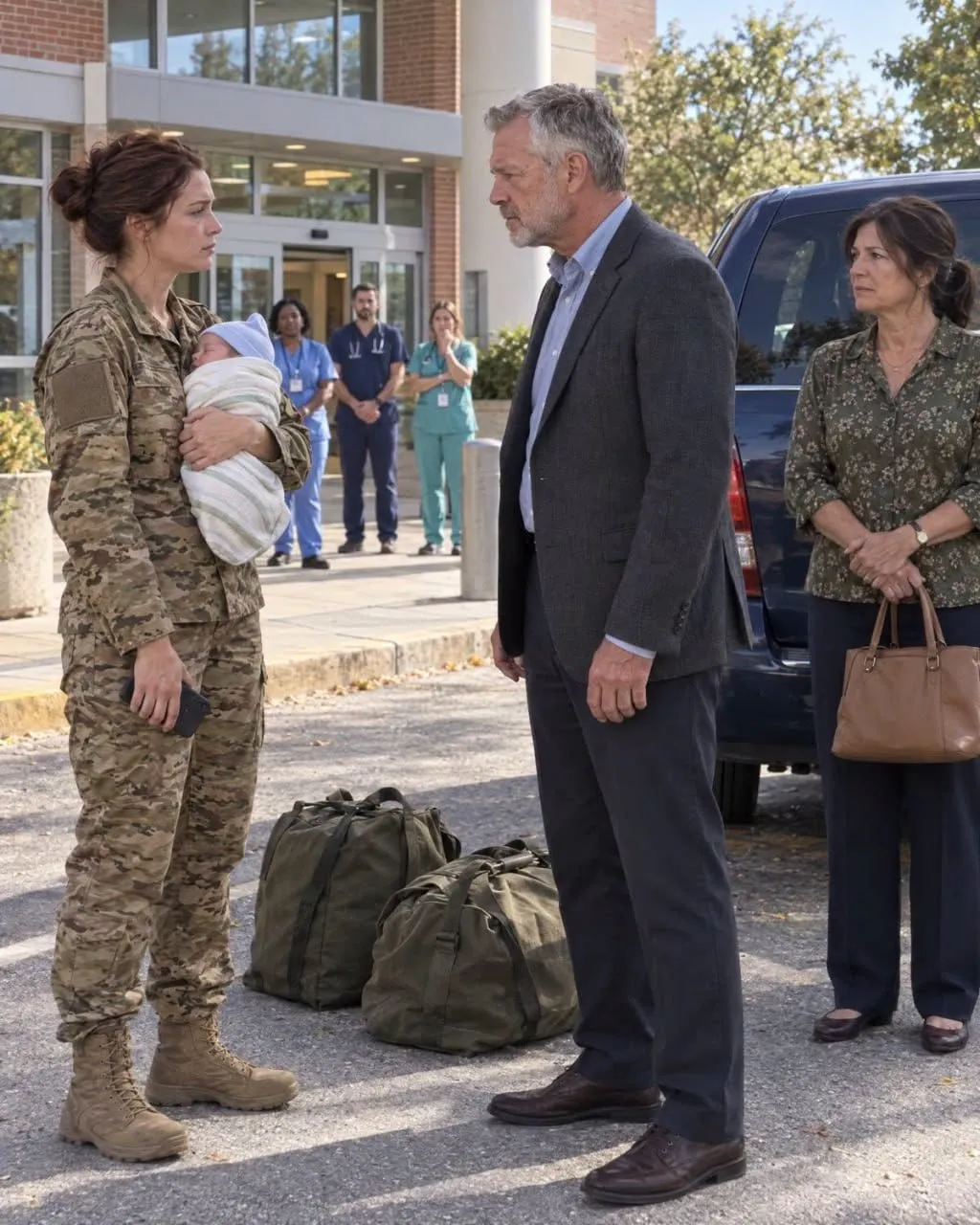
“Take the baby and leave. You’re not coming back to this house.”
My father dropped my two duffel bags onto the concrete outside the hospital entrance as if they were garbage.
I was twenty-seven years old, three days out from an emergency C-section, holding my newborn daughter against my chest.
My husband, David, had been killed in combat six days earlier.
My mother stood beside my father, clutching her purse.
“A widow and her baby aren’t our problem,” she said coldly.
They were waiting for me to cry.
To beg.
To sign whatever they put in front of me just so I could have somewhere to sleep that night.
Instead, I said nothing.
I adjusted my daughter in my arms, reached into my pocket, and pulled out my phone.
My father smirked.
He still thought he controlled everything I needed.
My car.
My belongings.
My husband’s paperwork.
And, most importantly, he believed he could control David’s $400,000 military life-insurance benefit.
What he didn’t know was that during the previous forty-eight hours, I had learned exactly how little power he actually had.
Six days earlier, two uniformed officers had arrived at my parents’ house.
I was thirty-eight weeks pregnant and temporarily staying with my parents while David was deployed.
The second I saw the officer and the chaplain standing on the porch, I knew.
The officer looked directly at me.
“Sergeant Ellis?”
I stood.
My father tried stepping between us.
“I’ll handle this.”
The officer ignored him.
Then came the words every military spouse fears.
David had been killed during a combat operation.
For several seconds, I couldn’t hear anything except a high ringing in my ears.
Then our baby kicked hard beneath my ribs.
Part of David was still alive inside me.
I forced myself to remain standing.
My mother covered her mouth dramatically.
My father stared at the officers.
But there was something strange in his expression.
Not grief.
Calculation.
After the notification team left, my father shut the front door and turned toward me.
“Go lie down,” he said.
“We’ll handle the paperwork.”
At the time, I was too broken to understand what he really meant.
The following afternoon, Major Thomas Sterling, David’s battalion commander, arrived with Sergeant First Class Elena Rostova, the casualty assistance officer assigned to help me.
Major Sterling sat across from me and told me how David had died.
His unit had been trapped during an attack.
A group of soldiers couldn’t retreat because razor wire blocked their path.
David moved forward under fire and cut through it.
He held the opening while the others escaped.
He saved dozens of lives.
For the first time since hearing he was gone, a tear rolled down my face.
Then Rostova began explaining survivor benefits.
She told me about Servicemembers’ Group Life Insurance.
The benefit was $400,000.
My father interrupted immediately.
“So what’s the actual payout?”
The room went silent.
My mother hurried in.
“She’s pregnant, hormonal, grieving. She can’t manage that kind of money right now. We’ll have to handle everything for her.”
That was when I understood.
They weren’t worried about me.
They wanted the money.
My father’s mechanic shop was drowning in debt.
Years earlier, when I first enlisted, he had pressured me into sending him $400 every month.
For five years.
Twenty-four thousand dollars.
He always told me it was my responsibility to help the family.
Eventually, David convinced me to stop.
My father never forgave him for that.
David knew exactly what kind of man he was dealing with.
One month before deploying, David gave me a thick green tactical folder.
Inside were copies of benefit information, important military contacts, beneficiary instructions, and Major Sterling’s personal phone number.
He placed it inside my medical bag.
“If something happens to me,” David said, “your father is going to circle like a buzzard.”
I laughed nervously.
He didn’t.
“If he starts talking about controlling your money or managing your assets, call Sterling.”
Then he looked straight at me.
“And don’t let your father touch this folder.”
A month later, David was dead.
Two days after receiving the news, my water broke.
Complications developed during labor.
Our daughter’s heart rate dropped, and the doctors rushed me into emergency surgery.
I remember the fluorescent lights above me.
The cold operating room.
The fear.
David should have been holding my hand.
Instead, a nurse did.
Then suddenly, I heard my daughter cry.
Eevee.
Seven pounds of everything David and I had dreamed about.
When they placed her against my chest, I cried harder than I had when the officers told me David was dead.
He would never see her.
Never hold her.
Never hear her laugh.
The next morning, I was still heavily medicated when my father came into the hospital room.
He barely looked at the baby.
Instead, he walked directly toward my medical bag.
Through half-open eyes, I watched him unzip it.
Then he pulled out David’s green tactical folder.
I tried to sit up.
Pain tore through my abdomen.
“Dad…”
He looked at me.
“I’ll keep this safe.”
Then he tucked the folder under his arm.
“You’re on pain medication. You don’t need to worry about paperwork.”
He left with it.
For several hours, I blamed myself for not stopping him.
Then Saturday night, my phone buzzed.
It was my older brother, Derek.
We hadn’t spoken in over a year.
His message contained four words.
“Watch your back.”
Then another message appeared.
He told me my father had been at his garage talking about David’s life-insurance benefit.
According to Derek, Dad believed the $400,000 could wipe out the debt on the shop.
Then another text came.
“Mom said if you refuse to sign the transfer paperwork, they’re leaving you at the hospital. No car. No ride. They think you’ll cave.”
I stared at the screen.
Three days after major abdominal surgery.
With a newborn.
They were planning to abandon me to force me into signing over control of David’s money.
Something inside me changed.
The following morning, Sergeant First Class Rostova entered my hospital room.
Her expression was serious.
“We had an issue yesterday.”
My stomach tightened.
She explained that my father had contacted her office claiming he was my financial representative.
He tried to redirect the life-insurance payment into a civilian business account.
I immediately recognized the account.
His mechanic shop.
“He also told us that because of your surgery and grief, you might not be mentally capable of managing the benefit yourself.”
I stared at her.
My own father was trying to use my surgery and my husband’s death to argue that I couldn’t control my finances.
Rostova continued.
“He got nowhere.”
She looked me directly in the eyes.
“You are David’s designated beneficiary. Nobody changes that because your father says so.”
For the first time in days, I felt something close to relief.
Later that afternoon, my parents arrived.
My father placed a document on my hospital tray.
A power-of-attorney form.
“Sign it.”
I looked at the paper.
Then at him.
He pushed a pen toward me.
“You focus on the baby. I’ll handle everything else.”
I picked up the pen.
My father smiled.
The pen hovered above the signature line.
One second.
Two.
Three.
Then I dropped it.
“I’m going to think about it.”
His smile disappeared.
“We leave at ten tomorrow morning,” he said.
“Make up your mind.”
That night, I made my own arrangements.
I called Sarah Jenkins, a fellow soldier and friend.
“Can you bring your car to the hospital tomorrow morning?”
“Absolutely.”
Then I contacted Rostova.
I asked what happened if I revoked my parents’ civilian sponsorship to enter the military installation.
She explained the procedure.
I slept better that night.
The next morning, my mother walked into my room carrying my duffel bags.
My father followed.
They expected a signed power of attorney.
They didn’t get one.
My father stared at the unsigned document.
Then his expression changed.
The fake concern disappeared.
“All right,” he said coldly.
We walked through the hospital.
Every step pulled at my fresh incision.
I held Eevee carefully against my chest.
Outside, my father’s battered Chevy Silverado was parked near the entrance.
And sitting openly on the dashboard was David’s green tactical folder.
He wanted me to see it.
He wanted me to believe that because he had the paperwork, he had the power.
My father walked to the back of the truck, grabbed my bags, and threw them onto the pavement.
Then he slammed the tailgate.
“Take the baby and walk.”
I stared at him.
“You’re not coming back to our house.”
My mother folded her arms.
“A widow isn’t our responsibility.”
There it was.
The ultimatum Derek had warned me about.
My father expected me to panic.
Instead, I reached into my pocket.
Unlocked my phone.
And called Major Sterling.
He answered almost immediately.
“Sterling.”
“Major Sterling. I’m outside the main entrance of Blanchfield Hospital. My parents are on this installation under my civilian sponsorship.”
My father’s expression changed slightly.
I continued.
“I am officially revoking that sponsorship effective immediately.”
My mother looked at my father.
“And my father is currently in possession of military casualty documents belonging to me. They’re sitting on the dashboard of his Silverado.”
There was a brief silence.
Then Sterling answered.
“Understood.”
His voice hardened.
“Stay where you are.”
The call ended.
My father laughed.
“You think your little officer friend is going to scare me?”
I didn’t answer.
He pointed at the green folder.
“You’d better get in this truck. Otherwise, that folder goes into my safe at the shop.”
Still, I said nothing.
Five minutes passed.
Then ten.
My father kept checking his watch.
At around twenty minutes, he pulled his truck keys from his pocket.
“All right. We’re leaving.”
Before he reached the driver’s door, a siren sounded.
Two military police vehicles entered the loading area and stopped near the Silverado.
The hospital doors opened.
Major Sterling walked outside.
Rostova followed him.
Two military police officers came behind them.
My father’s face changed completely.
Major Sterling walked directly toward me.
Then he turned toward my father.
“Mr. Vance, Sergeant Ellis has revoked your sponsorship for this installation. You and your wife are required to leave the property.”
My father raised his hands.
“This is a family matter.”
Sterling didn’t move.
“This is a federal installation.”
One of the military police officers stepped forward.
He pointed toward the green folder sitting on the Silverado dashboard.
“We have also received a report that you are in possession of documents belonging to Sergeant Ellis.”
My father looked at me.
Then at the MPs.
Then at Sterling.
His confidence disappeared.
“Lauren, tell them what’s going on.”
I said nothing.
He stepped toward me.
“Tell them you’re confused. You just had surgery.”
There it was again.
The same strategy.
Make me look weak.
Make me look incapable.
Make himself the person who should control everything.
I tightened my arm around my daughter.
Then I finally spoke.
“Give me David’s folder.”
My father stared at me.
“Lauren—”
“Give it back.”
He turned slowly toward the truck.
Reached through the open window.
Picked up the green folder.
And handed it to the military police officer.
The officer returned it to me.
My mother rolled down the passenger window.
“Don’t come crying to us when you waste all that money!”
I looked at her.
For the first time in my life, her words didn’t hurt.
The military police escorted their truck off the installation.
Ten minutes later, Sarah arrived.
She loaded my bags into her car.
Then she helped me secure Eevee into a car seat.
Before we left, I opened the green tactical folder.
Everything was still there.
The benefit paperwork.
The military contacts.
The instructions.
But behind them was an envelope.
David’s handwriting was on the front.
My hands started shaking.
The envelope had already been opened.
My father had read it.
I pulled out the letter.
David had written it before deployment.
“If you’re reading this, the worst happened.
But I know you’re still standing.
I left this folder as your shield.
Major Sterling knows what to do, but I told him something important.
He is not supposed to step in unless you are the one who calls him.
I can’t protect your boundaries forever, Lauren.
Eventually, you have to protect them yourself.
Take care of our girl.
I love you.”
I broke down.
Not because of my parents.
Because of David.
Even before he died, he had understood what I couldn’t.
He knew my parents would try to exploit the worst moment of my life.
And instead of trying to control everything from beyond the grave, he gave me a way to protect myself.
One week later, my parents were formally barred from entering the installation.
Then came David’s funeral.
Full military honors.
Rows of soldiers stood beneath a gray sky.
Taps echoed across the cemetery.
The honor guard folded the American flag.
Major Sterling knelt in front of me and placed it into my hands.
David was gone.
But what he had taught me remained.
Months later, my mother called.
Her voice was sweet again.
Too sweet.
She invited me to Thanksgiving.
“Your father wants to put everything behind us.”
Then came the real reason.
“He just wants to look over your insurance statements and make sure the government didn’t mess anything up.”
I almost laughed.
Nothing had changed.
I agreed to meet them once.
A public park.
One hour.
Sarah would come with me.
And I gave them one rule.
No discussion about money.
For the first twenty minutes, everything seemed normal.
My mother held Eevee.
My father barely spoke.
Then he cleared his throat.
“So… I don’t need access to anything. I just want to see the account statements.”
I stood immediately.
I took my daughter from my mother’s arms.
“You had one hour.”
My father frowned.
“You lasted twenty minutes.”
His face reddened.
“That Major Sterling put you up to this, didn’t he? The military has brainwashed you against your own family.”
I stared at him.
Then I gave him the only answer he deserved.
“It was me.”
I turned and walked away.
That was the last time I saw them.
Today, Eevee and I live peacefully near base.
David’s green folder sits in the top drawer of my dresser.
I don’t carry it around anymore.
I don’t need to.
I know the regulations.
I know who to call.
I know which documents matter.
Most importantly, I finally understand something David had been trying to teach me for years.
A physical folder was never the real protection.
Neither was Major Sterling.
Neither were the military police.
They helped when I needed them.
But real protection came when I stopped allowing fear, guilt, and family ties to override my boundaries.
My parents no longer control my decisions.
Their threats no longer control my future.
David trusted me to protect our daughter.
And I will.
Because forgiveness does not mean access.
And blood does not give anyone the right to destroy your life.