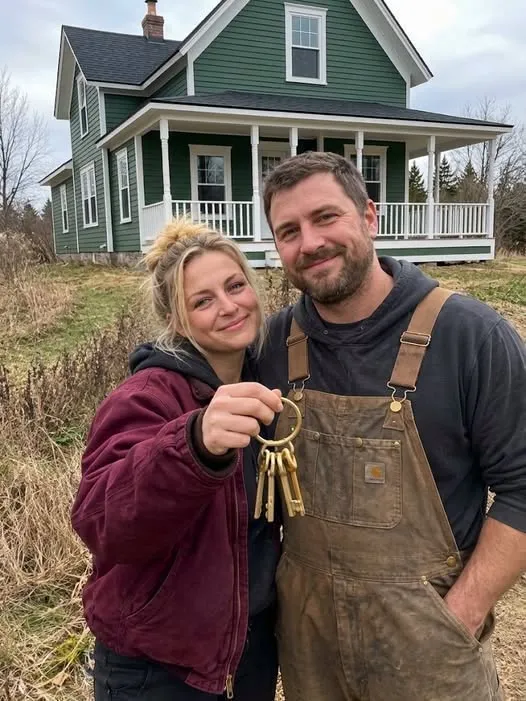
After years of being called the independent ones, Emily and Nate made a decision that changed their lives. However, the biggest surprise came after they bought an abandoned farmhouse.
The Dinner We Never Forgot
My father-in-law, Ron, stood at the head of the dining table with three white envelopes beside the gravy boat.
“Your mother and I sold the forty acres by the creek,” he announced. “We want to share the money while we’re still here to see you enjoy it.”
First, he handed an envelope to Kim. She opened it and gasped.
“Twenty thousand dollars?”
Judy smiled. “Now you can finally put a proper roof over your boys’ heads.”
Next, Ron gave Jeff a check for $20,000. Then Stacy received another $20,000 to help furnish her new home.
I quietly added the numbers. In less than five minutes, they had handed out $60,000.
However, there were no more large envelopes on the table.
Finally, Ron reached into his jacket and pulled out a small greeting card.
“This is for Nate and Emily.”
My husband took it without speaking. Inside was a bluebird card with one handwritten sentence.
You two have always been so capable. We never worry about you.
There was no check. Not even a small contribution.
Meanwhile, his siblings were still admiring their gifts.
“We knew you’d understand,” Judy said. “You two don’t need help like the others.”
Nate’s ears turned red. Nevertheless, he thanked his mother and quietly helped clear the table.
That evening, I realized something painful. In this family, being responsible meant being overlooked.
A Promise on the Drive Home
The bluebird card lay on our pickup’s dashboard as we drove home.
“How much do we have saved?” Nate asked.
“Six thousand two hundred dollars,” I replied. “And rent is due next week.”
He kept his eyes on the road.
“I’m not angry at Kim or Jeff,” he said. “They needed help.”
“Then what hurts?”
Nate was silent for a moment. Finally, he answered.
“I’d like somebody to worry about us just once.”
His words stayed with me.
We rented a modest house and worked hard to pay every bill. Yet we had no property, no family assistance, and little room for emergencies.
“Then we’ll buy a house ourselves,” I said.
“With what money?”
“We’ll save it.”
At first, he shook his head. A decent home in our county cost far more than we could afford.
However, I had already begun thinking about extra work.
“Let’s aim for forty thousand dollars,” I suggested. “Enough to give us a real chance.”
Nate glanced at the bluebird card.
“One condition,” he said. “We don’t tell my parents.”
I nodded. “We don’t tell anyone.”
Two Jobs Became Four
That Sunday, I visited Patty’s Truck Stop Diner and asked for weekend night shifts.
“You already work at the hospital,” Patty reminded me.
“I know. But I need the hours.”
After a long look, she agreed to put me on the schedule.
Meanwhile, Nate visited Frank, his boss at the diesel repair shop. He volunteered for emergency farm-equipment calls after dark.
Farmers couldn’t always wait until morning when a combine broke during harvest. Therefore, those late repairs sometimes paid well.
Our new routine began the following Friday.
During the week, I handled billing records at the county hospital. On weekends, I carried heavy plates and poured coffee for truck drivers through the night.
Nate spent his days repairing engines. Then, whenever the phone rang, he drove into fields and barns to fix machines in the cold.
We were exhausted. Still, every extra dollar had a purpose.
I kept a small notebook beside the kitchen toaster. Each week, I recorded our wages, tips, repair payments, and savings.
We stopped buying things we didn’t need. Instead, we watched our account grow a little at a time.
The Nights Nobody Saw
One freezing evening, I stood behind the diner’s counter with aching feet and a stained apron.
Patty handed me a fresh cup of coffee.
“What are you two working so hard for?” she asked.
“A home where nobody can tell us we owe them a favor,” I said.
Meanwhile, Nate was lying beneath a combine in icy mud, repairing a broken feeder chain.
The farmer needed the machine running before the weather worsened. Consequently, Nate stayed until the repair was complete.
He returned home after two in the morning with $300 and a pumpkin pie the farmer’s wife had packed for him.
I had earned tips at the diner that night, too.
Together, we laid the money on the kitchen counter and counted it.
Our savings had climbed past $21,000.
For a moment, neither of us spoke.
Then Nate washed the grease from his hands and asked about his mother’s latest phone call.
“She offered us Kim’s old living room rug,” I said.
He gave a tired smile.
“Tell her our floors are fine.”
Although we were struggling through long shifts, his parents still believed we needed nothing.
The Sacrifice I Hadn’t Asked For
Months later, a man arrived to inspect Nate’s fishing boat.
Nate had rebuilt that boat himself over several winters. Every repair had taken patience, spare parts, and hours of work.
I knew how much he loved it.
However, our savings goal was still just out of reach.
The buyer walked around the trailer and offered $3,600.
Nate accepted.
From the porch, I watched the stranger tow away the boat. Afterward, Nate remained standing in the driveway, staring at the empty patch of grass.
“You didn’t have to sell it,” I told him.
He handed me the money.
“We’ve got forty thousand eight hundred now,” he said softly.
I wanted to tell him how proud I was. Instead, I stood beside him until he was ready to go inside.
That evening, I entered the money in our notebook.
For the first time, owning a home felt possible.
Watching the Others Move Forward
While we saved, Nate’s siblings settled into their new homes.
Kim installed a fence around her backyard. Jeff moved into a three-bedroom ranch with fresh concrete in the driveway.
Ron and Judy proudly showed off every improvement.
At family gatherings, they described how their gifts had helped everyone get ahead.
Then Judy would turn to us and smile.
“You two will be next. You’ve always been so good with money.”
I would answer, “We’re working on it.”
However, she never asked what that work actually involved.
Sometimes, Ron paid another bill for Kim or helped Jeff with an unexpected expense.
Meanwhile, Nate continued taking emergency repair calls, and I kept my weekend shifts.
Neither of us resented his siblings for accepting help. Still, we couldn’t forget the message behind that bluebird card.
Because we had never asked for much, everyone assumed we never needed anything.
The Newspaper Notice
In March of our second year, I was eating lunch at my hospital desk when a small notice caught my attention.
It listed a county tax auction for the old Miller Farm.
The property included a two-story farmhouse, a barn, and 2.3 acres of land. Its owner had died, and the taxes remained unpaid.
I copied the parcel number into my notebook.
That evening, I showed Nate the notice.
“It’s been empty since Old Man Miller died,” he said.
“Can we look at it?”
He hesitated. Then he picked up his flashlight and car keys.
We drove down a gravel lane to a gray farmhouse surrounded by weeds.
The porch sagged, the siding needed repairs, and the electrical system was outdated.
However, Nate saw something different.
He examined the foundation, checked the roofline, and studied the old framing.
“Good bones, Em,” he said. “Really good bones.”
I stood beside the cracked concrete cistern and noticed a tiny green shoot growing through the dirt.
“Peonies,” I whispered. “My grandmother grew these.”
For the first time, I could imagine our life there.
The Price We Couldn’t Exceed
Back at the truck, Nate made a rough list of repairs.
We would need a new electrical panel, wiring, permits, and work on the porch. Eventually, the house would need many more improvements.
Still, the foundation looked sound.
“How much can we bid?” I asked.
He studied our savings total.
“Forty-one thousand five hundred dollars. No more.”
“And if somebody bids forty-two?”
“Then we let them have it.”
His answer disappointed me. However, I knew he was right.
We had worked too hard to take on a debt we couldn’t manage.
On auction morning, I went to the bank for a cashier’s check. The rest of our money sat in an envelope of cash saved from diner shifts.
Then I met Nate on the courthouse steps.
Around us stood investors, farmers, and a landlord who regularly purchased inexpensive properties.
I held the envelope tightly in my coat pocket.
This was everything we had worked for.
Forty-One Thousand Five Hundred Dollars
The auctioneer opened bidding at $20,000.
Immediately, the landlord raised his hand.
Another bidder offered $21,000. Soon, the price climbed to $25,000.
Nate remained quiet until the other bidder stepped away.
“Twenty-six,” he said.
The landlord answered with twenty-seven.
Then Nate offered twenty-eight.
Back and forth they went. With every new bid, I felt our savings disappearing.
At $40,000, the auctioneer paused.
“Forty thousand once. Forty thousand twice.”
Suddenly, the landlord called out, “Forty-one thousand!”
Nate didn’t look at me.
“Forty-one thousand five hundred,” he said.
The auctioneer asked for forty-two.
Nobody answered.
Finally, the gavel struck.
“Sold to Nathan and Emily Schafer for forty-one thousand five hundred dollars!”
For several seconds, I couldn’t move.
Then Nate reached for my hand.
We had bought the old Miller Farm.
However, neither of us knew what I would discover in the courthouse records afterward.
We Kept Our Purchase Quiet
That weekend, we visited Ron and Judy as usual.
Judy talked about Kim’s furniture, Jeff’s mortgage, and the money they had recently given the others.
“You two are the only ones who never need a hand,” she said proudly.
I looked at Nate. He said nothing.
Later, Ron asked him to repair the family’s riding mower.
Nate fixed it in minutes, saving his father a repair bill.
“Always could count on you,” Ron said.
Meanwhile, I listened to Judy explain why she had bought us some discounted dish towels.
“I know renting can be difficult,” she said.
I thanked her.
Neither of us mentioned the farmhouse.
We weren’t hiding it to punish them. Instead, we wanted one accomplishment that belonged entirely to us.
Besides, we had much bigger concerns than family approval.
The old house needed repairs, and almost all our savings were gone.
Starting With Almost Nothing
When Patty heard about the auction, she stared at me across the diner’s counter.
“You spent nearly every dollar you had?”
“Yes,” I said. “And now we need to make the place livable.”
She opened her schedule book and offered me more weekend hours.
Meanwhile, Nate began planning the electrical repairs and checking what work required county permits.
We would do what we could ourselves and hire qualified help where necessary.
The house wasn’t beautiful yet. In fact, it needed more work than either of us had ever taken on.
Nevertheless, it was ours.
On Monday morning, we returned to the courthouse to finish the paperwork and collect the keys.
A clerk pushed an old ring of seven mismatched keys across the counter.
Nate picked them up and smiled.
Then I asked one more question.
“Could I look at the historical land records while we’re here?”
I expected to find routine paperwork about our new property.
Instead, I found a record that changed how we understood the family’s money.
The Discovery in the Land Records
In the archive room, I opened a heavy ledger and found the old Miller Farm on a survey map.
Beside it lay another parcel: forty acres of creek-bottom land.
The description sounded familiar.
It was the land Ron had sold before that unforgettable family dinner.
Curious, I followed the recorded ownership history.
A deed from 1998 listed Arthur Schafer, Nate’s grandfather, as the person transferring an interest in the land.
The new owners were Ronald Schafer and Nathan Schafer.
I read the names again.
Nate had been eighteen at the time.
Then I turned to a document recorded six weeks later.
It was a quitclaim deed, apparently transferring Nate’s interest back to Ron for one dollar.
The signature looked like my husband’s handwriting.
However, I had never heard Nate mention signing away any land.
I asked the clerk about obtaining copies and whether the documents could be reviewed by an attorney.
Then Nate entered the archive carrying two paper cups of coffee.
“Did you find what you needed?” he asked.
I turned the ledger toward him.
“Look at this.”
The Signature Nate Remembered
Nate leaned over the page and studied the signature.
“That’s mine,” he said quietly.
“Do you remember signing it?”
He stared at the date.
“Dad brought a clipboard to the shop. He said it was paperwork for equipment insurance.”
I pointed to the document heading.
“It wasn’t equipment insurance. This is a quitclaim deed.”
For a long moment, Nate said nothing.
Then he looked at the earlier ownership record.
“Grandpa told me the creek land was mine,” he whispered. “I thought he was just talking.”
I felt my throat tighten.
The documents suggested that Nate had once held an ownership interest in the land his father later sold.
Whether the transfer was legally valid would require professional review. However, Nate’s memory raised questions neither of us could ignore.
“He told me I was signing insurance papers,” Nate repeated.
I touched his arm.
“We should get copies and speak to a property attorney.”
Nate nodded slowly.
Then he remembered the bluebird card.
You two have always been so capable. We never worry about you.
The words sounded different now.
What the Card Really Meant
We sat in silence beside the open ledger.
At dinner, Ron had handed checks to the other family members and praised Nate for never needing assistance.
However, these records suggested that Nate’s connection to the creek land had begun years before the sale.
The issue wasn’t simply that his parents had given him less money.
There was now a serious question about an ownership interest he remembered being told was something else.
“I thought Dad just forgot about us,” Nate said.
I didn’t know how to answer.
We couldn’t establish everything from one visit to the archive. Nevertheless, the documents gave us a reason to ask difficult questions.
Nate closed the ledger carefully.
“Let’s take the copies to a lawyer,” he said. “But first, I want to see our house.”
For the first time that morning, his voice sounded certain.
The Door We Opened Together
The old Miller farmhouse stood quietly at the end of the gravel lane.
We walked through the weeds and climbed onto the sagging porch.
Nate pulled out the ring of seven keys.
The first key didn’t fit. Neither did the second.
The third jammed halfway.
Then he tried the fourth.
A heavy latch clicked inside the door.
Slowly, Nate pushed it open.
Cold air drifted from the dark hallway. The house smelled of old wood, dust, and plaster.
We had almost no savings left. The roof needed attention, and the electrical work would take time.
Even so, we had a place to call our own.
Nate sat down on the porch step and looked across the overgrown yard.
“Capable,” he said, remembering his mother’s card.
A strange laugh escaped him. After a moment, I started laughing too.
We had spent two years proving that we could survive without anyone’s help.
Yet the most important thing we learned wasn’t that we were capable.
It was that being capable should never have made us invisible.
We still had questions about the family land, and we intended to find answers. However, we no longer needed permission to build our future.
Nate took my hand as the spring wind moved through the grass.
Behind us stood a house that needed everything.
Ahead of us was a life we could finally shape together.
The biggest surprise wasn’t what we bought at the auction. It was what we discovered about the land Nate’s grandfather had left behind.