The cold snap arrived during the third week of January.
It swept down from Saskatchewan on Tuesday night like a freight train. By Wednesday morning, the radio station in Bismarck was reporting temperatures of 31 degrees below zero near Harvey, North Dakota.
With the wind chill, it felt like 55 below.
That kind of cold freezes your nostrils on the first breath. Even touching a car door handle with bare fingers can hurt.
And in rural North Dakota, temperatures like that can kill.
On Wednesday evening, my 82-year-old mother didn’t answer her telephone.
At first, I wasn’t particularly worried.
Mom often fell asleep in her favorite chair while watching reruns of Lawrence Welk on public television. Sometimes, she left her phone in the bedroom and couldn’t hear it ringing.
However, when I called again at nine, nobody answered.
I tried at 9:30.
Still nothing.
By Thursday evening, I was becoming frightened.
The Phone Calls That Made Me Fear the Worst
I called Mom six times.
Then seven.
Each call went unanswered.
Next, I tried the Schmidts, her nearest neighbors. They lived two miles away along the gravel road.
Their telephone line was busy.
I tried again, but the result was the same.
I stood in my kitchen in Bismarck, gripping my phone as my heart pounded.
My husband, Steve, drives a snowplow for Burleigh County.
During severe winter storms, the crews sometimes stay out for days.
Steve had been working since Tuesday afternoon. Between shifts, he slept inside his truck at the county shop.
His job was to keep the roads open.
Nevertheless, I called him.
“Go,” he said immediately.
“I can’t get away. Take the Suburban. Fill the tank in Washburn. Take the emergency kit and the extra blanket.”
Then he added, “Call me when you get there.”
“Steve—”
“Go, Connie,” he interrupted. “I’ll pray the whole way.”
So I left Bismarck alone.
A 115-Mile Drive Through the North Dakota Cold
The drive was 115 miles.
I headed north on Highway 83, then east on Highway 200 through Turtle Lake and McClusky.
Above me, the sky was enormous and black.
The stars looked like pieces of broken glass scattered across the darkness.
Meanwhile, snowbanks glowed blue in my headlights.
I passed only one other vehicle during the entire journey.
Every mile brought me closer to the farmhouse where my mother had spent her life.
And every unanswered telephone call weighed on my mind.
The Farm Where My Mother Had Lived Her Entire Life
Our family farm sits twelve miles east of Harvey, North Dakota.
It’s another eight miles off the blacktop, along a gravel section-line road.
During winter, the county might plow that road only once a week.
My grandfather homesteaded the property in 1912.
The farm covered 320 acres of wheat fields, sunflower fields, and pasture.
A white two-story farmhouse stood near the center, with green shutters framing its windows.
Nearby, an old red barn had a roof that had collapsed at the northern end.
My grandmother planted a shelterbelt of caragana and ash trees to protect the property from the wind.
Beside the farmhouse stood a large white propane tank.
It rested on concrete blocks.
The tank held 500 gallons and looked like an enormous white pill.
Why Propane Was Essential to the Farmhouse
There has never been natural gas service at our farm.
Instead, families throughout rural Wells County rely on propane, fuel oil, or wood for heating.
During winter, cooperative delivery trucks travel the gravel roads to refill propane tanks.
But if a tank runs empty, the furnace stops.
When temperatures fall below 30 degrees below zero, frozen pipes can follow within hours.
More importantly, the people inside the house can be in danger.
I reached the farmyard at 11:20 that night.
The yard light was still burning.
However, the kitchen window was dark.
I parked beside the back door and grabbed my flashlight and extra blanket.
Then I stepped outside.
The cold struck like a wall.
My eyes watered immediately. Before I had taken three steps, tears were freezing against my eyelashes.
The kitchen door was unlocked, as it always was.
I pushed it open.
And the first thing I noticed was the silence.
The Sound Missing From My Mother’s House
The furnace wasn’t running.
That might not sound unusual, but I knew that farmhouse.
It had used the same furnace since 1987.
The old machine was loud.
Whenever it started, a deep rumble traveled through the basement.
Throughout winter, you could hear it switching on and off every few minutes.
But that night, there was no rumbling.
No warm air moving through the registers.
Only the ticking of a clock.
It was the old Westclox hanging above the kitchen table.
Dad had purchased it from the Harvey hardware store in 1970.
A rooster decorated its face.
Tick.
Tick.
Tick.
That was the only sound.
Then I noticed something worse.
I could see my breath inside the kitchen.
I Found Mom in Dad’s Old Recliner
I walked through the kitchen and entered the living room.
Snow fell from my boots onto the linoleum.
Then my flashlight caught the familiar recliner beside the picture window.
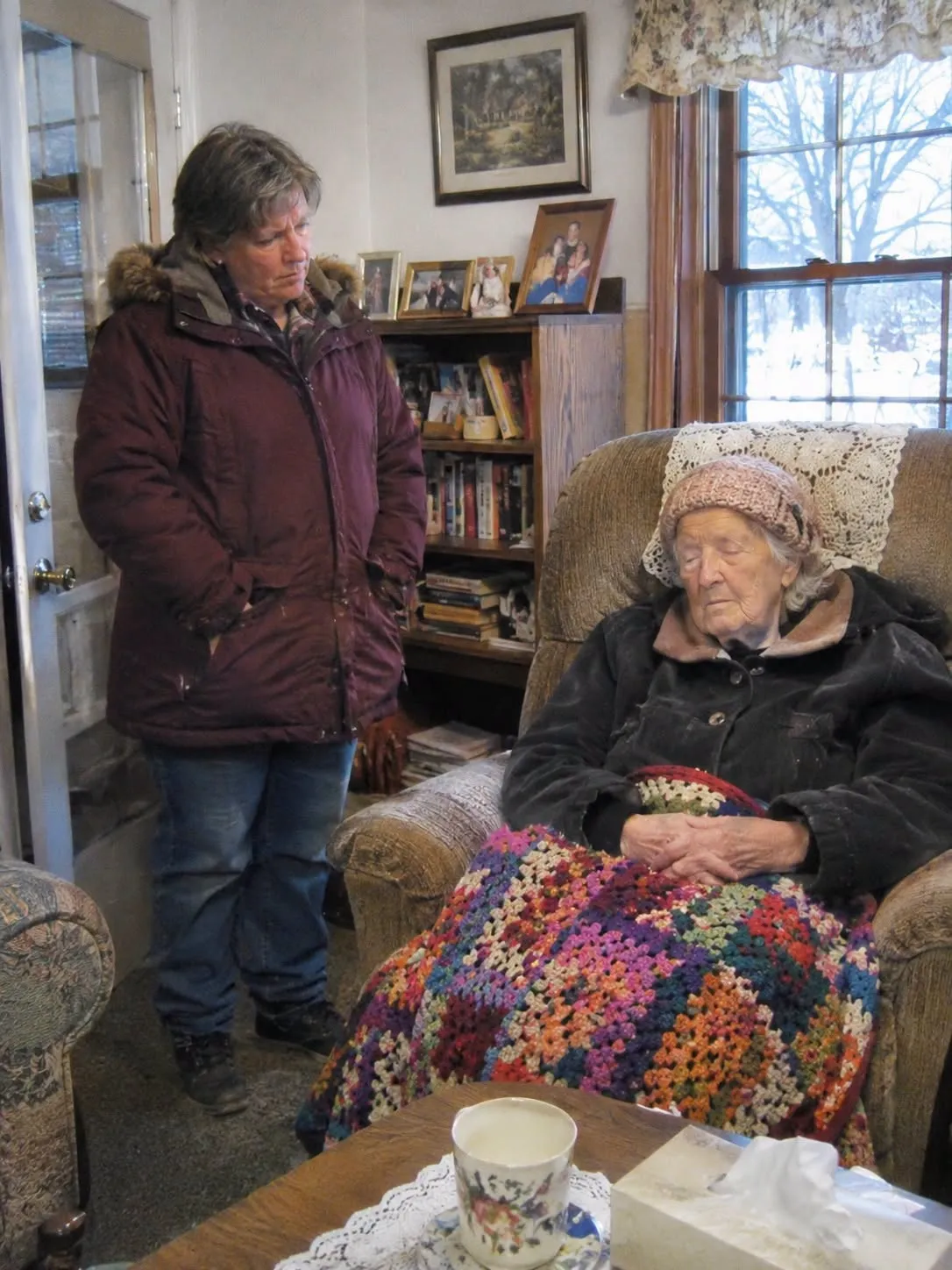
Mom was sitting in it.
At first glance, she appeared to be asleep.
It was Dad’s old brown La-Z-Boy.
The vinyl on the right arm was cracked, and the reclining lever always stuck.
For thirty-four years, Dad had sat there every evening.
After he died, Mom began using the chair.
But something was terribly wrong.
Why My Mother Was Wearing Her Winter Coat Indoors
Mom was dressed in her long brown wool coat.
It had large buttons and a fake fur collar.
She had worn that same coat to church every winter since 1995.
Now, it was zipped and buttoned all the way to her chin.
A red-and-green knitted hat covered her white hair.
The hat had a pom-pom on top. My niece had made it for her two Christmases earlier.
Over Mom’s lap lay an old crocheted afghan.
Grandma Heinz had made it in 1974, using orange, brown, and gold yarn.
Mom’s hands rested on top of the blanket.
She was wearing knitted gloves.
Behind her, frost covered the inside of the picture window.
Not the outside.
The inside.
Thick, feather-shaped ice crystals spread across the glass.
I couldn’t even see the yard light through them.
I stood frozen in the doorway.
My red parka was covered in melting snow.
My car keys were still in my hand.
Meanwhile, my flashlight pointed toward the floor.
For one terrible moment, I couldn’t tell whether Mom was breathing.
Then the afghan moved.
Only slightly.
Up.
Down.
I finally released the breath I had been holding.
The Thermostat Reading That Frightened Me
I looked toward the hallway thermostat.
It was an old round Honeywell.
Beige plastic surrounded a small arrow that you adjusted with your thumb.
The thermostat was set to 58 degrees.
However, the little mercury thermometer beneath it showed the actual room temperature.
It read 51.
Mom was eighty-two years old.
She had lived alone on the farm since Dad passed away four years earlier.
We had repeatedly asked her to move into town.
She refused.
She wouldn’t move in with any of her children either.
Instead, she always reminded us of her connection to the house.
She had been born there.
She had married there.
And she had raised four children beneath that roof.
She insisted she would die there too.
But standing in that freezing living room, I couldn’t accept that possibility.
Not like this, I thought.
Not tonight.
Why I Didn’t Immediately Call My Sister
My name is Connie Weber.
I’m fifty-four years old and the second of four children.
Pam is the oldest.
Then there’s me, followed by Rob and Dean.
Pam lives in Harvey, only twelve miles from Mom.
She has spent her entire married life there.
She works as a receptionist at the local clinic.
Her husband, Mark, drives a truck for the grain elevator.
Because Pam lives closest to the farm, she handles most of Mom’s everyday needs.
She checks on her regularly.
She takes her to medical appointments.
And she picks up groceries and prescriptions.
Meanwhile, I live in Bismarck and work as a payroll clerk for the school district.
Rob operates his own farm near Rugby, about an hour north.
Dean lives in Fargo and sells farm equipment.
We all have families, jobs, mortgages, and responsibilities.
Over time, we accepted that Pam would handle most things because she lived nearby.
Our Family’s Annual Propane Arrangement
Every October, Rob, Dean, and I sent Pam $250 each.
The money was intended for Mom’s propane.
We established that arrangement after Dad died.
I still remember discussing it during the funeral lunch in the church basement.
Pam offered to manage the propane account because she lived in town.
Rob suggested we all contribute.
Then Dean asked a question.
“Two-fifty each? Pam puts in the same?”
Pam nodded.
That meant four children contributing $250 each.
A total of $1,000.
We believed it would cover a fall delivery and another refill after Christmas.
For four years, we followed the same arrangement.
And during those four years, I never once asked Pam for a receipt.
Why would I?
She was my sister.
More importantly, she was the one who showed up every Sunday.
She drove Mom to appointments, collected her medication, and made sure she had groceries.
She was always there.
So when I found Mom in that cold living room, I didn’t call Pam.
I knew what would happen.
If I told her Mom was freezing, she would drive out immediately.
She would travel those dangerous roads in temperatures below 30 degrees below zero.
Then she would arrive frightened and apologetic.
We would probably argue.
And afterward, Mom would still be cold.
I needed to deal with the immediate danger first.
But there was another reason I didn’t call.
I was about to discover something that made the situation even more complicated.
The Propane Gauge Showed Just Five Percent
I didn’t wake Mom immediately.
Instead, I returned to the kitchen and grabbed my flashlight.
Then I stepped outside toward the propane tank.
Snow reached my knees.
The wind swept across the open fields like knives.
Within moments, I could barely feel my face.
On top of the tank was a small round gauge.
It sat beneath a metal cover and resembled a speedometer.
The numbers ran from zero to one hundred, showing the percentage of propane remaining.
Snow and ice covered the gauge.
I brushed away the snow with my glove.
Then I scraped ice from the glass using my car key.
I pointed the flashlight at the needle.
Five percent.
It rested barely above the red zone.
How Little Fuel Was Left
Our tank held 500 gallons.
At five percent, it contained approximately 25 gallons.
During a severe cold snap, an old furnace could burn through that amount quickly.
It might last a day.
Possibly less.
Moreover, low tank levels can cause pressure problems that prevent a furnace from operating reliably.
The furnace had already stopped running properly.
Now I understood why.
I stood in the snow, staring at the needle.
My hands shook.
But it wasn’t only because of the cold.
I hurried back inside.
The Delivery Receipt on the Refrigerator
Mom kept nearly everything on her refrigerator.
There were school pictures of her grandchildren.
Church bulletins covered one corner.
A calendar from the Harvey Farmers Elevator hung beside coupons she would probably never use.
Then I noticed a pink carbon-copy receipt.
A seed corn magnet shaped like an ear of corn held it in place.
I pulled it free.
The receipt came from the cooperative in Harvey.
It was dated October 19.
The details read:
Delivery: 200 gallons of propane
Customer: Pamela Ruff for Elsie Heinz
Tank reading after delivery: 47%
I read the receipt twice.
Two hundred gallons.
That number troubled me.
The Numbers Didn’t Match Our Arrangement
A 500-gallon propane tank is generally filled to approximately 80 percent for safety.
That allows room for the propane to expand.
Therefore, a full tank holds around 400 gallons.
A substantial refill from nearly empty could require approximately 350 to 400 gallons.
But the October delivery was only 200 gallons.
At the previous October’s approximate price of $2 per gallon, that delivery cost around $400.
A 400-gallon purchase would have cost approximately $800.
Another $200 could have covered a later top-off.
That was how we had expected our family’s $1,000 arrangement to work.
Yet Mom’s receipt showed only 200 gallons.
And there was no evidence of a later delivery.
I searched the papers attached to the refrigerator.
First, I checked behind the calendar.
Then I examined the church bulletins and coupons.
I looked for another receipt dated December or January.
Anything.
But there wasn’t one.
Mom Woke Up and Asked Me Not to Blame Pam
I returned to the living room.
Then I knelt beside Dad’s old recliner.
I placed my hand on Mom’s knee, over the afghan.
“Mom,” I said gently. “Mom, wake up. It’s Connie.”
Her eyes opened slowly.
At first, she looked confused.
Then she blinked.
“Connie?”
Her voice sounded thin and hoarse.
“What are you doing here? It’s the middle of the night.”
“You didn’t answer your phone,” I explained. “Two nights. I got worried.”
Mom looked around the room.
She noticed the frost on the windows.
Then she saw her breath hanging in the air.
Finally, she looked at my face.
Something changed in her expression.
Perhaps she saw my fear.
Maybe she noticed my anger.
Or perhaps she saw the pink delivery receipt in my hand.
Whatever it was, she suddenly reached for my wrist.
Her gloved fingers gripped me with surprising strength.
“Don’t you start with your sister,” she said.
I stared at her.
“Mom—”
“Don’t you start with Pam,” she repeated. “She’s got enough going on.”
I couldn’t understand why she was defending Pam.
“Mom, the tank’s at five percent,” I said. “It’s fifty-one degrees in here. You’re sleeping in your coat.”
“I’m fine.”
“You’re not fine. Your hands are like ice.”
I took one of her hands between mine.
Even through the knitted glove, her fingers felt freezing.
What Mom Told Me About Mark’s Surgery
“Pam’s husband had back surgery,” Mom said.
She looked directly at me.
“In September. Did you know that?”
I nodded.
Mark had ruptured two discs while lifting a grain auger at the elevator.
He underwent surgery at Trinity in Minot.
Pam had mentioned the operation during Thanksgiving.
“He hasn’t worked since,” Mom continued.
“Not a day. The elevator doesn’t have disability. They’re living on what Pam makes at the clinic.”
Mom looked down at our hands.
“Pam says propane’s dear this year,” she said quietly.
Then she tried to smile.
“I don’t mind it cool.”
I knew she was trying to reassure me.
But I couldn’t ignore the cold surrounding us.
The Emergency Call to the Propane Cooperative
I didn’t argue with Mom.
There wasn’t time.
It was almost midnight, and the propane tank was nearly empty.
The furnace might stop completely at any moment.
So I called the Harvey cooperative’s emergency number.
At first, a recording answered.
I tried again.
And again.
Finally, at 12:40 a.m., a man picked up.
He sounded sleepy and irritated.
“Harvey Farmers Co-op, emergency line.”
“This is Connie Weber,” I said.
“My mother is Elsie Heinz. She lives east of town on 64th Street.”
I explained the situation.
“Her tank is at five percent. Her furnace is going out. She’s eighty-two.”
There was a pause.
“Elsie Heinz,” the man repeated. “Art Heinz’s wife?”
“Yes.”
“Ma’am, this is Duane Kessler,” he said.
“I’ve been driving propane out there for twenty-two years. I knew your dad.”
His voice changed immediately.
He no longer sounded sleepy.
“Is she okay?” he asked. “Is she warm?”
“She’s in her coat and hat,” I answered. “It’s fifty-one degrees in the house.”
Duane went silent.
The Driver Who Promised to Come
“I can’t get the truck out tonight,” Duane finally explained.
“The roads are drifted shut. County won’t plow 64th till morning.”
Then he promised to come as soon as possible.
“I’ll be there first thing. Soon as I can get through.”
“Thank you,” I said.
But Duane wasn’t finished.
He suggested lowering the thermostat setting to 55 degrees to conserve the remaining fuel.
Then he advised me to keep Mom in the warmest room and close the doors to unused rooms.
“Is there a space heater?” he asked.
“I don’t know.”
“Look in the basement,” Duane said.
“Art always kept one down there. A little electric one. For the well pump.”
I remembered Dad storing tools and spare equipment near the water softener.
So I went downstairs to look.
A Long Night Beside My Mother’s Chair
I found the heater behind the water softener.
It was small, dusty, and electric.
When switched on, it produced an orange glow.
I carried it upstairs and plugged it in near Dad’s recliner.
Then I closed the doors leading to the kitchen, hallway, and dining room.
I tucked the afghan tightly around Mom’s legs.
Next, I removed my red parka and placed it over her.
She protested weakly.
But I wasn’t going to let her spend another night shivering without help.
Finally, I sat on the floor beside her chair.
My back rested against the cracked vinyl.
I stayed there all night.
And I didn’t sleep.
Morning Finally Arrived at the Farm
At seven, I heard the county snowplow approaching along 64th Street.
The scraping blade made a familiar sound against the gravel.
Through the frost-covered windows, I could see its orange warning light flashing.
The road was finally being cleared.
At 10:40, I called the cooperative again.
This time, I reached the main office.
A woman named Marlene answered.
She had worked at the Harvey cooperative since I was in high school.
“Connie Heinz!” she exclaimed.
“Duane told me. He’s loading up right now. How’s your mother?”
“Cold,” I answered.
Then I asked about the propane account.
“Marlene, whose name is Mom’s account under?”
She paused.
“It’s under Pam’s name,” she explained. “Pamela Ruff. She set it up after your dad passed.”
Pam was the billing contact.
“Can I change that?” I asked.
Marlene hesitated.
Then she explained that the account needed one person responsible for payments.
Pam could agree to transfer it.
Alternatively, I could open a new account in my own name and close the previous arrangement.
“I want to open a new one,” I said.
“In my name. Today.”
Marlene didn’t ask why.
She had spent thirty years working at that front desk.
I suspected she had witnessed nearly every kind of family disagreement imaginable.
“Okay, honey,” she replied. “I’ll set it up.”
The Decision I Made Without Asking Pam
I knew Mom had begged me not to confront my sister.
I also knew Pam had managed the account for four years.
Nevertheless, I couldn’t allow another winter emergency to happen.
The cooperative needed someone responsible for the account.
So I made that person me.
I didn’t ask Pam first.
At the time, I believed I was doing the only sensible thing.
Duane Arrived With the Propane Truck
Duane reached the farm around two that afternoon.
He was sixty-one, with a gray beard and a face reddened by decades of North Dakota wind.
A Harvey Hornets stocking cap covered his head.
He carefully backed the large white propane truck toward the tank.
Then he walked to the back door and knocked.
Mom answered.
She was still wearing her brown coat and red-and-green hat.
Duane took one look at her.
Then he removed his stocking cap.
“Mrs. Heinz,” he said. “I’m sorry I couldn’t get here sooner.”
“Oh, Duane,” Mom replied.
“You shouldn’t have come out in this. It’s not that cold in here.”
He glanced past her.
Frost still covered the kitchen windows.
Duane didn’t argue.
Instead, he nodded and returned to his truck.
The $783.75 Propane Delivery
Duane filled the tank to 80 percent.
The delivery totaled 375 gallons.
The price was $2.09 per gallon.
When he finished, he brought the receipt to the back door.
It showed:
375 gallons × $2.09 = $783.75
I paid $784 using my credit card.
Duane processed the payment through a small card reader he carried in his coat pocket.
Then I asked him another question.
“Duane, can you put the tank on keep-full?”
He looked at me.
“Keep-full?” Mom asked. “What’s that?”
Duane explained the program.
The cooperative would install a small monitor on the tank.
That monitor would send information to the office.
When the propane level dropped to approximately 30 percent, the cooperative would arrange another delivery.
Nobody would have to remember to call.
Nobody would need to check the gauge manually.
Then Duane added one important detail.
“It bills to the account holder. Every time.”
“Put it on keep-full,” I answered.
“In my name.”
Duane nodded slowly.
“Yes, ma’am.”
From that moment, the cooperative would monitor Mom’s propane supply.
Nobody had to remember anymore.
The Moment Warm Air Returned to the House
After Duane left, I walked toward the thermostat.
It was the same old round Honeywell I had checked the previous night.
I placed my thumb on the little arrow.
Then I turned it to 70 degrees.
The furnace clicked in the basement.
For a moment, nothing happened.
Then came a soft whump.
The burner had ignited.
I felt the vibration through the floor and the soles of my boots.
It seemed as though the entire farmhouse had taken a deep breath.
A moment later, the fan started.
Warm air rushed through the floor registers.
It carried the familiar smell of dust, old metal, and every winter of my childhood.
Mom sat in Dad’s recliner.
She was still wearing her coat and hat.
When she heard the furnace, she closed her eyes.
My Mother Finally Removed Her Coat
An hour later, the house had warmed to 68 degrees.
The frost on the windows began melting.
Thin streams of water ran down the glass.
Mom slowly stood from the recliner.
Her knees were bad, so she held the armrest for support.
First, she removed her knitted gloves.
She placed them on the side table.
Then she pulled off her red-and-green hat.
Her white hair lay flat and full of static.
She smoothed it with one hand.
Next, she unbuttoned her brown wool coat.
She pulled down the zipper.
Then she walked into the kitchen.
Beside the back door was a row of hooks.
Mom hung her coat on one of them.
For a long moment, she kept her hand resting against the wool.
Then she spoke quietly.
“I forgot what this felt like.”
The Message I Sent My Brothers
That night, Mom went to bed beneath two quilts.
Her bedroom was finally warm.
Meanwhile, I sat at the kitchen table with my phone.
I decided to contact my brothers.
But I didn’t include Pam.
I sent Rob and Dean a short message.
Mom’s tank is full. Next October, send the propane money to me. I’ll explain at Easter.
Dean called within a minute.
“Connie, what happened? Is Mom okay?”
“Mom’s fine,” I said. “She’s warm. She’s asleep.”
“What do you mean, she’s warm?” Dean asked.
“Was she cold?”
I hesitated.
“Dean, I’ll tell you everything at Easter. Face to face. I don’t want to do it on the phone.”
He went quiet.
Then he asked, “Is it Pam?”
“At Easter,” I repeated.
Rob’s Late-Night Telephone Call
Rob was feeding his cattle when I sent the message.
He called around ten that night.
That was typical of him.
Rob rarely called early, and he wasn’t a man who used unnecessary words.
“Got your text,” he said. “What’s going on?”
“Mom’s warm,” I explained.
“The tank’s full. It’s on automatic now. In my name.”
Rob remained silent.
Finally, he asked, “Was she cold?”
“Yes.”
“How cold?”
“Fifty-one degrees in the house,” I answered.
“She was sleeping in her coat.”
I heard him release a long, slow breath.
“Okay,” he said.
“Easter.”
Then he hung up.
I had told both brothers that Mom was safe and warm.
The rest would wait until we could speak face to face.
Pam Called Five Days Later
Five days passed.
Then, on Thursday, Pam called me at work.
I was sitting at my desk in the Bismarck school district office, processing payroll.
When her name appeared on my phone, I almost ignored it.
But I answered.
“The co-op called me,” Pam said immediately.
There was no greeting.
“They said Mom’s tank was moved off my account.”
“It was.”
“To your name.”
“Yes.”
A long silence followed.
Then Pam spoke again.
“You went behind my back.”
Her voice shook.
But it didn’t sound like ordinary anger.
There was something else beneath it.
“I went to the co-op,” I answered.
Pam didn’t respond.
I could hear the clinic telephones ringing in the background.
Someone called her name.
“Pam,” I said.
“I found Mom in her coat. In Dad’s chair. The tank was at five percent.”
I swallowed.
“It was fifty-one degrees in the house.”
Silence.
“Pam?”
She hung up.
We didn’t speak again for eleven weeks.
Eleven Weeks of Anger and Unanswered Questions
Those eleven weeks were among the hardest of my life.
Every night, I called Mom.
Thankfully, she was warm.
The keep-full monitor worked as promised.
In February, Duane returned and topped off the propane tank without anyone needing to call.
Mom continued her usual routine.
“Pam still comes Sundays,” she told me one evening.
“She brings my groceries. She takes me to church.”
“Does she talk about me?” I asked.
Mom hesitated.
“No.”
I thought about that conversation constantly.
After Steve returned home from the cold snap, I often lay awake beside him.
I stared at the bedroom ceiling and replayed everything.
The pink delivery ticket.
The 200 gallons.
And the money we had sent.
The Propane Money I Couldn’t Account For
Rob, Dean, and I had each contributed $250.
Together, we sent Pam $750 every October.
Yet the October delivery had cost approximately $400.
That left $350 unaccounted for.
Then there was Pam’s own promised contribution.
Had she ever added her $250?
I didn’t know.
But I kept doing the math.
And the more I thought about it, the angrier I became.
For years, we had congratulated ourselves for helping Mom.
We believed our contributions were enough.
Now I wondered what had actually happened to the money.
Steve Asked Me an Important Question
One night in March, Steve tried to talk about the situation.
“Have you thought about calling her?” he asked.
“She hung up on me.”
“That was eight weeks ago.”
“She went behind our backs first,” I replied.
“She took our money and let Mom freeze.”
Steve was quiet for a long time.
Then he asked gently, “Connie, do you know that’s what happened?”
I opened my mouth.
But no words came out.
Eventually, I admitted the truth.
“No. I don’t know.”
“Then maybe,” Steve said, “you ought to find out before Easter.”
I didn’t call Pam.
I was too angry.
Too hurt.
And too proud.
Pam had always been the oldest sister who took charge.
She lived near Mom and handled everything.
Meanwhile, the rest of us sent money and assumed the situation was under control.
I didn’t want to be the one to make the first call.
So I waited.
Easter Brought Everyone Back to the Farm
Our family had always gathered at the farm for Easter.
We did it when we were children.
We continued after we married and had families of our own.
Even the year Dean was hospitalized with appendicitis, we brought Easter dinner to him in Fargo.
Coming home was simply what we did.
That Saturday, Steve and I drove from Bismarck.
Most of the snow had melted.
Only dirty patches remained in the ditches and along the northern side of the shelterbelt.
The fields were brown and wet.
Above them, geese traveled north beneath a wide blue sky.
When we entered the farmyard, I noticed the propane tank.
It looked clean and white in the sunshine.
The keep-full monitor blinked green.
The Farmhouse Felt Different
Mom greeted us at the back door.
She wasn’t wearing her coat.
There was no knitted hat on her head.
Instead, she wore a blue cardigan, an apron, and house slippers.
The kitchen felt wonderfully warm.
I checked the thermostat.
Seventy-one degrees.
By Sunday noon, the entire family had arrived.
A ham was roasting in the oven.
Scalloped potatoes and green bean casserole were ready.
Rolls were rising beneath a dish towel on the counter.
Mom had also prepared two kuchens.
One was peach.
The other was prune.
They were the German custard pies her mother had taught her to make in that kitchen in 1950.
Rob and Dean sat at the kitchen table drinking coffee.
Rob had driven from Rugby with his wife, Linda.
Dean arrived from Fargo with Kelly and their two teenagers.
The teenagers sat in the living room looking at their phones.
Meanwhile, Steve watched the Twins spring training game with Rob’s son.
Mom rested in Dad’s recliner near the window.
Sunlight fell across her blue cardigan.
The old afghan covered her knees.
But this time, it wasn’t because she was freezing.
She simply liked having it there.
There was no coat.
No hat.
Then Pam arrived.
Pam Walked In Carrying a Box and a Coffee Can
I heard her car enter the yard.
It was a tan Chevy Malibu with a cracked windshield.
Moments later, the back door opened.
Pam stood in the kitchen doorway.
She was fifty-seven.
Short and sturdy, she resembled Mom at that age.
Her gray hair was cut short in a practical style.
She wore church clothes: a navy skirt and a white blouse.
But she looked exhausted.
More tired than I had ever seen her.
Mark wasn’t with her.
And she wasn’t empty-handed.
Pam carried a cardboard box.
Balanced on top was a large red Folgers coffee can.
It was the old three-pound size, faded from years of use.
She walked toward the kitchen table.
Then she placed both items in front of us.
The room became quiet.
Dean stopped sneaking a piece of kuchen and lowered his fork.
Rob set down his coffee.
Mom turned from the window.
Pam looked at her first.
Then she looked at me.
“I need to say something,” she announced.
“Before we eat. Before anybody says grace.”
Nobody moved.
“Connie’s been waiting eleven weeks to tell you what happened in January,” Pam continued.
She turned toward Rob and Dean.
“I’m going to tell you myself. Because it’s mine to tell.”
The Money Inside the Coffee Can
Pam removed the lid.
The coffee can was filled with cash.
Bills had been rolled into small bundles and secured with rubber bands.
There were twenties, tens, and fives.
Then she emptied everything onto the kitchen table.
The money landed beside the ham platter.
“Seven hundred and fifty dollars,” she said.
Her voice was steady, although only barely.
“That’s what you three sent me in October. Two-fifty each. For Mom’s propane.”
She looked directly at me.
“I spent four hundred of it on the delivery.”
Then she continued.
“The rest I spent on our mortgage. And our electric bill. And Mark’s prescriptions.”
Rob didn’t move.
Dean’s mouth fell open.
“And my share,” Pam added.
“My two-fifty. I didn’t put it in. I didn’t have it.”
She pushed the pile of cash across the table.
“That’s all of it,” she explained.
“Every dollar. Plus the four hundred I spent on the delivery.”
She wanted the money returned so I could be reimbursed for the propane payment on my credit card.
I looked at the cash.
Then I asked quietly, “Where did you get this?”
What Pam Had Sold to Repay the Money
“I sold my sewing machine,” she answered.
“The Bernina. Grandma Heinz’s.”
My stomach tightened.
That sewing machine had belonged to our grandmother.
Pam continued.
“And the quilt rack Dad made me. And Mark’s deer rifle.”
Her voice cracked.
Then she revealed something else.
“I picked up Saturday shifts at the Cenex in Harvey.”
She had been working the cash register there since January.
Mom made a small sound from her recliner.
“Pammy,” she whispered.
“Your grandma’s machine?”
But Pam didn’t look toward Mom.
Her eyes remained on me.
“You were right, Connie,” she said.
“To take the account. You were right to call the co-op. You were right to put it in your name.”
She swallowed hard.
“I’m the one who let Mom get cold.”
Her voice trembled.
“Not you. Not the co-op. Me.”
The Green Notebook Inside the Cardboard Box
Then Pam opened the cardboard box.
It was packed with papers.
There were hundreds of receipts.
Some were folded.
Others were stacked and secured with paper clips, binder clips, or rubber bands.
Several were pink carbon copies.
Others were pharmacy receipts printed on thermal paper, already faded almost white.
A few were handwritten.
At the top sat a green spiral notebook.
It was the inexpensive kind sold at dollar stores.
Pam picked it up and opened it.
Then she placed it in front of Rob.
Inside was a ledger.
Every page contained neat columns written in Pam’s handwriting.
The dates stretched back four years.
They began shortly after Dad’s funeral.
Four Years of Expenses Nobody Else Had Seen
Rob started reading.
The first entries included:
- March 2022 — Mom’s prescriptions at Harvey Drug: $86
- March 2022 — Groceries for Mom: $112
- April 2022 — Roof patch on the north side, Schmidt boys: $340
- May 2022 — Gas for Mom’s eye doctor appointment in Minot: $45
- June 2022 — Hearing aid batteries: $28
- July 2022 — Well pump repair: $610
There were pages and pages of expenses.
Rob turned them slowly.
Dean leaned over his shoulder.
Later entries included:
- October 2023 — Mom’s new glasses: $290
- December 2023 — Christmas groceries: $180
- February 2024 — Furnace igniter repair: $415
- August 2024 — Mom’s dental work: $1,100
Every entry represented something Pam had handled.
A prescription.
A repair.
A medical appointment.
Or another everyday need.
At the bottom of the final page, Pam had written a total.
She had circled it twice.
$14,860.
Nobody spoke.
Rob turned back to the first page.
Then he returned to the end.
Finally, he looked up.
“Pam,” he asked, his voice rough. “What is this?”
“That’s what I’ve spent on Mom,” she replied.
“Since Dad died. Out of my own pocket. Not counting propane.”
She looked around the table.
“I’m not asking you to pay it back,” she said quickly.
“I’m not. That’s not why I brought it.”
“Then why?” Dean asked.
Pam looked at him for a long moment.
“Because you each sent me two-fifty a year,” she answered.
“Every October. And you thought that was taking care of Mom.”
She tapped the notebook.
“This is taking care of Mom.”
The Financial Struggles Pam Had Hidden
Pam took a breath.
“I’m not trying to make anybody feel bad,” she explained.
“I wanted to do it. She’s my mother. I live twelve miles away. Who else was going to?”
Then she looked at me.
“But in September, Mark got hurt.”
She reminded us about his surgery.
The grain elevator didn’t provide disability benefits.
Consequently, they had been surviving on her clinic paycheck alone.
Her voice began to break.
“We were two months behind on the mortgage in October.”
She shook her head.
“I’d never been behind on anything in my life.”
Then she described the day our checks arrived.
She had sat at her kitchen table with $750 in front of her.
Beside the money was a mortgage notice.
There were also Mark’s pain medications to pay for.
After insurance, those prescriptions cost $300.
Pam closed her eyes.
The Decision She Made in October
“I called the co-op and ordered two hundred gallons,” she admitted.
“Instead of four hundred.”
She had hoped the smaller delivery would last until January.
By then, she believed their financial situation might improve.
Perhaps Mark would return to work.
Maybe she could get overtime at the clinic.
She thought she would somehow find the remaining money.
But the winter cold arrived.
And the propane disappeared much faster than she expected.
“Why didn’t you call us?” Dean asked.
“Pam, why didn’t you just tell us?”
She gave a short, broken laugh.
“And say what?”
Then the words came quickly.
“I spent Mom’s propane money on my mortgage? I can’t afford to take care of Mom anymore?”
She looked at her brothers.
“I’m the oldest. I’m the one who lives close. And I’m failing?”
Pam shook her head.
“I was ashamed, Dean.”
Nobody interrupted.
Then she continued.
“I was going to call the co-op in January, when the cold snap started.”
She had planned to order another delivery using a credit card.
She even had the telephone in her hand.
But before she could make the call, something happened.
Pam turned toward Mom.
“And then Mom called me.”
Mom Finally Revealed What She Had Done
Everyone looked toward the recliner.
Mom sat very still.
Her hands rested on the afghan.
She was looking out the window toward the fields.
“Mom?” I asked.
For several seconds, she didn’t answer.
Then she spoke.
“I told her not to.”
Her voice was quiet but steady.
“I knew about Mark’s surgery. I knew about the mortgage.”
She turned toward us.
“Pam tried to hide it, but I’m her mother. I knew.”
Then she explained what happened before the worst cold arrived.
Pam had called her on Monday.
She offered to order another propane delivery and put the cost on her credit card.
Mom remembered her words.
“Mom, I’m ordering you a top-off. I’ll put it on my card.”
Then Mom looked directly at Pam.
“And I said no.”
Pam stood beside the kitchen table, crying quietly.
Her arms were wrapped around herself.
The Promise Mom Made Pam Keep
“I told her to keep her money for her house,” Mom explained.
She had insisted that she owned enough blankets.
She had her winter coat.
And she believed she could tolerate the cold.
After all, she was born in 1943 in a house heated by a coal stove.
“I’ve lived through worse winters than this,” she told Pam.
Then she made her daughter promise two things.
Pam wasn’t to order another propane delivery.
And she wasn’t to tell the rest of us.
I stared at my mother.
“You did that?” I asked.
“You let yourself freeze?”
Mom looked at me.
“I didn’t freeze, Connie. I was cool. There’s a difference.”
“It was fifty-one degrees,” I reminded her.
“There was frost on the inside of the windows.”
For a long time, Mom remained silent.
Then she explained.
“I’m eighty-two years old. My daughter was going to lose her house.”
She looked toward Pam.
“Her husband couldn’t walk. And she was sitting at her kitchen table crying over my propane.”
Mom’s voice remained steady.
“I’d rather wear my coat for a week than watch my girl lose everything she’s got.”
Suddenly, I understood what had happened that night in January.
When Mom grabbed my wrist and begged me not to confront Pam, she wasn’t simply protecting her oldest daughter.
She was protecting a secret she had helped create.
It wasn’t Pam alone who had kept the truth from us.
Mom had kept it too.
The Kitchen Table Went Silent
Nobody spoke for a long time.
The ham sat on the counter.
Meanwhile, the rolls continued rising beneath the dish towel.
In the living room, the Twins game was still playing.
But nobody was watching anymore.
Steve and the children had gathered near the kitchen doorway.
The old Westclox clock ticked above the table.
Finally, Rob moved.
He picked up Pam’s green notebook.
Then he slowly turned through four years of receipts.
He reached the final page.
There was the number, circled twice.
$14,860.
Rob placed the notebook on the table.
Then he looked at Pam.
“Fourteen thousand dollars,” he said quietly.
“Over four years. And we sent you three thousand.”
Pam said nothing.
Rob Took Out His Checkbook
Rob reached into the back pocket of his jeans.
He pulled out an old-fashioned checkbook with carbon copies.
He still used checks for nearly everything.
Then he clicked his pen.
“Rob,” Pam protested.
“No. That’s not what—”
“Hush, Pam,” he interrupted.
He wrote a check.
Then he tore it out and placed it on the notebook.
From across the table, I could see the amount.
$3,715.
“That’s my share,” Rob said.
“A quarter of what you spent. Plus the two-fifty a year you shouldn’t have had to put in.”
Then he looked at Dean.
Dean was already reaching for his phone.
“I don’t have checks,” he said.
“Give me your Venmo, Pam.”
“Stop,” Pam begged.
“Both of you. Stop.”
Her tears came faster.
“I didn’t bring this so you’d pay me.”
She looked from one brother to the other.
“I brought it so you’d understand.”
“We understand,” Rob replied.
Then he stood.
Rob is six feet three inches tall and built like a grain bin.
He rarely shows emotion in public.
In fact, I hadn’t seen him hug anyone openly since Dad’s funeral.
But now he walked around the table.
He wrapped his arms around our oldest sister.
“I’m sorry, Pammy,” he whispered.
“I’m sorry we left you alone with it.”
My Turn to Apologize
Then I stood.
I walked around the kitchen table and stopped in front of Pam.
For eleven weeks, I had been angry with her.
I had spent countless nights calculating the propane money.
And I had convinced myself she had taken our contributions and allowed Mom to freeze.
I had been so certain.
Now I didn’t know what to say.
“Pam,” I began.
She looked at me.
Her eyes were red.
Tears covered her face.
“I’m sorry I went behind your back.”
Pam shook her head.
“You didn’t go behind my back,” she replied.
“You went to the co-op. You said so on the phone.”
She almost smiled.
“You were right. I hung up on you because you were right.”
I swallowed.
“I should’ve called you that night,” I admitted.
“From the doorway. I should’ve called you first.”
“Why didn’t you?” she asked.
I thought about standing in that freezing living room.
I remembered my red parka.
The car keys in my hand.
And the frost covering the windows.
“Because I was scared,” I answered.
“If I called you, it would turn into a fight. And at the end of the fight, Mom would still be cold.”
Then I admitted something harder.
“And because I’d already decided it was your fault. Before I even knew.”
Pam looked at me for a long moment.
“Fair enough,” she said.
Then she hugged me.
The Hug That Reminded Me of Childhood
Pam held me tightly.
It reminded me of when we were little girls.
Whenever I fell off the hay wagon or got stung by a wasp, Pam would pick me up.
Then she would carry me into that same kitchen.
Now she smelled like the clinic.
Hand sanitizer and coffee.
She leaned close to my ear.
“Thank you,” she whispered.
“Thank you for going out there.”
Our Family Made a New Plan That Easter
We didn’t eat Easter dinner until three o’clock.
By then, the ham had become dry.
The rolls had risen too much and collapsed.
But nobody cared.
Instead, we sat around Mom’s kitchen table.
Pam’s green notebook lay beside Rob’s checkbook.
Dean had found a legal pad in the junk drawer.
Together, we made a plan.
A New Arrangement for Mom’s Propane
The propane tank would remain on the keep-full program.
The account would stay in my name.
However, all four children would share the cost of each delivery.
Duane would send the bill to me.
Then I would divide the amount by four and notify everyone.
Pam would resume contributing once Mark returned to work.
Until then, Rob, Dean, and I would cover her share.
Nobody objected.
Sharing the Sunday Visits
Next, we divided the responsibility for visiting Mom.
Rob agreed to take the first Sunday of each month.
He would drive down from Rugby, bring groceries, and repair anything that needed attention.
Dean volunteered for the third Sunday.
He would travel from Fargo with his children.
The journey took three and a half hours each way.
But Dean said his teenagers needed to learn how to talk to their grandmother without holding phones.
I took the second and fourth Sundays.
That meant driving 115 miles from Bismarck.
Steve would accompany me whenever possible.
Pam could visit whenever she wanted.
“Or none,” Rob told her.
“You’ve done enough Sundays for all of us.”
A Shared Account for Mom’s Expenses
We also opened a shared bank account in Harvey.
The account would cover Mom’s everyday expenses.
That included prescriptions, eye appointments, and hearing aid batteries.
It would also pay for roof repairs, well pump problems, and other household needs.
Each of us agreed to contribute $100 every month.
Pam would continue managing the expenses.
After all, she understood Mom’s needs better than any of us.
But there would be one important difference.
Every month, the bank would email a statement to all four children.
Dean explained why.
“Not because we don’t trust you,” he told Pam.
“Because you shouldn’t have to carry the notebook alone.”
Mom Established One Final Family Rule
Before we ate, Mom cleared her throat.
She had remained quiet through most of our planning.
From Dad’s recliner, she watched her four children discuss schedules and expenses.
Now she wanted to speak.
“I have something to say.”
We all turned toward her.
“I’m the one who made Pam promise,” she began.
“I’m the one who told her not to order the top-off.”
Then she admitted something else.
“I’m the one who wore my coat in my own house and told myself it was fine.”
She looked at each of us.
“That was wrong.”
Mom explained that she had believed she was protecting Pam.
But in reality, she had been hiding the problem.
Just as Pam had.
Then she announced her rule.
“From now on, nobody in this family keeps a secret about money.”
She continued.
“Not about propane. Not about mortgages. Not about back surgery.”
Mom looked at Pam.
“If somebody’s drowning, they say so. Out loud. At this table.”
Then she turned toward me.
“And if somebody finds somebody else drowning, they call the others. Before they call the co-op.”
I laughed.
“Yes, ma’am.”
The Brown Coat Came Off the Hook
Mom slowly rose from Dad’s recliner.
She held the armrest to steady herself.
Then she crossed the kitchen toward the back door.
Her brown wool coat still hung on the same hook where she had placed it in January.
Mom took it down.
For a moment, she simply held it.
Then she handed it to Pam.
“Take this to the church rummage sale,” she said.
“I’ve got a newer one in the closet. I don’t need this one anymore.”
Pam stared at the coat.
“Mom, you’ve worn this to church for thirty years.”
“I know,” Mom replied.
“And I wore it in my living room for two weeks in January.”
Then she gently patted Pam’s cheek.
“I’d rather not look at it every time I walk out the door.”
The Months After Easter
That Easter gathering took place in April.
In May, Mark finally returned to work at the grain elevator.
He was assigned light duty in the scale house.
He couldn’t lift anything heavier than twenty pounds.
However, he could sit and weigh incoming trucks.
The work allowed him to begin earning again.
In June, Pam quit her Saturday shifts at the Cenex.
Life was slowly becoming more manageable.
Then, in July, something unexpected arrived at Pam’s house in Harvey.
It was a large cardboard box delivered by UPS.
There was no return address.
Pam called me that evening.
“Connie,” she said.
Her voice sounded strange.
“Did you send me something?”
“No. Why?”
“It’s Grandma’s sewing machine.”
I sat up.
“The Bernina?” I asked.
“The one I sold in February.”
She was crying.
“Somebody bought it back from the lady in Minot. And sent it to me.”
Then she mentioned a note inside the package.
The Two-Word Message Inside the Box
“What does the note say?” I asked.
Pam hesitated.
“It says, Keep-full.”
“That’s it?”
“That’s it,” she answered.
“Two words. In handwriting I don’t recognize.”
I began making telephone calls.
First, I asked Rob.
He said he hadn’t sent the machine.
Then I called Dean.
He denied knowing anything about it.
Steve didn’t know either.
Finally, I asked Mom.
She went quiet for a long time.
Then she said, “I don’t know what you’re talking about.”
Immediately afterward, she changed the subject to the weather.
I didn’t learn the truth until September.
Duane Finally Explained the Sewing Machine’s Return
I was visiting the farm one Thursday morning when Duane arrived to refill the propane tank.
He leaned against his truck and lit a cigarette.
Then he mentioned the sewing machine.
“That was your mom,” he said.
I stared at him.
“With the sewing machine.”
Duane explained what had happened.
Mom called him in June.
She wanted to know whether he knew a woman in Minot who had purchased an old Bernina sewing machine.
It turned out the buyer was his wife’s cousin.
“Small world,” Duane said.
Then he told me the rest.
Mom had paid the woman $400 to buy back the machine.
She used money she had saved from selling eggs.
Afterward, she asked Duane to take the package to the UPS store in Harvey.
He took another drag from his cigarette.
“She said she wanted her girl to have it back,” he explained.
Then he repeated Mom’s words.
“She said keep-full ought to work both ways.”
October Came Around Again
By October, the fields had been harvested.
The wheat and sunflowers were gone.
The shelterbelt stood gold and nearly bare.
Meanwhile, geese traveled south in long, wavering formations across the sky.
The propane tank beside Mom’s house was at 78 percent.
Its small monitor blinked green.
One afternoon, I checked my phone while sitting at my desk in Bismarck.
Three Venmo notifications were waiting.
The first came from Rob.
Rob Heinz paid you $250.
Note: Propane.
The second came from Dean.
Dean Heinz paid you $250.
Note: Propane — Mom’s warm.
Then I saw the third payment.
Pam Ruff paid you $250.
Note: My share. Finally.
I stared at that message for a long time.
Then I opened Venmo.
I found Pam’s name and sent her $250.
My note read:
Your Sundays. Four years’ worth. A little at a time.
The Call That Made Us Laugh Again
Pam called two minutes later.
“Connie,” she said. “What is this?”
“Keep-full,” I answered.
“It works both ways.”
For several seconds, she didn’t speak.
Then she laughed.
Not the strained laughter I had heard at Easter.
This was her real laugh.
The one I remembered from childhood.
When we were girls, we shared a bedroom at the top of the farmhouse stairs.
After the lights went out, we whispered to each other until we fell asleep.
That was the laugh I heard again.
“You’re impossible,” Pam said.
“I learned it from Mom,” I replied.
Thanksgiving at the Farmhouse
That Thanksgiving, we all returned to the farm.
Just as we always had.
Turkey roasted in the oven.
Mom’s kuchen sat on the counter.
This time, she had made pumpkin and peach.
Outside, the temperature was eight degrees below zero.
Wind swept across the stubble fields.
But inside, the furnace hummed steadily.
Every few minutes, it started with that familiar rumble.
The thermostat read 71 degrees.
Pam arrived last.
This time, Mark was with her.
He walked slowly and used a cane.
But he was walking.
Pam carried a sewing machine case.
She placed it at the end of the kitchen counter.
“I’m going to make Mom a new afghan,” she announced.
“This winter. On Grandma’s machine.”
Mom sat in Dad’s recliner beside the window.
She wore her blue cardigan.
There was no coat.
No hat.
She looked at the sewing machine.
Then she looked at Pam.
She didn’t say anything.
And she didn’t have to.
The Coat That Was No Longer Needed
After Thanksgiving dinner, we washed the dishes.
The children gathered in the living room.
Meanwhile, the men fell asleep in front of the Lions game.
I found Mom standing alone in the kitchen.
She was looking toward the hooks beside the back door.
Her new winter coat hung there.
It was navy blue and filled with down.
All four of us had given it to her the previous Christmas.
However, she hadn’t worn it until that fall.
The old brown coat was gone.
It had been sold at the Lutheran church rummage sale in May.
A young farm wife from Fessenden bought it for five dollars.
“Mom?” I asked.
“You okay?”
She turned toward me.
“I’m warm,” she said.
There was a hint of surprise in her voice.
Then she looked past me, through the kitchen window.
Outside stood the large white propane tank.
Snow swirled around it beneath the yard light.
And on top, the little monitor blinked green.
“Nobody has to remember anymore,” Mom said quietly.
She was right.
What Really Keeps My Mother Warm
The cooperative monitors the propane tank now.
Whenever the level drops, Duane comes to refill it.
The bill arrives in my name.
Then I divide the cost among the four of us.
Nobody has to remember to order propane.
But that isn’t really what keeps Mom warm.
What keeps her warm is the shared account at the bank in Harvey.
All four of us can see the expenses.
It’s the Sunday schedule hanging on the refrigerator beneath the seed corn magnet.
It’s knowing that groceries, prescriptions, and repairs are no longer one person’s responsibility.
And it’s the green notebook Pam no longer has to carry alone.
Most importantly, it’s the rule Mom made that Easter.
Sitting in Dad’s old recliner, she told us:
If somebody’s drowning, they say so. Out loud. At this table.
That night, after everyone had gone to bed, I sat alone at the kitchen table.
The farmhouse was quiet.
Above me, the old Westclox clock continued ticking.
The rooster on its face looked just as it had when Dad brought it home in 1970.
Then I heard another familiar sound.
The furnace.
Its deep rumble traveled through the floor.
There was a soft whump as the burner caught.
Then warm air rushed through the registers.
I sat there for a long time, listening.
It was the sound of a house that somebody was finally keeping full.
Related Articles
My Brothers-in-Law Gave Me $500,000 After My Husband Died—Then Told Me to Leave Our Farm
My 101-Year-Old Neighbor Was Caught Stealing $2,000 in Goods—But Refused to Tell the Judge Why
My Father Abandoned Me at 13—18 Years Later, a Wedding Invitation Brought Back the Past