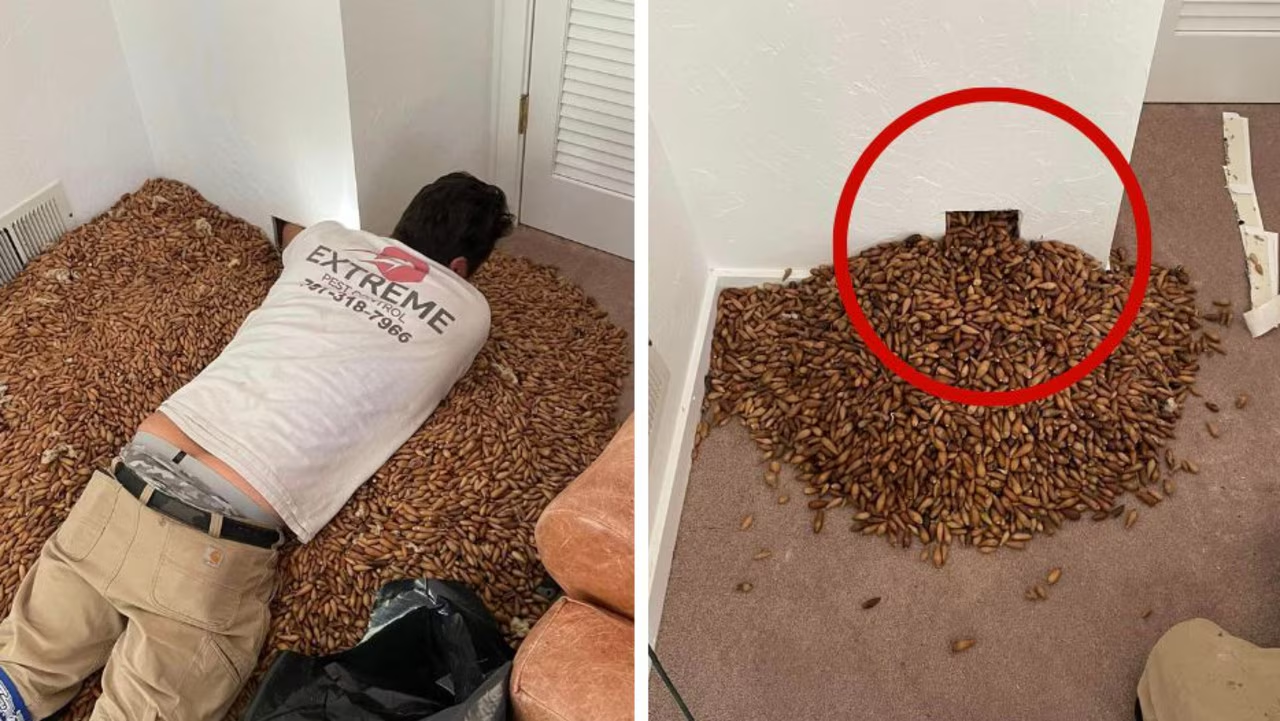
After more than two decades of working in pest control, Nick Castro thought he had seen just about everything. As the owner of Nick’s Extreme Pest Control in California, he had dealt with unusual infestations, unexpected animal behavior, and plenty of surprises hidden inside homes.
But one particular call left even an experienced professional genuinely stunned.
The problem initially sounded relatively straightforward: a homeowner was dealing with damage caused by a woodpecker. The bird had been repeatedly drilling holes into the home’s exterior siding.
Woodpeckers are known for pecking into wood and other surfaces, sometimes creating cavities that can later be used for nesting or storing food. In this case, however, the bird appeared to have found a rather unusual storage system.
It was using the house.
And what it was storing inside the walls was about to become an enormous problem.
It Started With a Few Holes in the Siding
When Castro arrived at the property, the homeowner had already noticed something unusual.
A local woodpecker had been creating holes in the exterior of the house.
At first, the damage may not have seemed particularly alarming. A bird making holes in siding is certainly inconvenient, but it isn’t necessarily something that would make you expect a massive discovery inside the walls.
The woodpecker, however, had a purpose.
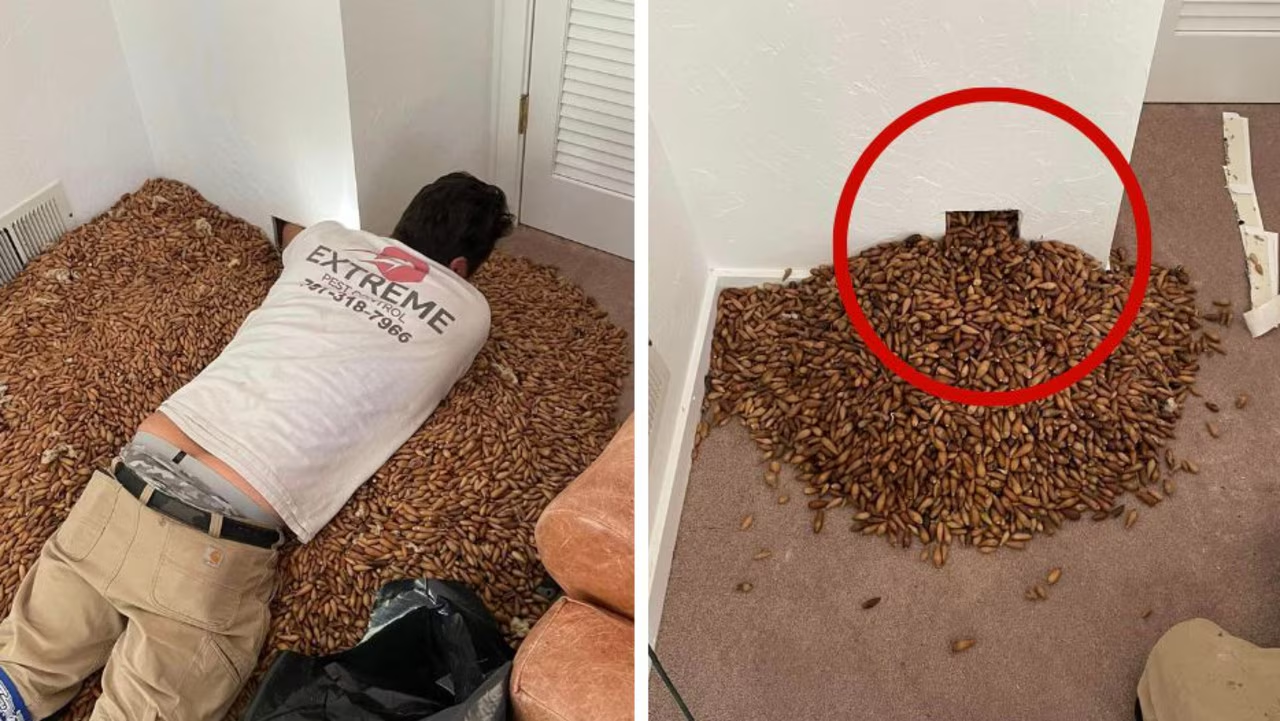
She had been collecting acorns and placing them into the holes she had created.
This behavior may seem strange when you first hear about it, but woodpeckers can store food in protected locations. Some species are known to create or use cavities where they can stash food for later.
The problem was that these particular cavities weren’t simply small holes in an isolated tree.
They connected to the hollow spaces inside the home’s walls.
And gravity was doing the rest.
The Acorns Were Falling Into the Walls
Castro knew that when he opened the wall, he would probably find some acorns.
What he didn’t expect was the sheer volume.
He cut into the wall expecting to remove a relatively modest amount of stored food.
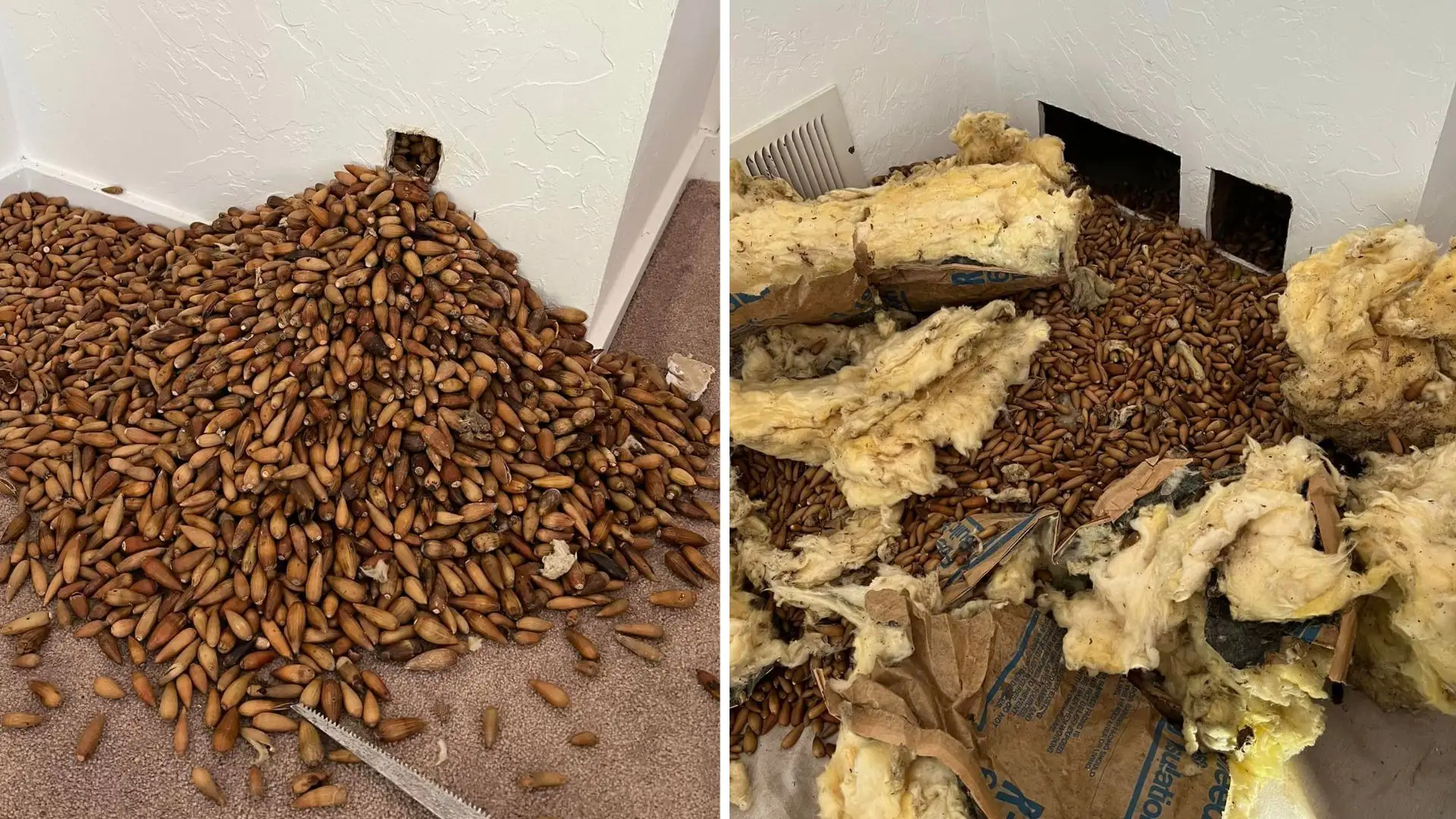
Instead, acorns began pouring out.
At first, it was a steady stream.
Then more and more started falling.
The discovery quickly went from curious to completely unbelievable.
It wasn’t a small collection hidden inside the wall.
There were apparently hundreds upon hundreds of acorns packed into the home’s cavities.
According to Castro, the acorns continued coming out nonstop.
The amount already visible was impressive, but it turned out that the biggest surprise was still waiting farther inside the structure.
The Acorns Reached Nearly to the Attic
The initial assumption was that the acorns had accumulated only partway up the wall.
That would already have been unusual.
But after Castro opened additional areas, the scale of the stash became clear.
The acorns had been accumulating throughout the wall cavities and had apparently reached all the way up toward the attic.
What looked from the outside like a bird simply making a few holes had actually become a remarkably large food-storage operation.
The woodpecker had been working repeatedly, bringing acorn after acorn back to the house.
Over time, those individual trips had added up.
And the result was astonishing.
Nearly 700 Pounds of Acorns
When everything was finally removed, the total was estimated at approximately 700 pounds of acorns.
That’s an incredible amount of food for one bird to have accumulated.
The stash was large enough to fill eight large trash bags.
Imagine opening a wall expecting to find a handful of acorns and instead watching them continue pouring out until you’ve filled bag after bag.
For Castro, who had spent more than 20 years working in pest control, it was something he had never encountered before.
The sheer quantity was what made the situation so memorable.
One small bird had essentially transformed the hollow spaces inside a house into a giant pantry.
How Did So Many Acorns Get There?
The explanation is actually much simpler than the discovery itself.
The woodpecker had been collecting acorns and placing them into openings in the home’s exterior.
Normally, a cavity used to store food would presumably hold the food in place.
But the house’s wall cavities created a different situation.
Instead of remaining neatly stored near the entrance, many of the acorns fell downward into the empty spaces inside the wall.
The woodpecker could continue returning to the same area without necessarily realizing that her carefully collected food was disappearing deeper into the structure.
One acorn became dozens.
Dozens became hundreds.
And eventually, hundreds became hundreds of pounds.
The Bird Was Working Hard—But Her Effort Was Going to Waste
There’s something almost heartbreaking about the story when you look at it from the bird’s perspective.
The woodpecker had clearly been busy.
She had found a source of food, transported the acorns, and repeatedly returned to store them.
From her perspective, she was building up a valuable reserve.
But because the acorns were falling into inaccessible areas of the house, the stash wasn’t necessarily serving its intended purpose.
Her hard work was effectively disappearing into the walls.
Every trip represented effort.
Every acorn represented another piece of food she had collected.
Yet the food was accumulating somewhere she couldn’t easily retrieve it.
An Unusual Pest-Control Job
For Castro, this wasn’t simply about removing a large amount of material from a wall.
The situation also involved an animal that wasn’t intentionally trying to damage the homeowner’s property.
The woodpecker was simply behaving according to its instincts.
That distinction mattered.
Rather than harming the bird, the pest-control team followed a humane approach.
The goal wasn’t to punish or eliminate the animal.
It was to prevent the house from continuing to be used as an enormous acorn storage facility.
The Solution Was Surprisingly Simple
Once the acorns had been removed, the next step was to prevent the woodpecker from continuing to use the same openings.
The existing holes in the exterior siding were patched.
The homeowner also planned to add new vinyl siding, which would make the previous storage locations less accessible.
This approach addressed the source of the problem without harming the bird.
Instead of trying to capture or eliminate the woodpecker, the team simply made the house less suitable for storing acorns.
Ideally, the bird would then find another location that was better suited to her natural behavior.
A Reminder That Wildlife Can Adapt to Human Structures
The story is also a fascinating example of how wildlife can interact with human environments.
Animals don’t necessarily understand the difference between a natural tree cavity and a hollow space inside a building.
If a location provides shelter, protection, or a convenient place to store food, an animal may take advantage of it.
From the woodpecker’s perspective, the house offered something useful:
a series of openings and cavities that could be used for food storage.
The homeowners, of course, saw the situation differently.
What was convenient for the bird was potentially damaging to the building.
This kind of conflict is common wherever human structures overlap with wildlife habitat.
Why the Discovery Was So Hard to Believe
The most fascinating part of this story isn’t simply that a woodpecker stored acorns.
It’s the scale of what happened.
Seeing one or two acorns around a house wouldn’t immediately raise suspicion.
Even finding a few dozen might not seem extraordinary.
But hundreds of pounds is an entirely different story.
The outside of the house didn’t necessarily reveal what was happening inside.
That is what made the discovery so surprising.
The wall essentially hid a giant collection of food that had been accumulating over time.
Until Castro opened it, there was no obvious way to appreciate just how much had been stored inside.
Nature Can Be Much Stranger Than It Looks
Stories like this are a good reminder that ordinary-looking places can contain surprisingly unusual secrets.
A few holes in the siding might look like nothing more than minor property damage.
But behind those holes was an enormous food stash.
The situation also shows how animal behavior can produce unexpected consequences when wildlife finds new opportunities in human-built environments.
The woodpecker wasn’t trying to create a bizarre mystery.
She was simply following her instincts.
She found a place where she could store food and kept returning to it.
The extraordinary part was what happened as those individual efforts accumulated over time.
What Homeowners Can Learn From the Story
If you notice repeated holes appearing in your home’s siding, roofline, fascia, or other exterior surfaces, it’s worth investigating rather than simply repairing them over and over.
Wildlife may be using those openings for:
- Food storage
- Nesting
- Shelter
- Access to wall cavities
- Protection from weather
A recurring pattern can be a sign that an animal has discovered something useful about the structure.
Repairing the visible damage without addressing the reason it keeps happening may only lead to more damage later.
If wildlife is involved, humane exclusion and professional guidance can help resolve the problem without unnecessarily harming the animal.
One Woodpecker, Hundreds of Pounds of Acorns
What began as a routine pest-control call turned into one of the strangest discoveries of Castro’s career.
A woodpecker had been using holes in a California home’s siding to store acorns.
The homeowner likely expected some minor cleanup.
Instead, approximately 700 pounds of acorns eventually came out of the walls—enough to fill around eight large trash bags.
The discovery was astonishing not because the bird had done something malicious, but because she had apparently been working so efficiently that her hidden pantry had grown to an almost unbelievable size.
And perhaps the most fitting ending is that the bird was allowed to remain unharmed.
The holes were patched, new siding helped make the house less attractive as a storage site, and the woodpecker could hopefully move on to a more suitable location.
Sometimes the strangest things hiding inside a house aren’t caused by pests invading the home – they’re caused by wildlife deciding that the home is the perfect place to build a pantry.
One Woodpecker, Hundreds of Pounds of Acorns—and What Happened After the Walls Were Opened
What began as an ordinary complaint about damage to a home’s exterior had already turned into one of the strangest pest-control jobs Nick Castro had encountered in more than two decades.
The homeowner had noticed holes appearing in the siding.
A woodpecker was responsible.
That part was easy enough to understand.
What nobody expected was what happened when the wall was opened.
Acorns began pouring out.
Not a few.
Not a bucketful.
Not even several boxes.
They kept coming.
According to the account, the hidden stash eventually amounted to approximately 700 pounds of acorns, filling roughly eight large trash bags.
The discovery was astonishing.
But once the immediate shock wore off, another set of questions remained.
Why had the woodpecker chosen the house?
How long had the acorns been accumulating?
Could the same thing happen again?
And what would happen to the bird once its enormous hidden pantry was suddenly gone?
Those questions turned what initially seemed like a bizarre pest-control story into something much more interesting—a story about wildlife, instinct, human homes, and the unexpected ways animals adapt to the environments people build around them.
The Morning After the Acorns Were Removed
The first priority was simple.
The wall needed to be cleared.
Hundreds of pounds of acorns inside a wall cavity were not something a homeowner could simply ignore.
The acorns occupied space that was never designed to function as a pantry.
They could add significant weight.
They could potentially attract insects or rodents.
And because the wall had been opened during the inspection, leaving the material behind would have defeated the purpose of the work.
So the cleanup continued.
Bag after bag was filled.
At one point, the quantity seemed almost comical.
The homeowner reportedly stood nearby watching the piles grow, apparently struggling to comprehend that all of it had come from the walls.
One bag became two.
Then three.
Then four.
Eventually, eight large trash bags were filled.
The total was estimated at around 700 pounds.
It was the kind of discovery that makes everyone in the room stop and say the same thing:
“How did all of that get in there?”
The answer was simple.
One acorn at a time.
The Mystery Wasn’t Really the Acorns
Once the physical evidence had been removed, the most interesting part of the story became the behavior behind it.
A woodpecker had apparently discovered that the house offered convenient cavities.
The bird wasn’t thinking about siding.
She wasn’t thinking about property damage.
And she certainly wasn’t thinking about the inconvenience she would cause a pest-control company years later.
She was looking for somewhere to put food.
That distinction is important.
Wild animals don’t understand human property boundaries in the same way people do.
A bird sees a hole.
A person sees damaged siding.
A bird sees a cavity.
A homeowner sees a wall.
The same structure can have completely different meanings depending on who—or what—is looking at it.
For the woodpecker, the house had apparently become a remarkably useful storage facility.
The House Had Become a Hidden Pantry
Imagine walking past your house every morning and seeing nothing unusual.
You might notice a few holes.
You might hear tapping.
You might occasionally see a bird flying away from the siding.
But you would have no idea that the empty spaces behind the exterior were gradually filling with food.
That was perhaps the strangest aspect of the entire incident.
The acorns were hidden.
They were not sitting in piles on the floor.
They weren’t stacked visibly against the walls.
They were inside cavities where the homeowner couldn’t see them.
That allowed the collection to grow quietly.
One trip by the bird didn’t create a dramatic problem.
Neither did the next.
Or the one after that.
But repeated behavior over a long period of time can produce surprisingly large results.
The woodpecker didn’t need to carry hundreds of pounds at once.
She only needed to carry one acorn at a time.
The accumulation happened gradually.
One Trip at a Time
It’s easy to imagine the bird returning to the house again and again.
She finds an acorn.
She carries it to the structure.
She lands near one of the holes.
She places the acorn inside.
Then she flies away.
Perhaps she returns minutes later.
Perhaps hours later.
Perhaps she uses several different openings.
From the bird’s perspective, the process is completely ordinary.
There is nothing particularly strange about storing food.
What made the situation unusual was the location.
The house provided an enormous amount of concealed space.
And because the acorns were falling deeper into the cavities, the bird could continue using the same general area without encountering the pile she had already created.
The storage system was, in a sense, self-expanding.
Every new acorn disappeared from sight.
That meant there was no obvious signal telling the bird:
You’ve stored enough.
The Hidden Weight
There was another reason the discovery was more serious than it initially appeared.
Seven hundred pounds is a lot of material.
Even distributed through a structure, that kind of accumulation can become significant.
The homeowner hadn’t intentionally put anything there.
The house wasn’t designed to hold it.
The wall cavities were simply empty spaces that happened to be accessible.
That is one reason wildlife activity around buildings deserves attention.
A small opening can lead to a much larger problem if an animal discovers a useful way to exploit it.
The visible damage may represent only the beginning.
A hole in siding can provide access to a wall.
A gap near a roof can provide access to an attic.
A broken vent can become an entrance.
A small opening that looks insignificant to a person can be an enormous opportunity to wildlife.
The Homeowner’s Perspective Changed Completely
Before the wall was opened, the homeowner probably saw the woodpecker as an annoyance.
There were holes.
There was noise.
There was damage.
The natural reaction was likely frustration.
After the discovery, however, the situation became more complicated.
It was still property damage.
But it was also evidence of a remarkable animal behavior.
Instead of simply seeing a bird destroying the house, the homeowner now knew that the bird had been using it for something specific.
She had turned the structure into a food-storage site.
That doesn’t mean the homeowner had to accept the damage.
It simply changed the way the problem could be understood.
The solution wasn’t about punishing the animal.
It was about changing the environment so the behavior would no longer work.
Why Simply Removing the Acorns Wasn’t Enough
If the acorns were removed but the holes remained open, the problem could potentially return.
The bird might come back.
She might begin filling the same cavities again.
And before long, the house could become another pantry.
That’s why the next stage was important.
The access points needed to be addressed.
The existing holes were patched.
The exterior was repaired.
The homeowner also planned to install new vinyl siding.
That would make the structure less accessible and less attractive for continued food storage.
In other words, the goal wasn’t simply:
Remove the acorns.
It was:
Remove the acorns and eliminate the opportunity that allowed the problem to develop.
The Bird Wasn’t the Enemy
This distinction is easy to lose when wildlife damages a home.
People understandably want to protect their property.
But the animal isn’t necessarily acting aggressively.
The woodpecker wasn’t attacking the homeowner.
She wasn’t deliberately trying to destroy the house.
She was following her instincts.
From her perspective, the behavior was successful.
She found food.
She found a place to store it.
She returned repeatedly.
The fact that humans considered the location inappropriate was irrelevant to the bird.
That is why humane wildlife management often focuses on exclusion rather than punishment.
If an animal has discovered a useful opening, closing that opening can solve the problem without harming the animal.
The Question of Where the Woodpecker Would Go Next
Once the holes were patched, there was an obvious question.
Where would the woodpecker go?
If she had become accustomed to the house, would she continue trying to access it?
Would she move to a nearby tree?
Would she find another structure?
Would she simply abandon the area?
Nobody could know for certain.
Wildlife is adaptable.
Animals constantly respond to changes in food availability, shelter, weather, competition, and habitat.
The bird had already demonstrated that she was willing to use an artificial structure.
That suggested she was capable of adjusting her behavior again.
The hope was that once the house no longer offered convenient cavities, she would find a more suitable place to store food.
The Strange Relationship Between Houses and Wildlife
Modern homes are designed for humans.
But they are not sealed boxes.
They contain gaps, cavities, vents, roof spaces, crawl spaces, wall voids, and other areas that can become useful to wildlife.
For a person, an empty wall cavity is just part of a building.
For an animal, it may be shelter.
A protected nesting site.
A hiding place.
Or, as this case demonstrated, a pantry.
This is one reason unusual wildlife encounters happen so frequently around homes.
Animals don’t necessarily invade buildings because they want to “move in.”
Sometimes they simply discover that the structure offers something they need.
Once they discover that, they may return.
What Makes Woodpeckers So Interesting
Woodpeckers are highly specialized birds.
Their behavior is closely associated with their ability to use their bills to interact with wood and other surfaces.
Their characteristic tapping can serve different purposes, including searching for food, communicating, establishing territory, or creating cavities.
Some woodpecker species also have unusual relationships with stored food.
That makes the behavior in this story particularly fascinating.
The bird wasn’t simply making holes randomly.
She had apparently discovered that those openings could serve a practical purpose.
The house became part of the bird’s behavioral landscape.
And once the bird learned that the structure worked, she kept using it.
The Difference Between Intent and Consequence
One of the most interesting lessons from the incident is that intent and consequence can be completely different.
The bird’s intent was apparently simple:
Store food.
The consequence was:
Hundreds of pounds of acorns inside a human home.
The bird didn’t understand the consequence.
The homeowner couldn’t have anticipated it.
And even an experienced pest-control professional didn’t expect the scale of the discovery before opening the wall.
That is what makes wildlife encounters so unpredictable.
The behavior itself may be ordinary.
The setting can make the result extraordinary.
Imagine Finding the First Acorn
There’s another amusing part of the story to imagine.
Suppose someone had discovered one acorn inside the wall.
They might have thought:
“That’s strange.”
Then they might have found five.
“Okay, maybe a bird is storing food.”
Then twenty.
“That’s unusual.”
Then fifty.
At some point, the homeowner would realize that this wasn’t a minor incident.
But by the time hundreds of pounds were discovered, the explanation would almost seem unbelievable.
The gradual nature of the accumulation is what makes the story so remarkable.
Nobody saw the pantry being built.
They only discovered the finished product.
What the Walls Didn’t Reveal
For the homeowner, the most unsettling part may have been realizing how much activity could take place inside the house without being visible.
Walls can hide many things.
Wiring.
Insulation.
Plumbing.
Structural components.
And sometimes, apparently, an enormous food cache.
This doesn’t mean homeowners should panic every time they hear a sound.
Most houses do not contain hundreds of pounds of acorns.
But unusual noises, repeated holes, animal activity, or unexplained damage can be worth investigating.
The important thing is not to assume that the visible problem is the entire problem.
A Lesson in Wildlife Exclusion
One of the practical lessons from the story is that prevention is often more effective than repeatedly repairing damage.
If a woodpecker keeps returning to the same section of siding, simply filling the hole may not solve the underlying issue.
The bird may create another hole.
Or reopen the old one.
Or find another access point nearby.
Understanding what the animal is trying to accomplish can help determine the appropriate solution.
If it is searching for insects, the underlying food source may matter.
If it is creating a nesting cavity, nesting behavior may be involved.
If it is storing food, accessible cavities may be the attraction.
Different behaviors require different approaches.
The New Siding Was More Than Cosmetic
Replacing or adding siding wasn’t simply about making the house look better.
It also changed the physical environment.
The woodpecker had discovered that the previous exterior offered access.
A different exterior surface could remove that opportunity.
This illustrates an important principle in wildlife management:
Change the conditions that encourage the behavior.
If the reward disappears, the animal often has less reason to continue.
Of course, every property and wildlife situation is different, and professional guidance may be appropriate when animals are repeatedly damaging a structure.
But the underlying principle remains useful.
The Eight Trash Bags Became the Story
Eventually, the enormous collection was gone.
The eight bags represented an almost unbelievable amount of work by one small bird.
Each acorn had been carried individually.
Each trip had taken energy.
Each storage attempt had been part of the bird’s natural behavior.
And now all those individual efforts were sitting in trash bags.
There was something strangely impressive about it.
A person could look at those bags and see a pest-control problem.
A biologist might see evidence of remarkable animal behavior.
A homeowner might see a warning about structural access.
And a storyteller might simply see an unforgettable tale.
All three interpretations could be true.
The Bird’s Persistence Was Part of the Problem
Wild animals don’t necessarily give up after the first obstacle.
If a location has proven useful, an animal may investigate it repeatedly.
That persistence can be frustrating for homeowners.
The bird had already invested effort in the house.
She had learned where the openings were.
She had learned that they could hold food.
From her perspective, there was no obvious reason to stop.
This is another reason exclusion needs to be thorough.
A single small opening may be enough to restart the behavior.
The Acorns Were More Than Just Food
Acorns have enormous ecological importance.
They are food for many animals.
Birds, squirrels, deer, and other wildlife may depend on them.
Storing food is a survival strategy.
An animal that successfully stores food can create a reserve for times when food is harder to find.
So from the woodpecker’s perspective, the enormous collection wasn’t absurd.
It was valuable.
The absurdity came from where the food had been stored.
A tree cavity would make sense.
A house wall is another matter entirely.
A Pantry No Human Would Have Built
Imagine designing a pantry that extends vertically through a wall and has no shelves, no doors, and no way to retrieve the food easily.
No human would build it that way.
But for the woodpecker, the system didn’t need to make human sense.
She wasn’t planning a kitchen.
She was following instinct.
The acorns disappeared into the cavity.
As long as the bird could continue accessing the opening, the location served its purpose.
This is one of the fascinating things about animal behavior.
Animals don’t need to understand an environment in the way humans do to exploit it successfully.
They only need to discover that something works.
What the Homeowner May Never Have Known
There may have been months—or potentially longer—when the homeowner walked past that wall completely unaware of what was happening.
The bird flew in.
The bird flew out.
The acorns accumulated.
And life continued normally inside the house.
That contrast is what makes the story so memorable.
From the outside:
A normal California home.
Inside:
Hundreds of pounds of acorns.
Above:
A woodpecker returning to her storage site.
Nobody planned it.
Nobody expected it.
It simply developed over time.
The Strange Things Pest-Control Professionals See
After decades in pest control, Castro had already encountered plenty of unusual situations.
Homes can contain surprises that homeowners never anticipate.
Animals find ways into places people don’t expect.
Insects establish colonies in hidden areas.
Rodents use tiny gaps.
Birds build nests in protected corners.
And occasionally, a woodpecker apparently decides that a house is an excellent place to store an enormous quantity of acorns.
That is part of what makes pest-control work so unpredictable.
Every house is different.
Every animal behaves differently.
And sometimes the explanation for a strange problem is much more unusual than anyone initially imagined.
The Importance of Looking Beyond the Obvious
The story also illustrates a broader lesson about home maintenance.
When damage appears, it’s tempting to repair the visible problem immediately.
A hole gets patched.
A board gets replaced.
A crack gets sealed.
But if something keeps causing the damage, the cycle can continue.
The better question is:
Why is this happening?
In this case, the answer wasn’t simply “a woodpecker is damaging the siding.”
The deeper answer was:
A woodpecker had discovered a useful food-storage system inside the structure.
Once that was understood, the solution became much clearer.
The Home Was Never Really the Bird’s Enemy
There is an interesting irony here.
The homeowner probably viewed the bird as the source of the problem.
But from the bird’s perspective, the house had simply become part of the environment.
There was no malicious behavior.
No intention to cause damage.
No understanding that the homeowner would eventually have to spend money fixing the siding.
The bird was simply surviving.
That doesn’t mean the homeowner should tolerate unlimited damage.
It means that humane solutions are possible.
The house can be protected without turning the animal into an enemy.
What Could Have Happened If Nobody Investigated?
The long-term consequences are difficult to predict.
The exact effects of hundreds of pounds of stored material inside a particular wall depend on the structure and circumstances.
But leaving a significant accumulation of organic material inside an inaccessible cavity isn’t something a homeowner would generally want.
Stored food can potentially create additional wildlife or pest attraction.
It can also complicate future maintenance.
And the longer the bird continued using the same location, the more material could accumulate.
Seven hundred pounds might have been the end of the story.
Or it might have been only a stage in an even larger accumulation.
That’s why investigating unusual wildlife damage can be worthwhile.
The Moment the Wall Was Finally Empty
Eventually, the final acorns were removed.
The wall cavity was empty.
The bags were full.
The visible evidence of the strange infestation had disappeared.
What remained was a damaged section of siding and a story that would probably be repeated for years.
The homeowner had started with a simple problem:
“A woodpecker is making holes in my house.”
The final explanation was:
“A woodpecker has stored roughly 700 pounds of acorns inside the walls.”
Those two sentences don’t sound like they belong to the same house.
But they did.
And Then Came the Quiet
After the repairs, the house became quiet again.
No tapping.
No new acorns.
No bags being filled.
No opening of walls.
The homeowner could finally look at the exterior without wondering what might be hidden behind it.
The bird was still somewhere nearby.
Perhaps she was already searching for another storage site.
Perhaps she had moved on.
Perhaps a nearby tree had become the new pantry.
Nobody could know exactly where she went.
But that uncertainty was part of the story.
The goal had never been to control every movement of the bird.
It was simply to keep the bird and the house from continuing to interfere with one another.
A Tiny Bird Left Behind a Huge Story
There is something almost comical about the imbalance.
The bird was small.
The house was large.
The problem was enormous.
One tiny animal managed to create a hidden collection weighing hundreds of pounds.
It is a reminder that size doesn’t always determine impact.
A small opening can lead to a large problem.
A single animal can create significant damage over time.
And a behavior that seems harmless at first can become extraordinary when repeated again and again.
Nature Doesn’t Always Follow Our Rules
People tend to divide the world into human spaces and natural spaces.
Our homes belong to us.
Trees belong to wildlife.
Gardens belong to people.
Forests belong to animals.
But nature doesn’t recognize those boundaries.
Birds land on roofs.
Squirrels enter attics.
Raccoons investigate garbage cans.
Insects enter kitchens.
And woodpeckers sometimes decide that exterior siding is useful for storing food.
Human structures become part of the environment.
Wildlife adapts.
Sometimes that adaptation creates fascinating encounters.
Sometimes it creates expensive repairs.
And occasionally, it creates a story worth telling.
The Unexpected Lesson of the 700-Pound Pantry
The most memorable thing about this incident isn’t the number.
Seven hundred pounds sounds unbelievable.
Eight trash bags sounds unbelievable.
A woodpecker storing acorns inside a house sounds unbelievable.
But the real lesson is simpler.
Wildlife is adaptable.
Animals take advantage of opportunities.
And the smallest signs can sometimes point toward something much bigger.
Those holes in the siding weren’t just damage.
They were evidence.
They told the story of a bird that had discovered a hidden space and repeatedly used it for a purpose.
The wall wasn’t simply damaged.
It had become a storage system.
What Homeowners Should Watch For
If you live in an area where woodpeckers are common, repeated holes in siding or other exterior surfaces are worth paying attention to.
Look for patterns.
Are the holes appearing in the same location?
Are they increasing over time?
Do you see birds repeatedly visiting the area?
Are there signs of nesting or food storage?
Is there an opening that leads into a wall cavity?
These observations can help explain what is happening.
And if you’re unsure, getting professional advice can be safer than trying to disturb wildlife yourself.
In particular, homeowners should avoid sealing animals inside a cavity without knowing whether something is currently nesting or sheltering there.
Wildlife exclusion is most effective when it accounts for the animal’s behavior.
Sometimes the Animal Is Telling You What the Problem Is
One of the most fascinating aspects of this case is that the woodpecker was essentially demonstrating the problem every day.
She flew to the wall.
She used the opening.
She disappeared.
She returned.
If someone had watched closely enough, they might have realized that something was happening inside.
Wildlife behavior can provide clues.
Repeated movement around one section of a house may indicate an access point.
Persistent scratching or tapping may indicate activity behind a surface.
Food disappearing may indicate an animal has found a way inside.
The animals themselves can sometimes reveal what is happening.
The House Became a Story Instead of Just a Repair
Once the repairs were finished, the homeowner had something that many people never experience.
A genuinely bizarre story.
If someone asked:
“What’s the strangest thing you’ve ever found in your house?”
The answer would probably be immediate.
“About 700 pounds of acorns.”
And then would come the inevitable question:
“How?”
“A woodpecker.”
That answer would sound like a joke.
But it wasn’t.
It happened.
And that’s why the story is so memorable.
A Final Look at the Woodpecker
It’s easy to imagine the bird returning one last time.
She lands near the repaired siding.
Tilts her head.
Looks at the place where the opening used to be.
Perhaps she taps once.
Nothing happens.
She tries again.
Still nothing.
Eventually, she flies away.
Maybe she finds a tree.
Maybe she discovers another cavity.
Maybe she chooses a completely different storage site.
Whatever happens next, one thing is certain.
She left behind an extraordinary legacy.
Not a nest.
Not a monument.
Not a famous song.
But hundreds of pounds of acorns hidden inside someone’s house.
The Strange Beauty of the Story
There is something strangely beautiful about the whole situation.
A homeowner wanted to protect a house.
A pest-control professional wanted to solve a problem.
A bird was simply trying to store food.
Nobody was really the villain.
They were just occupying the same environment with completely different needs.
The homeowner needed a functioning house.
The woodpecker needed somewhere to live and store food.
The solution was to create enough separation for both to continue.
The holes were patched.
The siding was replaced.
The acorns were removed.
And the bird was left unharmed.
That’s about as satisfying an ending as a wildlife conflict can have.
The Acorns Were Gone, But the Lesson Remained
Long after the last trash bag had been removed, the story remained.
It became a reminder that houses can hide surprising secrets.
It became a reminder that animals are capable of adapting to human environments in remarkable ways.
And it became a reminder that unusual damage should sometimes be investigated before it is simply repaired.
Because behind a few small holes might be nothing.
Or there might be a nest.
A colony.
A shelter.
Or, in one extraordinary case, nearly 700 pounds of acorns.
Sometimes the Most Extraordinary Discoveries Are Hiding in Plain Sight
The story began with a few holes.
That was all anyone could see.
But behind those holes was an entire hidden world.
A woodpecker had been making repeated trips.
An acorn would disappear.
Then another.
Then another.
The pile grew slowly.
Silently.
Unseen.
Until one day, someone finally opened the wall.
And suddenly the secret came pouring out.
Hundreds of pounds of food.
Eight large bags.
One very confused homeowner.
And one pest-control professional who had seen decades of unusual situations but still found himself surprised.
That’s perhaps the most memorable lesson of all.
You never really know what is happening behind a wall until you open it.
Sometimes the answer is exactly what you expect.
Sometimes it’s something you couldn’t possibly have imagined.
And sometimes, somewhere behind the siding of an ordinary-looking house, a small woodpecker has quietly built one of the strangest pantries you’ve ever seen.
The house was eventually repaired.
The acorns were removed.
The bird was left unharmed.
And the homeowner was left with a story that would probably be told for generations:
One little woodpecker. One ordinary house. And nearly 700 pounds of acorns hidden where nobody thought to look.
Related Articles

My husband had a vasectomy yet two months later I got pregnant[s]

My Family Mocked Me for Being Poor at the Auction—Then I Bought the $12.5 Million Estate They Thought Was Theirs

Woman Loses 160 Pounds to Climb Her Late Son’s Dream Mountain – At the Summit, His Twin Pulls Out a Note Revealing the Truth!