
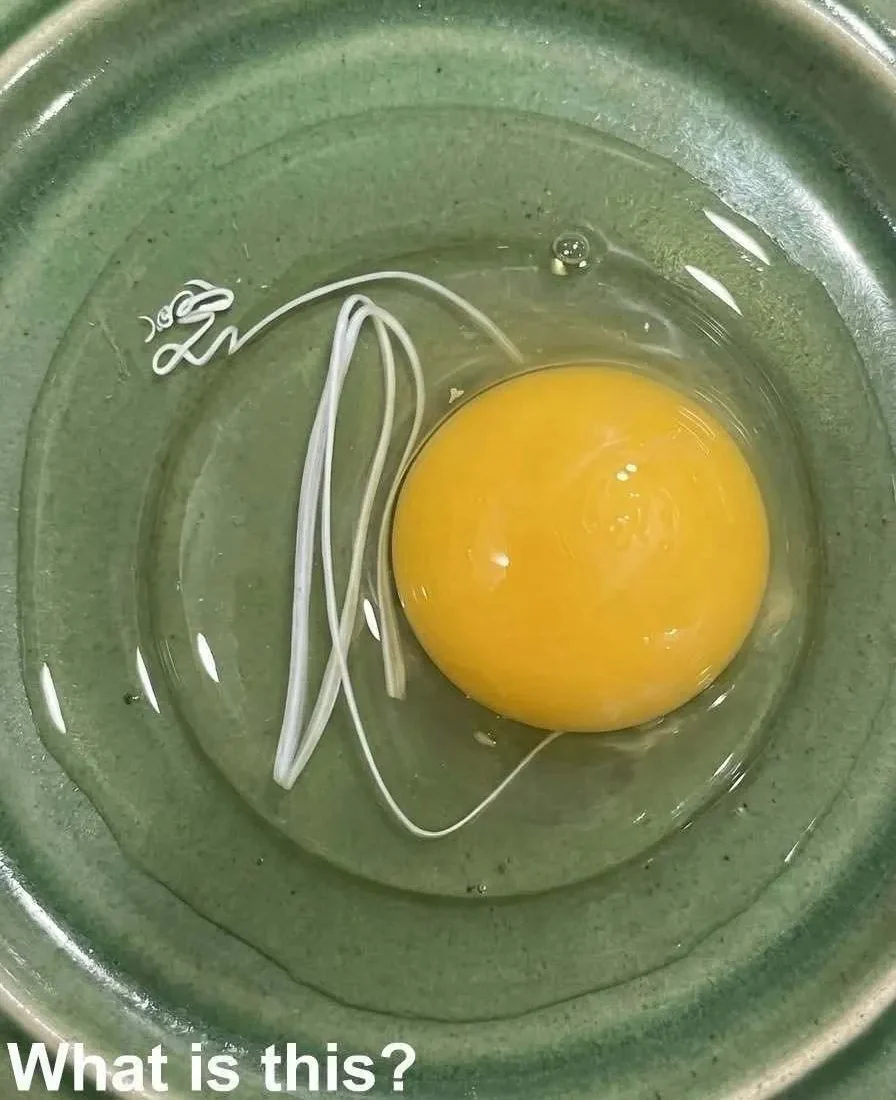
This morning, I was preparing breakfast when something inside an egg immediately made me stop.
I cracked it into a bowl as usual, but floating through the clear egg white was a strange pale strand.
It was thin, slightly twisted, and looked almost like a tiny piece of string.
For a second, my mind went straight to the worst possible explanation.
Was it some kind of worm?
Could the egg be contaminated?
Was it still safe to eat?
I stared at the bowl long enough that breakfast suddenly didn’t seem very appealing anymore.
My first instinct was to throw the egg away.
Instead, curiosity won.
I started looking into what that strange white strand could actually be, and the answer turned out to be far less alarming than I expected.
That mysterious structure is completely normal.
It is called the chalaza.
And chances are, you’ve eaten it countless times without ever noticing it.
So What Exactly Is a Chalaza?
The chalaza is a naturally occurring part of an egg.
It usually appears as one or more whitish, twisted strands extending through the egg white near the yolk.
Its job is surprisingly important.
The chalazae help keep the yolk positioned inside the egg instead of allowing it to move freely around the shell.
You can think of them almost like tiny internal cords supporting the yolk from opposite sides.
They are made from egg-white proteins and are completely edible.
So despite their strange appearance, they are not worms, parasites, or foreign material.
They are simply part of the egg’s natural structure.
Why Is It More Visible in Some Eggs?
Not every chalaza looks the same.
Sometimes it is barely noticeable.
Other times it may appear thick, white, and surprisingly obvious.
One major factor is freshness.
In fresher eggs, the chalazae are generally firmer and easier to see.
As an egg gets older, the internal structure gradually changes, and the strands may become less noticeable.
That means seeing a clearly defined chalaza is not automatically a reason to worry.
In fact, it can often be associated with a relatively fresh egg.
Why Haven’t You Noticed It Before?
There is a good chance you’ve seen hundreds of chalazae without realizing it.
Most cooking methods make them difficult to notice.
If you crack an egg directly into a hot pan, the white quickly becomes opaque and hides the strand.
If you scramble eggs, everything gets mixed together.
When eggs are used for cakes, pancakes, or other recipes, the chalaza simply becomes part of the mixture.
You’re much more likely to notice one when you crack a raw egg into a clear bowl and inspect it before cooking.
That’s exactly why something completely ordinary can suddenly look unfamiliar.
Is It Safe to Eat?
Yes.
There is normally no reason to remove the chalaza before cooking.
It is part of the egg white and can be cooked and eaten along with the rest of the egg.
It does not make the egg unsafe.
It does not mean the egg is fertilized.
And it does not indicate the presence of a parasite.
Some cooks remove it when preparing recipes where they want an especially smooth or uniform texture, but that is mostly a matter of preference.
For an ordinary breakfast, you can simply cook the egg normally.
Other Things Inside Eggs That Can Look Strange
The chalaza isn’t the only natural feature of an egg that can surprise people.
Occasionally, you may crack an egg and notice something different from what you’re used to seeing.
Blood or Meat Spots
Small reddish or brown spots can occasionally appear inside an egg.
These may form during the egg’s development and are not the same thing as an embryo.
Many people simply remove the spot before cooking if they find its appearance unpleasant.
Cloudy Egg Whites
Some people assume an egg white should always be perfectly transparent.
That’s not necessarily the case.
A cloudy-looking white is often seen in fresh eggs and may become clearer as the egg ages.
Double Yolks
Opening an egg and finding two yolks can certainly be surprising.
Double yolks can occur when two yolks are released close together during the egg-forming process.
They are unusual, but not mysterious or dangerous.
A Gray-Green Ring Around a Hard-Boiled Yolk
Sometimes a hard-boiled egg develops a gray or greenish ring around the outside of the yolk.
This commonly happens when the egg has been cooked for too long or cooled too slowly.
It may not look especially appetizing, but the discoloration itself is generally associated with a reaction that occurs during cooking.
But Could It Actually Be a Worm?
Seeing something that resembles a tiny string naturally makes some people think of parasites.
However, the chalaza has a recognizable appearance.
It is usually white or cloudy, attached near the yolk, and has a twisted, rope-like shape.
It doesn’t move.
And it forms as a normal part of the egg.
If what you’re seeing matches that description, it is very likely the chalaza rather than anything unusual.
That said, food should still be judged by its overall condition.
If an egg has an unpleasant odor, unusual coloration, a damaged shell that has been improperly stored, or anything else that genuinely suggests spoilage, the safest approach is not to use it.
The presence of a normal chalaza by itself, however, is not a warning sign.
Does It Mean the Egg Was Fertilized?
No.
This is another common misconception.
The chalaza occurs in eggs regardless of whether they have been fertilized.
Its purpose is structural.
It helps support the yolk inside the egg.
So spotting those white strands does not mean there was a developing chick inside the shell.
Can You Remove It?
You can, but you usually don’t need to.
If the appearance bothers you or you’re preparing a recipe where you want an especially smooth mixture, you can gently remove the strand with a spoon or another clean utensil.
Otherwise, simply leave it where it is.
Once the egg is cooked or mixed into a recipe, you’ll probably never notice it again.
Why Strange Food Can Make Us Panic
What surprised me most wasn’t really the chalaza.
It was how quickly my brain decided that something unfamiliar had to be dangerous.
We do this often with food.
We see a texture, color, or shape we don’t recognize and immediately imagine contamination or spoilage.
Sometimes that caution is useful.
Food safety matters.
But there are also many perfectly natural features in food that look strange simply because we’ve never stopped to examine them closely.
The chalaza is a great example.
At first glance, it may look unsettling.
Once you know what it is, it becomes completely ordinary.
Frequently Asked Questions
What is the white string attached to the yolk?
It is called the chalaza. It is a natural part of the egg that helps keep the yolk positioned inside the shell.
Is the chalaza a parasite?
No. It is part of the egg’s natural internal structure.
Can I safely eat it?
Yes. It can be cooked and eaten with the rest of the egg.
Why is it thicker in some eggs?
Chalazae can be easier to see in fresher eggs and may become less distinct as eggs age.
Does a visible chalaza mean the egg was fertilized?
No. Fertilized and unfertilized eggs can both contain chalazae.
Should I remove it before cooking?
Usually not. Removing it is simply a matter of personal preference or recipe presentation.
Does seeing one mean my egg is spoiled?
No. A chalaza is a normal part of an egg and is not itself a sign of spoilage.
The Simple Explanation
So that strange white strand that nearly made me throw away my breakfast?
It wasn’t a worm.
It wasn’t some mysterious contamination.
It was simply a normal part of the egg that I had probably eaten hundreds of times without ever paying attention to it.
Sometimes the things that look most unusual are completely harmless once we understand them.
The next time you crack an egg and notice a white twisted strand near the yolk, there’s no need to panic.
It’s called the chalaza.
It’s supposed to be there.
And your breakfast can continue as planned.