
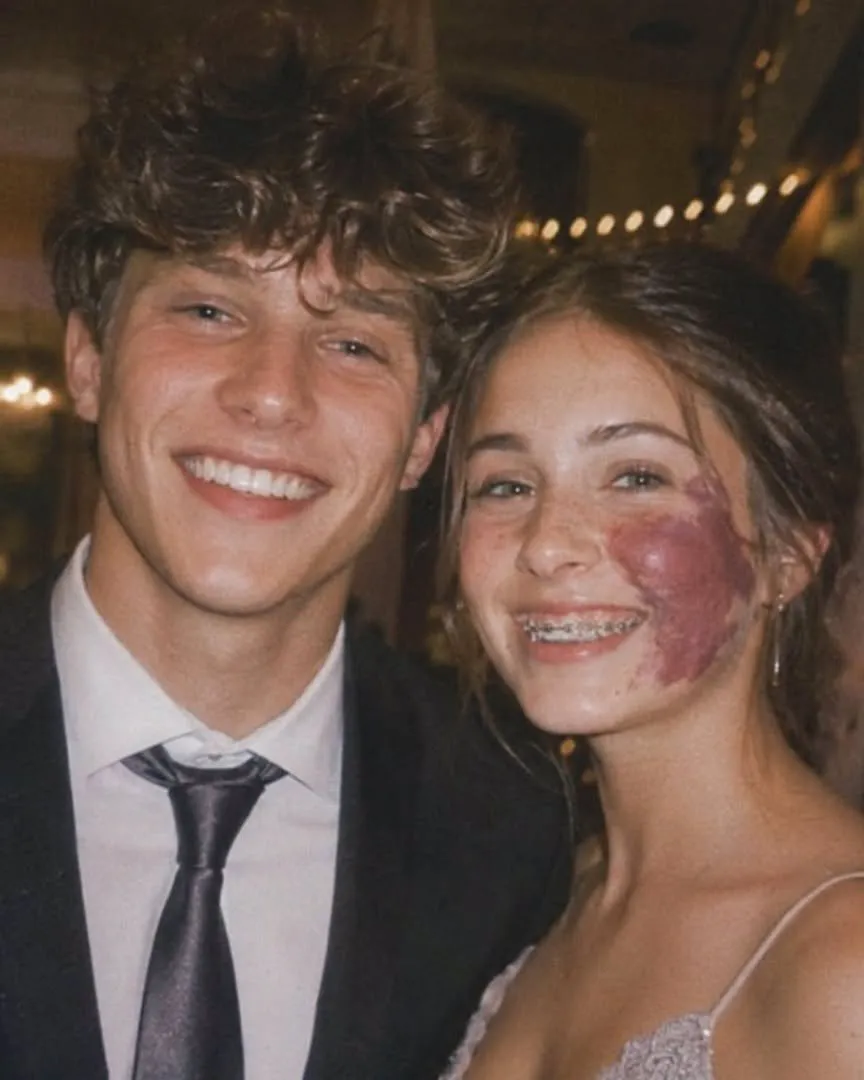
Leo was not the kind of boy anyone expected to ask Hannah to prom.
He was smart, quiet, and awkward in the way teenagers sometimes mistake for being uncool. His glasses were almost always slightly crooked. He read novels during lunch instead of sitting with the loudest groups, and most weekends he volunteered at the local animal shelter.
He wasn’t popular.
But he was kind.
And in high school, kindness could sometimes be mistaken for weakness.
Hannah knew something about being overlooked.
For most of her life, she had tried to disappear.
A large wine-colored birthmark covered part of her left cheek. It had been there since the day she was born, and by the time she reached high school, Hannah had learned every trick possible for hiding it.
Makeup.
Long hair.
Looking down when she walked.
Avoiding photographs.
Never volunteering to stand in front of a room.
The birthmark had made her a target when she was younger. Children had stared. Some had whispered. Others had been cruel enough to ask whether something had happened to her face.
Eventually, Hannah decided that being unnoticed hurt less than being noticed for the wrong reason.
Then Leo appeared beside her locker one afternoon holding a single daisy.
“Would you go to prom with me?” he asked.
Hannah stared at the flower.
Then at Leo.
Then back at the flower.
She waited for someone nearby to start laughing.
No one did.
“Is this a joke?” she asked.
Leo looked genuinely confused.
“No. Why would it be?”
Hannah folded her arms.
“You don’t have to do this.”
“Do what?”
“Feel sorry for me.”
His expression changed.
“I don’t.”
“You don’t have to rescue me, Leo.”
He was quiet for a moment.
Then he said something Hannah would remember for years.
“I’m not rescuing you. I’m asking you because I want to go with you. I’ve wanted to ask for a while. I just didn’t have the courage.”
Hannah didn’t know what to say.
Part of her wanted to walk away before she could be embarrassed.
But another part—the part she had spent years silencing—wanted to believe him.
So she said yes.
And for the first time in a long time, Hannah allowed herself to feel excited about something.
The Morning Everything Changed
The day before prom, Hannah was sitting in first-period history when someone knocked on the classroom door.
It was an ordinary Friday morning.
Mrs. Miller was explaining the Cold War while half the class pretended to take notes. One of the windows had been opened because the old radiator made the room unbearably warm.
Hannah sat near the back, doodling meaningless circles in the corner of her notebook.
Then the classroom door opened.
A uniformed police officer stepped inside.
The room became quiet almost instantly.
The officer exchanged a few words with the teacher before scanning the desks.
His eyes stopped on Hannah.
“Hannah Davis?”
Her stomach tightened.
“Yes?”
“Could you come with me, please?”
Every head in the classroom turned toward her.
Hannah felt heat rise into her face.
She hadn’t done anything wrong.
At least, she didn’t think she had.
As she gathered her books, the whispers began.
“What happened?”
“Why are the police here?”
“Did Hannah do something?”
She kept her eyes on the floor and followed the officer into the hallway.
But instead of taking her outside, he led her toward the principal’s office.
That was where Hannah’s life divided into two parts:
Everything she believed before she opened that door.
And everything she learned afterward.
A Woman Hannah Had Never Seen Before
Her mother was already sitting inside.
The woman Hannah had called Mom for as long as she could remember looked pale and frightened.
The principal stood near his desk.
Beside him was another woman in plain clothes who introduced herself as Detective Laura Miller.
On the table was a folder.
Several photographs.
And an old missing-child poster.
Hannah immediately knew something was wrong.
“What is this?” she asked.
Her mother looked away.
Detective Miller spoke carefully.
“Hannah, some information has recently come to our attention concerning your early childhood.”
Hannah glanced at her mother.
“What information?”
The detective opened the folder.
One photograph showed a little girl approximately two years old.
Hannah’s breath caught.
The child had dark hair.
Brown eyes.
And a distinctive reddish-purple birthmark spreading across the same side of her face as Hannah’s.
Underneath the photograph were two words:
MISSING CHILD
Hannah stared at it.
“That looks like me.”
Detective Miller nodded.
“It is you.”
The room seemed to disappear around her.
Hannah looked at the woman who had raised her.
“What is she talking about?”
Her mother began crying.
Detective Miller continued.
“You were reported missing when you were two years old during a complicated family custody dispute. The investigation eventually went cold. Recently, someone who had been reviewing old missing-person records saw a photograph of you and noticed the birthmark.”
Hannah touched her cheek without realizing it.
The mark she had spent her entire life trying to hide.
“They recognized me because of this?”
“Yes.”
The detective slid another photograph across the table.
This one showed a young woman smiling beside an older couple.
Hannah froze.
The woman looked startlingly familiar.
The same eyes.
The same shape of the face.
The same slight curve of the smile.
And along her cheek was a faint but unmistakable wine-colored mark.
“Who is she?”
Detective Miller’s voice softened.
“Her name was Rebecca. She was your biological mother.”
Hannah stopped breathing for a moment.
“Was?”
The detective hesitated.
“She passed away two years ago.”
Hannah looked back at the photograph.
A mother she had never remembered.
A woman who had apparently spent years looking for her.
A woman Hannah would never get the chance to meet.
She Had Never Stopped Looking
Over the next several hours, Hannah learned pieces of a story that had been hidden from her almost her entire life.
Her biological mother had searched for her for years.
She had contacted investigators.
Distributed photographs.
Maintained records.
And later supported organizations helping families of missing children.
Even when authorities had few new leads, Rebecca had refused to believe her daughter was gone forever.
Before her death, she left letters, photographs, childhood belongings, paintings, and documents with Hannah’s grandmother.
She had prepared them in case Hannah was ever found.
“She believed you might come home one day,” Detective Miller said.
Hannah looked again at the missing-child photograph.
All those years she had hated her birthmark.
She had covered it before school.
Avoided cameras because of it.
Cried because of it.
Wished she could wake up one morning and find it gone.
But without that birthmark, the person who reopened the case might never have recognized her.
The thing Hannah had spent years trying to erase had become the clue that uncovered her identity.
Seeing Her Birthmark Differently
That evening, Hannah stood in front of her bathroom mirror.
Usually, this was where she covered the mark.
Foundation first.
Then concealer.
Then another thin layer until the color became less noticeable.
But that night she did nothing.
She simply stared.
For the first time, the birthmark no longer looked like something that separated her from everybody else.
It looked like evidence that she came from somewhere.
Her biological mother had carried a similar mark.
Her grandmother later told her that other relatives had been born with smaller versions of it as well.
Hannah touched her cheek.
The mark hadn’t changed.
But its meaning had.
Prom Night
Prom arrived the following evening.
For several hours, Hannah considered staying home.
Too much had happened.
She had barely slept.
Her entire understanding of her childhood had been shaken.
But Leo had called her that afternoon.
“You don’t have to come,” he told her. “But if you still want to, I’ll be there.”
So Hannah went.
She wore a midnight-blue dress and pinned a small flower into her hair.
Normally, she would have arranged her hair carefully across the left side of her face.
That night, she pinned it back.
The birthmark was completely visible.
When Leo saw her, he smiled.
“You look amazing.”
Hannah waited for him to mention the mark.
He didn’t.
Not because he hadn’t noticed it.
Because to him, there was nothing unusual to explain.
They danced.
They laughed.
They took photographs.
And for the first time in years, Hannah didn’t turn her face away from the camera.
Halfway through the night, she went into the restroom and stood in front of the mirror.
Music echoed faintly through the walls.
Girls beside her adjusted their makeup and fixed their hair.
Hannah stared at her reflection.
Then she smiled.
She had spent years believing everyone saw the mark before they saw her.
Maybe some people did.
But that didn’t mean she had to hide.
Meeting the Family She Never Knew
Three weeks later, Hannah met her biological grandmother.
The moment the older woman saw her, she covered her mouth and began to cry.
Hannah did too.
Inside her grandmother’s house were pieces of a life Hannah had never known existed.
Family photographs covered the walls.
There were paintings made by Rebecca.
Boxes of letters.
Birthday cards written every year even though Rebecca had no address to send them to.
Photographs from Hannah’s infancy.
Stories about relatives she had never met.
Her grandmother opened one box and removed a stack of envelopes tied together with ribbon.
“Your mother wrote these for you,” she said.
Hannah stared at them.
“How many?”
“One for almost every birthday.”
That was the moment the reality finally became overwhelming.
Rebecca hadn’t forgotten her.
She hadn’t moved on.
She had continued being Hannah’s mother even when Hannah wasn’t there to see it.
Life Didn’t Become Perfect
Discovering the truth did not magically fix everything.
Hannah’s relationship with the woman who had raised her became complicated.
There were investigations, difficult conversations, questions about what had happened when Hannah was two, and truths that weren’t easy to hear.
Hannah also had to process the grief of discovering a biological mother only after it was too late to meet her.
Some days she was angry.
Some days she was confused.
Some days she missed the life she thought she’d had, even after learning parts of it weren’t true.
But one thing changed almost immediately.
Hannah stopped hiding her face.
She still wore makeup sometimes.
She still had insecure days.
Confidence didn’t appear overnight.
But she stopped arranging her entire life around making the birthmark disappear.
She raised her hand more often in class.
She looked people in the eyes.
She allowed herself to be photographed.
And slowly, the girl who had spent years trying to become invisible began allowing herself to be seen.
And What About Leo?
Leo remained an important part of Hannah’s life, although prom did not turn into a perfect teenage romance.
Eventually they went in different directions, as young people often do.
Years later, Hannah asked him why he had invited her in the first place.
His answer surprised her.
“I thought you were beautiful,” he said. “I never understood why you were always trying to hide.”
Leo hadn’t known about the missing-child case.
He hadn’t known about Rebecca.
He hadn’t known that Hannah’s birthmark would eventually become the clue to uncovering her past.
He had simply seen a girl he liked.
Long before Hannah learned to see herself differently, someone else already had.
Was Hannah’s Story Real?
Hannah’s story is fictional.
It draws inspiration from real situations in which distinctive physical characteristics—including scars, birthmarks, tattoos, and other identifying features—have helped authorities or families identify missing people.
The characters and events in Hannah’s story, however, were created for this narrative.
What Is a Port-Wine Birthmark?
A port-wine stain is a type of birthmark caused by abnormal development of tiny blood vessels in the skin.
It usually appears pink, red, purple, or wine-colored and may remain throughout a person’s life.
Most birthmarks do not carry any mysterious meaning or indicate that someone belongs to a particular family. However, distinctive physical characteristics can sometimes help establish or confirm someone’s identity when combined with other evidence.
The Mark She Once Wished Away
Near the end of the school year, Hannah found herself standing in front of her mirror again.
A few months earlier, she would have immediately noticed the birthmark and reached for concealer.
This time she simply looked at herself.
The mark had once represented everything she wanted to escape.
The staring.
The teasing.
The feeling of being different.
Now it reminded her of something entirely different.
Her mother.
Her grandmother.
A family that had searched for her.
A history she hadn’t known belonged to her.
Hannah finally understood something important.
The birthmark itself had never been the problem.
The shame she had been taught to attach to it was.
That fall, Hannah left for college in another state.
She didn’t suddenly become fearless.
She didn’t suddenly love every part of herself every day.
But she stopped trying to disappear.
In her first college ID photograph, her hair was pulled behind her ear.
The birthmark was visible.
Hannah looked directly into the camera.
And smiled.
For years, she had believed being seen was something to fear.
Now she understood that sometimes being seen can change everything.
The mark she once wished she could erase had helped lead her toward the truth.
And Hannah was finally done hiding.