
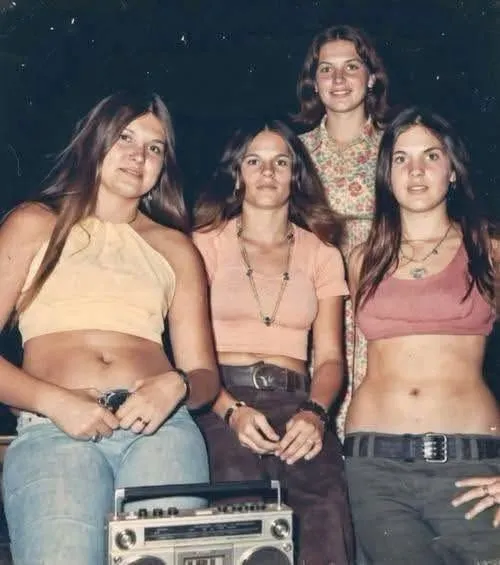
At first glance, this looks like a simple photo of four young women spending time together.
They are smiling, dressed casually, and standing beside an old stereo. Nothing about the setting seems unusual.
However, look a little closer.
There is something about this image that feels very different from many photos we see today.
It is not the clothes.
It is not the hairstyles.
Instead, it is the feeling that nobody is trying too hard to look perfect.
The photo seems natural, relaxed, and completely unplanned.
For that reason, images of women in the 1970s still capture so much attention today.
A Photo That Feels Different
The four women do not appear to be posing for an audience.
Their hair looks natural. Their clothes match the era. Their expressions seem relaxed.
Most importantly, the moment does not feel staged.
Today, many photos are taken with social media already in mind. For example, people may think about the lighting, background, pose, outfit, and angle before pressing the camera button.
Then, the editing begins.
A photo can be cropped, filtered, brightened, reshaped, or retouched within seconds.
By comparison, everyday photography in the 1970s was usually much simpler.
Someone picked up a camera, took the picture, and captured the moment.
In many cases, that was enough.
Photos Were Memories, Not Content
For many families and friends, photos once had a very different purpose.
They were memories.
People placed them in albums, kept them in boxes, or framed their favorites.
In addition, most photos were seen by a small circle of relatives and friends.
There was no pressure to collect thousands of likes or attract strangers online.
Because of that, ordinary photographs could remain ordinary.
A birthday party did not need the perfect background.
A night with friends did not need ten different camera angles.
Instead, people could simply enjoy what was happening.
As a result, older photos can feel especially genuine today.
Beauty Standards Still Existed
Of course, the 1970s were not free from beauty standards.
Women still saw fashionable celebrities in movies, magazines, advertisements, and television.
Hairstyles changed.
Clothing trends mattered.
Body ideals existed too.
However, the amount of comparison was very different.
People were not carrying a device that showed them hundreds of carefully selected images every hour.
Likewise, there was no endless feed filled with perfect skin, expensive vacations, designer outfits, and edited bodies.
As a result, visual comparison happened at a much slower pace.
Therefore, the pressure surrounding appearance was different from what many people experience today.
Social Media Changed Photography
Modern cameras are better than anything most families had decades ago.
However, technology is only part of the story.
The bigger change may be what happens after a photo is taken.
Today, a single image can reach thousands or even millions of people within minutes.
Because of this, photography can create a different kind of pressure.
Before posting, someone may ask:
Do I look good enough?
Is the angle flattering?
Should I change the lighting?
Should I use a filter?
Will people like it?
Eventually, those questions can turn a simple photograph into a performance.
By contrast, older photos often captured people who were simply living their lives.
Why Imperfect Photos Feel So Real
Perfect images can be beautiful.
Still, small imperfections often make a picture more memorable.
A messy hairstyle can show movement.
An awkward pose can make the moment feel spontaneous.
An ordinary room can make the scene feel familiar.
Meanwhile, a genuine smile can reveal more personality than a carefully practiced expression.
These little details tell us that something real was happening.
Nobody needed to hide every flaw.
Moreover, nobody needed to make the moment look more impressive than it actually was.
For that reason, authenticity is difficult to recreate on purpose.
Fashion Changes, Confidence Does Not
Fashion from the 1970s can look unusual to people today.
That is normal.
Every generation has its own clothes, hairstyles, makeup, shoes, and accessories.
Trends disappear and eventually return.
However, confidence is much harder to date.
The women in this photo seem comfortable with themselves.
They do not appear worried about matching one perfect standard.
Instead, each person still looks like an individual.
Perhaps, that is one of the most striking parts of the image.
Perfection Can Make Everyone Look Similar
Modern beauty culture often encourages individuality.
At the same time, social media can push millions of people toward the same trends.
The same hairstyles appear everywhere.
Similar makeup styles become popular.
In addition, people copy the same poses, outfits, facial expressions, and photo angles.
Ironically, trying to stand out can sometimes make everyone look more alike.
Because of this, old photographs can feel refreshing.
People often look more distinct.
As a result, their personalities remain visible.
Not Every Moment Needed an Audience
Think about how many experiences now become content.
Meals are photographed.
Vacations are documented.
Birthdays become photo shoots.
Even so, quiet moments can also end up online.
There is nothing wrong with sharing memories.
In fact, social media helps families stay connected. It also allows people to share experiences across the world.
However, there is a difference between documenting life and performing it.
Older photographs remind us that a moment can matter even when almost nobody else sees it.
Therefore, a memory does not become more valuable simply because it receives attention.
The Past Was Not Perfect
It is important not to romanticize the 1970s.
Women faced major social pressures and inequalities during that period.
Beauty expectations existed.
Advertising influenced appearance.
Celebrities shaped fashion.
Therefore, life was not automatically easier simply because social media did not exist.
The point is not that the past was perfect.
Instead, old photographs show us a different relationship with images.
They remind us that a photo can have value without being flawless.
What We Can Learn From Old Photos
Perhaps the lesson is surprisingly simple.
Not everything needs to be optimized.
Not every picture needs the perfect angle.
Not every outfit needs to follow the latest trend.
Not every face needs a filter.
Finally, not every moment needs to become content.
Sometimes an imperfect photograph carries more emotion than a polished one.
For example, it may show the wrinkles in a smile.
It may capture messy hair.
It may include an ordinary background.
Yet, those details are often what make the memory feel alive.
Why This Photo Still Gets Attention
The appeal of this image is not really about deciding whether women looked better in the 1970s.
That misses the point.
Instead, what stands out is how relaxed everything feels.
The women seem to be enjoying the moment rather than trying to create an image for an audience.
There is no obvious branding.
No perfect setup.
No visible attempt to impress thousands of strangers.
In other words, they simply look like themselves.
Today, that can feel surprisingly rare.
The Bottom Line
Photos of women in the 1970s can tell us more than what people wore or how they styled their hair.
They can also remind us how much photography has changed.
Beauty standards existed then, just as they do now.
However, everyday photos were usually less connected to filters, algorithms, public approval, and constant comparison.
Because of that, images like this can feel different.
They feel natural.
They feel personal.
Most of all, they feel real.
Ultimately, in a world filled with carefully edited images, reality may be the thing that catches our attention the most.