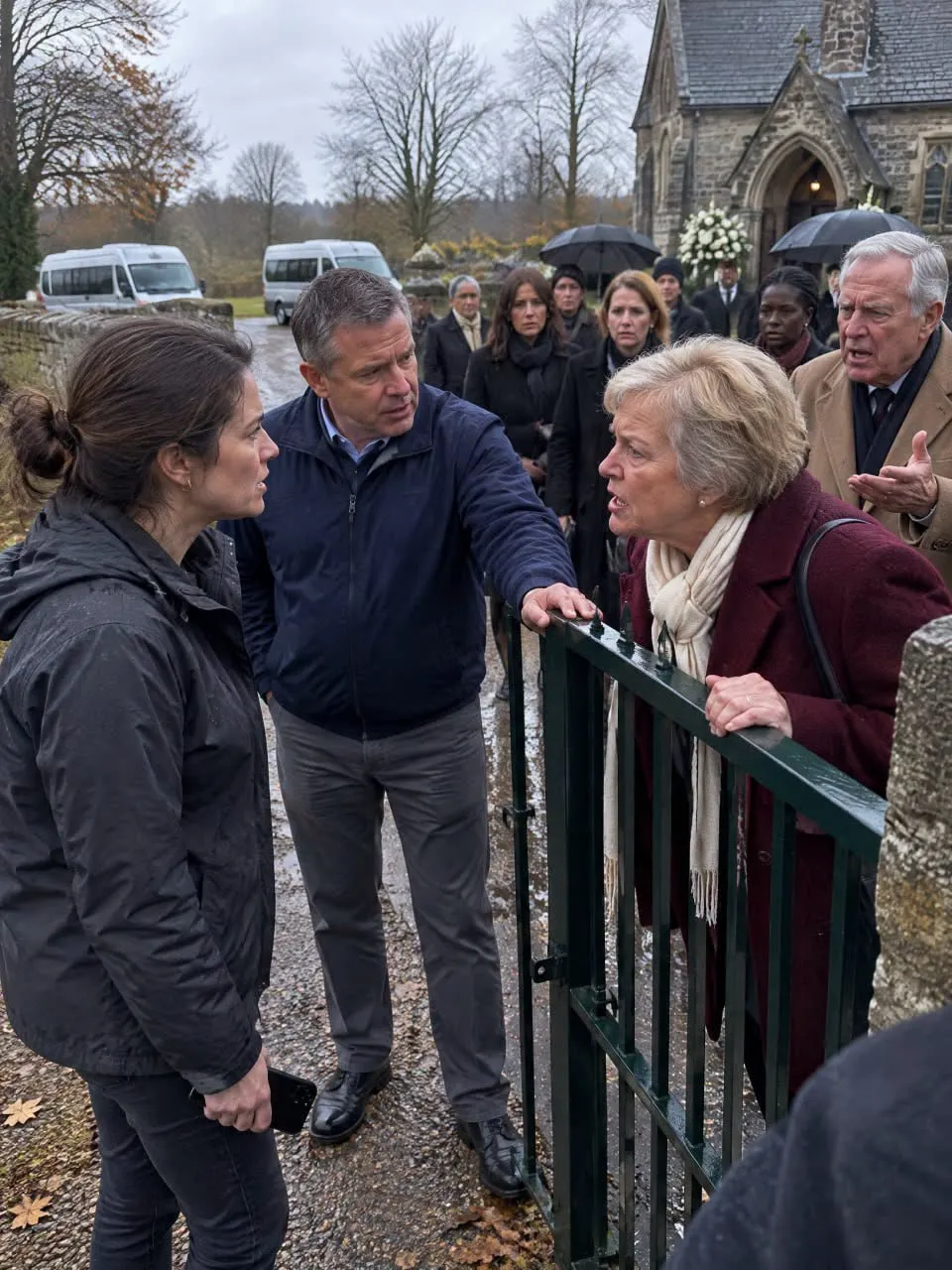
When my mother told me to keep my twelve-year-old daughter upstairs while forty guests celebrated directly beneath her bedroom, something inside me became completely calm.
“All right,” I said.
Mom heard surrender.
What she didn’t know was that I planned to clear the farmhouse exactly as she had requested.
By Friday evening, the folding tables were gone. The anniversary decorations, champagne cases and clothes my parents had left in the guest rooms were packed away too.
Afterward, I moved everything into a clean storage unit rented in my father’s name.
Then I changed the gate code, replaced the exterior locks and posted a signed no-trespassing notice.
The farmhouse belonged to me.
Not “the family.”
Not my parents’ retirement retreat.
Mine.
Seven years earlier, I had purchased it from my grandmother at its professionally appraised value. At the time, my parents had refused to buy it because they thought the plumbing was outdated and the surrounding twenty acres had little value.
However, after I renovated everything, they began calling it “our farmhouse.”
Normally, I ignored that.
This time, my daughter’s safety was involved.
And I was finished keeping the peace at her expense.
Three Buses Arrived at My Gate
At nine Saturday morning, tires rolled along the gravel road.
My parents’ silver Cadillac arrived first. Behind it came three chartered buses filled with anniversary guests.
Next came a catering van, a florist and a string quartet.
Meanwhile, Sheriff Daniel Brooks was waiting beside the locked gate.
From the living-room window, I watched while my daughter Lily rested in a sanitized room behind me.
She had returned home from a bone-marrow transplant only eleven days earlier.
Her doctors had been clear: while her immune system recovered, even an ordinary infection could become dangerous.
Therefore, forty guests were not entering my house.
Mom climbed from the Cadillac wearing an ivory dress and marched toward the gate.
“Why is this locked?”
Sheriff Brooks lifted the notice.
“Mrs. Carter, the property owner has withdrawn permission for you and your guests to enter.”
“I am her mother.”
“That does not make you the owner.”
Dad pointed toward the farmhouse.
“Emily agreed to clear the place.”
That was when I stepped onto the porch.
“I did.”
Mom looked toward me.
“I cleared it of everything belonging to you.”
By then, guests were already leaving the buses.
My mother stared through the iron bars, wearing the familiar smile she had used throughout my childhood whenever she believed public embarrassment would force me to cooperate.
“You are embarrassing yourself,” she said. “Open the gate.”
“No.”
Mom Tried Her Old Gate Code
Her smile disappeared.
“This is family property.”
“No, it isn’t.”
“Emily.”
“The deed has one name on it. Mine.”
Sheriff Brooks calmly asked her to step away.
Instead, Mom reached through the bars and entered the access code she had used for years.
Nothing happened.
She tried again.
Still nothing.
Then I noticed movement upstairs.
Lily stood behind the second-floor window. Her face was pale, and a medical mask covered her nose and mouth.
Mom noticed her too.
“See?” she called. “She’s already upstairs. There’s no problem.”
For a moment, even the sheriff said nothing.
During the previous eleven days, nearly every decision in my life had become a calculation of risk.
Who had entered the house? Was anyone coughing? Had everything been cleaned? Was Lily eating enough? Did she need more rest?
Meanwhile, my mother treated her recovery like an inconvenience interfering with an anniversary party.
So I reached into my pocket.
There was something she didn’t know I had saved.
A voicemail.
I pressed play.
“If Emily resists,” my mother’s recorded voice said, “we’ll go in through the kitchen. She won’t make a scene in front of everyone.”
Sheriff Brooks slowly turned toward her.
The Voicemail Silenced Everyone
Nobody spoke.
Not the guests.
Not the florist.
Even the musicians stood motionless with their instrument cases.
However, the recording wasn’t finished.
“Richard, bring the toolbox from the trunk, just in case,” Mom’s voice continued. “It’s my mother’s house. Nobody is going to keep me out of my own mother’s house.”
Then came a click.
Silence.
I lowered the phone.
For once, my mother didn’t immediately have an answer.
Sheriff Brooks looked from my phone to her.
“Mrs. Carter, did you leave that message?”
Mom released the gate and smoothed her ivory dress.
“It was taken out of context. We were trying to stop this celebration from becoming a family argument.”
“You said you planned to enter through the kitchen if the owner resisted.”
Dad glanced toward the buses.
By now, almost everyone was watching.
Mom lowered her voice.
“Emily is emotional. Her daughter has been sick. She isn’t thinking clearly.”
“My daughter’s recovery is exactly why I’m thinking clearly.”
The sheriff lifted the trespass notice.
“You have been told that you do not have permission to enter.”
Then my father did something I had rarely seen him do.
He stepped away from my mother.
“Diane,” he said quietly. “Let’s go.”
Dad Finally Stood Up to Her
Mom turned sharply.
“Don’t you dare, Richard.”
I knew that tone.
So did he.
Throughout my childhood, it usually worked.
Dad had spent forty years treating peace and silence as though they were the same thing. He was gentle, quiet and almost painfully unwilling to confront my mother.
Before he could respond, Sheriff Brooks raised the notice where everyone could see it.
“I personally checked the county records,” he said. “Emily Carter is the sole owner of this property. She has been for seven years.”
Whispers moved through the crowd.
“If anyone crosses this gate without her permission, that is trespassing.”
Then he glanced toward my phone.
“And entering through a kitchen window would become something more serious.”
Mom stared at him.
“You would arrest a sixty-six-year-old woman in front of her friends?”
“I’d much rather not.”
He paused.
“But I would.”
For perhaps the first time in her life, Mom had encountered someone who wasn’t interested in fighting with her.
He simply meant what he said.
I Had Already Packed Their Belongings
I walked toward the gate but stopped well away from the crowd.
Because of Lily, I hadn’t stood near a large group for months.
In my hand was a cream-colored envelope.
Sheriff Brooks passed it through the bars to Dad.
“Everything you left here is in Unit 214 at Harmon Road Self Storage,” I explained. “The unit is in your name and paid through next August.”
Dad opened the envelope.
“The key is inside, along with an inventory. Every box is labeled.”
Mom stared at me.
“You put our things in storage?”
“A clean, dry unit. I even hung your coats so they wouldn’t wrinkle.”
“You planned this.”
“Yes.”
My voice remained calm.
“I planned for my daughter. You planned for forty guests. We were always going to end up in different places.”
Mom wrapped both hands around the bars.
“Open. This. Gate.”
Normally, that voice would have made me surrender.
Not anymore.
Eleven days earlier, I had stood in a hospital corridor at three in the morning while machines monitored my daughter.
That experience taught me something.
There is the silence of someone who has stopped defending herself.
Then there is the silence of someone who has finally decided.
“No, Mom.”
The Guests Learned the Truth About Lily
Mom immediately turned toward the crowd.
“Everyone, I’m sorry. Emily is under enormous stress. She hasn’t been herself since Lily became ill.”
Sheriff Brooks glanced toward me.
“With respect, Mrs. Carter, your daughter appears to be the calmest person here.”
Several guests struggled not to react.
Then my brother Mark appeared from behind one of the buses.
“Em? What’s happening?”
“Ask Mom about Lily.”
Mark frowned.
“Mom told me she was doing much better.”
“She is recovering,” I explained. “That doesn’t mean she can safely have forty people inside the house.”
His face changed when I explained how recently Lily had come home.
Before Mom could defend herself, one of her friends stepped forward.
Bev Lindstrom had spent decades working in pediatric oncology.
“Diane,” she said. “Tell me you didn’t plan to put forty people inside this house.”
“Nobody was going near Lily,” Mom replied. “She would stay upstairs.”
Bev stared at her.
“That isn’t how infection risk works.”
“Nobody here is sick.”
At that exact moment, someone coughed.
A man near the front turned red.
“Sorry. I’ve had a tickle since Wednesday.”
The silence that followed said everything.
Lily Appeared at the Window
“I told her,” I said.
Mom stopped talking.
“I told you before the transplant. I told you from the hospital. Then I told you again when Lily came home.”
My voice stayed steady.
“I sent you the discharge instructions. I emailed you the medical guidance. You knew.”
A quiet voice came from behind her.
“She did.”
Everyone turned.
Dad was still holding the storage envelope.
“Emily told us, Diane. More than once.”
Mom stared at him.
“Richard.”
“She did.”
For once, there was no excuse afterward.
Then we heard a window latch.
Everyone looked up.
Lily stood behind the second-floor glass.
After a moment, she disappeared.
My heart jumped.
However, she soon returned carrying her sketchbook.
The first page read:
HI GRANDMA.
HI GRANDPA.
Then she showed another.
A crooked birthday-style cake filled the page.
HAPPY ANNIVERSARY!
My throat tightened.
Finally, Lily raised another message.
I’M SORRY I CAN’T COME DOWN. I WOULD IF I COULD.
I covered my mouth.
Lily had never heard Mom tell me to lock her upstairs.
Yet somehow, after everything she had survived, my daughter had decided she was the one who needed to apologize.
The final page showed only a large red heart.
Nobody spoke.
Dad removed his hat and walked toward the gate.
Then he lifted one hand toward the window.
Lily waved back.
His shoulders began to shake.
“She’s twelve,” Mom whispered.
That was when Aunt Ruth stepped forward.
“Yes,” she said. “She is.”
Aunt Ruth Revealed a 54-Year-Old Secret
Aunt Ruth was my mother’s older sister.
“Diane,” she said. “Look at me.”
“Ruth, not now.”
“Now.”
Ruth never raised her voice.
“Do you understand what you asked Emily to do? You wanted a medically vulnerable twelve-year-old upstairs while forty people celebrated below her.”
Mom shook her head.
“That’s not the same.”
Ruth stared at her.
“Isn’t it?”
Something changed in Mom’s expression.
“Ruth, don’t.”
“I’ve been saying ‘don’t’ for fifty-four years. I’m finished.”
Then Ruth turned toward us.
“Our little sister was named Annie.”
Mom closed her eyes.
“She was eight years old, and she had leukemia.”
The road became silent.
“It was 1972,” Ruth continued. “Annie died that spring.”
Then she looked toward the farmhouse.
“Her funeral gathering happened right here.”
My stomach tightened.
“Forty people came.”
Forty.
Again.
“Diane was twelve.”
Suddenly, the similarities were impossible to ignore.
My Mother Had Once Been the Girl Upstairs
“Our mother was overwhelmed,” Ruth explained. “She didn’t know how to comfort another grieving child.”
So she sent Diane upstairs.
Stay in your room.
Don’t make a scene.
According to Ruth, Mom sat at the top of those stairs for six hours wearing a black dress.
Nobody invited her down.
Nobody asked how she was coping with the death of her little sister.
After that day, she stopped crying in front of people.
Mom slowly sat on the running board of the Cadillac.
“I was twelve,” she whispered.
Her hands covered her mouth.
“Nobody asked me.”
For days, I had imagined confronting her.
I thought I would feel victorious when she finally understood.
Instead, I saw a sixty-six-year-old woman sitting beside a gravel road while the pain of a twelve-year-old girl finally caught up with her.
Part of me wanted to open the gate.
Still, I didn’t.
Understanding her pain did not make her plan safe.
Old wounds can explain someone’s behavior without excusing it.
Both things can be true.
“Mom,” I said. “I’m sorry about Annie. I’m sorry nobody sat beside you.”
Tears ran down her face.
“But you don’t get to give Lily the same staircase.”
She looked up.
“I love you. But I won’t do that to my daughter. Not for a party. Not to protect appearances. Not even for you.”
Mom Finally Broke Down
For the first time in my life, I watched the woman who always said, “We don’t make scenes,” have one.
She cried openly.
It wasn’t graceful or controlled.
However, it was real.
Dad knelt beside her and wrapped an arm around her shoulders.
Usually, he left difficult situations.
This time, he stayed.
Meanwhile, the anniversary party was moved to a nearby hall.
The caterer agreed to take the food there, while some extra meals were donated to families staying near the children’s hospital.
Before leaving, the string quartet asked if they could play one piece for Lily from the road.
I agreed.
They stood far from the house and began playing.
Lily appeared behind the window again.
When the music ended, the guests didn’t applaud.
Instead, one by one, they lifted a hand toward her.
Lily waved back with both hands.
That was when I finally cried.
Dad Returned Alone That Evening
Later, Lily asked why Grandma had looked so sad.
“Grandma remembered something painful from when she was your age,” I explained.
Then Lily told me why she had made the signs.
At the hospital, people who couldn’t enter her isolation room sometimes held messages against the glass.
“Even when they couldn’t come inside, I still felt like they were there,” she said.
Then she looked at me.
“You can still be together through a window, Mom. It’s just slower.”
That evening, the farmhouse porch light came on automatically.
My grandmother had always left it glowing overnight.
Whenever I asked why, she gave the same answer.
“In case somebody needs to find their way home, Emmy.”
At six o’clock, I looked outside.
Dad was standing beyond the gate.
Alone.
The Secret Behind Lily’s Teddy Bear
Dad told me that months earlier, while Lily was in the hospital, he had driven there secretly.
However, fear stopped him from going upstairs.
He sat in the parking garage for hours.
Before leaving, he entered the gift shop and bought a brown teddy bear wearing a blue vest.
Then he left it at the nurses’ station with a note.
Be brave. Somebody is thinking of you. A friend.
I covered my mouth.
That bear was Barnaby.
Lily had slept beside him through treatment and the transplant.
“It was you?”
Dad nodded.
“It was me.”
Tears filled my eyes.
“She sleeps with him every night.”
Dad lowered his head.
“I don’t expect forgiveness. Just tell me what I need to do.”
“Learn,” I said.
So he did.
Dad Started Showing Up Every Sunday
The following Sunday, Dad arrived at exactly two o’clock.
He brought a folding chair and sat far from the porch while Lily stayed wrapped in blankets on the swing.
Together, they did crossword puzzles by calling clues across the yard.
Then he returned the next Sunday.
And the next.
Soon, Lily was correcting him and laughing at his answers.
Meanwhile, Mom stayed away.
For three weeks, part of me kept looking toward the gate.
Then, on the fourth Sunday, Dad handed me an envelope.
“Your mother wrote this for Lily.”
I read it first.
Mom told Lily about Annie.
She described being twelve years old and listening from the staircase while adults downstairs talked about her dead sister.
Then she wrote:
I thought hiding my feelings made me strong. It didn’t. It became a locked door, and I spent fifty-four years standing behind it.
She admitted she had repeated the same mistake with Lily.
Finally, she wrote:
You have nothing to apologize for. I was the one who should have climbed those stairs a long time ago.
Lily’s Answer Changed Everything
After reading Grandma’s letter twice, Lily pulled out her sketchbook.
Her answer was simple.
She told Mom she was sorry about Annie.
Then she wrote:
You were twelve when it happened, and I’m twelve too, so I think we understand each other.
Another line followed:
You can come see me when the doctors say it’s okay. I’ll be on the porch. I’ll wave first.
Behind the letter was a drawing.
Two twelve-year-old girls sat together on a staircase.
One was Lily.
The other was Annie.
When Dad saw it, his voice broke.
“I think your mother is going to need to sit down.”
A few days later, Mom returned.
Mom Came Back Alone
It was six in the morning.
No ivory dress.
No guests.
No makeup.
Only a plain gray coat.
Most importantly, she didn’t touch the gate.
“I don’t want to come inside,” she said. “I just want you to listen.”
So I did.
Mom had contacted Lily’s medical team.
She had spoken to a social worker and attended caregiver education classes.
Finally, she understood the danger she had almost created.
“I didn’t mean to hurt Lily,” she said. “But that doesn’t mean I couldn’t have.”
Then came another surprise.
She had started counseling.
“I don’t know how to fix forty years, Emily.”
Her eyes filled with tears.
“But I can stop repeating them.”
Afterward, she looked directly at me.
“I’m not asking you to forgive me. I’m asking you to let me earn my way back.”
For a moment, I said nothing.
Then I noticed her coat wasn’t even buttoned properly.
“You came here alone at six in the morning just to tell me the truth.”
She nodded.
“That isn’t nothing, Mom.”
Still, I couldn’t open the gate yet.
Lily wasn’t ready.
For once, Mom accepted my answer.
Two Months Later, I Opened the Gate
Two months later, Lily reached an important recovery milestone.
Her doctors finally allowed a small outdoor family gathering.
Only a few people could attend.
Everyone had to be healthy, masked and at a safe distance.
We followed every rule.
When my parents arrived, Mom stopped outside the gate.
She hadn’t crossed it since the morning of the canceled anniversary party.
I sent her a text.
The new gate code is the date of Lily’s transplant.
The day her new cells came home.
You know the date.
Mom looked toward me.
I nodded.
Slowly, she entered the numbers.
The lock clicked.
Then the gate opened.
Mom stared at it before laughing through her tears.
“It works.”
“It works, Mom.”
I smiled.
“Come on in.”
“The Grass Counts”
Everyone stopped at the safe distance marked across the yard.
Lily sat on the porch swing with Barnaby beside her.
Then she raised one hand.
“I said I’d wave first.”
Mom smiled.
“Hi, Grandma,” Lily said.
“Hello, Lily.”
Then my mother did something none of us expected.
She sat on the frosted grass.
Right there in her good dress.
“I’ve been wanting to sit beside someone on a staircase for fifty-four years,” she said.
Her voice trembled.
“I hope the grass counts.”
Lily considered it seriously.
“The grass counts.”
Soon, Dad sat beside Mom.
Then Ruth joined them, followed by the rest of our small group.
Although everyone remained physically separated, we somehow felt closer than we had in decades.
Everybody Gets to Come Home
Near the end of the gathering, Mom stood.
“I used to think love meant keeping everything under control,” she said.
Then she looked toward Lily.
“But sometimes love means showing up when you’re afraid.”
Her voice trembled.
“It means you don’t send someone upstairs because their pain makes you uncomfortable.”
After a pause, she continued.
“And if someone has already been sent there, you go find them. You sit beside them. And you stay.”
Then Lily reached beneath the porch swing.
“I made something.”
Her sketchbook showed the farmhouse.
A little girl waved from the upstairs window.
Several people sat together across the yard.
Above the door, the porch light glowed.
Its yellow beam stretched across the lawn, through the open gate and down the road.
Underneath, Lily had written four words:
EVERYBODY GETS TO COME HOME.
Mom covered her mouth.
I walked to the edge of the safe boundary.
“Mom.”
She looked at me.
“Welcome home.”
Her arms opened.
I couldn’t move closer yet.
She understood.
So I opened mine too.
Ten feet of cold air separated us.
Still, it felt like the most complete hug we had ever shared.
What the Locked Gate Taught Me
After everyone left, Lily and I sat together on the porch swing.
“Mom?”
“Yes, sweetheart?”
“Are we keeping the gate code?”
“For now.”
“Good.”
She rested her head against my shoulder.
“I want Grandma to remember that she knows it.”
I wrapped one arm around her.
Then I looked toward the porch light.
For years, I thought my grandmother left that light on out of habit.
Now I understood.
The farmhouse belonged to me.
I had bought it, renovated it and protected it.
Sometimes love means standing behind a locked gate and saying no as many times as necessary.
However, a house is still only wood, glass and nails.
What makes it a home is the light you leave burning.
It is the person willing to walk toward that light honestly.
And it is the family that learns to sit beside someone on the stairs instead of leaving them there alone.
At dusk, the porch light switched on.
Lily eventually fell asleep against my shoulder with Barnaby tucked beneath one arm.
Far down the road, my parents’ Cadillac disappeared beyond the hill.
The porch light remained on behind us.
It always did.
In case somebody needed to find their way home.