My daughter offered me a basement room for $800 a month. However, there was another condition: four days of babysitting every week.
She called it “earning my keep.”
I was 67, recently widowed, and about to lose the farmhouse where I’d spent most of my married life.
I didn’t argue with her. Instead, I found a little house of my own for $550 a month.
What happened afterward changed our family in ways none of us expected.
The Offer That Broke My Heart
My son-in-law, Todd, slid a sheet of notebook paper across the kitchen table.
There was one number on it, circled twice.
“That’s rent, utilities, and your share of the groceries,” my daughter, Michelle, explained.
She held a coffee mug between both hands, although the coffee had gone cold.
“And then four days a week with the kids. So you’d be earning your keep, Mom. It wouldn’t be charity.”
Earning my keep.
Those three words stayed with me longer than anything else she said that afternoon.
It was a Saturday in early October. Outside, the grain elevator’s dryer fans filled the air with their familiar harvest roar.
I looked at the paper again.
“Eight hundred dollars?” I asked.
Todd nodded without meeting my eyes.
“A one-bedroom apartment near the highway costs $775,” he explained. “We checked. So this is fair.”
Michelle leaned forward.
“And you’d have family around you, Mom. You wouldn’t be alone anymore.”
The Numbers Didn’t Add Up
I was 67 years old.
My monthly Social Security survivor benefit was $1,640. After paying $800, I would have only $840 remaining.
That money had to cover car insurance, my Medicare supplement, gasoline, medication, church donations, and gifts for my grandchildren.
I had worked as a bookkeeper for 22 years. Therefore, I understood exactly what those numbers meant.
However, the money wasn’t what hurt most.
My daughter wanted me to pay rent while providing four days of childcare every week.
I would be paying nearly half my income for the privilege of becoming unpaid help in her household.
Still, Michelle wasn’t deliberately cruel.
She spoke pleasantly, almost nervously, as though she’d rehearsed the conversation and wanted it finished.
That somehow made it harder.
“Could I see the basement again?” I asked.
“Of course, Mom.”
Thirteen Steps Down to the Basement
Michelle led me downstairs while Todd remained at the kitchen table.
The basement had tan carpeting laid over concrete. There was a double bed, an old lamp, and a dehumidifier humming in the corner.
A small window sat near the ceiling.
Through it, I could see only the bottom of the neighbor’s fence.
The room smelled faintly of damp cardboard and laundry detergent.
“Todd’s going to build a wall here,” Michelle explained. “That way, you’ll have your own space.”
“And the bathroom?”
“Just upstairs.”
I looked toward the staircase.
“It’s only thirteen steps,” she added.
I counted them when we went back up.
She was right.
Thirteen steps.
A Question From My Granddaughter
My four-year-old granddaughter, Sadie, followed us downstairs.
She wore a princess nightgown and only one sock. Her thumb hovered near her mouth, although she was trying to break that habit.
“Grandma,” she asked, “are you going to live in the under?”
“We’ll see, sweet pea.”
“There’s a spider down here. Eli named him Kevin.”
I smiled.
“Well, then I’d have company.”
But inside, something ached.
I loved those children more than I could explain. Nevertheless, I couldn’t imagine spending my remaining years feeling like an employee in their home.
I wanted to be their grandmother.
Not someone who had to earn the right to stay.
Why I Couldn’t Simply Say No
Later, my friend Brenda asked why I hadn’t refused immediately.
She thought I should have told Michelle that mothers shouldn’t have to earn their place in their children’s lives.
Perhaps she was right.
But I had already buried my husband, Dale.
Michelle was my only child. She was also the only other person who remembered his voice the way I did.
I didn’t want a disagreement over money to become a family argument we could never repair.
So I smiled.
“Thank you, honey. I can see you’ve both worked on this. Let me think about it.”
Michelle seemed relieved.
“Okay. But you need to be out of the farmhouse by November first.”
“I know.”
I folded Todd’s paper twice and slipped it into my purse.
Then I went outside, climbed into my Buick, and sat quietly behind the wheel.
I had nowhere certain to go.
At least, not yet.
The Farmhouse I Had to Leave
To understand my situation, you need to understand the house where Dale and I lived.
My husband worked for Jim Olson, a farmer south of Holdrege, Nebraska, for 31 years.
During that time, we lived in the hired man’s farmhouse.
It was a square, white, two-story house with cold winter drafts and wonderful garden soil.
We never owned it.
The house belonged to the job, and we understood that arrangement from the beginning.
Dale died two years earlier, in March.
He had been greasing a planter inside the machine shed. At some point, he sat on an overturned bucket to rest.
He never got up again.
Jim found him.
At Dale’s funeral, Jim cried harder than I did.
I think my grief was still too enormous to understand.
The Kindness of the Olson Family
Technically, I should have moved out shortly after Dale died.
However, Jim and his wife let me remain.
For two years and seven months, they never once asked for rent or pressured me to leave.
Jim cleared my driveway every winter. His wife brought sweet corn from their garden each August.
Then their son decided to return to farming.
He had a wife, a baby, and another child on the way. They needed the farmhouse.
Jim came to my door that August with his cap in his hands.
“Take until November, Judy. Longer if you need it.”
I shook my head.
“That house was always yours, Jim. You’ve been kinder than anyone could ask.”
There was no villain in that situation.
A young family needed a home, and I needed to find somewhere else to live.
But I never imagined my own daughter would make me feel like a financial burden.
The Little House Near the Grain Elevator
I had noticed Mr. Brandt’s little house before.
It stood near his feed store, close to the grain elevator.
For several weeks, I’d looked at it whenever I stopped to buy birdseed.
Eventually, I decided to ask whether it was available.
Mr. Brandt showed me inside.
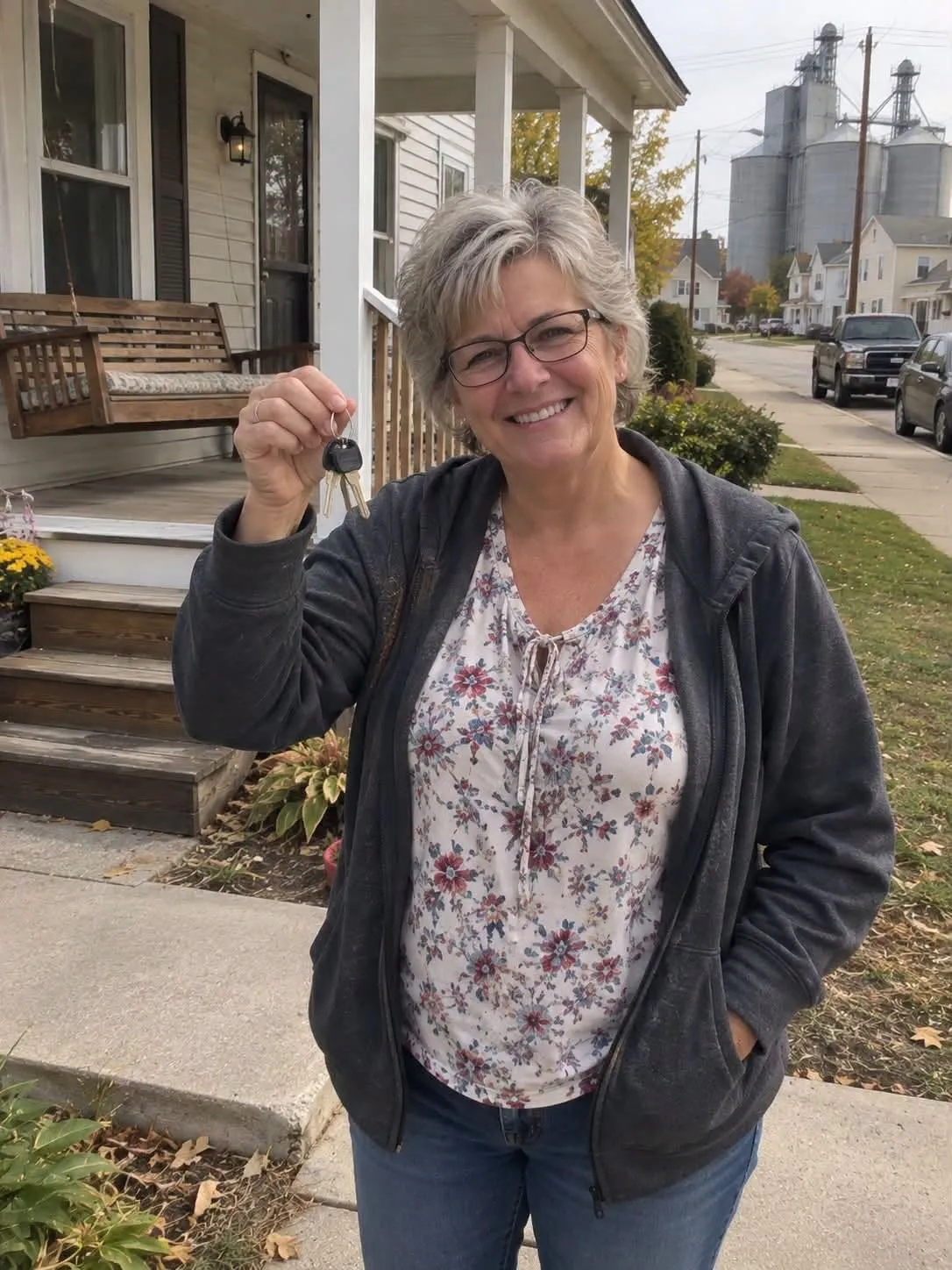
The house had white siding, a green roof, and a small porch with a swing.
Most importantly, there was only one step leading to the front door.
“My mother couldn’t manage stairs,” he explained.
Inside, the living room and kitchen shared one open space.
There was a sink beneath a large window, a four-burner stove, a refrigerator, and enough room for a table.
A heating stove stood in one corner.
Through another doorway was a bedroom, a closet, and a bathroom with a grab bar beside the tub.
That was everything.
A House Small Enough to Call Mine
From the center of the living room, I could practically see the entire house.
The kitchen window overlooked the elevator, where trucks arrived throughout harvest.
“It gets loud,” Mr. Brandt warned. “The fans run all night. And trains pass through around two and five in the morning.”
“I’ve lived in a quiet house for two years,” I replied. “A little noise might be good for me.”
He smiled.
“There’s also corn dust everywhere during harvest.”
“I’ve lived on a farm most of my life. I’m familiar with corn dust.”
Then I asked the important question.
“How much?”
“Five hundred and fifty dollars a month. You pay electricity and gas. I’ll handle the roof, furnace, and mowing.”
I calculated immediately.
My $1,640 income minus $550 rent would leave $1,090.
That was $250 more than Michelle’s arrangement would leave me.
And I wouldn’t owe anyone four days of childcare.
Two Brass Keys and a New Beginning
“It isn’t much,” Mr. Brandt said.
I looked around the little house.
“It has a door,” I answered. “I’ll take it.”
He seemed surprised.
“Don’t you want to think about it? Maybe discuss it with Michelle?”
“I’ve been thinking about this place for three weeks.”
I wrote the first month’s rent check on the hood of my Buick.
Mr. Brandt tried to waive the deposit because he’d known Dale.
However, I insisted on handling the arrangement properly.
Then he removed two brass keys from his ring.
“Front and back,” he explained.
I held them in my palm.
For the first time in my life, I’d chosen a home entirely for myself.
I’d gone from my father’s house to Dale’s employer’s farmhouse when I was nineteen.
Now, at 67, I finally held keys to a place I had chosen.
It wasn’t a grand house. But it was my decision, my space, and my door.
I turned toward the elevator so Mr. Brandt wouldn’t see the tears in my eyes.
The Secret Move
I didn’t tell Michelle immediately.
When she called on Monday, asking whether I’d decided about the basement, I said I was still thinking.
That wasn’t entirely truthful.
I was thinking about where to put my couch.
Jim Olson and his son helped me move on a Wednesday.
They backed a flatbed truck up to the farmhouse porch and insisted on carrying the heavy furniture themselves.
I brought my bed, couch, sewing machine, and Dale’s recliner.
I also brought the kitchen table we’d bought at a farm sale in 1981.
Four chairs and nine boxes completed most of my belongings.
Thirty-one years of marriage and memories had become one truckload.
The remaining household items went to Jim’s son’s family.
His wife cried when I gave her my collection of canning jars.
The First Night Alone
Jim stood in the middle of my new living room and looked around.
“Well, Judy. It’s snug.”
“It is.”
He glanced toward the porch.
“Dale would’ve fixed that uneven step before we finished unloading.”
“He certainly would have.”
We laughed.
Then we fell silent.
After they left, I hung my curtains and arranged my African violets on the kitchen windowsill.
I positioned Dale’s recliner beside the heating stove, facing the window.
That night, the grain elevator fans roared.
At two in the morning, a train passed so close that the water beside my bed trembled.
I lay awake wondering whether I’d made a terrible mistake.
By the second night, I slept until five.
And slowly, the little house began to feel like home.
My Daughter Discovered the Truth
Todd found out nine days after I moved.
He drove past the elevator on his way to work and noticed my Buick parked outside.
Through the window, he apparently saw me watering my violets.
Michelle called that evening.
“Mom. You rented a house.”
“I did.”
“From Mr. Brandt? Near the elevator?”
“That’s right.”
“You’ve been living four blocks from us for over a week!”
I took a breath.
“You’re right. I should have told you sooner. I was afraid of this conversation, and I kept putting it off.”
There was a long silence.
Then she asked the question I’d expected.
“How much are you paying?”
“Five hundred and fifty.”
The Words I Finally Had to Say
“So it’s only a $250 difference?” Michelle asked.
Her voice grew sharp.
“You’d rather give your money to a stranger than your own family?”
“Mr. Brandt isn’t a stranger,” I answered.
Then I said what I’d been carrying inside since that Saturday.
“I’d rather be your mother than your renter, Michelle.”
She became upset.
“We made a place for you!”
“I know you did, honey.”
“I even told the daycare we might take Sadie out! I thought I could start working Fridays!”
I hadn’t known any of that.
Michelle accused me of making decisions without considering her family.
I listened until she finished.
Then I spoke quietly.
“I would’ve watched those children for nothing. Gladly. But you said I’d be earning my keep.”
My throat tightened.
“Michelle, I earned my keep with you a long time ago. I don’t believe I owe anything on that.”
She hung up.
I sat at Dale’s old kitchen table until darkness covered the window.
Ten Days Without My Grandchildren
For ten days, Michelle didn’t call.
There were no pictures of Sadie with spaghetti on her forehead.
No photographs of Eli showing off his missing tooth.
No messages asking whether I wanted to come over.
Every evening, I sat on my porch swing and watched grain trucks cross the scale.
I had my own home.
I had my keys, my violets, and my freedom.
Yet I wondered whether independence had cost me something more precious.
It wasn’t the basement itself that troubled me.
I’d lived in simple places before.
It wasn’t even the $800, although that amount would’ve strained my budget.
It was the arrangement.
I Didn’t Want Love to Become a Contract
If I’d moved into that basement, every meal might have felt like something I owed.
Every Thursday I wanted to rest, I would have remembered those words.
Earning your keep.
I imagined what might happen when the children grew older and no longer needed daycare.
Would I still be useful?
Would the arrangement change?
Would my place in the household depend on how much work I could provide?
I wanted to help my daughter.
However, I didn’t want our relationship measured in dollars and hours.
Still, I missed Sadie and Eli terribly.
I would’ve traded my porch swing for five minutes with them.
Those were ten very long days.
A Shoebox Changed My Finances
During that difficult period, I stopped at Mr. Brandt’s store for sunflower seed.
He stood behind the counter surrounded by receipts, invoices, and bank statements.
His glasses rested on his forehead.
“Lois handled all this,” he muttered.
Lois, his wife, had died four years earlier.
“She did it for forty-three years. I never even asked how.”
His accountant needed the quarterly records, but Mr. Brandt couldn’t make the numbers balance.
I set down my purse.
“Do you have a ledger?”
He nodded.
“Somewhere. I haven’t been able to make it come out right for nearly a year.”
I smiled.
“Mr. Brandt, I kept books at the lumber yard for twenty-two years.”
Then I made him an offer.
“Give me that ledger, those receipts, and a pot of coffee.”
Three Afternoons of Bookkeeping
For three afternoons, I worked at the small desk behind the veterinary supplies.
I sorted invoices, checked payments, and reconciled his accounts.
Several customers had unpaid balances dating back months.
I also discovered a bank deposit recorded twice.
Most importantly, I found more than $2,000 in charge tickets that had never been billed.
When I finished, the ledger balanced to the penny.
Mr. Brandt was delighted.
That Friday evening, he came to my porch holding his cap.
“I’d like you to do the books every Friday,” he said.
“I can’t pay what the work is worth. But I could reduce your rent to four hundred dollars.”
I didn’t hesitate.
“That would be agreeable.”
He looked relieved.
“It’s not charity, Judy. You’re helping me more than you know.”
“I understand.”
And I did.
The Difference Between Being Needed and Being Used
After he left, I sat on the swing thinking about his offer.
Mr. Brandt had approached me honestly.
He explained what he needed and offered something in return.
He respected my experience.
There was no suggestion that I had to justify my existence or earn the right to belong.
He simply needed help.
And he’d asked.
My rent was now $400 a month.
More importantly, I felt useful again.
I wished Michelle had understood that she could have asked me for help just as plainly.
She might have been surprised by my answer.
The Evening My Daughter Returned
On the tenth day, I was frying potatoes when I heard a pickup door slam.
I recognized the sound immediately.
Todd’s Ford had made that distinctive noise ever since he’d backed into a mailbox.
I looked through the kitchen window.
Michelle climbed out wearing her dental-office scrubs.
Her eyes were red.
Todd came around the truck carrying a yellow legal pad.
Neither child was with them.
I turned down the stove and opened the screen door.
For a moment, nobody spoke.
Then Todd looked at me.
“Judy, I wrote that $800 figure. That was me. I want you to know.”
“All right.”
“Can we come inside?”
“Of course. But somebody’s going to have to eat these potatoes before they burn.”
Michelle gave a small, shaky laugh.
The Table That Remembered Everything
Michelle stepped inside and looked around.
She saw the couch, Dale’s recliner, and the violets above the sink.
Then she noticed the kitchen table.
She walked over and placed her hand on a dark burn mark.
She’d made that mark when she was eleven, after setting down a hot pan.
“You kept the table,” she whispered.
“Of course I did.”
I served potatoes and leftover ham.
Nobody ate very much.
Then Todd placed his legal pad in the middle of the table.
“I should’ve shown you this instead of that other paper,” he said.
“I was ashamed.”
I looked down.
It was their household budget.
And for the first time, I understood what had really happened.
The Financial Secret Behind the $800 Demand
Todd and Michelle brought home approximately $5,400 each month.
Their expenses told a different story.
The mortgage, including taxes and insurance, cost $1,180.
Todd’s truck payment was $612.
Daycare cost $1,080.
Then came groceries, utilities, and credit-card payments.
A furnace replacement the previous January had added $4,800 in debt.
The interest rate was painfully high.
At the bottom of the page, Todd had circled their total monthly expenses.
$5,710.
I did the subtraction.
“You’re short $310 every month.”
Todd nodded.
“Since June.”
A Budget Built on Overtime
Todd explained that his employer had reduced overtime hours.
For three years, he’d regularly worked an additional ten or twelve hours each week.
Eventually, the family began treating that extra income as guaranteed.
When the overtime disappeared, their expenses stayed the same.
They covered the difference with credit cards.
Todd had expected the overtime to return by fall.
It hadn’t.
“So when you needed somewhere to live,” he admitted, “I thought about putting you in the basement.”
He looked down at his hands.
“If Sadie left daycare most of the week, we’d save money. And then I thought about charging you rent.”
He paused.
“I looked up apartment prices and convinced myself $800 was fair.”
Finally, he met my eyes.
“But it wasn’t fair.”
Todd’s Confession
“I was trying to plug a hole in our budget with your Social Security check,” he admitted.
“And I knew what I was doing.”
His voice broke slightly.
“I was scared, Judy. But that doesn’t excuse it.”
Then he said something that almost made me smile.
“Dale would’ve taken me behind the machine shed.”
I shook my head.
“Dale would’ve taught you to read your pay stub first.”
Todd let out a breath.
“Then the machine shed?”
“Possibly.”
For the first time that evening, we all smiled.
I finally understood the expression I’d seen on his face when I folded that first paper.
It had been shame.
He’d known the arrangement was wrong before he ever offered it.
The Apology I Needed From Michelle
I turned toward my daughter.
“And the part about earning my keep?”
Michelle’s chin trembled.
“I’ve thought about that every night,” she whispered.
“I don’t know how to explain it without making it sound worse.”
“Try, honey.”
She wiped her eyes.
“I didn’t want to ask you for help.”
I waited.
“You and Dad never had extra money. But you always managed. You never asked anyone for anything.”
Her voice grew smaller.
“I couldn’t say, Mom, we’re drowning. We need you.”
“So you made it a business arrangement?”
She nodded.
“I thought if you paid rent and watched the kids, nobody would feel like they were begging.”
Then she began crying.
“But I heard myself say ‘earn your keep.’ And I saw your face. I knew it was wrong.”
The Lesson I’d Taught Without Realizing
I reached across the table and took her hand.
“Michelle, who taught you that asking for help was something to be ashamed of?”
She gave a sad little laugh.
“You did, Mom.”
I sat quietly.
Because she was right.
For years, I’d taken pride in managing everything without asking for assistance.
I thought that made me strong.
However, my daughter had learned that needing help meant failure.
I hadn’t intended to teach her that.
But I had.
“I was wrong about that,” I admitted.
“Sometimes asking someone for help is the most honest thing you can do.”
I told her about Mr. Brandt and his shoebox full of receipts.
Then I reached for Todd’s legal pad.
“Hand me a pencil.”
A Grandmother’s Offer, Not an Employee’s Contract
Todd looked confused.
“Judy, we didn’t come here to ask you for money.”
“I know. You came to apologize, and I’ve accepted it.”
I adjusted my reading glasses.
“But you’re sitting at a bookkeeper’s table with numbers that don’t balance.”
Todd handed me the pencil.
“Here’s what I can offer,” I said.
“Tuesdays and Thursdays. I’ll watch Sadie all day and pick Eli up after school.”
Michelle started to interrupt.
I raised one finger.
“I’m not finished.”
The children would come to my house.
I’d care for them as their grandmother, without charging anything.
However, I would keep my independence.
“If I have a doctor’s appointment, I’ll tell you ahead of time. Then you’ll arrange something else.”
I looked at both of them.
“I’m Grandma. I’m not staff.”
A Plan That Could Actually Work
I also explained that Fridays were reserved for Mr. Brandt’s bookkeeping.
That arrangement wasn’t changing.
Todd seemed surprised when I told him it had reduced my rent by $150.
Then I asked Michelle about the daycare’s part-time rates.
“Thirty-eight dollars a day for Sadie,” she said. “Twelve for Eli after school.”
Two days each week would save approximately $100 weekly.
That came to roughly $433 a month.
I crossed out their original $1,080 daycare expense.
Beside it, I wrote $647.
Their previous monthly shortfall of $310 would become a surplus of approximately $123.
Todd stared at the page.
“We’d actually be ahead?”
“A little,” I answered. “But enough to stop adding debt.”
One Rule About the Extra Money
I pointed at the furnace debt.
“Every spare dollar goes toward that credit card.”
Todd nodded.
“Not the truck. Not Christmas. The card,” I continued.
“And if your overtime returns, don’t build your budget around it again.”
“Yes, ma’am.”
Then I took off my glasses.
“One more thing.”
Both looked at me.
“I love you. And I’m not going to hold this against you.”
Michelle’s eyes filled again.
“But I won’t be spoken to that way anymore. If you need me, come to my door and ask.”
I squeezed her hand.
“You might be surprised how often I say yes.”
Michelle lowered her head onto the old kitchen table.
She cried against the same burn mark she’d made as a little girl.
Todd placed his hand gently on her back.
I got the apple pie.
They each ate two slices.
The First Tuesday at Grandma’s House
Three weeks have passed since that evening.
On the first Tuesday, Sadie arrived carrying a backpack nearly as big as she was.
She stopped at my porch.
“Grandma! You have a swing!”
“I do.”
“Is it for me?”
“It’s for whoever wants to sit on it.”
We stayed outside until her nose grew cold.
She asked about every truck driving toward the grain elevator.
I told her what they carried.
Corn.
Corn.
Beans.
More corn.
She found the whole operation fascinating.
Eli’s Run Across the Schoolyard
At three o’clock, Sadie and I walked to the school.
I stood near the flagpole with the other parents and grandparents.
When Eli came through the first-grade door, he spotted me immediately.
Then he ran.
He hadn’t run toward me like that since he was three years old.
For so long, I’d been the grandmother who visited their house and sat quietly in the corner chair.
Now, I had become somewhere they could go.
A place that belonged to me.
A place where they were always welcome.
And that made all the difference.
The First Sleepover in My Little House
A few days later, Michelle came to my door after work.
She knocked.
“Mom, Todd and I haven’t gone anywhere alone since before Sadie was born.”
I smiled.
“Would you like me to watch the children Saturday?”
She nodded.
“But you can say no.”
“I can,” I replied. “I’m not going to.”
There wasn’t a spare bedroom in my house.
There wasn’t much spare space anywhere.
So I spread quilts across the living room floor.
My mother’s handmade wedding-ring quilt went on top.
I told the children I’d built them a nest.
We ate pancakes for supper because Grandma’s house has different rules.
Then we played Old Maid until Eli realized Sadie was deliberately showing him her cards.
Afterward, I washed two sticky faces at the kitchen sink.
Outside, the elevator lights shone through the window.
The Question That Nearly Made Me Cry
I’d planned to sleep in my bedroom.
However, Sadie insisted that I stay nearby.
So I settled onto the couch while both children lay under the quilts.
“Grandma?” Sadie whispered.
“Go to sleep, sweet pea.”
“Is this your whole house?”
“Yes, sweetheart. This is all of it.”
She was quiet for a moment.
Then she said something I’ll never forget.
“I like it. I can see you from everywhere.”
I swallowed hard.
“I can see you from everywhere too.”
Eli raised his head.
“Grandma?”
“Yes, buddy?”
“Mom said you were going to live in our basement, but then you didn’t want to.”
I knew I had to answer carefully.
Why I Chose to Live Nearby Instead
“It wasn’t that I didn’t want to be with you,” I explained.
“I wanted to live near you. That’s different.”
Eli frowned.
“Why?”
I thought about it.
“If I lived in your basement, I’d always be in your house.”
He nodded.
“But now you get to come visit me. You come here because you want to.”
I reached down and gently touched his hair.
“I wanted to be somebody you’d come see on purpose.”
He considered that for a moment.
Then he smiled.
“I’d come see you on purpose, Grandma.”
My heart felt as though it might burst.
“I’d even come if you lived in the elevator,” he added.
I laughed.
“Well, I couldn’t afford the elevator.”
Eli giggled.
Then Sadie started laughing because he was laughing.
A few minutes later, they were both asleep.
The Train at Two in the Morning
I didn’t sleep much that night.
I didn’t want to.
I lay on the couch listening to my grandchildren breathe beneath my mother’s quilt.
The house was tiny.
The heating stove clicked softly.
Outside, the grain elevator fans hummed.
At two o’clock, the train came through.
The windows rattled.
Sadie sat upright, her hair sticking in every direction.
“Grandma!”
“It’s only the train, sweetheart.”
She looked toward the window.
“Is it saying goodnight?”
I smiled.
“I believe it is.”
She climbed onto the couch and curled against me.
Her feet were cold against my legs.
Before the final train car passed, she was asleep again.
What I Told My Husband That Night
I thought about Dale.
I still talk to him sometimes, silently.
That night, I imagined telling him about the little house.
You’d have fixed that porch step by now.
Then I thought about Mr. Brandt’s ledger.
The books balance, Dale.
Finally, I looked down at my sleeping granddaughter and across at Eli beneath the quilt.
I’ve got them both right here.
And I’m not earning a thing.
For the first time in a long while, I felt completely at peace.
The Knock on My Door
Michelle arrived the next morning before church.
I was making pancakes.
Both children sat at the kitchen table in their pajamas, with syrup on their hands.
Through the window, I saw her van pull up.
She walked toward the porch.
Todd had visited the previous Saturday to fix the uneven step.
He’d used a cedar shingle and Dale’s old level.
He hadn’t asked whether I wanted it repaired.
He simply saw something that needed fixing and took care of it.
The porch step was now perfectly level.
Michelle climbed that single step.
Through the screen door, she could see the children, the pancakes, and me standing at the stove.
The inside door was already open.
Yet she stopped.
And she knocked.
A Small Gesture That Meant Everything
“It’s open!” I called.
“Come in, honey. There’s plenty.”
Michelle stepped inside.
She kissed Sadie and Eli on their sticky heads.
Then she kissed me.
Without asking, she took a plate and sat in the fourth chair at our old family table.
Outside, the first grain truck of the morning rolled onto the scale.
And everything felt right.
My Little House Gave Me Something Money Couldn’t Buy
I’m 67 years old.
I have two rooms.
Two brass keys.
Two grandchildren who visit every Tuesday and Thursday.
And a shoebox of bookkeeping work every Friday.
My rent is $400 a month.
The house is small enough to see almost entirely from the middle of the living room.
I don’t have a fancy kitchen or an extra bedroom.
I hear the grain elevator every night, and the trains still shake my windows.
But I have something I never realized I needed so badly.
A home where I belong without having to prove my worth.
My daughter has learned that asking for help isn’t shameful.
My son-in-law has learned that financial problems require honesty, not unfair arrangements.
And I’ve learned that loving your family doesn’t mean surrendering your independence.
Sometimes, the kindest thing you can do is establish a boundary before resentment destroys a relationship.
Because love should never feel like rent.
And family should never make you earn the right to belong.
Now, whenever Michelle or the children want to see me, they walk up my single porch step.
They knock on my door.
And I always let them in.
Related Articles
My husband had a vasectomy yet two months later I got pregnant[s]

My Family Mocked Me for Being Poor at the Auction—Then I Bought the $12.5 Million Estate They Thought Was Theirs

Woman Loses 160 Pounds to Climb Her Late Son’s Dream Mountain – At the Summit, His Twin Pulls Out a Note Revealing the Truth!