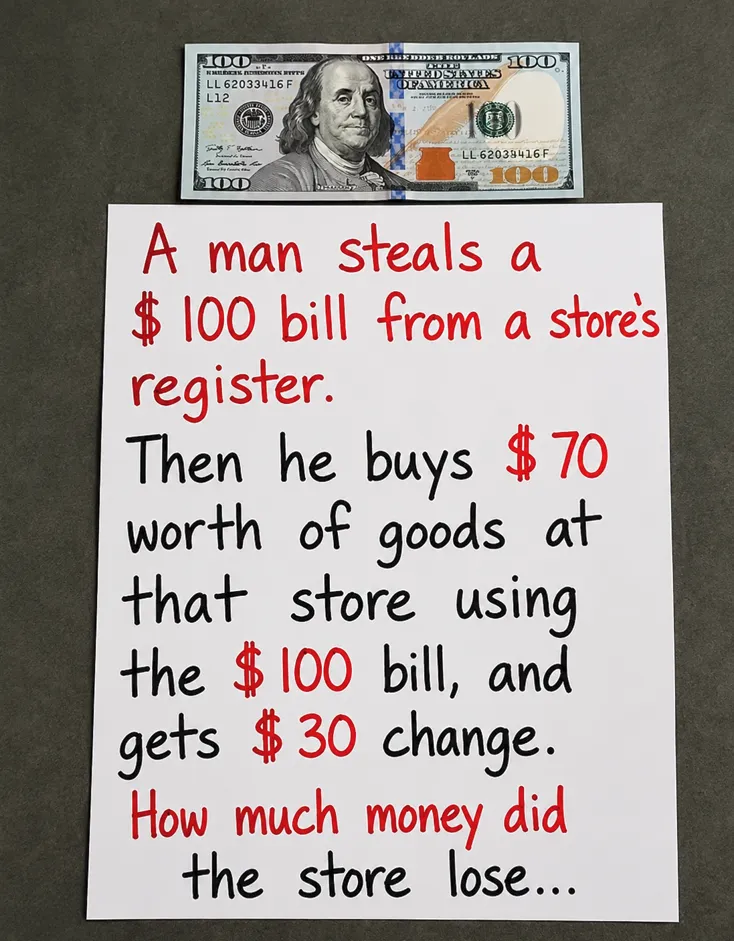
A man steals a $100 bill from a store’s cash register. Minutes later, he returns to the same store and purchases $70 worth of merchandise using the stolen bill. The cashier gives him $30 in change, and the man walks away.
At first, the situation seems straightforward. However, one simple question has left countless people scratching their heads.
How much money did the store actually lose?
Some people believe the answer is $200. Others confidently argue that the store lost $170 or $130. Meanwhile, another group insists the correct answer is only $100.
Surprisingly, the confusion doesn’t come from complicated mathematics. Instead, it comes from how people interpret the movement of money.
To understand the answer, we need to examine what happened during each transaction.
The First Transaction: $100 Disappears
Imagine a small convenience store during a busy afternoon. Customers are walking through the aisles, and the cashier is occupied with everyday transactions.
At some point, a man approaches the register and steals a $100 bill.
He leaves without purchasing anything.
At this moment, the store has suffered a clear financial loss. Its cash register contains $100 less than it should.
If the story ended here, there would be no mystery. The store would simply have lost $100.
However, the man makes an unusual decision.
Rather than keeping the money and disappearing, he returns to the same store.
This second visit changes how the loss must be calculated.
The Second Transaction: The Thief Returns
The man enters the store again and selects several products.
The merchandise has a total selling price of $70.
He approaches the cashier and hands over a $100 bill.
However, this isn’t just any bill. It’s the exact same $100 he stole earlier.
The cashier doesn’t recognize what happened and processes the purchase normally.
Since the merchandise costs $70, the cashier gives the man $30 in change.
The man leaves with the purchased items and the change.
At this point, the store has received its stolen $100 bill back. Nevertheless, it has also handed over merchandise and cash.
This is where the puzzle becomes interesting.
Why So Many People Get the Answer Wrong
One common response is that the store lost $200.
The reasoning usually follows three steps.
First, the thief stole $100.
Second, he received $70 worth of merchandise.
Third, he collected another $30 in change.
Adding these amounts produces $200.
However, this calculation contains a fundamental mistake.
It counts the original stolen $100 as a permanent loss, even though that same bill returned to the register.
The store didn’t lose the original bill and then lose another $100 independently.
Instead, the stolen money was used to complete the second transaction.
Therefore, we must account for its return before calculating the final loss.
Understanding Where the Money Went
The easiest way to solve this puzzle is to follow the cash movements.
Initially, the thief removes $100 from the register.
The store’s cash balance decreases by $100.
Later, he returns and uses the stolen bill to pay for the merchandise.
The store receives that same $100 back.
Consequently, the original cash shortage is eliminated.
However, the cashier then gives the thief $30 in change.
As a result, the register finishes with $30 less than it contained before the theft.
Meanwhile, the thief has also taken $70 worth of merchandise.
These two remaining losses determine the answer.
The important detail is that the store never receives any money belonging to the thief.
He simply returns the money he originally stole.
The Correct Answer to the $100 Riddle
Using the merchandise’s stated selling price, the calculation is straightforward.
$70 in merchandise + $30 in change = $100 total loss.
The store lost $100 in total.
The original stolen bill returned to the register, so it cannot be counted as an additional permanent loss.
Instead, the thief effectively converted that stolen money into $70 worth of goods and $30 in cash.
This explains why the answer is neither $200 nor $170.
Although the thief performed two separate actions, the store ultimately lost only the value of what he kept.
Another Simple Way to Solve the Puzzle
Consider the situation from the thief’s perspective.
At the beginning, he possesses none of the store’s money or merchandise.
After stealing the $100 bill, he temporarily possesses $100 belonging to the store.
However, he gives that bill back when purchasing the merchandise.
Therefore, he no longer possesses the stolen bill.
What does he have when he finally leaves?
He has $70 worth of merchandise and $30 in cash.
Together, these items have a stated value of $100.
This method reaches the same conclusion without requiring complicated calculations.
It also demonstrates why adding every number mentioned in a word problem can produce an incorrect answer.
Does the Store Really Lose $70 in Merchandise?
There is one important distinction worth considering.
The puzzle states that the merchandise is worth $70. Usually, this means the products have a retail selling price of $70.
However, stores often purchase inventory for less than the amount they charge customers.
For example, suppose the merchandise originally cost the store $45.
In that situation, the store’s direct loss measured at inventory cost would be $45 in products plus $30 in cash.
That would equal $75.
Nevertheless, the traditional riddle doesn’t provide the wholesale cost of the merchandise.
Therefore, the conventional answer uses the stated $70 retail value.
Under those assumptions, the total loss remains $100.
This distinction matters because a mathematical riddle and a detailed accounting calculation may measure losses differently.
Why This Simple Riddle Is So Confusing
The puzzle demonstrates how easily people can confuse money movements with actual financial losses.
When several transactions happen in sequence, it’s tempting to add every amount mentioned.
However, that approach ignores whether money was returned, transferred, or permanently removed.
In this case, the stolen bill leaves the register and later returns.
Those movements cancel each other out.
The remaining loss consists of the merchandise and the change.
Furthermore, the story creates a psychological distraction. Because the man steals money before making a purchase, readers may treat the theft and purchase as completely separate losses.
Yet both transactions involve the same $100 bill.
Recognizing that connection is the key to solving the puzzle correctly.
Final Answer: How Much Did the Store Lose?
The correct conventional answer is $100.
The thief initially stole $100 but returned that exact bill during the purchase.
He then left with $70 worth of merchandise and $30 in change.
Therefore, the store’s total loss, measured using the merchandise’s stated retail value, was $100.
The lesson is simple: when solving financial riddles, follow what actually leaves and returns.
Don’t count the same money twice.
A problem that initially appears complicated can become surprisingly easy once every transaction is accounted for.
And that is what makes the stolen $100 bill riddle such an interesting test of logical thinking.
Related Articles
Strange Dark Object Found Behind Man’s Ear Raises Important Health Questions

Gay Couple Was Shamed for Adopting a Blind Girl – 12 Years Later, Her Biological Father Offered Them Anything to Take Her Away

We Shaved Our Heads for Our Friend Battling Cancer at 13 — 17 Years Later, He Gathered Us for an Unforgettable Surprise