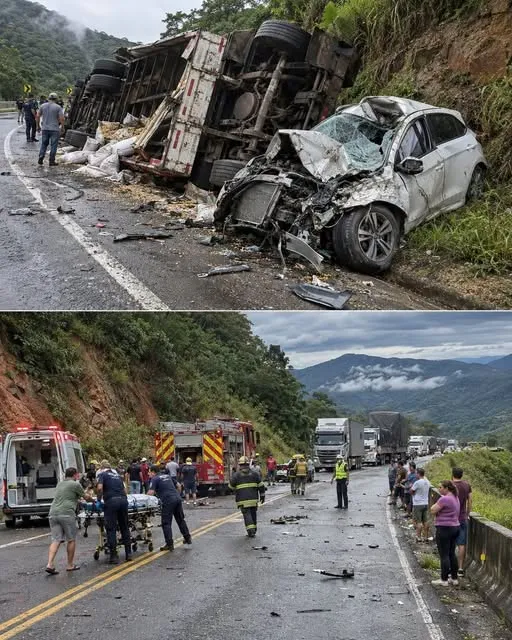
A devastating collision between a passenger van and a truck on Brazil’s BR-251 highway claimed nine lives and injured ten others. The tragedy occurred on May 13, 2025, near Grão Mogol in Minas Gerais, leaving families facing heartbreaking losses and raising serious questions about road safety.
For 17 people traveling in a passenger van through northern Minas Gerais, the journey was supposed to bring them closer to their destination.
The passengers were traveling from Brazil’s Triângulo Mineiro region toward Ceará, a northeastern state hundreds of miles away.
However, their journey ended in tragedy on a dark stretch of highway.
At approximately 9:30 p.m. on May 13, 2025, the van collided head-on with a large truck on BR-251.
Nine people lost their lives, including a four-year-old boy. Another ten people suffered injuries in the devastating collision.
What began as an ordinary long-distance journey became a tragedy that affected families across several Brazilian states.
What Happened on BR-251 That Night?
The crash occurred near the community of Barrocão, in the municipality of Grão Mogol, northern Minas Gerais.
According to reports from the Minas Gerais Fire Department, the collision happened near kilometer 446 of BR-251.
The passenger van was traveling toward Ceará, while the truck was heading in the opposite direction.
The impact forced both vehicles off the roadway and into vegetation beside the highway.
Emergency responders later described difficult conditions at the crash site.
Several occupants of the van were trapped inside the damaged vehicle, requiring specialized rescue equipment.
Unfortunately, nine passengers had already died by the time rescuers assessed the scene.
Eight Adults and a Young Child Lost Their Lives
Among those killed were eight adults and a four-year-old boy.
The victims came from different communities, including locations in Ceará, Pernambuco, and Paraíba.
Each person had their own destination, responsibilities, and relationships waiting beyond the journey.
For their families, the news brought an unimaginable loss.
The young boy’s death was particularly heartbreaking, highlighting how a single road accident can affect several generations.
Meanwhile, survivors faced an uncertain recovery as medical teams worked to treat their injuries.
Ten People Injured as Emergency Teams Responded
Authorities reported ten injured people following the collision.
Eight were traveling in the passenger van, while the remaining two were occupants of the truck.
The truck’s driver and passenger sustained relatively minor injuries and received medical attention at the scene.
However, several van passengers required urgent hospital treatment.
Emergency crews transported injured survivors to medical facilities in Francisco Sá and Montes Claros.
Some Survivors Were in Serious Condition
Initial hospital reports indicated that some patients had suffered serious injuries.
Among those receiving treatment was a 27-year-old man who required breathing assistance.
An eight-year-old girl, a 36-year-old woman, and another young adult were also among the hospitalized survivors.
Medical professionals continued assessing their conditions following the accident.
The injuries added another painful dimension to the tragedy.
While some families were mourning loved ones, others waited anxiously for updates from hospitals.
For survivors, physical recovery could also involve emotional challenges following such a traumatic experience.
Rescue Workers Faced Difficult Conditions
The accident required a coordinated emergency response involving several Brazilian agencies.
Firefighters, ambulance teams, highway police, and forensic specialists arrived to assist.
The location presented additional difficulties because the vehicles had left the road and stopped in an area with limited access.
Rescuers needed specialized equipment to reach occupants trapped inside the van.
Meanwhile, medical teams assessed injuries and organized transportation to nearby hospitals.
Multiple Emergency Services Joined the Operation
The response involved the Minas Gerais Fire Department and Brazil’s Mobile Emergency Care Service, known as SAMU.
Federal Highway Police officers also attended the scene.
Civil Police forensic teams worked to examine the collision and gather evidence.
Authorities temporarily closed BR-251 in both directions while rescue and investigative operations continued.
Traffic resumed during the early hours of May 14 after emergency teams completed their initial work.
The coordinated response demonstrated the challenges emergency personnel face when serious accidents occur far from major urban centers.
Investigators Examined How the Vehicles Collided
Following the accident, investigators began examining the circumstances surrounding the head-on collision.
Preliminary findings from the Civil Police of Minas Gerais indicated that the truck had crossed into the opposite lane.
According to those initial findings, the truck was traveling toward Montes Claros when it entered the lane occupied by the passenger van.
The vehicles subsequently collided, leaving extensive damage.
However, investigators still needed to establish the complete sequence of events and determine any legal responsibility.
Why the Investigation Matters
Determining the cause of a serious highway collision involves examining several possible contributing factors.
Investigators may consider vehicle movements, road conditions, driver behavior, visibility, and mechanical evidence.
Importantly, a preliminary finding does not necessarily establish every factor involved in an accident.
The distinction matters because accurate investigations help authorities identify problems and recommend preventive measures.
In this case, the investigation also brought attention to another concern involving the passenger van.
Passenger Van Lacked Interstate Transport Authorization
Brazil’s National Land Transport Agency, known as ANTT, confirmed that the van did not have authorization for interstate passenger transportation.
The agency’s statement raised questions about regulatory compliance and oversight of long-distance passenger services.
In Brazil, companies transporting passengers between states must meet applicable licensing and regulatory requirements.
These rules help authorities monitor commercial operations and enforce transportation standards.
What the Missing Authorization Means
The absence of authorization represented a regulatory concern separate from the immediate circumstances of the collision.
It did not, by itself, establish what caused the crash.
Nevertheless, the finding highlighted the importance of checking whether commercial passenger transportation services operate legally.
For travelers, choosing an authorized service can provide greater confidence that the operator falls under the relevant regulatory framework.
For authorities, the case reinforced the importance of effective inspections and transport oversight.
Why BR-251 Is an Important Highway in Brazil
Brazil depends heavily on road transportation to connect distant regions.
Many communities rely on highways for access to employment, education, healthcare, and family connections.
BR-251 forms part of this extensive transportation network.
In northern Minas Gerais, the road serves passenger vehicles, buses, vans, and commercial trucks.
These different vehicles frequently share the same highway while traveling considerable distances.
However, the combination of heavy freight traffic and smaller passenger vehicles creates important safety challenges.
Head-On Collisions Can Have Severe Consequences
Head-on crashes involving trucks and smaller vehicles are particularly dangerous because of the forces involved.
Large commercial trucks carry significantly more mass than passenger vans.
Consequently, the smaller vehicle may sustain extensive damage during a direct collision.
The severity of an accident can depend on vehicle speeds, impact angles, safety equipment, and other conditions.
Road design also plays an important role.
Physical barriers between opposing lanes can help prevent certain types of cross-lane collisions.
Additionally, clear road markings, effective lighting, and appropriate speed management can reduce risks.
These are general safety considerations, not confirmed causes of the BR-251 accident.
A Journey That Never Reached Its Destination
Long-distance travel is part of everyday life for many Brazilian families.
People cross state borders to visit relatives, return home, seek employment, or attend important family events.
For the passengers traveling toward Ceará, the trip was another journey along a route connecting distant communities.
Yet the events of May 13 changed everything.
Nine passengers never reached their destinations.
The injured faced hospital treatment, while relatives waited for information about those involved.
Families Faced an Unexpected Loss
Behind every reported fatality is a person whose absence changes the lives of others.
The loss of a parent, child, sibling, or friend can leave families struggling with grief and unanswered questions.
In tragedies involving travelers from different communities, the emotional impact often extends across several towns and states.
The BR-251 crash was therefore more than a local traffic incident.
It affected families whose lives were connected by a journey that ended unexpectedly.
Although the names and personal histories of every victim were not included in the initial reports, the scale of the loss was unmistakable.
What Can Be Learned From the BR-251 Tragedy?
The collision highlighted several important road safety issues.
First, commercial transportation operators must follow applicable licensing and safety requirements.
Second, highway infrastructure must account for the risks created when heavy trucks and passenger vehicles share the same roads.
Furthermore, effective enforcement and timely emergency responses remain essential.
Individual drivers also play a role through responsible decisions and attention to changing road conditions.
Prevention Requires More Than One Solution
Improving road safety requires cooperation among government agencies, transport operators, road engineers, and motorists.
Authorities can examine collision patterns and identify locations where infrastructure improvements may reduce risks.
Transport regulators can strengthen oversight of passenger services.
Meanwhile, operators can prioritize vehicle maintenance, driver training, and compliance with applicable rules.
No single measure can prevent every accident.
However, combining effective infrastructure, responsible driving, and consistent enforcement can make highways safer.
Remembering the Nine Victims
The BR-251 collision remains a painful reminder of how quickly an ordinary journey can become a tragedy.
On May 13, 2025, nine people lost their lives on a highway in northern Minas Gerais.
Among them was a four-year-old boy whose life had barely begun.
Ten others were injured, and families across Brazil were left dealing with the consequences.
The investigation and regulatory findings raised important questions about transportation safety.
Yet beyond those questions lies the human cost.
The victims were people traveling toward destinations that mattered to them.
Their deaths underline the importance of continued efforts to prevent serious highway accidents and protect those who depend on Brazil’s roads.
For the families affected, the tragedy will always be remembered for the people who never came home.
Related Articles

My husband had a vasectomy yet two months later I got pregnant[s]

My Family Mocked Me for Being Poor at the Auction—Then I Bought the $12.5 Million Estate They Thought Was Theirs

Woman Loses 160 Pounds to Climb Her Late Son’s Dream Mountain – At the Summit, His Twin Pulls Out a Note Revealing the Truth!