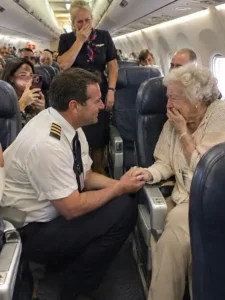
A wealthy woman filled her shopping cart with every discounted Thanksgiving turkey in a grocery store. When an elderly grandmother begged her to leave just one for her sick grandson, she refused. The woman even reminded everyone that her family was one of the richest in town. But minutes later, an unexpected announcement came over the store’s speakers. When she recognized the voice, her face turned pale. What happened next revealed a secret her family had carried for more than fifty years.
A Thanksgiving Shopping Trip Nobody Would Forget
It was 6:40 p.m. on the Tuesday before Thanksgiving.
The Shop-Rite on Commerce Street in Millbrook, Pennsylvania, was crowded with families preparing for the holiday.
Shopping carts filled the aisles. Children complained about waiting, while cashiers struggled to keep up with the evening rush.
I had just finished a twelve-hour shift at Millbrook General Hospital.
My name is Kara Lindell, and I work as a respiratory therapist.
I was exhausted.
My feet hurt, my back ached, and all I wanted was to buy a few groceries before heading home.
Milk, eggs, and frozen pierogies.
Nothing complicated.
However, as I reached for the refrigerator door, I heard a trembling voice behind me.
“Please, ma’am. I only need one.”
Something about the desperation in those words made me turn around.
Near the refrigerated meat section, two women stood beside a nearly empty freezer.
One had a shopping cart overflowing with frozen turkeys.
The other carried a small plastic basket.
And the difference between them was impossible to ignore.
The Woman Who Took Every Discounted Turkey
The woman with the overflowing cart looked to be around fifty.
She wore an expensive camel-colored coat, pearl earrings, and designer heels.
Her blonde hair was perfectly styled.
A leather handbag hung from her arm.
I recognized her immediately.
Her name was Beatrice Pemberton.
Almost everyone in Millbrook knew the Pemberton family.
They owned automobile dealerships, commercial properties, and several apartment buildings.
Their name appeared on a hospital wing, a downtown building, and numerous charitable donations.
Beatrice managed the family’s foundation and property interests.
She frequently appeared in newspaper photographs at fundraising events.
However, that evening, she wasn’t organizing a charity event.
She was collecting discounted turkeys.
Every single one.
Thirteen Turkeys and One Empty Freezer
The store had offered thirteen frozen turkeys for $9.99 each.
Their regular prices were approximately $38 to $40.
For struggling families, the discount made a significant difference.
Some customers depended on these sales to prepare Thanksgiving dinner.
Others bought the affordable turkeys for relatives, neighbors, or community meals.
Yet Beatrice had loaded twelve into her cart.
Only one remained.
Beside her stood an elderly woman wearing a faded blue coat.
Her gray hair was pulled into a simple bun.
She held a red shopping basket containing crackers, chicken broth, carrots, an onion, egg noodles, and cold medicine.
Then she reached toward the final turkey.
But Beatrice grabbed it first.
The Grandmother Who Only Wanted One Turkey
“Ma’am, please,” the elderly woman said.
Beatrice continued arranging the turkeys in her cart.
“You already have twelve. Could you leave me just one?”
“Thirteen,” Beatrice corrected.
The older woman lowered her eyes.
“My grandson is sick.”
For the first time, I looked closely at her.
Her hands were trembling.
Her coat was worn, and one button was missing.
She explained that she was raising her nine-year-old grandson, Micah, alone.
He had been suffering from the flu since Saturday.
For two days, he had barely eaten.
“I wanted to make my mother’s turkey soup,” she explained.
“It’s the only thing he asks for when he’s sick.”
She glanced toward the regular-priced turkeys.
“But those cost almost forty dollars. I don’t have that much until the first of the month.”
Beatrice barely looked at her.
“Then buy chicken.”
“The chicken isn’t on sale either,” the grandmother replied.
She explained that a whole chicken cost eleven dollars.
More importantly, Micah wanted the familiar soup his grandmother had always made.
Still, Beatrice refused.
Ten Dollars That Meant Everything
The elderly woman opened her small purse.
Its broken clasp was held together with a rubber band.
After searching inside, she removed a folded ten-dollar bill.
She held it toward Beatrice.
“I can give you the money right now.”
Her voice was barely audible.
“You won’t even have to wait in line again.”
Beatrice laughed.
Not loudly.
Just enough to make the humiliation worse.
“If ten dollars is such a problem, perhaps turkey soup shouldn’t be your priority.”
The aisle went quiet.
Several shoppers stopped moving.
A young father carrying a baby looked toward the women.
A teenager in a football jacket stood beside the freezer.
Two older shoppers exchanged uncomfortable glances.
I couldn’t remain silent.
“Are you seriously taking every turkey?” I asked.
Beatrice turned toward me.
Her eyes moved over my hospital scrubs and identification badge.
“Absolutely.”
Then she smiled.
“And I’m not giving one away.”
The grandmother slowly lowered her hand.
She was still holding the ten-dollar bill.
“My grandson hasn’t eaten properly in two days,” she whispered.
Beatrice pushed her cart forward.
“That’s not my problem.”
The Words That Silenced the Grocery Store
I had spent the previous twelve hours helping children with respiratory illnesses.
I’d watched frightened parents sit beside hospital beds.
I’d seen grandparents hold small hands while waiting for medical updates.
Therefore, hearing Beatrice dismiss a sick child so casually was difficult.
But she wasn’t finished.
Before leaving the aisle, she turned toward the gathering shoppers.
“And before anyone makes a scene, remember who my family is.”
Then she started pushing her cart away.
Thirteen frozen turkeys made it unusually heavy.
One wheel wobbled, forcing her to lean against the handle.
Her expensive heels clicked against the floor.
She had barely reached the end of the aisle when the store’s announcement system crackled.
A familiar two-note chime sounded.
“Attention, shoppers.”
The voice belonged to an older man.
It was deep, slow, and unmistakably serious.
Beatrice continued walking.
Then the voice spoke again.
“Beatrice.”
She stopped immediately.
Her cart struck a display of Thanksgiving stuffing.
Boxes scattered across the floor.
But she didn’t move to pick them up.
Instead, she stared toward the ceiling speakers.
An Unexpected Voice Over the Speakers
“You just reminded everyone to remember who your family is,” the man announced.
Beatrice tightened her grip on the shopping cart.
Her face began losing color.
The voice continued.
“That’s actually an excellent idea.”
People turned toward her.
She whispered something I couldn’t hear.
Then came another instruction.
“Stay exactly where you are, Beatrice.”
“Why?” she shouted.
Her voice echoed through the store.
The man answered calmly.
“Because there’s something you need to see.”
Beatrice turned toward the front entrance.
I followed her gaze.
An elderly man was approaching with a wooden cane.
He wore a gray wool overcoat and a tweed cap.
Beside him walked the store manager, Ron.
Ron carried a portable microphone connected to the announcement system.
The elderly man moved slowly.
Yet everyone seemed to recognize him.
Shoppers stepped aside without being asked.
And when I saw his face, I understood why Beatrice looked terrified.
The Man Everyone in Millbrook Recognized
The man was Elias J. Pemberton.
Beatrice’s father.
He had founded the businesses that made the family wealthy.
His name appeared on the hospital wing where I worked.
He was also known for supporting community projects and local charities.
Elias approached the meat section.
Then he stopped beside his daughter’s shopping cart.
He looked at the thirteen discounted turkeys.
For several seconds, he said nothing.
Next, he turned toward the elderly grandmother.
She stood beside the empty freezer, holding her small basket.
The ten-dollar bill remained in her hand.
When Elias saw her face, his expression changed.
He took a step closer.
Then he whispered a name.
“Hattie?”
The grandmother looked up.
Her eyes widened.
She stared at him as though she were seeing someone from another lifetime.
“Eli?”
Elias removed his cap.
And suddenly, the situation was no longer about thirteen turkeys.
It was about something that had happened more than fifty years earlier.
How Elias Learned What His Daughter Had Done
Later that evening, Ron explained how everything began.
Elias visited the supermarket every Tuesday.
He had maintained that routine for eleven years, ever since his wife died.
He usually arrived around 6:30 p.m.
He purchased a rotisserie chicken, rye bread, chocolate milk, and hard candies.
Before shopping, he often stopped by Ron’s office.
The two men had known each other for years.
Ron’s father had worked at Elias’s automobile dealership for more than three decades.
That evening, Elias was sitting in the manager’s office when he noticed something on a security monitor.
His daughter was standing beside a cart full of turkeys.
Nearby, an elderly woman was pleading with her.
Elias asked Ron to turn up the audio.
They listened to the conversation.
He heard the grandmother explain that her grandson was sick.
He heard Beatrice refuse to leave one turkey.
And he heard his daughter remind everyone of her family’s wealth and influence.
Then Elias placed his coffee cup down.
“Ron,” he said quietly, “where’s your microphone?”
A Reunion Fifty-Four Years in the Making
Back in the aisle, Elias approached the grandmother.
“Hattie Gaines,” he said.
His voice trembled.
“Eli Pemberton,” she replied.
For a moment, neither seemed able to believe what was happening.
“How long has it been?” Elias asked.
Hattie thought for a moment.
“Fifty-four years. Since Lula’s closed.”
Elias looked at her basket.
He noticed the broth, vegetables, and egg noodles.
Then he asked an unusual question.
“You’re making the soup?”
Hattie’s eyes filled with tears.
“For my grandson. Micah. He’s nine.”
“Your mother’s recipe?”
She nodded.
“Mama’s turkey soup.”
Elias closed his eyes.
When he opened them again, he turned toward Beatrice.
“Come here.”
“Daddy, please,” she whispered.
“Come here, Beatrice.”
She slowly approached.
Her heels clicked against the floor.
The other shoppers watched in silence.
Elias pointed toward Hattie.
“Do you know who this woman is?”
Beatrice shook her head.
“No, Daddy.”
He looked at his daughter.
“Then it’s time you learned.”
The Secret Behind the Pemberton Family Fortune
Elias turned toward the gathered shoppers.
“My daughter reminded everyone to remember who our family is.”
He paused.
“So I’m going to explain where our family came from.”
He began describing his life in 1970.
At twenty-six, he had returned from Vietnam after serving two tours.
His parents were gone.
His childhood home had been sold because of unpaid taxes.
He had approximately four hundred dollars and a dream of starting a used-car business.
He rented a small gravel lot along Route 422.
Then he purchased three inexpensive cars at an auction.
A Ford Falcon.
A Chevrolet Bel Air.
And an old Rambler that barely ran.
Unfortunately, he spent almost everything getting the business started.
He couldn’t afford an apartment.
Instead, he slept on a cot inside a small office trailer.
The Winter That Nearly Ended His Dream
January 1971 brought bitterly cold weather.
The pipes in Elias’s trailer froze.
His heater stopped working.
Meanwhile, he developed a serious illness.
He coughed constantly and struggled to stay warm.
Business was equally difficult.
He hadn’t sold a car in three months.
Eventually, he had only eleven dollars remaining.
To survive, he visited a small restaurant called Lula’s Diner.
Every evening, he ordered the cheapest soup on the menu.
Split pea soup.
Thirty-five cents.
But a young waitress noticed him.
Her name was Hattie.
She was around nineteen and had recently moved from Georgia.
Every evening, she brought Elias a different soup.
Turkey soup.
When he questioned the change, she told him it cost the same.
What Elias didn’t realize was that the soup wasn’t even on the restaurant’s menu.
Hattie was making it herself.
The Young Waitress Who Saved His Life
Hattie prepared the soup in her tiny apartment above a laundromat.
She used her mother’s recipe.
Every evening, she carried it to work in a glass jar.
Then she warmed it before serving Elias.
For six weeks, she continued bringing him homemade soup.
She never charged more than thirty-five cents.
But one winter evening, Elias didn’t appear.
He missed the following evening too.
Hattie became concerned.
On the third night, she finished her shift and walked approximately two miles through the freezing snow.
She went to Elias’s car lot.
When nobody answered the trailer door, she went inside.
She found him lying on his cot.
He was seriously ill.
His fever was dangerously high.
Hattie had brought another jar of soup.
She kept it inside her coat to protect it from the cold.
Then she sat beside Elias and helped him eat.
He was too weak to hold the spoon himself.
Afterward, she found a telephone and contacted her pastor.
Together, they arranged to get Elias to the hospital.
Doctors later told him that another night without medical treatment could have been fatal.
The Kindness He Never Forgot
Elias remained hospitalized for two weeks.
Every day, Hattie visited him after work.
And every day, she brought another jar of soup.
When he recovered, he returned to his small car lot.
The following week, he sold his first vehicle.
Soon afterward, he sold another.
He reinvested the money.
By the end of 1971, he had eight cars available for sale.
In 1975, he acquired a Ford dealership.
Five years later, he added Chevrolet.
His businesses continued growing.
Eventually, the Pemberton name appeared throughout Millbrook.
But standing inside the supermarket, Elias reminded everyone where his success began.
“Everything my family owns started because a young waitress cared about a stranger.”
He turned toward Hattie.
“She walked two miles through the snow to help a man who couldn’t afford a doctor.”
Then he faced his daughter.
“That’s the foundation of our family, Beatrice.”
The Lesson His Daughter Had Refused to Hear
Beatrice was crying.
“Daddy, I didn’t know.”
Elias shook his head.
“I told you.”
He reminded her that he’d shared the story when she was a child.
He had repeated it when she was twelve and sixteen.
He even mentioned Hattie during his speech at Beatrice’s wedding.
But she had never truly listened.
To Beatrice, the story had always seemed like another memory from her father’s difficult childhood.
She understood the family’s wealth.
She knew about the dealerships and properties.
Yet she had overlooked the kindness that helped make everything possible.
“You thought our name meant money,” Elias said.
He glanced at Hattie.
“It never started with money.”
Then he pointed toward the grandmother’s basket.
“It started with a jar of soup.”
Why Elias Had Never Found Hattie Again
After recovering from his illness, Elias had tried to find the young waitress.
But Lula’s Diner closed in 1972.
The building changed ownership.
Hattie disappeared from his life.
He didn’t know her last name.
All he remembered was the name on her waitress badge.
Hattie.
Now, fifty-four years later, she stood before him.
Elias asked where she had gone.
She explained that she married Leroy Gaines in 1972.
They moved to Scranton because of his work.
After Leroy died, Hattie eventually returned to Millbrook in 1998.
She had seen Elias’s name on buildings and businesses throughout town.
But she never approached him.
“Why didn’t you find me?” Elias asked.
Hattie smiled sadly.
“What would I have said? Remember the girl who made you soup?”
She looked down.
“You were a successful businessman. I was a widow cleaning offices at night.”
She didn’t want him to think she was asking for money.
Elias stared at her.
“Hattie, I’ve been looking for you for fifty-four years.”
The Truth About the Thirteen Turkeys
Then Elias turned toward his daughter’s shopping cart.
“Beatrice, why do you need thirteen turkeys?”
She lowered her head.
“For the foundation.”
“What foundation?”
“The Thanksgiving turkey drive.”
The Pemberton Family Foundation planned to distribute food at the community center.
A newspaper photographer was expected to attend.
Elias looked at the discounted turkeys.
“So you purchased every turkey meant for families trying to save money?”
Beatrice nodded.
“The budget was tight.”
She explained that the annual charity gala had cost more than expected.
Therefore, she wanted to reduce expenses for the Thanksgiving giveaway.
Elias stared at her.
“You were buying discounted turkeys to donate to families in need?”
“Yes.”
“And when a family in need stood beside you, asking for one, you refused?”
Beatrice couldn’t answer.
He continued.
“You were going to give that turkey away in front of a photographer.”
Then he pointed toward Hattie.
“But you wouldn’t give it to someone who needed it right now.”
Beatrice began sobbing.
For the first time, she seemed to understand what she had done.
The Announcement That Changed Thanksgiving
Elias turned toward Ron, the store manager.
“How many regular turkeys do you have in the freezer?”
Ron thought for a moment.
“About eighty.”
“Bring them out.”
Ron looked confused.
“All of them?”
“Every one.”
Elias paused.
“Put them in the discount section.”
“At $9.99?”
Elias shook his head.
“No. Free.”
The shoppers fell silent.
“One turkey per family. Charge them to my account.”
Then he addressed everyone.
“Anyone in Millbrook who needs a turkey for Thanksgiving can take one.”
Applause spread through the store.
But Elias wasn’t finished.
He looked directly at Beatrice.
“There’s one rule.”
She wiped her face.
“One per family.”
Then he reached into her shopping cart.
He removed the turkey she had taken from Hattie.
And he placed it in his daughter’s arms.
An Apology Money Couldn’t Buy
“Take this to Mrs. Gaines,” Elias instructed.
Beatrice hesitated.
“You will carry it yourself.”
She held the frozen turkey against her expensive coat.
Then she walked toward Hattie.
Her hands were shaking.
“I’m sorry,” she whispered.
Hattie watched her quietly.
“I’m sorry for what I said about your grandson.”
Beatrice struggled to continue.
“I shouldn’t have treated you that way.”
Hattie didn’t immediately accept the turkey.
Instead, she asked a question.
“Would you still be sorry if you didn’t know who I was?”
Beatrice looked confused.
Hattie continued.
“You know I helped your father fifty-four years ago.”
She gestured toward her basket.
“But when you first saw me, I was only an old woman with ten dollars.”
Beatrice lowered her eyes.
“Would you have apologized if your father hadn’t recognized me?”
There was no answer.
And that silence said more than any explanation could.
Finally, Hattie accepted the turkey.
Then she offered Beatrice the ten-dollar bill.
“I said I would pay.”
Elias tried to refuse.
But Hattie insisted.
She reminded him that he had always paid thirty-five cents for the soup she brought him.
Even when she wanted to give it away.
Elias laughed.
“You haven’t changed.”
Hattie smiled.
“Neither have you.”
The Hospital Visit Nobody Expected
After the confrontation, I offered Hattie a ride home.
She had planned to take the bus.
Carrying a heavy turkey and several groceries would have been difficult.
When she noticed my hospital uniform, she asked about my work.
I explained that I was a respiratory therapist.
Her expression changed.
“Micah’s breathing hasn’t been good today.”
She hesitated.
“He’s been wheezing.”
I became concerned.
“Has he seen a doctor?”
She shook her head.
I offered to accompany her home and help assess whether he needed urgent medical care.
Elias insisted on coming too.
We drove to Hattie’s apartment on Third Street.
It was above a laundromat.
Surprisingly, it was the same building where she had lived in 1971.
The same place where she once prepared soup for Elias.
When we entered, Micah was lying on the couch beneath a Spider-Man blanket.
He looked exhausted.
His breathing was fast and difficult.
I could hear wheezing before I reached him.
A Sick Little Boy Needed Immediate Help
I knelt beside Micah.
“Hello, buddy. My name is Kara.”
He looked toward me.
“Can I listen to your breathing?”
He nodded.
I used the stethoscope I carried in my work bag.
What I heard concerned me.
His breathing was shallow.
There were abnormal sounds in both lungs.
His lips also appeared slightly blue.
I checked his oxygen saturation with a portable pulse oximeter.
The reading was 89%.
That was dangerously low for a child.
“Mrs. Gaines, he needs emergency medical attention.”
Hattie covered her mouth.
“But it’s just the flu.”
“I’m concerned he may have developed pneumonia.”
Elias looked toward the boy.
The word seemed to affect him deeply.
Pneumonia.
The same illness that had nearly taken his life decades earlier.
He immediately arranged transportation to the hospital.
His driver helped carry Micah downstairs.
Hattie followed with the boy’s blanket.
Elias walked behind them.
Before leaving, he looked toward Hattie’s small kitchen.
“When he’s better, I’m coming back for that soup.”
Hattie smiled.
“Then you’ll have to help me make it.”
“I will.”
A Second Life Changed by the Same Family
Micah arrived at Millbrook General that evening.
Doctors examined him and ordered further testing.
They confirmed that he had bacterial pneumonia alongside influenza A.
Both lungs were affected.
He needed oxygen, intravenous antibiotics, and fluids.
Fortunately, his condition began improving with treatment.
By midnight, his oxygen saturation had risen.
Later that night, he was breathing more comfortably.
Hattie stayed beside his bed.
She held his hand while he slept.
Elias remained in the room too.
He sat quietly in a chair with his cane resting across his knees.
At approximately three in the morning, I returned to check on Micah.
I suggested that Elias go home and rest.
He shook his head.
“Fifty-four years ago, I was lying in a hospital bed.”
He looked toward Hattie.
“She sat beside me every day.”
Then he turned back toward Micah.
“I’m not leaving.”
The Woman Who Returned With a Glass Jar
At seven the following morning, Beatrice arrived at the hospital.
But she looked completely different.
Her expensive coat was gone.
So were her designer heels, pearl earrings, and carefully applied makeup.
She wore jeans, sneakers, and a sweatshirt.
Her eyes were swollen from crying.
In her hands, she carried a glass jar.
Hattie looked up when Beatrice entered.
“Mrs. Gaines, may I come in?”
After a moment, Hattie nodded.
Beatrice approached Micah’s bed.
Then she held out the jar.
Inside was homemade turkey soup.
She explained that she had spent most of the night preparing it.
She had never cooked a turkey before.
In fact, she rarely cooked anything.
Her family had always employed someone to prepare meals.
But after leaving the supermarket, she went home and searched for recipes online.
She found a video showing how to make turkey soup.
Then she spent hours trying to prepare it herself.
“I don’t know if it’s anything like your mother’s recipe,” she admitted.
“But I wanted to try.”
The Childhood Memory Beatrice Had Never Shared
Hattie studied the jar.
Then she asked a simple question.
“Why?”
Beatrice looked toward Micah.
“When I was nine, I had pneumonia too.”
Elias became still.
Beatrice continued.
She remembered spending a week in the hospital.
Her father had been attending an automobile convention in Detroit.
Her mother was visiting relatives in Florida.
A nanny stayed with her during the day.
But the nanny went home every evening.
Beatrice remembered feeling terribly alone.
“Nobody brought me soup,” she whispered.
“Nobody stayed beside my bed.”
Tears filled her eyes.
She explained that she had heard her father’s story many times.
But she had never understood what made Hattie’s kindness so important.
The previous evening, something finally changed.
She realized that Hattie had cared for a sick stranger when nobody else noticed him.
And Beatrice had refused to help a grandmother trying to care for her own grandson.
“I became the kind of person who would have ignored my father when he needed help.”
She looked down at the jar.
“I don’t want to be that person anymore.”
The Soup That Finally Brought Them Together
Hattie accepted the jar.
She opened the lid and smelled the soup.
Then she frowned.
“Too much salt.”
Beatrice looked embarrassed.
“I wasn’t sure how much to use.”
Hattie examined it again.
“And the noodles are overcooked.”
“I didn’t know when to add them.”
“You put them in near the end.”
Beatrice nodded.
Hattie continued examining the soup.
Then she looked up.
“Did you really stay awake making this?”
“Yes, ma’am.”
For the first time, Hattie smiled.
“Then it’s good soup.”
She placed the jar beside Micah’s bed.
“When he wakes up, I’ll give him some.”
Then she pulled out a chair.
“Sit down, honey. You look exhausted.”
Beatrice sat beside her.
For a long time, neither woman spoke.
Across the room, Elias watched quietly.
He didn’t need to say anything.
A Little Boy’s Unexpected Request
Micah woke later that morning.
He looked around the hospital room.
Then he noticed Beatrice.
“Grandma, who’s that?”
Hattie smiled.
“That’s a friend. She made you soup.”
Micah looked toward the jar.
“Is it your soup?”
“No, sweetheart. It’s hers.”
Hattie paused.
“It’s a little salty.”
Beatrice covered her face.
Micah asked whether he could taste it.
Hattie poured a small amount into a paper cup.
He took a sip.
Then he made a face.
“It is salty.”
Beatrice laughed nervously.
But Micah took another sip.
Then another.
“It’s still good,” he said.
When he finished, he looked at Beatrice.
“Can you make it again when I go home?”
She smiled through her tears.
“Of course.”
“But less salty?”
Everyone laughed.
Beatrice nodded.
“If your grandmother teaches me.”
Hattie agreed.
Every Sunday afternoon.
At two o’clock.
In her little kitchen above the laundromat.
Then she looked toward Elias.
“You can come too.”
He smiled.
And for the first time in decades, the three of them had something to look forward to together.
One Year Later, Everything Had Changed
Micah remained hospitalized for six days.
Then he returned home.
A year later, he was ten years old and playing Little League baseball.
His grandmother continued making her famous soup.
But the events at the supermarket had changed more than one family’s Thanksgiving.
Someone had recorded the confrontation.
The video spread online.
By Thanksgiving morning, millions of people had reportedly watched it.
Many criticized Beatrice’s behavior.
Others praised Elias for reminding his daughter what generosity should mean.
However, Beatrice didn’t disappear from public life.
Instead, she began changing how she lived.
A Thanksgiving Donation Without Cameras
The Pemberton Family Foundation continued its annual Thanksgiving food drive.
But this time, Beatrice wasn’t posing beside a banner.
Hattie stood at the front.
The foundation distributed four hundred turkeys.
They were purchased at regular price.
And Beatrice paid the $16,000 expense personally.
She didn’t use the foundation’s budget.
For once, the donation wasn’t about appearing generous in a newspaper photograph.
It was about helping people who needed food.
But that was only the beginning.
The Old Diner That Became Something Special
The following January, Elias purchased an old building on Second Street.
It had once housed Lula’s Diner.
The same restaurant where Hattie had worked in 1971.
Over the years, the building had served several purposes.
Eventually, it stood empty.
Elias decided to restore it.
He brought back the counter, stools, booths, and black-and-white floor tiles.
By May, the building reopened.
But it wasn’t an ordinary restaurant.
It was a community kitchen.
And its name was Hattie’s.
Every evening, from five until nine, anyone could come inside for a free meal.
There were no complicated forms.
No questions about income.
No requirement to explain why someone needed food.
The kitchen served one specialty.
Turkey soup.
Prepared from Hattie’s mother’s recipe.
Beatrice Found a Different Purpose
Hattie helped oversee the kitchen.
She sat behind the counter and supervised the cooks.
Whenever the soup needed less salt, she made sure everyone knew.
Beatrice volunteered regularly.
She worked on Sundays and Wednesdays.
Instead of expensive designer clothing, she wore comfortable shoes and practical clothes.
She chopped vegetables.
She washed dishes.
And she learned exactly when to add the noodles.
Eventually, she also stepped down from the hospital board.
She wanted to spend more time volunteering with children.
At Millbrook General, she began visiting pediatric patients whose parents couldn’t always remain beside them.
Sometimes she sat quietly.
Sometimes she held a child’s hand.
And sometimes she brought homemade soup.
I saw her there occasionally during my shifts.
She wasn’t the same woman who had filled her shopping cart with thirteen turkeys.
At least, she was trying very hard not to be.
The New Rule at the Supermarket
The following Thanksgiving, I returned to the Shop-Rite after work.
I needed milk, eggs, and pierogies.
Almost exactly what I’d planned to buy the previous year.
As I walked past the refrigerated meat section, I noticed something different.
A permanent sign hung above the turkey freezer.
It explained that families who needed a turkey could take one free of charge.
The Pemberton family covered the cost.
But the final instruction was the most important.
TAKE ONE. LEAVE THE REST.
Beneath it were two words.
HATTIE’S RULE.
I watched an elderly man approach the freezer.
He selected one turkey.
Then he read the sign and walked away.
A young mother carrying a baby came next.
She took one too.
Then a teenage boy approached.
He looked familiar.
I thought he might have been the same teenager who witnessed the confrontation the previous year.
He selected a turkey.
Then he reached into his pocket.
He removed a folded ten-dollar bill.
Instead of keeping it, he tucked it beneath the sign.
And walked away.
I stood there for a long moment.
Thinking about how far one small act of kindness could travel.
The Story Behind Hattie’s Mother’s Soup
Some weeks earlier, Hattie had told me why her mother always made turkey soup.
The tradition began during the Great Depression.
Her mother was only nine when her father lost his job at a cotton mill in Georgia.
The family struggled to find enough food.
Then, one Thanksgiving, a woman from their church left a turkey on the porch.
She didn’t ask for payment.
She didn’t wait for thanks.
She simply left the food and walked away.
Hattie’s grandmother used that turkey to feed her family for nearly two weeks.
She prepared soup, stretching every ingredient as far as possible.
Years later, she continued making the same recipe for anyone who was sick or hungry.
Hattie learned it from her.
Then she carried the tradition into adulthood.
When she met Elias in 1971, she didn’t have much money herself.
But she had enough ingredients to prepare one more bowl.
And that bowl helped change his life.
The Kindness That Traveled Across Generations
I often think about the woman who left a turkey on a porch during the Depression.
She couldn’t have imagined what her small gesture would eventually inspire.
A little girl learned to share food.
That girl grew into a mother who taught her daughter the same lesson.
Years later, Hattie carried homemade soup through the snow to help a sick veteran.
That veteran recovered and built a successful business.
Decades afterward, his daughter nearly forgot what generosity meant.
Until she encountered the very woman who had once helped her father survive.
And another sick child brought their lives together again.
The story began with a turkey.
Then a jar of soup.
And finally, a supermarket sign reminding everyone to leave something for the next person.
What the Pemberton Family Finally Understood
Beatrice once believed her family name represented wealth, influence, and success.
She pointed to the buildings, dealerships, and charitable foundation as proof of their importance.
But Elias knew something she had forgotten.
His success didn’t begin with a luxury home or a profitable business.
It began with a young waitress who noticed a hungry man.
Someone who helped without expecting recognition.
Someone who gave what little she had.
And when Beatrice finally understood that lesson, her life began changing.
Hattie never needed expensive gifts to prove her worth.
She simply wanted to make soup for her grandson.
Yet her kindness eventually inspired an entire community.
Sometimes the greatest inheritance isn’t money, property, or a famous family name. It’s the kindness someone showed us when we had nothing. And the best way to honor that kindness is to pass it on.
Take one. Leave the rest.
Related Articles

I Farmed Beside My Dad for 22 Years, but He Left All 400 Acres to My Brother — Then Planting Season Changed Everything

My Husband Had a Vasectomy, but Two Months Later, I Found Out I Was Pregnant

A Mans Ex Flirts with Him Right in Front of His Wife at His 60th High School Reunion So the Wife Gives Her a Little Gift That Sends the Ex Straight for the Exit