A Cold Plate
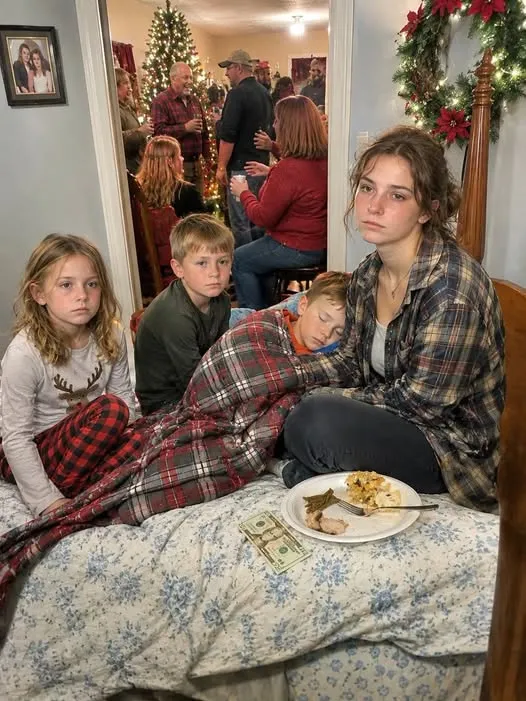
It was almost eight o’clock on Christmas night when I carried a slice of pecan pie upstairs and found my stepdaughter sitting on the guest room floor in the dark.
The door was halfway open. The only light came from the television on the dresser, where a cartoon reindeer was singing to nobody. My two-year-old son, Caleb, was asleep in the portable crib in the corner, with his stuffed dinosaur tucked beneath his chin. Meanwhile, my husband’s niece and nephew were asleep on a quilt on the carpet. Six-year-old Finn lay on his back with his mouth open, while four-year-old Lucy curled against him like a kitten.
And there was Tessa, sitting cross-legged beside the bed. She was still wearing the green velvet dress she had arrived in that morning.
On the nightstand beside her sat a paper plate filled with turkey, mashed potatoes, and green beans. Someone had brought it upstairs hours earlier. However, the gravy had turned thick and gray, and the potatoes had developed a dry skin. She hadn’t touched a single bite.
“Hey, Julie,” she whispered, careful not to wake anyone.
“Sweetheart,” I whispered back. “Why are you still up here?”
She shrugged, the way fourteen-year-olds do when they don’t want anyone to see that something hurts.
“Dad said to stay with them.”
“For three hours?”
Her eyes moved past me toward the hallway. From downstairs, I could hear laughter drifting up from the living room. Someone had just answered a trivia question correctly, and my husband’s cheerful voice rose above everyone else’s.
I looked around the room. The wrapping paper from her new watercolor set had been folded into a neat square beside her overnight bag. Her shoes were lined up beneath the chair.
Then I noticed a twenty-dollar bill on the pillow behind her, right beside a small package wrapped in brown paper covered with tiny hand-drawn Christmas trees.
I picked it up.
“Tessa, what’s this?”
Her cheeks turned pink.
“Dad left it.”
“What for?”
“For watching everybody.” She looked down at her hands. “He came up when they were finishing dinner and put it there. He said thanks for holding down the fort.”
I stared at the money.
“Did you ask him to pay you?”
She quickly shook her head.
“No.”
Then she said something I would remember every night for weeks.
“I didn’t even want the money,” she whispered. “I just wanted to have Christmas dinner.”
I placed the pie on the nightstand and knelt in front of her.
“You can come downstairs,” I said. “Right now. Bring your pie. I’ll stay with the kids.”
For the first time that evening, my stepdaughter looked genuinely frightened.
“Did Dad say I was allowed to?”
I didn’t understand that question that night. However, much later, I would realize how many things I had failed to notice.
Chapter One: The Family I Thought I Knew
My name is Julie Kessler. I’m thirty-nine years old, and I work as a dental office manager in Overland Park, Kansas, a suburb of Kansas City filled with cul-de-sacs, good schools, and minivans.
I’ve been married to Mark for five years. Together, we have a son named Caleb, who turned two in October and believes every empty box is a hat.
However, Mark also has a daughter from his first marriage. Her name is Tessa, and she was nine when I first met her.
Back then, she was a skinny, serious little girl with braces and a sketchbook she carried everywhere. Now she’s fourteen, a freshman at Blue Valley Northwest, and taller than me. She has long brown hair that she usually wears in a braid, along with the same love of drawing.
Tessa lives mostly with her mother, Nina, in Olathe, about twenty minutes away. She spends every other weekend with us, from Friday evening until Sunday afternoon. In addition, she visits one evening each week and spends alternating holidays with us.
This year, Christmas Day was ours.
She’s a sweet kid. Although she’s a little quiet around adults, she has a dry sense of humor that appears whenever she feels comfortable. She’s also surprisingly patient with Caleb.
When he was a baby, she would sit on the nursery floor for an hour, drawing animals on a whiteboard while he babbled at her. He absolutely adores her. Whenever she walks through the door on Fridays, he shrieks her name, which comes out as “Tetta,” before running toward her knees.
I’ve been her stepmother for five years, and I honestly believed we had a good relationship.
We weren’t especially close, but things were friendly and easy. I made sure her room was ready on weekends, bought her favorite cereal, and attended her school art show in the spring.
Most importantly, I thought I knew what happened inside my own home.
Unfortunately, Christmas showed me just how wrong I was.
Chapter Two: Green Velvet
That Christmas morning, Tessa arrived just before noon.
Nina dropped her off at the curb. From the front window, I watched Tessa step out of her mother’s car wearing a dark green velvet dress with a white collar. She carried her overnight bag and a small package wrapped in brown paper.
After Nina drove away, Tessa stood on the sidewalk for a moment, looking at our house. Then she finally walked toward the front door.
“Is Dad here?” she asked as soon as she stepped inside.
“He’s in the garage,” I replied, taking her coat. “He’s getting the extra folding chairs down from the rafters. Merry Christmas, honey. You look beautiful.”
She smiled, showing her new retainer.
“Thanks. Mom found it at a vintage store.”
Then she held up the little package. Up close, I could see hundreds of tiny Christmas trees drawn by hand with green and gold ink. Each one looked slightly different.
“I made him something,” she explained.
“Tessa, that’s gorgeous. Even the wrapping!”
“Can I give it to him tonight? After dinner? When it’s quiet?”
“Of course,” I answered.
She walked over to the Christmas tree, knelt down, and carefully placed the package beneath it. Unlike the other presents, she didn’t put it in the middle of the pile. Instead, she placed it off to one side, beneath the lowest branch, where nobody could accidentally crush it.
She adjusted it twice until it looked exactly right.
A moment later, Caleb came running down the hallway.
“Tetta! Tetta!”
Tessa immediately scooped him up and spun him around. He laughed so hard that he got the hiccups.
I smiled as I watched them. At that moment, everything seemed perfectly normal.
Chapter Three: Presents
By four o’clock, our house was completely full.
Mark’s older brother, Aaron, arrived with his wife, Beth, and their two children, Finn and Lucy. Mark’s parents, Gene and Marilyn, drove in from Topeka with a pecan pie and a ham.
Soon, two aunts, an uncle, and three cousins I could never keep straight had joined us.
Coats covered our bed, casserole dishes filled every inch of the kitchen counter, and wrapping paper was already scattered across the living room floor.
Mark was in his element.
My husband loves a crowded house. He grew up in a loud family in Topeka as the oldest of three boys. Consequently, he moves through a busy room as naturally as other people move through water.
He was refilling drinks, telling jokes, carrying Lucy on his shoulders, and arguing with his uncle about the Chiefs.
As usual, the children opened their presents first.
Caleb was more interested in the boxes than the toys. He put a shoebox on his head and walked straight into the coffee table.
Meanwhile, Finn started assembling a plastic race track that took up half the living room. Lucy received a pink dollhouse with a working doorbell and insisted that every adult come over to ring it.
Tessa received a cream-colored cable-knit sweater from her grandparents.
From Mark and me, she got a professional watercolor set in a wooden box, complete with twenty-four colors and three sable brushes.
I had chosen the paints myself. Her art teacher had told me at the spring show that Tessa had real talent, so I had spent an hour at the downtown art store finding something special.
When she opened the wooden box, she stared at it for a long moment.
Then she looked up at me, and her eyes began to shine.
“These are the ones Ms. Ortega uses,” she said.
“I know. I asked her.”
She looked genuinely happy. In fact, she seemed happier than I had seen her in months.
She even let Caleb sit in her lap and unwrap her final present, a gift card from her aunt. As he tore at the paper, she gently held his hands so he wouldn’t accidentally destroy the card.
I remember that moment because I took a photograph.
Tessa was sitting on the floor in her green dress, laughing with Caleb in her lap. He was holding a piece of red ribbon above his head like a trophy.
Behind them, Mark sat on the couch with a coffee cup in his hand, smiling.
Looking at that photograph later, nobody would have guessed anything was wrong.
Neither would I.
Chapter Four: The First Mistake
The trouble started when we began preparing dinner.
Caleb was getting tired and cranky because he had missed his nap. At the same time, Finn and Lucy had scattered race cars and dollhouse furniture across the living room.
The adults were trying to move the couch and coffee table so we could set up the long folding table for dinner.
Mark glanced over at Tessa, who was sitting on the floor testing the colors from her new watercolor set.
“Hey, Tess,” he said. “Why don’t you take the little ones upstairs for a while?”
She looked up.
“All three?”
“Yeah. Put on a Christmas movie in the guest room. They can play up there while we get dinner sorted out.”
Tessa hesitated for a moment.
“Can I eat with everyone first?” she asked.
“We’re not even sitting down yet,” Mark replied. He nodded toward the stairs. “Come on. Give the adults a little peace.”
I was carrying a hot baking dish of sweet potatoes from the oven to the counter. I heard the entire conversation.
I also heard her question.
However, I didn’t stop what I was doing. I didn’t put down the dish or tell Mark that she should stay.
That was my first mistake.
Tessa gathered Caleb’s stuffed dinosaur and his sippy cup. Then she helped Lucy carry her favorite doll and the little pink doorbell from the dollhouse.
She also asked Finn to bring his race cars.
Finally, she picked Caleb up on her hip and led the three children upstairs. Lucy held her hand while Finn raced ahead.
I assumed she would return before dinner.
I assumed someone would go upstairs to get her.
Most importantly, I assumed she was perfectly happy with the arrangement.
I was wrong about all three things.
Chapter Five: The Table
At five-thirty, everyone sat down to dinner.
Fourteen of us gathered around two folding tables pushed together and covered with my mother’s white tablecloths.
I was carving the turkey, refilling drinks, and finding another chair for Mark’s Aunt Ruth, who had arrived late carrying a Jell-O salad nobody would eat.
The candles were lit, and the football game was finally off.
Gene said grace, delivering a long prayer and thanking God for family.
Then someone asked where Tessa was.
I believe it was Marilyn, Mark’s mother.
Mark answered before I could.
“She’s upstairs with the kids,” he said, passing the rolls. “She said she didn’t mind watching them.”
Beth looked relieved.
“Oh, that’s sweet of her,” she said. “She’s so good with them.”
“She really is a natural,” Aaron added.
I leaned toward Mark and quietly asked whether he could go get her.
We could bring the little ones downstairs, and someone could hold Caleb while Tessa ate.
However, Mark shook his head.
“She’ll eat in a bit. Caleb’s finally settled down. If I bring them down now, it’ll be chaos. Let’s just enjoy this.”
I glanced toward the stairs.
At that moment, Aunt Ruth knocked over the cranberry sauce. A red stain spread across my mother’s tablecloth, so I jumped up and hurried into the kitchen for club soda and towels.
By the time I returned, the conversation had moved on to Gene’s knee replacement.
I sat down and started eating.
I didn’t ask about Tessa again.
That was my second mistake.
At some point during dinner, Mark got up and walked into the kitchen. He returned a few minutes later.
I assumed he had gone to get more ice.
What I didn’t know was that he had prepared a plate of food, carried it upstairs, and placed it on the nightstand.
I also had no idea he had left a twenty-dollar bill on Tessa’s pillow.
Dinner lasted nearly an hour.
Afterward, the adults moved into the living room for coffee, dessert, and Mark’s annual Christmas trivia game.
He writes the questions himself on index cards. They’re usually terrible, but everyone loves playing.
Around seven, I noticed Lucy’s pink dollhouse was still sitting untouched beneath the tree.
She had been so excited about that little doorbell.
“Shouldn’t the kids come down?” I asked Mark between trivia questions. “Lucy hasn’t even played with her dollhouse.”
“The kids are fine,” he replied, shuffling his cards. “Tessa has them watching something. They’re probably asleep.”
“Shouldn’t Tessa come down, then?”
“In a minute,” he said. “Okay, next question. Uncle Ray, what was the name of the dog in It’s a Wonderful Life?”
Then Marilyn called everyone into the kitchen to admire the lattice on her pecan pie. She had been perfecting that recipe for forty years.
We all stood around looking at it, and another half hour passed.
Finally, around eight o’clock, I realized I hadn’t seen Tessa since four-thirty.
Three and a half hours.
I cut a slice of Marilyn’s pecan pie, placed it on one of my good plates, and carried it upstairs.
Chapter Six: Was She Allowed?
I found Tessa sitting on the guest room floor, still wearing her green velvet dress.
The moment I showed her the twenty-dollar bill, I wanted to understand what had happened.
“Tessa,” I said slowly, “you don’t need permission to come to Christmas.”
She looked at me as though I had spoken a foreign language.
“He said to stay with them,” she repeated. “He said if I came down and they followed me, it would ruin everything.”
She glanced toward the sleeping children.
“Lucy cried for her mom twice. I didn’t want to bring her down and have her cry at the table.”
“Did you eat anything?”
She looked at the cold plate.
“I wasn’t really hungry.”
I knew that wasn’t true. The way she looked at the pie told me everything.
“Eat this,” I said, handing her the fork. “Right now. Then we’re going downstairs.”
She took a bite.
Then another.
Within ninety seconds, she had eaten the entire slice.
Sitting there on the floor, I realized she had probably eaten nothing since breakfast.
“Thank you,” she whispered, handing me the empty plate.
I went downstairs and asked Beth to come sit with the sleeping children.
She followed me upstairs. However, when she entered the guest room and saw Tessa on the floor, the cold plate on the nightstand, and the three children sleeping around her, her expression changed.
“Oh, honey,” she said. “Have you been up here this whole time?”
Tessa shrugged.
“I thought you came down for dinner,” Beth continued. “Mark said…”
She stopped.
Then she looked at me.
Neither of us finished that sentence.
I took Tessa’s hand and walked downstairs with her.
She followed me as though she were heading into the principal’s office.
When we entered the living room, the trivia game was still going.
Mark looked up and saw her. For a brief moment, his expression changed. It wasn’t happiness. It was something closer to annoyance.
“Who’s watching the kids?” he asked.
“Beth,” I replied. “Tessa has been upstairs for three and a half hours, Mark. She missed dinner.”
“I brought her a plate,” he said.
“It’s cold. She didn’t eat it.”
“Well, that’s not my fault.” He laughed lightly, looking around as if inviting everyone else to laugh too. “Tess, you should’ve eaten it. Come on, sit down. You can be on my team.”
But Tessa didn’t sit down.
She stood in the doorway with her hands clasped in front of her.
“Can I give you your present now?” she asked her father. “The one under the tree?”
Mark glanced at his index cards.
“Let’s finish the game first, okay? Then you can.”
She nodded and sat on the floor at the edge of the room, away from everyone, with her knees pulled up.
The game continued for another forty minutes.
Eventually, the aunts gathered their coats. Gene and Marilyn prepared to drive back to Topeka before the weather turned, while Aaron and Beth carried their sleeping children to the car.
By the time the house was empty, it was nearly ten o’clock.
Mark collapsed onto the couch and turned on the television.
Meanwhile, Tessa’s little brown-paper package remained beneath the lowest branch of the Christmas tree.
She looked at it, then at her father, who was already half-asleep in front of a football replay.
Finally, she went upstairs to her room and closed the door.
She never gave him the present that night.
Chapter Seven: The Morning After
Nina arrived at noon the next day to pick up Tessa.
My stepdaughter was already packed and waiting by the front door at eleven-thirty. She had her overnight bag and her new watercolor box.
She had also stripped the sheets from her bed and folded them neatly, something she had never done before.
Most surprisingly, she had left the twenty-dollar bill on the kitchen counter, underneath the salt shaker, where Mark would eventually see it.
Mark was in the garage putting the folding chairs back into the rafters.
When Nina’s car pulled up, I called out to him that Tessa was leaving.
“Bye, Tess!” he shouted through the garage door. “Love you! See you in two weeks!”
He didn’t come outside.
Tessa stood in the hallway for a moment, listening to the garage door.
Then she picked up her bag.
“Tessa,” I said. “Wait.”
She turned around.
“Your present,” I said. “It’s still under the tree. Do you want me to give it to him?”
She looked toward the living room.
For a long moment, she said nothing.
“No,” she finally answered. “I’ll take it.”
She walked over to the tree, knelt down, and carefully picked up the package with both hands.
Then she placed it inside her overnight bag between her clothes.
Without looking back, she walked out the front door and down the driveway toward her mother’s car.
Nina got out of the car. She didn’t usually do that. Normally, she waited at the curb with the engine running.
This time, however, she stood beside the car and watched her daughter approach.
Then she looked up at me.
It was a long look, and I couldn’t understand what she was thinking.
A moment later, she got back into the car and drove away.
I remained in the doorway, staring at the empty street.
Then I returned to the kitchen and picked up the twenty-dollar bill from beneath the salt shaker.
I held it in my hand for a long time.
That afternoon, while Mark watched football and Caleb napped, I sat at the kitchen table with my phone.
For some reason, I began scrolling through every photograph I had taken during the previous year.
Eventually, I found something that made my stomach drop.
In photograph after photograph, Tessa was holding a child.
At Caleb’s birthday party in October, she was holding him while everyone else ate cake.
During the Fourth of July cookout at Aaron’s house, she was pushing Finn on the swing while the adults sat on the deck.
At Easter, she was sitting on the floor playing with Lucy while everyone else gathered around the table.
At the zoo in August, she was carrying Caleb on her hip while Mark and I walked ahead.
There wasn’t a single photograph from the entire year showing Tessa sitting at a table with the adults.
Not one.
In five years of being her stepmother, I had never noticed.
Chapter Eight: What the Phone Knew
Two days after Christmas, a Venmo notification finally made me understand what had been happening.
Mark had left his phone on the kitchen counter while he took Caleb to the park.
It buzzed.
Without thinking, I glanced at the screen.
The notification read:
Aaron K. paid you $60. “Xmas babysitting, thx bro.”
I stood in the kitchen staring at those words.
In five years of marriage, I had never gone through my husband’s phone. I didn’t do it that day either.
Instead, I opened my own Venmo app because Mark and I were connected on the platform.
His public transaction history was visible to his friends.
I started scrolling.
There it was.
Months of payments from Aaron.
- Aaron K. paid Mark $50. Saturday babysitting.
- Aaron K. paid Mark $50. Date night, thanks for Tess.
- Aaron K. paid Mark $40. Sunday afternoon.
- Aaron K. paid Mark $75. Overnight.
- Aaron K. paid Mark $60. Xmas babysitting, thx bro.
I counted every transaction.
Fourteen payments since March.
Seven hundred and forty dollars.
Every single payment had arrived during one of Tessa’s weekends with us.
I slowly sat down at the kitchen table.
Suddenly, all those Saturdays made sense. Mark had repeatedly told me that we were watching Aaron’s children because he had promised his brother.
On some weekends, I was at work or running errands. Meanwhile, Finn and Lucy arrived with their pajamas and toothbrushes.
Mark would casually say, “Tess’ll keep an eye on them. She loves it.”
Then he would head to the garage, the golf course, or a bar on Metcalf Avenue with his brother.
I had been grateful that Tessa was so good with the children.
However, I had never asked whether she wanted to babysit.
More importantly, I had never wondered where the money was going.
I thought about the twenty-dollar bill on her pillow.
Seven hundred and forty dollars had been paid to Mark for childcare. Yet his daughter had received only twenty dollars that Christmas.
I couldn’t sit there pretending I hadn’t seen it.
For the first time since becoming Tessa’s stepmother, I picked up my phone and called Nina.
Chapter Nine: Nina
Nina answered on the fourth ring.
“Julie?”
“Nina,” I said. “I’m sorry to bother you. Can we talk about Tessa? Just you and me.”
There was a long silence.
Then she answered quietly.
“I was wondering when you’d call.”
We arranged to meet at a Panera on 119th Street the following afternoon.
I had never shared a meal alone with my husband’s ex-wife.
When I arrived, Nina was already sitting at a corner table near the window with a cup of tea.
She’s forty-one, works as a nurse at Olathe Health, and has short dark hair. She also has Tessa’s serious brown eyes.
I sat across from her.
For a moment, neither of us spoke.
Finally, Nina broke the silence.
“She came home on the twenty-sixth and went straight to her room. She didn’t come out until dinner. When she did, she’d been crying.”
I lowered my eyes.
“I asked her what happened, but she said nothing. That’s what she always says. Nothing.”
Nina wrapped both hands around her tea.
“Then she asked me, ‘Mom, can I just stay here next Christmas?’”
I closed my eyes.
“She has been asking to skip weekends at your house since summer,” Nina continued. “Not every weekend, just some of them. She makes up reasons. A school project. A friend’s birthday. Sometimes I let her stay.”
She paused.
“I thought it was just being fourteen.”
Then she looked directly at me.
“In September, she told me something. She said, ‘At Dad’s house, I’m the babysitter. Not the daughter.’ She laughed when she said it, but I knew she wasn’t joking.”
I told Nina everything about Christmas.
I explained how Tessa had spent three and a half hours upstairs, how Mark had brought her a cold plate, and how he had left twenty dollars on her pillow.
Finally, I told her about the fourteen Venmo payments.
Seven hundred and forty dollars.
Nina’s expression remained still as she listened.
However, when I mentioned the twenty dollars, she slowly put down her tea.
“How much of that money did Tessa actually get?” she asked.
“I don’t know,” I admitted. “Twenty dollars at Christmas. I don’t know about the rest.”
Nina shook her head.
“She never mentioned getting paid. Not once. He’s charging his brother for his daughter’s time and keeping the money.”
We sat in silence for a moment.
Then Nina told me something else.
“In October, Tessa heard Mark talking to his mother on the phone. He told Marilyn it was nice having Tess around on weekends because she was ‘built-in childcare.’”
Nina’s voice cracked.
“Julie, she told me, ‘Mom, I think that’s the only reason Dad still wants me to come.’”
I put my hand over my mouth.
Then Nina took a deep breath.
“There’s something else you should know. I’ve been talking to a lawyer since November about changing the parenting plan.”
I looked up.
“In Kansas, the judge has to listen to what a child Tessa’s age wants. She wants fewer weekends at her father’s house. Maybe none.”
“Does Mark know?”
“Not yet,” Nina replied. “I was waiting until after Christmas. I wanted to give him one more chance.”
She looked at me across the table.
“I guess he had it.”
Chapter Ten: The Package
That night, after Caleb was asleep, I confronted Mark.
I hadn’t prepared a speech. Instead, I sat across from him at the kitchen table with my phone open to his Venmo history.
I also placed the twenty-dollar bill between us.
He looked at the screen, then at the money, and finally at me.
“You went through my Venmo?”
“It’s public, Mark. Anyone you’re friends with can see it.”
I pointed at the screen.
“Seven hundred and forty dollars. Fourteen payments. All during Tessa’s weekends.”
He leaned back in his chair.
“So? Aaron pays me to watch his kids. That’s normal. Family helps family.”
“You didn’t watch his kids,” I replied. “Tessa did.”
“We all did. It’s our house.”
“Mark, how much of that seven hundred and forty dollars did Tessa receive?”
He didn’t answer.
“Twenty dollars at Christmas,” I continued. “Did she get anything else?”
He looked down at the table.
“She’s fourteen. She doesn’t need seven hundred dollars.”
“She needed a seat at the table,” I said.
My voice was shaking, but I kept going.
“On Christmas, she asked you if she could eat with everyone first. I heard her ask. You sent her upstairs for three and a half hours. Then you went up there and left twenty dollars on her pillow like she was a hotel maid.”
His face turned red.
“That’s not fair.”
“She asked me whether she was allowed to come downstairs, Mark. Your daughter asked if she had permission to join Christmas dinner in her own home.”
He stood up and walked toward the sink.
For a long time, he stood with his back to me, gripping the edge of the counter.
“Nina called me,” I said quietly. “Well, I called her. We met yesterday. She’s talking to a lawyer about changing the parenting plan.”
I continued explaining what Tessa had told her mother.
“She thinks she’s the babysitter here, not the daughter. She even believes that’s the only reason you still want her to visit.”
Mark turned around.
His face had gone white.
“That’s not true,” he said. “That’s not true, Jules. I love her. She’s my kid.”
“Then why does she think it?”
He opened his mouth, but no answer came.
Eventually, he sat back down at the table.
“When I was her age,” he began, “I watched Aaron and Danny every single weekend. My parents both worked. Dad was at the rail yard, and Mom worked at the hospital.”
He rubbed his face.
“Every Saturday and Sunday, I looked after them. I didn’t go to a single football game in high school. I changed diapers, made mac and cheese, and broke up fights.”
He paused.
“That’s just what you did. The oldest child helped. I never thought twice about it.”
I looked at him.
“Did you like it?”
He remained quiet for a long moment.
“No,” he finally admitted. “I hated it. I hated every second of it.”
“Then why would you do it to her?”
He had no answer.
Instead, he stared at the twenty-dollar bill.
Then I got up and walked into the hallway. I reached into my purse and took out the brown paper package covered with hand-drawn Christmas trees.
Nina had given it to me at the restaurant. Tessa had left it on her desk at her mother’s house and told Nina to throw it away.
Nina couldn’t bring herself to do that.
She had brought it to me in a grocery bag.
“Tessa wanted to give you this,” I said, placing it on the table. “She wanted to give it to you on Christmas night. She waited all day. You told her to wait until after the game. Then everyone left, and you fell asleep.”
Mark stared at the package.
Slowly, he began unwrapping it.
Inside was a small handmade book. It contained sixteen pages of heavy watercolor paper, folded and stitched together with green thread.
The cover was painted by Tessa herself.
Written across it were the words:
Christmas With Dad.
He opened the book.
Every page contained a small, careful watercolor painting with a date written underneath.
The first showed Mark lying on the living room floor of their old house in Lenexa. A tiny girl in a red nightgown was sitting on his chest, and both of them were laughing.
The next showed him carrying Tessa on his shoulders through the Christmas lights at the Country Club Plaza.
There were paintings of them building a crooked gingerbread house, attending a Christmas Eve service, and sitting together on the couch.
Another showed Mark sleeping with a Santa hat on while a little girl drew on his arm with a marker.
Year after year, she had painted their memories.
Then the pictures began to change.
In year nine, the year of the divorce, she painted two Christmas trees standing side by side. One represented her mother’s home, and the other represented her father’s.
A little girl stood between them.
In year ten, she painted her first Christmas with me included in the picture.
By year twelve, baby Caleb had appeared in her arms.
Finally, Mark reached the last page.
It showed our dining room.
The long table was covered with my mother’s white tablecloths. Candles stood in the middle, and our entire family was gathered around the meal.
I was at one end carving the turkey.
Mark sat at the head of the table, laughing.
And in the chair beside him was a girl with a long brown braid, wearing a green velvet dress.
She was sitting at the table and laughing too.
Underneath, Tessa had written:
This year. I hope.
She had painted that picture before Christmas.
Before she arrived at our house, she had imagined the dinner she wanted to have. She had painted the seat she wanted to occupy.
Then she wrapped it in paper covered with tiny Christmas trees and waited all day to give it to her father.
Instead, she spent Christmas dinner upstairs on the floor with three sleeping children and a cold plate beside her.
Mark stared at the painting for a long time.
Then he closed the little book, covered his face with both hands, and began to cry.
At first, quietly.
Then he couldn’t hold it back anymore.
Chapter Eleven: Aaron
Mark didn’t sleep that night.
I heard him downstairs at two in the morning and again at four.
When I came down at six, he was sitting at the kitchen table in yesterday’s clothes. The little watercolor book lay open in front of him, and his phone was in his hand.
“I need to fix this,” he said. His eyes were red. “I don’t know how, but I need to fix it.”
“Start with the money,” I replied.
After work that Monday, Mark drove to Aaron’s house. He asked me to come along.
I left Caleb with a neighbor and rode beside my husband in silence as we drove to Leawood.
Aaron and Beth live in a large stone house on a corner lot.
Aaron answered the door wearing his work clothes and holding a beer.
“Hey, bro. What’s up?”
Mark held out his phone.
“I need to talk to you about this.”
The two brothers went onto the back deck to talk. I stayed in the kitchen with Beth, who made coffee and said very little.
Through the window, I could see them standing outside in the cold.
At first, Aaron laughed.
Then his expression changed.
He started arguing, but eventually he sat down heavily in a deck chair and put his head in his hands.
When they came back inside, his face looked gray.
“I didn’t know,” he said to me. “Julie, I swear to God, I didn’t know Tessa wasn’t getting the money. I thought Mark was giving it to her. I thought that’s what I was paying for.”
He turned toward his brother.
“I’d never have kept doing it if I’d known. I thought I was paying her for her first job.”
Beth had gone completely still at the kitchen counter.
“And Christmas,” Aaron continued quietly. “I didn’t know she was upstairs the whole time. Mark said she didn’t mind. I figured she’d come down when she was ready.”
He shook his head.
“I never even went upstairs to check on my own kids.”
Beth slowly put down her coffee cup.
“Neither did I,” she admitted.
Her voice cracked.
“I went upstairs at eight because Julie asked me to. That was the first time. When I saw Finn and Lucy sleeping on the floor, with that cold plate on the nightstand, I thought, what kind of mother doesn’t check on her children for four hours on Christmas?”
She wiped her eyes.
“I knew they were fine because Tessa had them. I didn’t think about Tessa at all.”
Aaron took out his phone.
He opened Venmo and typed for a moment. Then he turned the screen around so Mark could see it.
Aaron K. paid Tessa Kessler $740.
“For every time. Should’ve been you all along. Sorry, kiddo.”
“I already paid you,” Aaron told his brother. “Now I’m paying her. You can do whatever you want with the money I gave you before.”
Then he looked at Mark.
“But I think you know what you should do with it.”
Mark drove home quietly.
Once we arrived, he went upstairs and sat on the edge of our bed with his laptop.
He stayed there for a long time.
Eventually, he came downstairs and showed me the screen.
He had opened a 529 education savings account through the state of Kansas in Tessa’s name.
He had deposited seven hundred and forty dollars, the full amount Aaron had originally paid him.
In addition, he had arranged an automatic monthly deposit of one hundred dollars.
“For art school,” he said quietly. “If that’s what she wants. Ms. Ortega told Julie she’s good enough.”
He swallowed.
“I never once asked her what she wanted to do after high school. Did you know that? Five years, and I never asked.”
Chapter Twelve: The Table for Two
Mark asked Nina if he could take Tessa to dinner.
Just the two of them.
Not during his regular weekend and not at our house.
Nina said she would ask Tessa.
However, Tessa said no.
Mark took the rejection harder than I expected.
He sat in the car in the driveway for twenty minutes after Nina sent him the message.
Eventually, he came inside and asked whether he could write Tessa a letter instead.
A real letter, on paper, just as she had made him a real book.
It took him three nights.
He wrote at the kitchen table after Caleb went to bed. The little watercolor book remained open beside him as he crossed out sentences and started again.
I didn’t read the letter. He didn’t offer, and I didn’t ask.
He mailed it to Nina’s house on a Friday.
The following Wednesday, Nina called me.
“She read it four times,” she said. “She cried. Then she painted for two hours. After that, she came out of her room and said she’d have dinner with him.”
I smiled.
“That’s wonderful.”
Nina paused.
“There’s one condition. She wants to choose the restaurant, and she wants it to be just the two of them. No Caleb. No you. No Aaron’s children. Nobody to watch.”
“That’s fair,” I replied.
“I thought so too.”
Tessa chose a little Italian restaurant in downtown Olathe called Mama’s. It had red-checkered tablecloths and a waiter who had worked there since the eighties.
Mark wore his good shirt.
He returned home at nine-thirty and sat beside me on the couch. For a long time, he didn’t say anything.
Finally, he spoke.
“She asked me why.”
“Why what?”
“Why I sent her upstairs. Why I never let her stay at the table.”
“What did you tell her?”
“The truth,” he answered. “I told her I didn’t see her. I saw a fourteen-year-old who was good with children, and I used that because it was easy.”
He shook his head.
“I did what my parents had done with me. I didn’t think about what she wanted. I assumed that because she never complained, she didn’t mind.”
Then he told me what Tessa had said.
“Dad, I never complained because I was scared that if I did, you wouldn’t want me to come anymore.”
He became quiet.
“She told me that’s why she asked Julie if she was allowed to come downstairs. She was afraid the children would follow her and ruin dinner. She thought I’d get angry and eventually tell Nina that she didn’t need to come every other weekend.”
Mark covered his face.
“She has been afraid for a year that I’d stop wanting her. Meanwhile, I’ve been paying my brother’s babysitter with her time.”
I placed my hand on his back.
After a moment, he continued.
“She gave me terms. She’s fourteen years old, and she gave me terms like a lawyer.”
“What were they?”
He counted them on his fingers.
“First, no babysitting Finn and Lucy. Ever. Unless she offers. If she does, Aaron pays her directly at whatever rate she chooses.”
He continued.
“When she’s at our house, Caleb is our responsibility, not hers. She can play with him whenever she wants because she loves him, but she’s never in charge of him.”
Then he looked at me.
“She also wants a seat at the table. Every holiday, every Sunday dinner, every meal. Beside me.”
I nodded.
“Those are good terms.”
“And she wants to keep coming every other weekend,” he added.
His voice broke.
“She told Nina to call the lawyer and stop. She wants to keep coming, as long as I keep my promises.”
Chapter Thirteen: This Year
Mark kept his promises.
He kept them on Valentine’s Day, when Aaron called asking if Tessa could watch Finn and Lucy so he and Beth could go out.
Mark said no.
Instead, he went to Aaron’s house and watched the children himself.
He also kept his promises at Easter. When the family gathered around the dining table, Mark placed Tessa’s chair beside his and asked her to say grace.
She did, although she turned bright red and managed only four words.
Most importantly, he kept his promises during every other weekend.
When Caleb woke up at six in the morning demanding pancakes, Mark got out of bed and made them himself. He never knocked on Tessa’s door expecting her to help.
Slowly, things began to change.
Tessa started coming downstairs on her own.
At first, she would hover in the kitchen doorway, just as she had on Christmas night. Then she began sitting at the counter while I prepared dinner.
She brought her sketchbook and told me about her art class. Sometimes, she even talked about a boy named Ethan, although she insisted she definitely did not have a crush on him.
In March, she entered a watercolor painting in the Johnson County high school art show.
It showed Caleb asleep in his crib, with his stuffed dinosaur tucked beneath his chin.
Her painting won second place in the freshman division.
Mark took the afternoon off work and drove to the show at the community college in Overland Park.
He stood in front of her painting for twenty minutes.
When Tessa finally approached him, he put his arm around her shoulders.
He didn’t need to say anything.
Later, she told me it was the first time he had ever attended one of her art shows.
Then came June.
Aaron hired Tessa to watch Finn and Lucy for a week while Beth was out of town.
This time, however, Tessa offered.
She named her price: twelve dollars an hour.
Aaron paid her directly every evening into her own Venmo account. She saved most of the money for college.
By August, she had started asking me to teach her how to cook.
Not because anyone expected her to help.
Simply because she wanted to spend time in the kitchen.
Then Christmas came around again.
Tessa arrived just before noon.
Nina dropped her off, but this time she got out of the car, walked her daughter to the door, and came inside for coffee.
She spent half an hour talking with me in the kitchen while Mark tried to get Caleb into his Christmas sweater.
Before leaving, Nina hugged Tessa.
Then, unexpectedly, she hugged me too.
By four o’clock, our house was full again.
Gene and Marilyn arrived with the aunts. Aaron and Beth brought Finn and Lucy.
Coats covered the bed, casserole dishes filled the kitchen counter, and wrapping paper scattered across the living room.
The children opened their presents first.
Caleb, now three, wore a box on his head and walked into the coffee table again.
Finn built another race track, while Lucy received a dollhouse family to go with her dollhouse.
When the adults began moving furniture for dinner, Caleb started fussing. At the same time, Finn and Lucy began fighting over a race car.
I noticed Aaron glance toward the stairs.
It was an old reflex.
However, he caught himself.
Mark stood up from the couch.
“Okay,” he announced. “I’ve got the little ones. Aaron, you’re with me. We’re taking them upstairs for a movie until dinner’s ready. Then everybody comes down. Everybody.”
Aaron looked at him.
Then he laughed a little, stood up, and followed his brother.
Mark carried Caleb on his hip while Aaron held Lucy’s hand. Together, they led the children upstairs.
Tessa was sitting on the living room floor with her sketchbook.
She watched them leave.
Then she looked at me in the kitchen doorway and smiled.
It was a real smile.
“Want to help me with the gravy?” I asked.
She closed her sketchbook and stood up.
“Yeah,” she answered. “I do.”
Chapter Fourteen: The Saved Seat
At five-thirty, everyone sat down.
All of us.
The children came downstairs together, with Caleb riding on Mark’s shoulders and Lucy holding Aaron’s hand.
Fourteen adults and three children gathered around two folding tables pushed end to end. My mother’s white tablecloths covered the tables, and I had finally managed to remove the cranberry stain from the previous year.
Mark sat at the head of the table.
Beside him, wearing a dark green velvet dress that was now a little short on her, sat Tessa.
Gene said grace, delivering another long prayer and thanking God for family.
This time, Mark held his daughter’s hand while he prayed.
Halfway through dinner, he stood up and tapped his glass with his fork.
The entire table became quiet.
“I have to give somebody something,” he said. “I was supposed to get it last year, but I didn’t. I was too busy to see what was right in front of me.”
He reached beneath his chair and brought out a package.
It was wrapped in brown paper and covered with hand-drawn Christmas trees.
They weren’t nearly as beautiful as Tessa’s. Some were lopsided, others were smudged, and the green and gold marker had clearly given him trouble.
He had spent two evenings working on the wrapping paper at the kitchen table, swearing under his breath.
He placed the package in front of his daughter.
Tessa looked at it.
Then she looked at him.
Slowly, she began unwrapping it.
Inside was her little watercolor book.
Christmas With Dad.
It was the same book she had made the previous year, with its green thread binding. However, something was different.
Mark had taken it to an art supply store in Kansas City and asked them to add more pages.
Forty additional pages of blank, heavy watercolor paper had been stitched into the book.
Tessa turned to the last painting she had created the previous Christmas.
There was the dining room table, the candles, and the girl in the green velvet dress sitting beside her father.
Underneath, she had written:
This year. I hope.
Mark had added two words beneath her message.
This year.
Then she turned to the next page.
It was blank, except for a small sentence written in pencil at the bottom.
Next year. Your seat’s already saved.
Tessa stared at the words for a long moment.
The entire table had gone quiet.
Marilyn pressed her napkin against her mouth. Beth was crying, while Aaron looked down at his plate.
Finally, Tessa closed the book and turned toward her father.
She put her arms around his neck, right there at the dinner table, in front of everyone.
Mark held her tightly.
He didn’t say anything.
He didn’t have to.
After dinner, the adults moved into the living room for coffee, pie, and Mark’s terrible Christmas trivia game.
He handed out the index cards.
This time, Tessa sat beside him on the couch.
They were on the same team.
They lost badly, and she laughed so hard at one of his questions that she had to bury her face in a pillow.
Around eight o’clock, I went upstairs to check on Caleb.
He had fallen asleep in the portable crib in the guest room.
The door was halfway open.
The television was off.
On the nightstand, where a cold paper plate had sat exactly one year earlier, there was nothing.
Only the lamp, a stuffed dinosaur, and a small framed photograph I had placed there that morning.
It was the photograph I had taken the previous Christmas.
Tessa was sitting on the floor in her green dress, laughing, with Caleb in her lap. He was holding a piece of red ribbon above his head.
Behind them, Mark was sitting on the couch, smiling.
Nobody looking at that photograph would have guessed anything was wrong.
That’s exactly why I keep it there.
It reminds me how easy it is to miss the most important thing in a room, even when you’re the person holding the camera.
I went back downstairs.
My husband was standing near the coffee table, reading a trivia question in a ridiculous voice.
My stepdaughter sat beside him, laughing.
My son was asleep upstairs, watched over by nothing but his own dreams.
And for the first time in six years of Christmases, everyone who belonged at that table was finally sitting at it.
Related Articles

My Parents Abandoned Me at a Truck Stop Over My Nursing School Savings — One Year Later, They Needed My Help
His Uncle Left Him an Old Coat, but What He Found Inside Changed Everything
I Married My First Love to Fulfill Her Dying Wish—Then Her Son Revealed a Secret