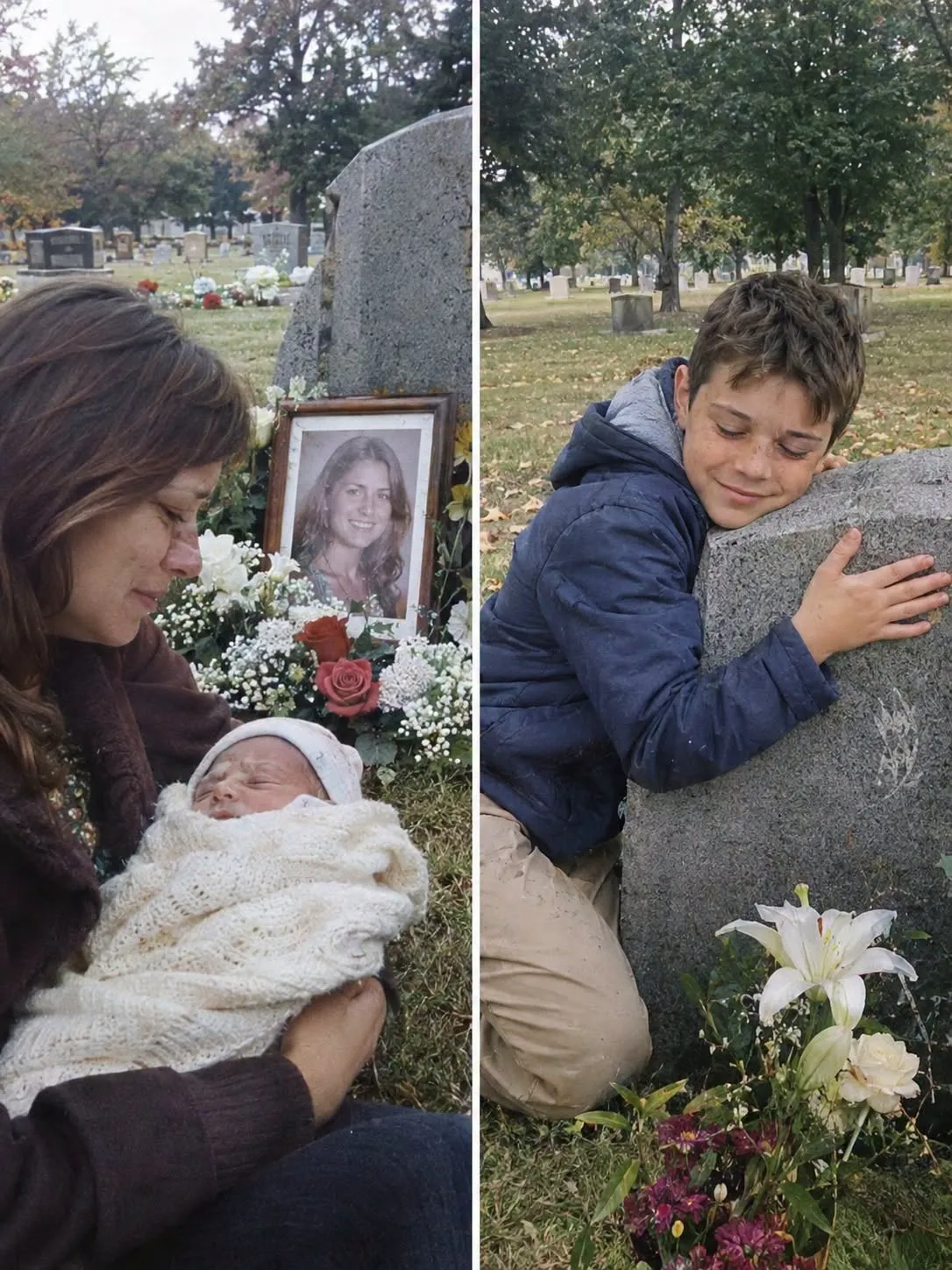
An Unexpected Visitor at My Daughter’s Grave
“I made your daughter a promise. Now it’s time you knew the truth.”
The woman standing beside Teagan’s headstone held out a sealed envelope.
My name was written on the front.
Mom.
It was handwriting I hadn’t seen in ten years. My daughter’s handwriting.
For a moment, I couldn’t breathe.
It was a bright, windy Saturday in early April. Although the sun was warm, the spring air still carried a bitter chill.
Oak Grove Cemetery sits on a hill on the north side of Springfield, Missouri. The wind comes over that hill and pushes against you as though it’s trying to get somewhere.
I was holding a bunch of yellow tulips from Hy-Vee. They were Teagan’s favorite flowers, so I brought them every year on her birthday.
She would have been twenty-nine.
Initially, I hadn’t noticed the woman standing beside her grave.
Lucas and I had parked near the old stone chapel at the bottom of the hill. However, he’d stopped to search the back seat for the birthday card he’d made.
Meanwhile, I walked ahead.
When I reached the top, the woman was already there.
She appeared to be in her sixties. She had short gray hair, a navy raincoat, and sensible shoes.
With her hands folded in front of her, she was studying Teagan’s headstone.
TEAGAN MARIE DAWSON.
APRIL 6, 1997 – APRIL 2, 2016.
BELOVED DAUGHTER. MOTHER.
I’d paid extra for that last word.
At the monument company, the man had asked whether I was certain. After all, Teagan had only been a mother for forty minutes.
Nevertheless, I’d told him I was sure.
A Letter Hidden for Ten Years
The woman looked up when she heard my footsteps on the gravel.
Instead of smiling, she studied my face for a long time. Then she reached into her raincoat pocket and removed the envelope.
“Where did you get that?” I asked.
“She gave it to me.”
“When?”
“The day her baby was born.”
I tightened my grip on the tulips until the plastic wrapping crackled.
Nothing she said made sense.
“You’ve had a letter from my daughter,” I asked slowly, “for ten years?”
The woman lowered her eyes toward the grass.
“Yes.”
Before I could respond, Lucas shouted from the bottom of the hill.
“Grandma! I found it!”
My ten-year-old grandson came running toward us along the gravel path.
He had skinny legs, grass-stained jeans, and a backward Cardinals cap. Meanwhile, he waved the birthday card above his head like a flag.
He’d made it himself at our kitchen table the previous evening.
Purple construction paper was folded in half. Across the front, he’d written HAPPY BIRTHDAY MOM in green marker.
Additionally, he’d drawn a baseball diamond with a long-haired stick figure standing in the outfield.
Lucas had spent forty-five minutes making it. However, he wouldn’t let me see what he’d written inside.
The woman glanced toward him, and her expression suddenly changed.
Something soft and sad appeared across her face.
Then she turned back to me.
“Don’t open this in front of him,” she whispered.
“Who are you?”
“My name is Trudy.”
“That tells me nothing.”
After studying me for another moment, she finally explained.
“I knew Teagan at the hospital. I was her nurse.”
Memories I Had Tried to Bury
A sick feeling settled in my stomach.
Suddenly, I remembered Mercy Hospital.
The fourth floor. Labor and delivery.
There was a waiting room with blue chairs and a television bolted to the wall. It had been playing a home improvement show without sound.
Then there was the doctor in green scrubs who had sat beside me.
Meanwhile, Lucas was halfway up the hill, still waving his card.
Trudy firmly pressed the envelope into my hand. After folding my fingers around it, she stepped back.
“My number’s on the back.”
Without another word, she walked down the opposite side of the hill toward the far gate.
I remained beside Teagan’s grave, holding the envelope and the tulips.
My hands wouldn’t stop shaking.
“Grandma?” Lucas asked breathlessly. “Who was that?”
I quickly tucked the envelope inside my coat.
“Nobody, sweetheart. Just someone visiting.”
He looked at me before glancing toward the woman walking away.
Then he studied my face again.
Lucas didn’t believe me.
He never does because he’s too much like his mother.
The Evening Teagan Told Me She Was Pregnant
Teagan was eighteen when she told me she was expecting a baby.
It was a Tuesday evening in August 2015. After dinner, I was standing at the kitchen sink washing dishes.
Meanwhile, she sat behind me with her chemistry textbook open. Supposedly, she was studying for a summer class at Ozarks Technical Community College.
“Mom,” she said. “I need to tell you something.”
“Mm-hmm.”
“I’m pregnant.”
Immediately, a plate slipped from my hands.
Fortunately, it didn’t break. Instead, it clattered against the sink.
For several seconds, I stood with my hands submerged in soapy water without turning around.
“How far?” I finally asked.
“Fourteen weeks.”
Fourteen weeks.
She’d known for two months, perhaps longer. Yet she’d been sitting across from me every evening, eating my meatloaf and asking me to pass the salt.
When I turned around, Teagan was sitting unusually straight.
Her hands rested flat against the textbook. Furthermore, her face was pale, and her eyes were red.
She’d clearly been crying before coming downstairs. However, she’d tried to hide it.
At that moment, she looked incredibly young.
Almost twelve years old.
“Who’s the father?” I asked.
That was my first question.
I didn’t ask whether she was okay. Neither did I ask whether she was frightened or how she was feeling.
Instead, I wanted to know who the father was.
I’ve thought about that question countless times since.
The Arguments That Followed
Throughout her pregnancy, I repeatedly questioned Teagan about the baby’s father.
I asked during breakfast, in the car, and at her doctor’s appointments. Sometimes, I even brought it up at the grocery store.
“Does he know?”
“Mom, please.”
“What’s his name?”
“I can handle this myself.”
“You shouldn’t have to do this alone.”
“Please stop making this harder.”
Unfortunately, every conversation became another argument.
Afterward, she’d retreat upstairs and close her bedroom door.
Sometimes, I knocked. Other times, I simply stood outside in the hallway.
Eventually, neither of us knew how to discuss the pregnancy without hurting the other.
Therefore, we mostly stopped talking about it.
Why I Was So Determined to Protect Her
I want to explain why I asked so many questions.
Not because I’m trying to excuse my behavior. Instead, I want you to understand where it came from.
Teagan’s father left when she was two.
His name was Gary Dawson, and we’d been married for four years.
Gary worked as a long-haul truck driver. One day in March 1999, he left for a delivery in Dallas and never returned.
Three days later, he called me from a pay phone in Texarkana.
Apparently, he’d met someone else.
He apologized and promised to send money.
Initially, he sent money twice.
Afterward, nothing.
As a result, I raised Teagan entirely on my own.
For twenty-two years, I worked as a medical receptionist at a family practice on Battlefield Road.
Additionally, I worked Saturdays at a craft store to earn extra money.
I bought Teagan’s school clothes at Goodwill and told her they were vintage.
Meanwhile, I learned how to repair a toilet and change a tire. I even dealt with a wasp nest myself using hairspray and a lighter.
Everything fell on my shoulders.
However, I never wanted my daughter to experience the same struggles.
So when she announced her pregnancy, I could only think about protecting her.
Not my girl.
She wasn’t going to raise a child alone. Somehow, I would find that boy and make him accept his responsibilities.
At the time, I believed I was protecting her.
Furthermore, I genuinely thought that was what love looked like.
The Boy Who Visited Our House
A teenage boy came to our house twice that fall.
Although I barely remembered him, certain details remained clear.
He was tall and skinny, with dark hair falling into his eyes.
Additionally, he wore a letterman jacket from Glendale High School, which wasn’t Teagan’s school.
His first visit happened in September.
While Teagan finished getting ready, he sat at our kitchen table with a can of Sprite.
He nervously turned the can around in his hands.
“Yes, ma’am.”
“No, ma’am.”
Beyond those polite answers, he barely spoke.
Eventually, they left together. According to Teagan, they were going to the movies.
The second visit happened in October.
Instead of inviting him inside, Teagan met him on the front porch.
They talked for half an hour despite the cold. Meanwhile, I watched them through the living room curtain.
At one point, he placed his hand against her stomach.
Then he left.
When Teagan returned inside, I immediately questioned her.
“Is that him?”
“Who?”
“Don’t play games with me, Teagan. Is that the father?”
For a long time, she simply looked at me.
“He’s a friend.”
Afterward, she went upstairs.
I never saw that boy again.
Furthermore, I’d never bothered to ask his name.
At the time, I didn’t think he mattered. I assumed he was simply another teenage boy.
The Morning My Daughter Went Into Labor
Teagan went into labor on April 2, 2016, four days before her nineteenth birthday.
At five-thirty that morning, she entered my bedroom and woke me.
“Mom. I think it’s time.”
I immediately drove her to Mercy Hospital.
Throughout the journey, she held my hand. During contractions, she squeezed so tightly that my knuckles remained bruised for a week.
Although she was frightened, she continued making jokes.
Her face had turned gray by the time we stopped at a red light on Glenstone.
“If I die,” she said, “you can’t give my room to the cat.”
“You’re not going to die.”
“Promise you won’t give my room to the cat.”
“Tee, we don’t have a cat.”
“You’ll get one,” she insisted. “I know you. You’ll get lonely, get a cat, and give it my room.”
I laughed.
I actually laughed.
When we arrived, the hospital staff took her to labor and delivery.
Meanwhile, a nurse carrying a clipboard asked me to remain in the family waiting room.
“Just for a few minutes. We’ll come get you.”
However, I spent three hours waiting.
They brought me back twice, once at eight and again at ten.
During those visits, I held Teagan’s hand and fed her ice chips.
Because she was experiencing considerable pain, the medical team gave her an epidural.
Eventually, she fell asleep for a little while.
The Last Words My Daughter Said to Me
At eleven-thirty, another nurse asked me to step outside.
They needed to examine Teagan because labor was progressing.
Apparently, it was almost time.
Before leaving, I kissed her forehead.
“I’ll be right outside.”
“I know,” she answered.
Those were the last words my daughter ever said to me.
I know.
At one-fifteen that afternoon, a doctor entered the waiting room and sat beside me.
He appeared to be in his thirties.
He wore green scrubs and a surgical cap decorated with little cartoon bears. Additionally, a mask hung around his neck.
After sitting in the blue chair, he remained silent for several seconds.
Somehow, I already knew.
Even before he opened his mouth, I knew.
“I’m so sorry,” he finally said. “We did everything we could.”
However, I couldn’t understand what he was saying.
His words seemed to float around me as though he were speaking another language.
He explained that Teagan had experienced an amniotic fluid embolism.
According to him, it was a rare and sudden complication that affected her heart.
The medical team had tried to save her for forty minutes.
Unfortunately, nobody could have predicted what happened.
The doctor explained that nothing anyone could have done would have changed the outcome.
Most of his explanation disappeared from my memory.
Nevertheless, I remembered asking one question.
“The baby?”
“He’s alive,” the doctor answered. “He’s healthy. Seven pounds, one ounce.”
Then he gently placed his hand on my arm.
“He’s going to need you.”
Raising My Grandson After Losing My Daughter
Teagan never came home from that hospital.
Instead, her newborn son came home with me.
I named him Lucas because Teagan had already chosen that name.
In February, she’d written a sticky note and placed it on the refrigerator.
LUCAS JAMES?
Later, using a different-colored pen, she’d crossed out the question mark.
Therefore, he became Lucas James.
James had been my father’s name.
However, there was no father listed on Lucas’s birth certificate.
When the hospital asked about his identity, I explained that I didn’t know.
That was the truth.
For the next ten years, Lucas and I became our own little family.
Although I loved him deeply, I won’t pretend those early years were easy.
At forty-five, I suddenly found myself caring for a newborn with colic.
For three consecutive months, he cried every evening from nine until midnight.
Meanwhile, I carried him up and down the hallway until my feet ached.
I sang every song I knew, most of them by Patsy Cline.
After taking six weeks off work, I returned to my job.
Fortunately, my friend Carol from church watched Lucas during the day for almost nothing.
Exhaustion became part of my daily life.
Sometimes, I even fell asleep at red lights.
Additionally, I cried in the shower every morning so Lucas wouldn’t hear me.
Nevertheless, he continued growing.
The Little Boy Who Reminded Me of Teagan
Lucas became a thoughtful and curious child.
He constantly asked questions that nobody could easily answer.
“Grandma, where does the wind start?”
“Grandma, do fish get thirsty?”
Sometimes, his questions became even more complicated.
“Grandma, if you dig through the Earth, do you fall out the other side or get stuck in the middle?”
Above everything else, Lucas loved baseball.
For hours, he’d throw a ball against the side of our garage.
Thunk. Thunk. Thunk.
Eventually, the neighbors complained.
Additionally, he loved my Sunday pancakes.
I’d made them every Sunday morning since he was two.
Buttermilk pancakes with real maple syrup.
Usually, he’d eat four. However, he’d happily eat five if I allowed him.
Lucas had Teagan’s dark, straight, serious eyebrows.
He also inherited her slightly upturned nose.
Whenever he concentrated, his tongue stuck out from the corner of his mouth.
Teagan used to do exactly the same thing.
However, there was one question Lucas repeatedly asked that I couldn’t answer.
The Question I Could Never Answer
Lucas first asked about his father when he was four.
We were visiting the park when he noticed another little boy being pushed on the swings by his dad.
After watching them for a long time, Lucas looked up at me.
“Grandma, who’s my dad?”
“I don’t know, sweetheart.”
He asked again when he was six, seven, eight, and nine.
Every Father’s Day, the question returned because his classmates were making cards for their dads.
Additionally, he asked during his first Little League game.
The coach had invited all the fathers onto the field for a photograph.
“Grandma, who was my dad?”
“I don’t know.”
Although it was the truth, eventually it started feeling like a lie.
Now, standing beside Teagan’s grave with her envelope inside my coat, I felt afraid.
Perhaps discovering the truth would hurt even more than not knowing.
Meanwhile, Lucas placed his birthday card against the headstone.
After making me promise not to look inside, he began talking to his mother.
He told her about baseball tryouts and his spelling test.
Furthermore, he complained that Grandma had made the pancakes too thick again last Sunday.
I stood several steps away and allowed him to talk.
Throughout the conversation, I could feel the envelope pressing against my ribs.
The Letter Inside My Kitchen Drawer
When we returned home, I hid the envelope in our kitchen junk drawer.
It disappeared beneath takeout menus, rubber bands, and batteries that might have been dead.
Meanwhile, Lucas dropped his backpack beside the dining table.
“Who was that lady?”
“Someone who knew your mom.”
Immediately, his face lit up.
“Really? What did she say?”
“Not much.”
Then came the question I’d been expecting.
“Did she know my dad?”
I pushed the drawer shut a little too hard.
The rubber bands rattled inside.
“I don’t know.”
Lucas studied my face.
“You always say that.”
“Because it’s something I just don’t know, my love.”
Afterward, he became quiet.
His eyes dropped toward the floor, and his jaw tightened.
That expression painfully reminded me of Teagan.
Whenever a conversation became difficult, she’d grow still and retreat inside herself.
It was like watching someone close an invisible door.
“Okay,” Lucas finally said.
Then he went into the living room and turned on the television.
Finding the Courage to Open It
After Lucas went upstairs to bed, I retrieved the envelope.
For a long time, I stood at the kitchen counter holding it.
The refrigerator hummed, while the clock above the stove continued ticking.
It was almost ten-thirty.
On the front, written in blue ballpoint pen, was one word.
Mom.
However, the handwriting on the back was different.
Small, neat letters spelled out a name.
Trudy Pell.
Beneath it was a telephone number.
I repeatedly turned the envelope over.
For ten years, I’d waited and prayed for answers.
Nevertheless, now that the truth was finally within reach, I was terrified to discover it.
What if the letter contained something I couldn’t live with?
What if my daughter hated me?
Finally, I broke the seal.
A photograph immediately fell onto the countertop.
It was a small, faded four-by-six print. The kind of photograph people used to develop at Walgreens.
Teagan was standing beside a duck pond, probably at Phelps Grove Park.
She wore jeans and her old gray Missouri State hoodie.
Something had made her laugh.
However, she wasn’t alone.
Beside her stood a tall, skinny teenage boy with dark hair falling into his eyes.
I recognized him immediately.
It was the boy who’d sat at my kitchen table with a can of Sprite.
Additionally, an old baseball glove was tucked beneath his arm.
Its brown leather was worn and cracked, while the laces were frayed.
My hands began shaking again.
Then I picked up the letter.
It was a single sheet of notebook paper, folded into thirds.
The torn edge showed where someone had removed it from a spiral notebook.
Carefully, I unfolded it.
My Daughter’s Letter
Mom,
I know you think I won’t tell you because I don’t trust you.
However, that isn’t why.
He knows about the baby.
I stopped reading.
My fingers trembled so badly that the paper rattled.
Nevertheless, I forced myself to continue.
He wanted to stay. But wanting something and being ready for it aren’t the same thing.
His family keeps telling him this will ruin everything he planned. College. Baseball. All of it.
I told him not to come back because he’s scared of disappointing them.
If he comes back, I need it to be because he chooses us himself.
Not because I made him. Not because you made him. Because he chose.
I know you’d make him. You’d find him and drag him here by his ear.
I know you would because you love me.
But I don’t want a boy who was dragged here.
Instead, I want someone who walks through the door on his own.
Then I reached the sentence that changed everything I believed about those final months.
You kept asking me who he was. But you never asked why I was scared.
I placed the letter on the countertop.
Because my legs were struggling to support me, I leaned forward with both hands against the counter.
Suddenly, a forgotten memory returned.
It arrived all at once, like a door blowing open.
The Conversation I Had Forgotten
It was a Thursday evening in January 2016, three months before Teagan died.
I was sitting at the kitchen table paying bills.
There were electricity bills, water bills, and hospital pre-registration forms.
Additionally, I had a calculator, a stack of envelopes, and a cup of tea that had gone cold.
Teagan entered the kitchen wearing pajamas.
She was seven months pregnant, and her hair was tied in a messy bun.
After stopping beside the refrigerator, she spoke.
“Mom, can I ask you something?”
However, I didn’t even look up.
I’d worked ten hours that day. My back hurt, and I was busy adding a column of numbers.
“If this is about dodging the father question again, I can’t do this tonight, Tee.”
She remained beside the refrigerator without moving.
For several seconds, the kitchen was completely silent.
Then she spoke very quietly.
“Never mind.”
Afterward, she returned upstairs.
I’d completely forgotten that conversation for ten years.
It had disappeared among thousands of other ordinary moments.
Throughout those years, I’d convinced myself that Teagan refused to confide in me.
Perhaps she’d been too proud, too stubborn, or too ashamed.
However, after reading her letter, I began wondering whether I’d been the one who closed the door.
Calling the Nurse Who Kept the Secret
I immediately called the number written on the envelope.
Although it was ten-forty at night, I didn’t care.
Trudy answered after four rings.
“Hello?”
Her groggy voice suggested I’d awakened her.
“You had this for ten years,” I said.
After a brief silence, she spoke.
“Elizabeth.”
“You had my daughter’s letter for ten years.”
“I know.”
“Don’t say that to me like it’s perfectly fine.”
Instead of responding, Trudy remained silent.
I could hear her breathing through the telephone.
“Meet me,” I demanded.
“Elizabeth, I—”
“Tomorrow. You owe me that.”
Following another long pause, she finally agreed.
“Lindberg’s Diner. On Commercial Street. Two o’clock.”
Meeting Trudy at the Diner
The following afternoon, Trudy was waiting in a booth near the back of Lindberg’s.
It’s an old diner with red vinyl booths and a pie case beside the register.
Additionally, a waitress named Pam has worked there since the 1980s.
She calls everybody honey.
Trudy wore the same navy raincoat. Meanwhile, an untouched cup of coffee sat in front of her.
When she noticed me, she stood before sitting down again.
Instead of immediately joining her, I removed the photograph from my purse.
I placed it on the table between us.
Then I sat down.
“You took care of Teagan?”
“For part of that day.”
“Then why did she give you the letter? Why not me?”
Trudy studied the photograph for a long time.
“She was scared. However, she didn’t think she was going to die, Elizabeth.”
Then she reminded me of something important.
“She was eighteen and about to have a baby.”
Her words hit me hard.
I’d always imagined the letter as a final goodbye, as though Teagan somehow knew what would happen.
However, she hadn’t known.
She hadn’t known any more than I did.
Instead, she’d simply been a frightened young woman preparing to become a mother.
If something went wrong, she wanted someone to know the truth.
What Happened Inside the Hospital Room
According to Trudy, Teagan wrote the letter around seven that morning.
It was before she’d received her epidural.
Meanwhile, I’d gone downstairs to the cafeteria for coffee.
“She asked me for a piece of paper,” Trudy explained. “So I tore one out of my notebook.”
After swallowing nervously, she continued.
“She told me that if something went wrong and he didn’t come, I should give the letter to you.”
Apparently, Teagan had been very specific.
If something goes wrong and he doesn’t come.
I pointed toward the boy in the photograph.
“Is this him?”
“I don’t know his name. She never told me.”
“Then what do you know?”
Trudy hesitated before answering.
“She talked about him. Not a lot, but enough.”
According to her, Teagan had described him as kind and frightened.
Furthermore, his parents had ambitious plans for his future.
Teagan didn’t want to become the reason those plans fell apart.
For a moment, I stared at the photograph.
“Do you know where he is now?”
“No,” Trudy replied.
She explained that she’d kept the letter because Teagan had asked her to.
However, she’d never attempted to locate the boy.
She didn’t believe it was her place.
I left the diner with more questions than answers.
Nevertheless, I finally had something to work with.
A face.
And a baseball glove.
Searching for My Grandson’s Father
I began looking for him.
The search took several weeks.
First, I examined old school yearbooks and newspaper articles about high school baseball.
Additionally, I searched social media and made several careful telephone calls.
I contacted people who might have known someone attending Glendale High around 2015.
Eventually, I found him.
His name was Jesse Carter.
He lived in Mount Vernon, approximately forty minutes away, and worked at a hardware store.
According to the information I found, he was thirty and unmarried.
Furthermore, I couldn’t find any mention of children.
Before entering the hardware store, I sat inside my car for a long time.
Finally, I gathered enough courage to walk inside.
Jesse was standing behind the counter.
Although he was taller and broader than I remembered, his dark hair still fell slightly into his eyes.
When the bell above the door rang, he looked up.
Initially, he regarded me like any ordinary customer.
However, his expression quickly changed.
He recognized me.
“Elizabeth,” he said.
After all those years, he still remembered my name.
“Jesse.”
He walked around the counter.
Together, we stood in the aisle between the paint and the power tools.
“I got a letter,” I explained. “From Teagan. After all this time.”
Immediately, his eyes filled with tears.
“She wrote one?”
“She did.”
However, I wasn’t ready to show it to him.
Not yet.
“I need to know why you never came.”
Jesse Finally Explained What Happened
Jesse lowered his eyes toward the floor.
“I was eighteen. My parents said everything would be over if I became a father at eighteen.”
They’d warned him about losing his college plans, baseball scholarship, and future.
Furthermore, they’d convinced him that Teagan would be better off without him holding her back.
“And you believed them?”
“I was scared,” Jesse admitted.
He explained that he’d loved Teagan and wanted the baby.
However, he’d listened to his parents instead of listening to her.
Then he looked directly at me.
“I went to the hospital on April 2nd.”
For a moment, I couldn’t move.
“I bought flowers. Pink carnations. I stood in the parking lot for an hour.”
Eventually, he’d entered the hospital and reached the elevators.
Nevertheless, he’d turned around and left.
Something cold settled inside my chest.
“You were there.”
“I was there,” Jesse confirmed. “And I left.”
He admitted that he’d regretted that decision every day since.
After wiping his face with the back of his hand, he continued.
Two days later, he’d learned about Teagan’s death through a friend of a friend.
Furthermore, he’d attended her funeral.
He’d stood at the back, where he’d seen both me and the baby.
However, he still hadn’t approached us.
“Ten years,” I said.
“Ten years,” he agreed.
For a while, neither of us spoke.
A Chance to Make Different Choices
“I’m not asking you to forgive me,” Jesse eventually said.
He wasn’t asking me for anything.
Instead, he wanted Lucas to know that he would answer any questions if Lucas ever wanted to meet him.
“I’ll take whatever he wants to give me. Or nothing.”
I studied him for a long time.
Eventually, we continued our conversation at a nearby coffee shop.
“You’re years late,” I told him. “But you do get a chance to decide what kind of man you’re going to be now.”
Jesse sat across from me holding his coffee cup.
Previously, he’d been nervously turning it in his hands.
However, he’d finally stopped.
“Yes, ma’am.”
Understanding My Daughter’s Fear
On the drive home, I had to pull over.
I stopped at a rest area along I-44 near Halltown.
Between two large trucks, I rested my head against the steering wheel.
Surprisingly, I didn’t cry.
Instead, I simply sat there.
I thought about Gary calling me from a pay phone in Texarkana.
I remembered his promise to send money.
For twenty-seven years, I’d tried to ensure no man would ever do the same thing to my daughter.
Consequently, I’d asked the same questions repeatedly.
Who’s the father?
What’s his name?
Does he know?
However, I’d never asked the question that mattered most.
Why are you scared, baby?
Teagan had been afraid of exactly the same thing I feared.
Being with someone who hadn’t chosen her.
The Letter Jesse Left for Lucas
Two days later, I discovered an envelope on my front porch.
It was plain white, without a stamp, and tucked into the screen door.
Across the front, written in neat block letters, was one name.
LUCAS.
Although I disliked reading his private mail, he was only ten.
Protecting him was still my responsibility.
Therefore, I sat at the kitchen table and opened it.
Inside were three handwritten pages of lined paper covered in blue ink.
I read the entire letter twice.
However, one sentence stood out above everything else.
I was scared when I was eighteen, but being scared doesn’t explain ten years.
There were no demands for forgiveness.
Furthermore, Jesse didn’t make excuses or blame anyone else.
He wrote about Teagan and the dock at Table Rock Lake.
Additionally, he mentioned the bread and the fish.
He remembered how loudly she’d laughed, sometimes causing people to turn around in restaurants.
Then he wrote about baseball.
The glove in the photograph had belonged to his grandfather in 1962.
He also described April 2nd, the pink carnations, and the hospital elevator.
Finally, he wrote something directly to Lucas.
I’m not asking you to call me Dad. I haven’t earned that.
I’m not asking you to like me. I’m not asking you for anything.
I just want you to know that you were never something I didn’t want.
You were something I was too scared to deserve.
He signed the letter simply.
Jesse.
Not Dad.
After folding it again, I placed it beneath the takeout menus inside the kitchen drawer.
However, I wasn’t trying to hide it.
I simply wasn’t ready yet.
The Questions I Needed to Ask Trudy
Before showing Lucas the letter, I called Trudy again.
“Can you meet me?”
She sounded surprised.
“I thought you’d never want to see me again.”
“I didn’t say I forgave you.”
“I understand.”
“There’s something else I need.”
The following afternoon, we returned to Lindberg’s and sat in the same booth.
Without being asked, Pam brought us coffee and two slices of coconut cream pie.
“You both look like you need it, honey.”
However, this conversation wasn’t about Lucas’s father.
Instead, it was about the daughter I’d lost.
“Was she scared?” I asked.
Trudy’s expression softened.
“Yes.”
“Was she alone?”
“No,” she assured me.
Throughout everything, people had remained beside Teagan.
Trudy, another nurse, the doctor, and an anesthesiologist had all been there.
“She was never alone. Not for one second.”
Relief and sorrow overwhelmed me simultaneously.
After covering my mouth with my hand, I asked another question.
“Did she ask for me?”
Trudy nodded.
“Yes.”
My throat tightened.
“Did she think I’d left?”
“No. She knew you were right outside.”
Then Trudy repeated something Teagan had said.
“My mom’s in the waiting room. She’s probably reorganizing the magazines.”
Despite my tears, I laughed.
Because that was exactly what I’d been doing.
Remembering My Daughter’s Sense of Humor
“What else did she say?”
Trudy thought for a moment while watching the traffic on Commercial Street.
“She worried she hadn’t bought enough diapers.”
Again, I laughed through my tears.
“That sounds like her.”
Apparently, Teagan had purchased only one package of newborn diapers.
She worried the baby might be too big for them.
“What if he skips newborn?” she’d asked.
“Then I’ll have all these diapers and no baby to put them on. Or a baby and no diapers.”
Then Trudy mentioned something else.
“She talked about you.”
Immediately, I looked up.
“What about me?”
A small, sad smile appeared on Trudy’s face.
“She said you make pancakes too thick. And you refuse to admit it.”
This time, I laughed so loudly that Pam looked over from the counter.
Even after ten years, my daughter could still find a way to tease me.
“She used to say that every Sunday,” I explained.
“Mom, these are basically biscuits.”
Meanwhile, I’d always defended my cooking.
“They’re fluffy, Tee. That’s how they’re supposed to be.”
“She said you’d say that,” Trudy replied.
Then her expression became serious.
“She wasn’t angry with you.”
“She should’ve been,” I admitted.
After all, I’d spent more time asking about Lucas’s father than asking my daughter what frightened her.
“Maybe,” Trudy answered. “But that isn’t what she gave me.”
The Answer I’d Needed for Ten Years
For a while, I sat quietly with my coffee.
Finally, I asked the question that had haunted me for a decade.
“Did she know I loved her?”
Without hesitation, Trudy answered.
“Yes.”
For the first time since our cemetery encounter, her words brought me comfort rather than another painful surprise.
“How do you know?” I whispered.
Trudy looked directly at me.
“Because right before it happened, she said something.”
Then she repeated my daughter’s words.
“If anything happens, tell my mom I’m sorry I didn’t tell her.”
“And tell her I know she’d have been there anyway.”
I couldn’t speak.
Trudy continued quietly.
“I should have told you that ten years ago. That part especially.”
Then she apologized.
“I’m sorry, Elizabeth. I’m so sorry.”
Although I wasn’t ready to forgive her, something inside me softened.
I reached across the table and placed my hand over hers.
“Thank you for telling me now.”
Lucas Discovers the Photograph
That evening, Lucas found the photograph on our kitchen table.
I’d left it there intentionally, I think.
While I washed dishes, he entered the kitchen for a glass of milk.
However, he stopped when he noticed the photograph.
After picking it up, he studied Teagan and Jesse standing beside the duck pond.
For a long time, he remained silent.
“That’s him, isn’t it?”
My first instinct was to hide the photograph.
I wanted to take it from him and pretend the boy was nobody.
Perhaps I could tell him he’d understand when he was older.
Instead, I turned off the faucet and dried my hands.
Then I sat beside him.
“Yes, my boy.”
Lucas moved to the chair across from me.
After placing the photograph between us, he asked another question.
“Did he know about me?”
“Yes.”
“Then why wasn’t he here?”
I took a deep breath before answering.
“He was scared when he was young. He listened to his parents instead of making his own choice.”
Lucas listened carefully.
His expression was serious, with those familiar eyebrows he’d inherited from Teagan.
“However, later he had choices of his own,” I continued. “And he still stayed away.”
“Did Mom want him to stay?”
“She wanted him to choose you. On his own, not because anybody made him.”
“Did he?”
Although the answer was painful, I refused to hide it.
“Not when he should have.”
Letting Lucas Make His Own Decision
Lucas stared down at the photograph.
After a long silence, he looked up.
“Do you hate him?”
“I did,” I admitted. “Before I knew who he was.”
“And now?”
I thought about Jesse nervously turning his coffee cup.
Additionally, I remembered him crying inside that Mount Vernon coffee shop.
Then I remembered the sentence he’d written to Lucas.
I was scared when I was eighteen, but being scared doesn’t explain ten years.
“I understand him better now,” I explained. “However, that isn’t the same as forgiving him.”
Lucas considered my answer.
Then I told him about the letter.
“He wrote you one.”
Immediately, his head lifted.
“He did?”
“It’s inside the drawer. You can read it tonight, tomorrow, or never. It’s entirely up to you.”
Although Lucas looked toward the drawer, he remained seated.
“Do I have to meet him, Grandma?”
“No.”
He studied my face.
“But can I?”
Everything inside me wanted to say not yet.
I wanted more time to investigate Jesse and ensure he wouldn’t disappear again.
After all, Lucas and I had spent ten years building our life together.
Our little house on Grand Street.
Sunday pancakes, backyard baseball, and Patsy Cline playing on the radio.
We’d created a good life.
Furthermore, it was a safe one.
What if Jesse entered our lives and ruined everything?
What if he stayed for three months before disappearing?
What if Lucas ended up heartbroken?
However, at that moment, I remembered my daughter’s words.
You never asked why I was scared.
I couldn’t allow my own fear to determine my grandson’s future.
Not again.
Not twice.
“Yes,” I finally answered.
The Letter Lucas Read Behind a Closed Door
Lucas read Jesse’s letter that evening.
He remained inside his bedroom with the door closed.
Meanwhile, I stood in the hallway outside.
Although I wanted to knock, I stopped myself.
After a long time, I heard him crying.
My first instinct was to enter his room.
Nevertheless, I stayed where I was.
Eventually, the crying stopped, and the light beneath his bedroom door disappeared.
The following morning, Lucas placed the letter beside his cereal bowl.
“He has a glove,” he said.
“I know.”
“His grandpa’s. From 1962.”
“I know.”
Lucas poked his cereal with his spoon before explaining what he wanted.
“I want to meet him at a baseball field.”
However, he didn’t want to meet inside a restaurant or at our house.
He specifically wanted a baseball field.
“Okay.”
“And I want you to be there.”
“I’ll be there.”
“But not too close.”
Despite everything, I almost laughed.
“Not too close. Got it.”
The First Meeting at Cooper Park
Lucas chose the baseball field at Cooper Park.
It was beside the Sports Complex where he played Little League.
Specifically, he chose Field Four, the one with the green dugouts.
We arranged the meeting for a Sunday afternoon near the end of April.
The weather was sunny and warm. Additionally, the dogwood trees were blooming.
Jesse arrived before us.
When we entered the parking lot, I noticed his gray Tacoma.
He was standing beside the backstop with his hands in his pockets.
However, he was also holding an old leather baseball glove.
Lucas noticed it immediately.
After stopping in his tracks, he pointed toward it.
“That’s the one from the picture.”
Together, we walked toward Jesse.
When he turned around and noticed us, his expression changed.
I’ll never forget the look on his face.
It was as though he was finally seeing something he’d simultaneously feared and waited for over ten years.
Jesse looked at Lucas.
Meanwhile, Lucas studied him.
Then Jesse glanced down at the glove.
“Yeah.”
“You kept it all this time?”
“I kept more things than I had a right to,” Jesse admitted.
Lucas carefully approached him.
After stopping several feet away, he introduced himself.
“I’m Lucas.”
“I know,” Jesse answered, his voice cracking. “Hi, Lucas. I’m Jesse.”
Then Lucas pointed toward the baseball field.
“Are you any good?”
Jesse almost laughed.
“Not really.”
“You had a glove.”
“Owning one and being good are different things.”
Finally, Lucas smiled.
Just slightly, at one corner of his mouth.
Exactly the way Teagan used to smile.
Learning to Play Catch Together
They began tossing a baseball back and forth.
Lucas wore his own Rawlings glove, which I’d purchased at Dick’s for his ninth birthday.
Meanwhile, Jesse wore his grandfather’s old glove.
Initially, their movements were awkward.
Neither knew how hard to throw the ball.
Lucas threw too softly, so the ball bounced against the dirt.
However, Jesse threw so carefully that the ball seemed to float.
Then one throw went much too high.
Lucas jumped but missed it.
The ball sailed over his head before rolling toward the outfield fence.
Embarrassed, Lucas scuffed the dirt with his shoe.
His face turned red.
“Sorry,” Jesse said. “That one was mine.”
“I should’ve caught it.”
“No. I threw it badly.”
Lucas studied Jesse’s face.
Clearly, he was thinking about what he’d just heard.
Then he ran after the baseball.
Meanwhile, I remained several yards away beside the bleachers, with my purse resting in my lap.
Not too close.
They continued throwing.
Eventually, their movements became smoother.
Lucas began throwing harder, while Jesse gradually moved farther away.
Neither spoke very much.
Instead, the familiar sound of a baseball hitting leather filled the afternoon.
Thwack. Thwack. Thwack.
The Question Lucas Asked His Father
Eventually, Lucas stopped throwing the baseball.
He walked toward Jesse and asked him something.
However, I was too far away to hear the question.
Jesse lowered himself onto one knee in the dirt.
That way, he and Lucas could look directly into each other’s eyes.
Without thinking, I began standing up.
I was ready to approach them, intervene, and protect my grandson.
However, I caught myself.
Instead, I sat back down.
Lucas listened while Jesse answered his question.
After a long conversation, Lucas nodded.
Then they returned to throwing the baseball.
Meanwhile, I remained exactly where I was.
During our drive home, I finally asked Lucas about their conversation.
“What did you ask him when he knelt down?”
Lucas looked through the car window.
“I asked him if he loved Mom.”
Immediately, my grip tightened around the steering wheel.
“What did he say?”
After a brief silence, Lucas answered.
“He said yes. He said she was the bravest person he ever knew.”
Furthermore, Jesse had admitted that he hadn’t been brave enough for her.
Ever since, he’d been trying to become braver.
Then Lucas looked toward me.
“I said I’m not very brave either.”
Jesse had answered him with something unexpected.
“You came to meet me. That’s braver than I was for ten years.”
I remained silent.
Because I couldn’t find the words.
Building Trust One Day at a Time
That first afternoon didn’t automatically make Jesse a permanent part of our family.
I want to make that clear.
During the first week, he called once.
The following week, he called twice.
However, he always contacted me first.
Before asking to speak with Lucas, he checked whether it was a convenient time.
Furthermore, he never pressured Lucas to call him anything in particular.
One evening, Lucas didn’t want to speak with him.
He’d experienced a difficult day at school because he’d argued with his friend Mateo.
From his bedroom, Lucas simply told me what to say.
“Tell him not tonight.”
So I explained the situation to Jesse.
After a brief pause, he answered.
“Okay. Tell him I hope tomorrow’s better. I’ll try again Thursday.”
And he did.
On Thursday, Lucas spoke with Jesse for forty-five minutes.
They discussed the argument with Mateo.
Additionally, they talked about Jesse’s dog, Beau, who was afraid of the vacuum cleaner.
Eventually, their conversation turned toward whether the Cardinals would make the playoffs.
I carefully observed all these small moments.
For example, I watched how Jesse responded when someone told him no.
Once, he was running late because he was stuck at work.
However, he called ahead and apologized.
I also observed how he handled difficult questions from Lucas.
“Why didn’t your mom want me?”
Instead of making excuses, Jesse answered honestly.
“I think my mom was scared too. I think a lot of people were scared. That’s not your fault.”
My caution wasn’t cruelty.
After all, ten years of absence couldn’t disappear after one baseball game or several telephone calls.
If Jesse wanted our trust, he’d have to earn it consistently.
Week after week.
Month after month.
Meanwhile, I needed to learn how to give him that opportunity.
For me, that was the harder part.
What Teagan Had Planned to Tell Me
In May, I called Trudy again on a Sunday evening.
“I wanted you to know that he met Lucas.”
Then I explained that they were gradually getting to know each other.
For a long time, Trudy remained silent.
“Thank you for telling me.”
“I’m not doing it for you.”
“I know.”
After hesitating, I asked another question.
“Trudy, what exactly did Teagan say when she gave you that letter?”
Trudy thought carefully before answering.
Apparently, Teagan had folded the paper and written Mom across the front.
Then she’d handed it to Trudy.
“Just in case. You probably won’t need it. I’m going to tell her myself.”
I closed my eyes.
Tell Mom. Tell Mom.
“She was going to tell me,” I whispered.
“She was going to tell you,” Trudy confirmed.
According to her, Teagan had planned everything.
She intended to explain the situation after the baby arrived.
“Once she’s holding him, she won’t be able to stay mad at me.”
Despite my tears, I laughed.
“She was right. I’d never have been able to stay mad at her.”
“I know,” Trudy answered. “I watched you hold him.”
A Conversation Over Sunday Pancakes
Three weeks after their first meeting, Lucas sat at our kitchen table eating his usual Sunday pancakes.
As always, I’d made them much too thick.
“He wants to come to my game Saturday,” Lucas announced with his mouth full.
I placed the syrup bottle on the table.
“Do you want him there?”
Lucas nodded.
“Yeah.”
“Then he should come.”
However, Lucas continued studying my face.
He was checking my reaction, exactly as Teagan used to do.
“You won’t be mad?”
“No.”
After poking his pancake, he explained something else.
“He’s still not my dad-dad.”
“You don’t have to decide what to call him,” I reassured him.
Not now.
Furthermore, he never had to choose a particular name if he didn’t want to.
Satisfied with my answer, Lucas returned to his breakfast.
Pancake number four.
Without thinking, I reached across the table to straighten his napkin.
It was a habit I’d developed over our years together.
However, something made me stop.
Suddenly, I noticed the crumbs scattered across the table.
There was a sticky ring beneath the syrup bottle.
Meanwhile, his plate sat crooked on the placemat.
His milk was dangerously close to the edge, and his elbow rested in the butter.
For once, I resisted the urge to rearrange everything.
Instead, I allowed it all to remain exactly where it was.
The Baseball Game That Changed Something Between Us
Jesse attended the game on Saturday.
Instead of sitting beside me, he chose a seat two rows behind.
He brought Lucas a Gatorade. Additionally, he brought me a cup of coffee.
Throughout the game, he didn’t yell or attempt to coach from the bleachers.
Furthermore, he didn’t constantly wave to attract Lucas’s attention.
He simply watched.
During the fourth inning, Lucas hit a line drive into left field.
It was his first real hit of the season.
After reaching first base, he looked toward the bleachers.
First, he looked at me.
Then he glanced two rows behind me.
And he grinned.
I heard Jesse make a sound behind me.
However, I didn’t turn around.
Instead, I gave him a moment.
It seemed like the least I could do.
The Question Lucas Asked on the Way Home
During our drive home, Lucas sat in the back seat with his baseball glove resting in his lap.
His face was still red from the sun.
“Grandma, can I ask you something?”
“Of course.”
“Were you scared when you found out about Jesse?”
I looked at him through the rearview mirror.
Ten years old.
Dirt on his cheek.
Teagan’s eyebrows.
“Yes,” I admitted. “I was very scared.”
“Of what?”
For a moment, I considered avoiding the question.
Perhaps I could simply tell him it was grown-up stuff.
Instead, I decided to tell him the truth.
“I was scared you’d love him more than me.”
Additionally, I’d been afraid that Jesse would leave again.
However, there was another fear I’d carried for years.
“I was scared I’d made a mistake with your mom. That I didn’t listen when she needed me to.”
Lucas remained quiet for a while.
“I don’t love him more than you.”
“I know, baby.”
“I don’t even know if I love him at all yet.”
“That’s okay.”
“But I like him,” Lucas admitted. “Kind of.”
“That’s okay too.”
Then he looked through the window.
“What are you scared of now?”
His question caught me completely off guard.
Nobody had asked me that in a very long time.
The Fear I Had Never Spoken About
“I’m scared of getting old before you’re grown up,” I admitted.
Furthermore, I worried about not being there for everything.
Lucas thought about my answer.
“You make really thick pancakes.”
Then he reminded me what his mother had told Trudy at the hospital.
“Mom said so. That lady told you.”
“She did.”
“So you have to keep being here,” Lucas explained. “Or who’s going to make them wrong?”
I laughed so hard that I had to pull over.
Returning to Teagan’s Grave One Year Later
The following April, we returned to Oak Grove Cemetery on Teagan’s birthday.
Lucas and I went together.
However, this time, Jesse came with us.
He’d called me in March to ask permission.
“I’d like to come, if that’s okay. If it’s not, I understand.”
Instead of deciding for everyone, I asked Lucas.
He said yes.
Once again, the wind swept over the cemetery hill.
I brought yellow tulips, just as I did every year.
Meanwhile, Lucas carried another purple construction paper birthday card.
As usual, he refused to let either of us see inside.
Jesse brought pink carnations he’d purchased at a gas station.
While Lucas talked to his mother, Jesse respectfully remained several steps away.
Lucas told Teagan about baseball and fifth grade.
Additionally, he talked about Beau, the dog who was afraid of the vacuum cleaner.
Then he told her about Jesse.
After Lucas finished, Jesse approached the headstone.
He knelt beside it and placed his carnations next to my yellow tulips.
For a long time, he remained silent.
Finally, he spoke very quietly.
“I chose, Tee. I’m sorry it took so long.”
I looked away.
Once again, I gave him a moment.
The Question I Finally Learned to Ask
Before we left, Lucas sat on the grass beside his mother’s headstone.
After pulling his knees toward his chest, he looked across the hill.
Below us lay the city and trees that were beginning to grow new leaves.
He became quiet in that familiar way.
Exactly as his mother used to do.
It was like watching someone retreat inside themselves and close an invisible door.
A year earlier, I would have immediately asked what he was thinking.
Furthermore, I would have pushed him to answer.
Perhaps I would have asked about his grades, baseball, or whether he’d finished his homework.
However, this time, I did something different.
Instead, I sat beside him on the grass.
At sixty-two, getting down there wasn’t easy.
My knees certainly complained.
Nevertheless, I placed my arm around my grandson.
Then I asked the question I should have asked his mother all those years ago.
“Are you scared of something, sweetheart?”
Lucas looked at me for a long time.
Eventually, he rested his head against my shoulder.
And he told me.
I’m not going to tell you what he said.
It’s his.
But I’ll tell you this.
I listened to every single word.
And this time, I didn’t look away.
Related Articles
My New Husband Hung His Father’s Deer Head Over My Fireplace — Then His Mother Arrived With an Unexpected Surprise
I Married My First Love to Fulfill Her Dying Wish — After Her Funeral, Her Son Revealed a Secret She Had Kept for 45 Years
My Parents Chose My Adopted Brother Over Me for 10 Years — Five Years After I Left Home, They Suddenly Needed My Help