Part 3: The Truth Behind My Childhood
The previous week, my mother had told a national television audience that her daughter had disappeared without her knowledge.
However, she was now staring at a document proving she knew exactly where she’d left me.
Meanwhile, Vince shifted uncomfortably.
“Gail, maybe we should—”
“Be quiet,” she snapped.
Then, she turned toward me again.
“Who gave you this?”
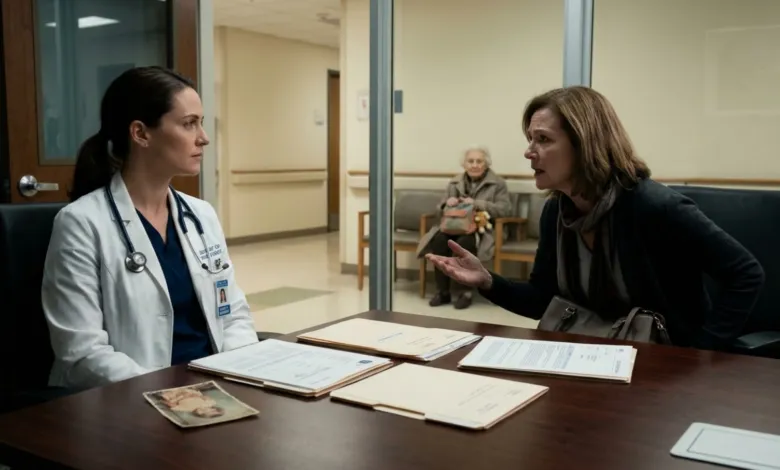
Instead of answering immediately, I reached for the second document.
“This is the original intake record from Saint Jude’s. It records the date you brought me there, the clothes I was wearing, the belongings you left with me, and the name of the person who signed me into the facility.”
Mom’s lips parted.
Additionally, I showed her another record.
“This is also the adoption record confirming that Michael and Olivia Kingsley legally adopted me two years later.”
Slowly, Tori lifted her head.
“Wait…”
Her eyes moved from the documents to my face.
Finally, I looked directly at her.
“My name is Annie.”
She stared at me.
“My birth name was Annie Saunders. My adoptive parents gave me their surname, but I never changed my first name.”
Suddenly, Tori’s hands began trembling.
“Nia?”
I nodded.
For a moment, she looked like a little girl again. Then, she covered her mouth.
“Oh my God.”
Her wheelchair moved slightly as she pushed herself forward.
“You’re Annie?”
I reached across the table and took her hand.
“Yes, Tory Bear.”
Reunited After Thirty Years
Immediately, she started crying.
These weren’t quiet or polite tears. Instead, she cried as though she’d recovered a piece of her childhood she’d believed was lost forever.
All along, that missing piece had been sitting directly in front of her.
“I knew it,” she whispered. “I knew that song. I knew I wasn’t imagining it.”
Gently, I squeezed her fingers.
“I’m sorry it took so long.”
However, she shook her head.
“No. No, don’t say that.”
Then, she leaned forward and wrapped her arms around me.
I held her carefully.
For thirty years, I’d imagined what seeing my sister again might feel like.
Sometimes, I’d imagined feeling angry. Other times, I’d wondered why she’d never looked for me.
However, as I held her, I finally understood something.
She had been five years old when I disappeared from her life.
My sister hadn’t abandoned me.
Instead, she’d grown up believing the same story our mother had told everyone else.
Across the table, Mom suddenly stood.
“This is ridiculous.”
Nobody moved.
Then, she pointed at me.
“You knew who I was when I came into your office?”
“Yes.”
“And you let me sit there without telling me?”
“I wanted to understand what you were looking for.”
“I was looking for my daughter!”
I looked directly at her.
“Which daughter?”
Her mouth opened. However, no words came out.
The Questions My Mother Couldn’t Answer
“You spent thirty years telling Tori that I ran away,” I continued.
“You went on television and said you didn’t know what happened to me. Yet here is your signature on the document showing you personally surrendered me.”
Mom shook her head.
“We were young. We were struggling. You don’t understand what things were like back then.”
“I was five, Mom.”
The word escaped before I could stop it.
Immediately, she froze.
For the first time in thirty years, I’d called her Mom.
It wasn’t something I’d planned or rehearsed. Nevertheless, hearing myself say it made the room feel smaller.
“I was five years old,” I repeated.
“I didn’t understand bills, rent, groceries, or how difficult life could become.”
“I only understood that my mother put me in a building, gave someone my clothes, and drove away with my sister.”
Mom looked down.
For once, she seemed unable to find an immediate answer.
However, the silence didn’t last.
“We couldn’t afford two children,” she said defensively. “We had to make a decision.”
Slowly, I nodded.
“And somehow, thirty years later, you still believe I was the extra one.”
Meanwhile, Vince cleared his throat.
“Annie, nobody is saying that now. We just need to focus on Tori.”
I turned toward him.
“You’re right. We do need to focus on Tori. That’s why we’re here.”
Then, I opened the third document.
The Kidney Compatibility Report
“This is my preliminary compatibility report.”
Immediately, Mom leaned forward.
“Then it’s true? You’re a match?”
“Yes.”
Her entire expression changed.
Suddenly, the anger disappeared. Her shoulders relaxed, and she even smiled.
“Oh, thank goodness. I knew everything would work out.”
She reached across the table, apparently intending to touch my hand.
However, I moved it away.
“There’s something else you need to understand.”
Her smile faded.
“The transplant evaluation is being handled by an independent team.”
“My medical records and donor evaluation have been separated from my surgical responsibilities.”
“Therefore, I will not be making the final decision about my sister’s treatment.”
Mom frowned.
“What does that mean?”
“It means I am not going to operate on my own sister, and I am not going to influence the medical team.”
“Fine. Whatever. When can you schedule the surgery?”
For a long moment, I looked at her.
“You haven’t asked whether I want to donate.”
She gave a small laugh.
“Why wouldn’t you?”
“Because it’s my body.”
Immediately, her expression hardened.
“Annie, don’t start this.”
Meanwhile, I looked toward Tori.
She had stopped crying. Instead, her eyes remained fixed on our mother.
Mom continued.
“You have two kidneys. Your sister is dying. What kind of person would refuse to help her own family?”
Something inside me suddenly settled.
It wasn’t anger or even sadness. Rather, it was a strange sense of clarity.
For thirty years, I’d wondered whether my mother regretted leaving me.
Now, I finally had my answer.
She regretted losing access to me.
There was a difference.
A Decision That Belonged to Me
Next, I opened the fourth document.
“This is the donor consent policy. It explains that living donation must be completely voluntary.”
“Nobody can force me, pressure me, threaten me, or use family obligation to make the decision.”
Mom rolled her eyes.
“Doctors and their paperwork.”
“No, Gail.”
Immediately, she looked up.
I’d stopped calling her Mom.
“This isn’t paperwork. This is my life.”
Once again, the room became silent.
Then, Tori spoke.
“Mom, stop.”
Gail turned toward her.
“What?”
“Stop asking her like that.”
“Victoria, stay out of this.”
However, Tori swallowed and continued.
“She just told you she’s my sister. She’s the person you’ve been telling me abandoned me.”
“And instead of asking her how she feels, you’re asking when she can give me a kidney.”
Mom’s face tightened.
“I am trying to save your life.”
“I know. But she’s a person, Mom. Not a spare-parts department.”
Meanwhile, the transplant coordinator lowered her eyes, trying not to react.
I almost smiled.
My little sister had grown up. Moreover, she was stronger than either of us had realized.
Mom grabbed her handbag.
“This meeting is going nowhere.”
Then, she turned toward me.
“I want to speak to you privately.”
“There is nothing we need to discuss privately.”
“I’m your mother.”
I looked down at the document bearing her signature.
“You were my mother when you signed that form, too.”
Her eyes filled with an emotion I couldn’t identify.
Nevertheless, she turned and walked out.
Vince followed her, and the conference room door closed behind them.
An Old Photograph From Our Childhood
For several seconds, nobody moved.
Eventually, Tori looked at me.
“I’m sorry.”
I shook my head.
“You don’t have to apologize for anything.”
“But she shouldn’t have said those things.”
Sadly, I smiled.
“She’s been saying those things for thirty years.”
Then, Tori reached into her sweater pocket and removed a small, folded piece of paper.
“I brought something.”
She placed it in front of me.
It was an old photograph.
A little girl with dark hair sat on the floor beside a baby wrapped in a white blanket.
Immediately, I recognized myself.
I was holding a stuffed bear. Meanwhile, Tori was barely old enough to sit up.
On the back, four words appeared in faded blue ink.
Annie and her Tory Bear.
Carefully, I touched the photograph.
“Where did you get this?”
“I found it in an old box at home. Mom said she’d thrown everything away, but she must have missed this one.”
For a moment, I simply stared at the picture.
For thirty years, I’d believed the photograph Mom brought into my office was the only surviving picture of my childhood.
Apparently, however, someone else had kept a memory.
Tori wiped her cheeks.
“I used to look at this when I was little. I thought you were somewhere waiting for me.”
My throat tightened.
“I was.”
She looked at me.
“Did you have a good life?”
After considering the question, I nodded.
“Yes. I did.”
The Family That Raised Me
I told her about Michael and Olivia.
For example, I described our first Christmas, when they let me choose whatever I wanted for dinner.
Additionally, I explained how Olivia had taught me to bake.
Michael used to bring medical textbooks home and pretend he needed my help studying.
Even when I was only twelve, he’d encourage my curiosity.
Then, I told her about medical school and the long nights of studying.
I described the first time I’d assisted in a transplant operation.
Finally, I shared the story of becoming chief of transplant surgery.
Throughout our conversation, Tori listened to every word.
When I finished, she smiled.
“I’m glad somebody loved you.”
I looked at her.
“Somebody loved you, too. Even if they didn’t always know how to show it.”
She lowered her eyes.
Then, she asked the question I’d been avoiding.
“Are you really going to give me your kidney?”
I took a breath.
“I want to make sure you’re medically safe. I want an independent team to evaluate everything.”
“And I want you to understand that you don’t owe me anything either.”
However, she shook her head.
“Annie, I don’t want you to risk your life because of me.”
“I know.”
“I mean it. I would rather stay on dialysis than lose you again.”
Gently, I reached across the table.
“You’re not losing me.”
She started crying again.
This time, I cried with her.
My Mother’s Latest Accusations
Three days later, the situation became more complicated.
Mom contacted the hospital administration.
She claimed I’d deliberately delayed Tori’s transplant because of a personal disagreement.
Additionally, she accused me of using my professional position to obtain confidential adoption documents.
Consequently, the hospital attorney requested a meeting.
I wasn’t concerned about the documents.
Every record I’d obtained belonged to my own legal adoption history or had come through appropriate channels.
However, I was deeply concerned about the pressure being placed on Tori.
She was already dealing with kidney failure, dialysis, exhaustion, and uncertainty about her future.
The last thing she needed was her family turning her medical treatment into a public argument.
That afternoon, the transplant coordinator called me.
“Dr. Kingsley, there’s something you should know.”
“What is it?”
“Your mother has contacted two local news stations.”
“She’s telling people that you are refusing to save your sister unless she apologizes for abandoning you.”
I closed my eyes.
Of course.
Once again, Mom had found a way to present herself as the victim.
“Has Tori seen it?”
“Not yet.”
“Please don’t let anyone show it to her.”
“I understand.”
After ending the call, I sat alone in my office.
Throughout my career, I’d learned to remain calm during emergencies.
I’d stood beside patients whose families were falling apart. Additionally, I’d delivered difficult news to people facing uncertain futures.
I’d also watched patients receive second chances through organ transplantation.
Nevertheless, nothing in medical school had prepared me for this particular pain.
The woman who had abandoned me still believed she had the right to decide what happened to my body.
A Conversation With My Adoptive Father
That evening, I went to see Dad.
He was sitting in his kitchen, reading a newspaper.
When I entered, he looked up.
“You look tired.”
“I am.”
Immediately, he put the newspaper down.
I told him about the meeting, the television calls, and Mom’s latest accusation.
Throughout the conversation, he listened without interrupting.
Afterward, he poured me a cup of tea.
“Annie, do you remember what you told me when you were sixteen?”
I shook my head.
“You said you wanted to become a doctor because you wanted to make sure nobody ever felt helpless in a hospital.”
Faintly, I smiled.
“I remember.”
“You’ve done that. You’ve helped people. You’ve built a life.”
“But don’t confuse being a good person with allowing people to hurt you.”
For a moment, I stared into my cup.
“What if I don’t donate?”
“Then you don’t donate.”
“What if Tori dies?”
Dad reached across the table.
“Then you will grieve. And you will wonder whether you could have done something differently.”
“But that doesn’t mean anyone had the right to force you into surgery.”
After a brief pause, he continued.
“Your sister deserves compassion. You deserve it, too.”
I looked at him.
“Would you be disappointed if I decided not to?”
However, he shook his head.
“I would be disappointed if you made the decision because someone frightened you into it.”
Then, he smiled.
“But if you choose to help her because you genuinely want to, I’ll be proud of you.”
“Either way, you’re my daughter.”
I reached for his hand.
Finally, for the first time in several days, I felt as though I could breathe again.
An Unexpected Visitor From Saint Jude’s
The following Monday, I received an unexpected visitor.
It was Lorraine Miller.
She was seventy-two now, with silver hair and a walking stick.
Although nearly six years had passed since our last meeting, I recognized her immediately.
When she entered my office, I stood.
“Lorraine!”
She smiled.
“Look at you. The little girl who used to hide apples under her pillow.”
I laughed.
“You remember that?”
“Of course. You were convinced someone would take them.”
Carefully, she sat down.
Then, she placed a small brown envelope on my desk.
“I brought something I should have given you years ago.”
Curiously, I looked at the envelope.
“What is it?”
“Something your mother left behind.”
Immediately, my stomach tightened.
“Another document?”
However, Lorraine shook her head.
“No. Something different.”
She opened the envelope and removed a small piece of paper.
It was a handwritten note.
Over the years, the paper had turned yellow. Furthermore, its edges had softened from repeated handling.
I recognized my mother’s handwriting immediately.
Meanwhile, Lorraine watched me carefully.
“Your mother wrote it the day she left you. She gave it to me and told me to keep it with your belongings.”
I stared at her.
“Why didn’t you tell me?”
“I wanted to. But when your adoption was finalized, the agency advised us to preserve the records.”
“Later, when you were old enough to understand, I didn’t know whether showing it to you would help or hurt.”
Slowly, I unfolded the note.
The Letter My Mother Left Behind
There were only a few lines.
Annie,
Your sister is too young to understand what’s happening. Please don’t let her forget that she had a big sister.
I hope someday you will understand that we had no choice.
Take care of her if you ever see her again.
Mom.
First, I read it once. Then, I read it again.
My fingers began trembling.
Meanwhile, Lorraine spoke softly.
“I never understood why she wrote that. She had just signed the surrender form.”
“But she seemed to believe you would somehow remain responsible for your sister.”
Carefully, I placed the note on my desk.
For years, I’d imagined my mother crying after leaving me.
Sometimes, I’d pictured her looking in the rearview mirror. Other times, I’d imagined her returning to the group home.
However, I now understood something even more painful.
Even when she left me, she’d been thinking about what I could do for the child she kept.
She hadn’t written about what I needed or whether I was frightened.
Furthermore, she hadn’t expressed concern about whether I’d have enough to eat.
Instead, she’d written instructions for a five-year-old child to take care of someone else.
I wiped my eyes.
“Did she ever come back?”
Lorraine shook her head.
“Not once.”
“Did she ever call?”
“No.”
Slowly, I nodded.
A Small Reminder of the Little Girl I Once Was
Then, Lorraine reached into her handbag and removed another small item.
It was the gray-and-red knitted hat.
I’d worn it on the day my mother left me.
Carefully, I picked it up.
It was smaller than I remembered. Moreover, the gray wool had faded, and one red thread had come loose near the edge.
I pressed it against my chest.
“I thought this was gone.”
Lorraine smiled sadly.
“You left it on a chair that afternoon. I picked it up because I thought you might want it someday.”
I looked at her.
“Thank you.”
Gently, she squeezed my hand.
“You were a very brave little girl, Annie. But you shouldn’t have had to be.”
Those words broke something open inside me.
Suddenly, I began crying.
It wasn’t because I wanted my mother back. Neither did I regret the life I’d built.
Instead, I cried because someone had finally acknowledged what happened without trying to explain it away.
For the first time, someone had recognized that I’d deserved better.
My Sister’s Condition Worsens
Two days later, Tori’s medical condition deteriorated.
Her blood pressure dropped during dialysis. Additionally, she developed a serious infection.
Although the medical team stabilized her, her doctors warned that her condition was becoming increasingly fragile.
That evening, I visited her.
She was awake, staring at the ceiling.
When she noticed me, she smiled weakly.
“Hey, Nia.”
“Hey, Tory Bear.”
She shifted slightly.
“Mom came to see me.”
I pulled a chair closer to her bed.
“What did she say?”
Tori looked toward the window.
“She said you were punishing her.”
I sighed.
“I’m sorry.”
“She also said she never meant to abandon you.”
However, I didn’t answer.
Tori continued.
“She said she thought the group home would take care of you until she could come back.”
I looked directly at my sister.
“Did she tell you why she never came back?”
She shook her head.
“Not really.”
For a moment, I sat quietly.
Then, I told her about the handwritten note.
Additionally, I showed her the photograph and the old knitted hat.
When she saw the note, her eyes filled with tears.
“She wrote that?”
“Yes.”
Slowly, Tori read the words.
Afterward, she handed the note back.
“I think she wanted me to believe you were responsible for leaving.”
I nodded.
“She told you I ran away.”
“Yes.”
“She told the television audience she didn’t know where I was.”
“Yes.”
Finally, Tori closed her eyes.
“I don’t know what to believe anymore.”
I reached for her hand.
“You don’t have to figure everything out tonight.”
Gently, she squeezed my fingers.
The Question My Sister Had Carried for Years
Then, Tori asked something quietly.
“Did you hate me?”
Surprised, I stared at her.
“What?”
“When we were little. When Mom kept me and left you. Did you ever hate me for being the one they chose?”
Immediately, my throat tightened.
“Tori, you were five.”
“But I was the one who stayed.”
“You were a child. Just like me.”
She started crying.
“I wish I could remember more.”
Carefully, I brushed a tear from her cheek.
“You don’t have to remember everything for it to be real.”
She looked at me.
Then, she smiled faintly.
“Will you sing the bear song again?”
Softly, I laughed.
“Of course.”
I began humming the familiar little melody.
It was the same song I’d sung in the back of that red Ford Escort.
Additionally, it was the melody I’d hummed while waiting for her blood pressure to stabilize.
Somehow, she still remembered it from a childhood she’d almost forgotten.
Slowly, her eyes closed.
As I continued humming, I realized that the little girl in the red car had never truly disappeared from either of our lives.
Instead, thirty years of silence had separated us.
Making My Own Decision
The following morning, I made my decision.
I contacted the independent transplant coordinator and requested a formal donor evaluation.
First, I wanted every necessary medical test completed.
Additionally, I wanted an independent physician to explain every risk.
Psychological counseling was also important to me.
Above all, I wanted the medical team to document that the decision belonged entirely to me.
The coordinator agreed.
Several weeks later, following extensive testing and review, the independent transplant team confirmed that I was medically suitable to donate.
Furthermore, they confirmed that I understood the risks and had made my decision without coercion.
Eventually, the coordinator asked me one final time whether I wanted to proceed.
I looked at the photograph of two little girls sitting together on the floor.
One held a stuffed bear. Meanwhile, the other was wrapped in a white blanket.
Then, I answered.
“Yes.”
It wasn’t because my mother demanded it.
Neither was it because she’d given birth to me or because I owed anyone a kidney.
Instead, I said yes because Tori was my sister.
I wanted her to have the opportunity to live a long life.
However, there was one more thing I needed to do before surgery.
I needed to speak to my mother.
This time, I wouldn’t approach her as the chief of transplant surgery, the donor, or the daughter she’d suddenly remembered.
Instead, I would speak as the little girl she’d left behind.
And this time, I wouldn’t let her change the story.
Part 4: The Conversation Before Surgery
The day before surgery, I asked my mother to meet me.
However, I didn’t invite her to my office or the hospital conference room.
Instead, I chose the small family waiting room on the fourth floor.
Tori had spent countless afternoons there waiting for her dialysis appointments.
Mom arrived twenty minutes late.
She wore the same lilac coat she’d worn the first day she entered my office.
Meanwhile, Vince followed her, carrying a paper cup of coffee.
Mom looked around the room.
“Where is Victoria?”
“She knows we’re meeting. She wanted some time alone.”
Mom frowned.
“Why are we doing this now? The surgery is tomorrow. We should be celebrating.”
I gestured toward the chair opposite me.
“Please sit down.”
She sat.
Then, I placed three things on the table.
First, the old photograph of Tori and me.
Next, the gray-and-red knitted hat.
Finally, the handwritten note she’d left at Saint Jude’s thirty years earlier.
Mom stared at the items.
Immediately, her expression changed.
“Where did you get those?”
“Lorraine kept them.”
Carefully, she picked up the photograph.
For a moment, she looked almost human in her sadness.
Then, she placed it back on the table.
“I remember that day.”
I waited.
She rubbed her forehead.
“You were always attached to your sister. You followed her everywhere.”
“You wouldn’t even let me carry her without asking where you were going.”
Sadly, I smiled.
“I was five. She was my little sister.”
Asking for the Truth
Mom looked at the photograph again.
“You don’t understand what happened back then.”
“Then explain it to me.”
She sighed.
“Your father had lost his job. We were behind on rent.”
“Tori was sick all the time, and we couldn’t afford everything.”
“Someone at the social services office told us there were families who could take care of children temporarily.”
I looked directly at her.
“Temporarily?”
“Yes.”
“Then why did you sign a voluntary surrender form?”
Uncomfortably, she shifted in her chair.
“I didn’t know what else to do.”
“Why didn’t you come back?”
She didn’t answer.
“Why didn’t you call?”
Again, silence.
“Why did you tell Tori I ran away?”
Finally, her eyes lifted.
“I didn’t want her to grow up thinking her parents abandoned her.”
I stared at her.
“So you gave her a different story and made me the person who abandoned everyone.”
“That wasn’t what I intended.”
“But that’s what happened.”
At that point, Vince finally spoke.
“Annie, people make mistakes. Your mother was under enormous pressure.”
“We shouldn’t spend the rest of our lives punishing her for something that happened thirty years ago.”
I turned toward him.
“Were you there?”
Confused, he looked at me.
“What?”
“When I was left at Saint Jude’s. Were you there?”
He shook his head.
“No. I met your mother later.”
“Then you weren’t part of that day. But you’ve spent years helping her maintain the lie.”
Vince looked down.
A Happy Life Doesn’t Erase the Past
Then, I turned back toward Mom.
“I need you to understand something. I had a good life.”
“Michael and Olivia loved me. They gave me everything I needed. I’m grateful for that every day.”
Mom nodded quickly.
“Of course. That’s wonderful.”
“However, having a good life doesn’t erase what happened when I was five.”
Her expression hardened.
“I said I was sorry.”
“No. You said you had no choice. Those are different things.”
She stared at me.
Nevertheless, I continued.
“You came into my office because Tori needed a kidney. You didn’t recognize me.”
“You didn’t ask whether I was happy or what happened to me.”
“You didn’t even wonder whether I had survived.”
Mom looked away.
“I didn’t know it was you.”
“That is exactly the point.”
For several seconds, the air conditioning was the only sound in the room.
Then, I pushed the handwritten note toward her.
“Read it.”
Initially, she hesitated.
Eventually, she picked it up.
Her eyes moved slowly across the words.
Please don’t let her forget that she had a big sister.
Take care of her if you ever see her again.
Mom.
When she finished reading, she placed the paper on the table.
“I was hoping you would always love your sister.”
I swallowed.
“I did.”
She looked at me.
“I never stopped.”
What My Mother Finally Admitted
Mom’s eyes filled with tears.
Then, she said something I hadn’t expected.
“I was afraid.”
I waited.
“I thought you would hate us. I thought if you ever found out what happened, you would never want anything to do with us.”
Slowly, I nodded.
“Maybe you were right.”
She started crying.
“But now you have come back,” she said. “And you’re saving your sister. Maybe we can finally be a family again.”
For a long moment, I looked at her.
Then, I shook my head.
“Tomorrow, I’m donating a kidney to Tori. I’m not donating my life back to this family.”
Her face fell.
“Annie…”
“I can love my sister without pretending you didn’t hurt me.”
She reached across the table.
However, I didn’t move.
“I don’t know whether I’ll ever be able to have a relationship with you,” I explained.
“Maybe someday. Maybe never. But if we ever try, it has to begin with the truth.”
She wiped her cheeks.
“What truth?”
“The truth that you left me. That you didn’t come back.”
“That you told Tori I ran away. And that you went on television and lied about not knowing what happened.”
Finally, Mom lowered her head.
I Was No Longer Waiting
I stood.
“I don’t need you to give me anything.”
“I don’t need an apology for the cameras, money, or for you to call me your daughter in front of strangers.”
For a moment, I paused.
“I needed a mother when I was five. I needed one when I was ten.”
“I needed one when I was sixteen and wondering why nobody had ever come looking for me.”
My voice trembled.
“But I don’t need to keep waiting.”
Carefully, I picked up the photograph.
“Tomorrow, I’m going into surgery because I choose to.”
“Please don’t turn that into proof that you were right to abandon me.”
Then, I walked out.
Behind me, my mother began crying.
I heard her say my name.
However, I didn’t turn around.
For once, I didn’t feel guilty about walking away.
Related Articles
I Gave My 12-Year-Old Son Our Last $30 for a Thanksgiving Turkey — An Hour Later, My Neighbor Called in Tears
My Husband Wore My Wedding Dress to Stop Our Son’s Wedding — And He Had a Very Good Reason
Natalie Replaced Her Gender Reveal Slideshow With Ryan’s Messages — Leaving Everyone Speechless