My name is Alva Hartley. I’m 58 years old, and I live in a little rented duplex on the east side of Pueblo, Colorado.
There’s a chain-link fence, a crabapple tree, and a neighbor who plays Marty Robbins records too loudly on Saturday nights.
Until last spring, however, my life looked considerably different. I lived in a four-bedroom house on six acres out on Boone Road.
We had a barn, a horse pasture, and a kitchen where I’d personally chosen every cabinet.
I was married to Devlin Hartley for 31 years.
The Tuesday That Changed My Life
Devlin came home on a Tuesday in April. I remember because Tuesday was meatloaf night.
Dinner was already in the oven, and the entire house smelled like ketchup and onions.
He walked through the back door at 6:15, later than usual. However, he didn’t remove his boots as I’d asked him to for three decades.
Instead, he stood in the middle of my kitchen with muddy boots and his truck keys in his hand.
“Alva,” he said. “Sit down.”
Rather than sitting, I remained beside the stove, holding a pot holder.
“I’m in love with Kendra,” he announced.
Kendra was his assistant. She had worked for Hartley Roofing for two years, answering phones and managing the schedule.
At 34, she wore long blond extensions and remarkably long fingernails. More than once, I’d wondered how she managed to type.
I’d met her at the company Christmas party. During our conversation, she’d hugged me and described my green bean casserole as “so retro.”
The Words I Never Expected
“I want a divorce,” Devlin continued. “I’ve thought about it a long time. I deserve to be happy, Alva. I’m sixty. I don’t have that many years left. For the years I’ve got, I deserve to be happy.”
Behind me, the oven timer went off. Although the meatloaf was ready, I couldn’t bring myself to move.
“How long?” I asked.
“Does it matter?”
“It matters to me.”
He looked down at the floor.
“About a year.”
Meanwhile, the timer continued beeping.
Finally, Devlin reached past me and turned off the oven himself. Then he walked outside, climbed into his truck, and drove away.
I remained in the kitchen until the meatloaf was cold.
Afterward, I threw everything into the trash, including the pan.
Everything I Had Given Our Marriage
I’d given that man 31 years of my life.
Together, we had two children, Josie and Cody. Josie is now 29 and works as a dental hygienist in Colorado Springs.
Meanwhile, Cody is 26 and works for his father.
When Devlin established Hartley Roofing in 1998, he had one truck, two ladders, and a loan from his father.
After the children went to bed, I kept the company’s books at our kitchen table.
Initially, I handled payroll, invoices, and quarterly taxes using an adding machine. Later, I taught myself to use a computer with help from a library book.
Moreover, I prepared lunches for his roofing crews every summer.
Even in hundred-degree heat, I delivered coolers filled with ham sandwiches and iced tea to his job sites.
Eventually, the company grew to include 12 trucks and 30 employees.
Devlin hired a bookkeeper and an office manager. Then he hired Kendra and told me I could finally relax.
Unfortunately, I didn’t realize I’d be relaxing all the way out the door.
The Divorce Settlement
Devlin’s lawyer was exceptionally good at his job.
His name was Garrett Pruitt. He worked in a glass building downtown on Main Street.
Inside his office was a framed photograph of him shaking hands with a governor.
Garrett wore cufflinks. Later, I discovered that he charged $450 an hour.
Naturally, Devlin paid every penny through the business.
My lawyer, however, was a kind young woman from Colorado Legal Services named Rosa Delgado.
She was 29, a year older than my daughter at the time.
Her tiny office on Abriendo Avenue had a water stain on the ceiling shaped like Texas.
Rosa was intelligent, hardworking, and genuinely believed me. Nevertheless, she had 140 other cases and no secretary.
Garrett Pruitt ran over her like a cattle truck.
Fighting for My Share
Devlin kept our house on Boone Road. Additionally, he kept his 22-foot Bayliner, which he stored at Lake Pueblo.
He only used that boat about four times each summer.
More importantly, he kept Hartley Roofing, including its trucks, equipment, contracts, and name.
Garrett argued that the company was Devlin’s “separate enterprise.” Furthermore, he described my years of bookkeeping as “informal household assistance.”
Rosa fought that argument relentlessly.
She even arranged for a forensic accountant to examine the company’s financial records.
Unfortunately, we couldn’t afford to retain him for very long.
Ultimately, the judge reached a compromise that favored Devlin considerably more than me.
What Was Left for Me
Devlin also kept most of our savings.
There was approximately $240,000 in retirement accounts and a money market account at Legacy Bank.
During mediation, he insisted that he’d earned it.
Across the long conference table, he wore a sport coat I’d purchased for our 25th wedding anniversary.
“I’m the one who was out on those roofs in August, Alva,” he said. “Not you. I earned that money with my own two hands.”
Instead of responding, I looked at his hands resting on the table.
They certainly had calluses.
However, one wrist also carried a heavy, brand-new gold watch I’d never seen before.
When everything was finalized, I received a check for $62,000.
Apparently, that was my share of 31 years after Garrett Pruitt finished his calculations.
Additionally, I received my 2014 Honda Accord, which had 160,000 miles on it.
I kept my mother’s china, my sewing machine, and the guest room furniture.
However, there was one more thing.
His father’s old pickup truck.
The Man Behind the Old Pickup
I should tell you about Elmer.
Elmer Hartley was Devlin’s father. He had died six years earlier at the age of 87.
As a rancher, he raised cattle on 400 acres south of Pueblo.
His property stretched beyond Rye toward the Wet Mountains, on land his father had homesteaded in 1911.
Elmer was tall, thin, and quiet. His face resembled a dry creek bed, while his hands felt like old saddle leather.
Generally, he didn’t like many people.
According to Elmer, most people talked too much without saying anything meaningful.
He didn’t attend church or visit town unless necessary. In fact, he didn’t own a television until 1994.
However, he liked me.
I’m not entirely sure why. Perhaps it was because I didn’t talk too much either.
The First Sunday
Devlin first took me to meet Elmer in 1992, when we were engaged.
Throughout that afternoon, Elmer barely said three words to me.
However, as we prepared to leave, he walked me to Devlin’s car.
“You know how to make biscuits?” he asked.
“Yes, sir. My grandmother’s recipe.”
“Huh,” Elmer replied.
That was all.
The following Sunday, I drove to the ranch alone.
On the passenger seat were a pan of biscuits and a pot of chicken and dumplings wrapped in towels.
When Elmer opened his door, he looked at the food in my hands. Then he looked at me.
“Devlin’s not with you,” he observed.
“No, sir. He had a job.”
For a long moment, Elmer stood silently in the doorway.
Finally, he stepped aside and invited me inside.
A Tradition That Lasted 25 Years
After that, I visited every Sunday for 25 years.
I’d attend the early service at First Methodist. Then I’d drive 45 minutes to the ranch with a hot dinner beside me.
Sometimes, I brought pot roast or fried chicken. During winter, I often prepared green chile stew.
Meanwhile, summer meant peach, cherry, or rhubarb pie. The rhubarb came from the plant beside his back steps.
We ate together at his kitchen table.
Afterward, we’d sit in two old wooden chairs on his front porch and admire the mountains.
Some Sundays, we talked for hours. Other Sundays, we didn’t speak at all.
Either way, we were perfectly comfortable.
Devlin, however, visited perhaps four or five times a year.
He came for Christmas, Elmer’s birthday, and occasionally when he needed money for the business.
When Elmer Needed Someone
Eventually, Elmer’s health began deteriorating.
First, he experienced heart problems. Then his kidneys started failing, followed by several other complications.
I became the person responsible for his care.
For example, I drove him to appointments at Parkview Medical Center in Pueblo and sat in the waiting rooms.
Additionally, I collected his prescriptions from Walgreens on Northern Avenue.
During his final two months, Elmer could no longer stay alone.
Consequently, I drove to the ranch every day and remained there until the night nurse arrived.
I gave him his medication, changed his sheets, and read Louis L’Amour novels aloud.
Although he’d already read those books a hundred times, I continued reading them to him.
Meanwhile, Devlin was always too busy.
“Roofing season, Alva,” he’d explain. “You know how it is. Somebody’s got to make the money around here.”
A Rusty 1957 Chevrolet Pickup
Elmer owned a 1957 Chevrolet pickup.
Its faded green paint resembled an old dollar bill. Meanwhile, the original white trim had gradually turned yellow.
The truck had rusty fenders, a cracked windshield, and a dent in the tailgate.
According to Elmer, a cow had kicked it in 1974.
The cracked leather seat had several patches of duct tape.
Elmer once told me that he’d purchased the truck brand-new in the spring of 1957.
At the Chevrolet dealer on Union Avenue, he spent money he’d saved for 11 years.
For the next 45 years, he drove it every single day.
Eventually, his eyesight deteriorated, and he could no longer drive.
Afterward, the pickup remained inside his barn.
When Elmer died and Devlin sold the ranch, he arranged for the truck to be towed to our barn.
Devlin promised that he would “fix it up someday.”
However, he never touched it.
For six years, the pickup remained behind an old lawn tractor and a stack of shingles.
Dust accumulated, mice built nests, and all four tires went flat.
Furthermore, the engine no longer ran.
Barn swallows had even built a nest on top of the cab.
The One Thing Devlin Didn’t Want
During our divorce mediation, Rosa requested the old pickup.
Devlin immediately laughed.
“The truck? Dad’s old truck?”
He looked at Garrett Pruitt before laughing again.
“Take it. It’s worth maybe five hundred bucks for scrap. If that. Enjoy.”
Garrett made a note on his legal pad without objecting.
However, I’d been thinking about that pickup for months, ever since the evening Devlin left.
Therefore, I leaned toward Rosa and whispered something.
Before the agreement was typed, she added another line in her neat handwriting.
“The 1957 Chevrolet pickup truck, VIN on file, and all of its contents.”
Devlin didn’t even bother reading it.
Instead, he was eager to leave.
Kendra was waiting outside in his new black Ram, with the engine running and music playing.
Throughout the mediation, he’d checked his phone four times.
When Garrett finally handed him the settlement agreement, Devlin signed wherever the yellow sticky arrows indicated.
Without reading a single word, he pushed the documents back across the table.
I, however, read every page.
Twice.
Only then did I sign.
Leaving the House I Once Called Home
In July, on the day I moved out, I hired a towing company to collect Elmer’s pickup.
A man named Hector arrived from Pueblo with a flatbed truck and a winch.
Because all four tires were flat, extracting the pickup from the barn took nearly an hour.
Meanwhile, the barn swallows protested loudly.
Devlin and Kendra watched everything from the front porch.
Although it was only two in the afternoon, Kendra was holding a glass of white wine.
Furthermore, she was wearing my old gardening hat.
I’d left it hanging beside the back door.
Eventually, Hector secured the pickup onto the flatbed.
There it sat beneath the sunshine, green, rusty, and neglected.
Its windshield was cracked, its tires were flat, and a bird’s nest remained on the cab.
“Good luck with your junk!” Kendra called from the porch, raising her wine glass.
Devlin laughed.
For a moment, I looked at them standing on the porch I’d swept every morning for 22 years.
“Okay,” I replied.
Then I climbed into my Honda and followed the tow truck down the long gravel driveway.
I never looked back.
A Promise Made Six Years Earlier
What Devlin didn’t know was what his father had told me two days before he died.
It happened on a Thursday evening in October, six years earlier.
By then, Elmer was in a hospital bed at Parkview.
Because his breathing had deteriorated, doctors had admitted him the previous week.
As usual, I sat beside his bed that evening.
Devlin had visited that afternoon. However, he stayed for only 15 minutes before leaving.
Elmer had slept through most of the day.
Around seven o’clock, he woke up and reached for my hand.
His fingers were thin and cold, with little more than bones beneath his weathered skin.
“Alva,” he whispered.
His voice was barely audible.
“I’m right here, Elmer.”
Suddenly, he tightened his grip with more strength than I’d expected.
“Don’t ever let my son sell that truck,” he said. “You hear me? Don’t you let him sell it. When the time is right, somebody will come. You’ll know.”
His Final Request
Initially, I thought he was confused.
The doctors had given him considerable medication for his pain. Consequently, he sometimes said unusual things.
The previous day, he’d asked whether I’d fed the horses.
However, he hadn’t owned a horse since 1988.
“Okay, Elmer,” I assured him. “I won’t let him sell it.”
“Promise me.”
“I promise.”
He nodded slowly before closing his eyes.
Afterward, he barely spoke again.
Two days later, on Saturday morning, he passed away while I held his hand.
Meanwhile, Devlin was working at a job site in Cañon City.
I never told Devlin about his father’s request.
At the time, I dismissed it as the confused words of a seriously ill man.
Moreover, the pickup remained in our barn for six years without attracting Devlin’s attention.
He never attempted to sell it because he never thought about it.
Consequently, I’d never needed to act on my promise.
That changed during mediation.
When Devlin laughed and described the pickup as $500 worth of scrap, I remembered everything.
The hospital room, Elmer’s cold hand, and the promise I’d made.
Starting Over in a Small Duplex
When I reached my rented duplex, Hector unloaded the pickup behind the building.
He placed it beneath the crabapple tree, on a gravel strip between my back door and the alley.
I paid him $220.
Afterward, he examined the truck sitting on its four flat tires before turning toward me.
“Ma’am, you want me to haul it to the scrapyard instead? I could get you a couple hundred for it.”
“No,” I answered. “It stays.”
He shrugged and drove away.
For months, I didn’t touch the truck.
In fact, I didn’t even open its doors.
I’m not entirely sure why.
Perhaps I feared discovering nothing except mouse nests and old receipts.
Then I’d have to admit that I’d fought over a worthless vehicle because of a dying man’s unusual request.
However, another part of me still considered it Elmer’s truck.
Somehow, going through his belongings didn’t feel right.
Therefore, the pickup remained beneath the crabapple tree.
In August, my landlord, a retired postman named Mr. Archuleta, politely asked about it.
I explained that it belonged to my late father-in-law and that I wasn’t ready to move it.
He nodded and never mentioned it again.
Building a Different Life
Eight months passed.
I found a front desk position at a physical therapy clinic on Pueblo Boulevard.
The job paid $16 an hour, and I worked 28 hours each week.
Because I didn’t know what else to do, I deposited most of my $62,000 into a credit union CD.
Meanwhile, I lived on the remaining money.
I rarely saw Devlin. Nevertheless, I occasionally heard about his new life.
Kendra had moved into the Boone Road house in August.
Apparently, they had remodeled my kitchen.
They removed the oak cabinets I’d chosen and replaced them with white cabinets featuring gold hardware.
Additionally, Devlin had purchased another boat, larger than his previous one.
Most of those updates came from Cody.
My son was only 26, worked for his father, and found himself in a difficult position.
Therefore, I tried not to make things harder for him.
Whenever he shared something, I simply replied, “Okay, honey,” before changing the subject.
My First Thanksgiving in the Duplex
Thanksgiving was quiet that year.
Josie drove down from Colorado Springs the previous evening.
Together, we prepared dinner in my tiny kitchen, constantly bumping elbows.
We made a small turkey breast, mashed potatoes, my grandmother’s biscuits, and a pumpkin pie.
Afterward, we ate at my little card table in the living room while watching the Lions game.
Meanwhile, Cody spent Thanksgiving with Devlin and Kendra at the Boone Road house.
He called that morning to wish me a happy Thanksgiving.
His voice sounded small.
“I’m sorry, Mom.”
“Don’t be sorry, honey,” I reassured him. “You go be with your dad. I’m fine. Josie’s here.”
“Kendra’s making a tofu turkey,” he added.
“Well,” I replied. “Good luck with that.”
Josie laughed so hard that she had to put down the potato masher.
Unfortunately, she needed to work on Friday.
Therefore, she returned to Colorado Springs that evening.
I washed the dishes alone and went to bed early.
Throughout the entire evening, I never thought about the pickup.
However, the following morning brought an unexpected visitor.
A Stranger Knocked on My Door
At exactly nine o’clock on the morning after Thanksgiving, somebody knocked on my front door.
Still wearing my bathrobe, I was drinking coffee and completing the Pueblo Chieftain crossword at my card table.
Initially, I considered ignoring the knock.
Nobody usually visited me at nine in the morning. Therefore, I assumed someone was selling something.
Eventually, I opened the door, leaving the security chain attached.
A man in his sixties stood on my small concrete porch.
He was tall and thin, with a gray mustache and a weathered face.
His expensive gray suit was the kind rarely seen around Pueblo.
Additionally, he wore a white shirt and a bolo tie featuring a turquoise stone.
However, his brown cowboy boots were old and worn as soft as gloves.
A leather folder rested beneath his arm.
He removed his gray Stetson and held it against his chest.
“Good morning, ma’am. I’m sorry to come so early on a holiday weekend. Are you Alva? Elmer Hartley’s daughter-in-law?”
Through the narrow opening, I studied his face.
“I was,” I answered.
He nodded slowly.
“I heard about that, ma’am. I’m sorry.”
“Who are you?”
An Old Friend From Santa Fe
“My name’s Bertrand Ashby,” he explained. “I’m a collector. Out of Santa Fe. Old cars and trucks, mostly.”
He told me that he and Elmer had known each other for 40 years.
They’d met at a cattle auction in La Junta in 1981.
Apparently, they’d spent three hours arguing about Herefords versus Angus cattle.
“He was wrong, but I liked him anyway.”
Bertrand smiled slightly beneath his mustache.
“Before he passed, he made me promise him something. I’ve been waiting six years to keep that promise.”
Then he pointed past the side of my duplex.
Beyond the gravel strip stood the crabapple tree. Underneath its branches was Elmer’s old green pickup.
An Unexpected $85,000 Offer
“I’d like to buy that truck,” Bertrand announced. “I’m prepared to pay you eighty-five thousand dollars for it. Cash. Today.”
He explained that his folder contained a cashier’s check from First Bank of Santa Fe.
However, he was willing to pay in cash if I preferred.
I nearly fell over.
Immediately, I grabbed the doorframe for support.
“For that?” I asked. “That truck? It doesn’t even run, Mr. Ashby. The tires are flat. There’s a bird’s nest on the roof.”
He smiled.
“Ma’am, that truck’s worth a lot more than you think.”
According to Bertrand, Elmer’s pickup was a 1957 Chevrolet Cameo Carrier.
Chevrolet had produced only about 2,200 of them that year.
Furthermore, Elmer had purchased it directly from the dealership on Union Avenue.
Throughout its history, he’d been its only owner.
The engine was original. Additionally, the remaining paint was original.
Elmer had also preserved every receipt and service record since the day he purchased it.
Bertrand explained that collectors valued vehicles with such extensive ownership histories.
In fact, he’d been trying to purchase the pickup from Elmer since 1985.
However, Elmer had always refused.
With my hand resting on the doorframe, I stood silently while my coffee grew cold.
“Then why now?” I finally asked.
The Promise Bertrand Had Made
“Because he made me promise,” Bertrand replied.
Two weeks before his death, Elmer had called him in Santa Fe.
Surprisingly, it was the first time Elmer had ever called him.
Bertrand repeated what my father-in-law had said.
“Bert, when I’m gone, my boy’s going to have that truck. He’s going to let it rot in a barn because he doesn’t know what it is.”
Elmer had continued explaining that someday the pickup would belong to me.
“When it does, you go to her and make her a fair offer. Not a collector’s offer. A fair one.”
Bertrand shook his head.
Naturally, he’d asked Elmer how he could possibly know that I’d eventually receive the pickup.
Elmer’s response had been simple.
“I know my son.”
For a moment, I couldn’t say anything.
Bertrand explained that he’d been keeping an eye out for the vehicle.
A friend in Pueblo knew Hector Rubio, the man who had towed it.
When Hector mentioned moving a 1957 Cameo from the Hartley property to an east-side duplex, Bertrand immediately understood.
However, Elmer had specifically instructed him to wait.
He wanted me to have time to settle into my new home and allow things to calm down.
Consequently, Bertrand waited until after Thanksgiving.
One More Instruction
Then he reached into his suit jacket’s inside pocket.
“But ma’am, before you say yes, Elmer asked me to make sure you did one thing first.”
Apparently, Elmer had been particularly insistent about this request.
He’d even made Bertrand repeat the instructions over the phone.
Bertrand extended his hand.
Resting in his palm was a small, rusty key attached to a loop of old leather string.
“He said, ‘Tell her to look under the seat.'”
Opening Elmer’s Pickup for the First Time
I removed the chain from my front door.
Although I don’t remember putting on my shoes, I must have.
After all, the gravel didn’t hurt my feet.
Still wearing my bathrobe, I walked around the duplex.
Bertrand followed a few steps behind, holding his hat.
The morning was cold and bright. Meanwhile, frost covered the crabapple branches.
The old green pickup remained beneath the tree.
Frost coated its cracked windshield, while dead crabapple leaves covered the hood.
My hands were shaking as I approached the driver’s side.
Initially, the handle wouldn’t move.
Therefore, I pulled harder.
Finally, the door opened with a long, familiar creak.
Immediately, the smell reached me.
There was dust, old leather, motor oil, and something else.
Something that reminded me of Elmer.
Pipe tobacco and hay.
I hadn’t experienced that smell in six years.
For a moment, I simply stood there with my hand resting on the door.
Something Beneath the Seat
The brown leather bench seat was cracked and patched with silver duct tape in three places.
Carefully, I reached beneath its front edge, as though lifting a couch cushion.
However, the seat was stiff and heavy.
My first attempt accomplished nothing.
Therefore, I pulled again, using both hands.
Finally, the seat lifted with a crack and a cloud of dust.
It was hinged at the back, like many old truck seats.
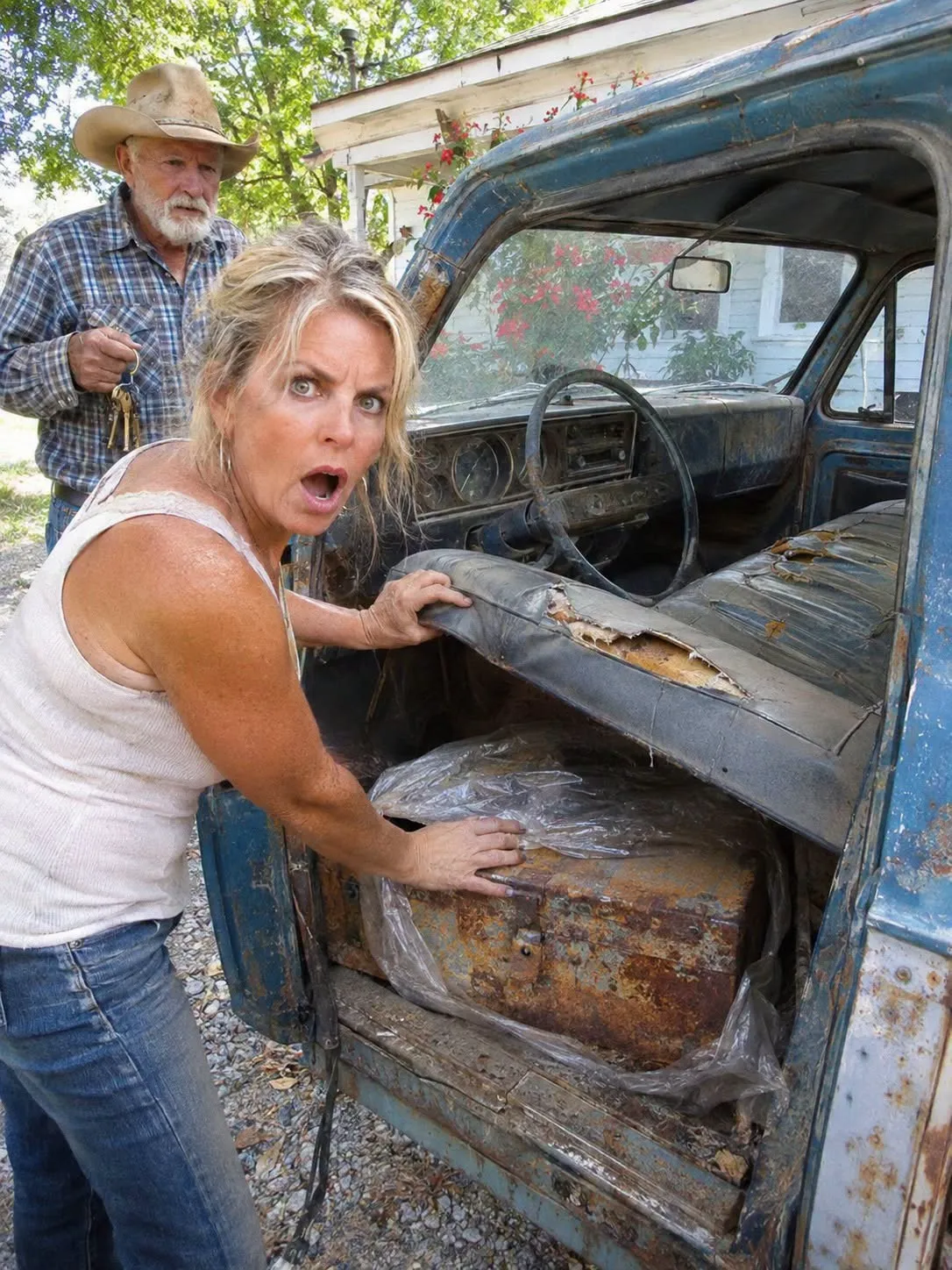
Underneath it was a metal box.
The gray steel container was approximately the size of a shoebox.
It resembled something used to store tools or important documents.
Furthermore, someone had carefully wrapped it in a heavy, clear plastic bag, similar to those used for animal feed.
The plastic had been folded repeatedly and secured with gray duct tape.
Beneath the wrapping, white letters appeared on the lid.
Someone had painted them using a small brush.
The handwriting was careful but shaky.
It spelled my name.
ALVA.
For a long time, I stood in the cold, staring at the box.
“I don’t know what’s in it, ma’am,” Bertrand said quietly. “I swear to that. He never told me.”
He explained that Elmer had only instructed him to tell me where to look.
“I’ll wait out front, if you’d like some privacy.”
“No,” I replied. “Stay. Please.”
Opening the Metal Box
Carefully, I lifted the box.
Surprisingly, it was much heavier than it appeared.
After carrying it inside, I placed it beside my coffee cup and unfinished crossword.
Then I used kitchen scissors to cut through the plastic and duct tape.
A small padlock secured the lid.
The rusty key Bertrand had given me fit perfectly.
Finally, I opened the box.
On top was a plain white envelope that had yellowed with age.
Once again, my name appeared in Elmer’s familiar handwriting.
Beneath the envelope was a stack of something wrapped in a blue checked dish towel.
Immediately, I recognized it.
The towel belonged to me.
It was one of the towels I’d used to wrap biscuits before my Sunday visits to the ranch.
Over the years, several of those towels had disappeared.
I’d always assumed Elmer was simply terrible at returning them.
Before examining the wrapped bundle, however, I opened the envelope.
My hands shook so badly that I tore it.
Inside was a letter written in pencil on a single sheet of lined paper.
The Letter Elmer Had Left Behind
Alva,
If you’re reading this, then my son did what I figured he’d do, and you’re the one who’s got the truck.
I’m sorry about that, honey. Whatever he did, I’m sorry. Since I raised him, some of it’s on me.
I want you to know a few things.
Every Sunday for twenty-five years, you drove out here with a hot dinner. You never once asked me for anything.
Not once did you ask about the ranch, the money, or what I was leaving to anyone.
Instead, you just sat on my porch and ate pie with me and looked at the mountains.
Do you know how rare that is? I’ve known a lot of people in eighty-seven years. Most of them wanted something. You never did.
So I started putting something aside for you.
Every Sunday after you left, I’d take a little money down to the bank in Rye. There, I’d buy a savings bond in your name.
Twenty-five dollars, at first. Later on, fifty, when cattle prices were good.
I never told you because you’d have told me to stop. After all, I know you. You’re as stubborn as I am.
They’re all in here, wrapped in one of your dish towels. I know you’ve been wondering where those went.
The bonds are in your name, not Devlin’s. They’re yours and nobody else’s.
I asked the man at the bank, and he says that’s how it works. My son can’t touch them.
Elmer’s Final Instructions
About the truck. Bert Ashby has been trying to buy that truck off me since Reagan was president.
He’s a good man and an honest one.
If he comes, and he will, you sell it to him if you want to. Or keep it. It’s yours either way.
But don’t you ever sell it to anybody my son sends, and don’t sell it for scrap.
You were more of a daughter to me than I ever had a right to. Thank you for the biscuits.
Elmer
I placed the letter on the card table before covering my face with my hands.
Meanwhile, Bertrand stood silently in the doorway of my little living room.
His hat rested against his chest.
Without speaking or moving, he gave me the time I needed.
For that, I was incredibly grateful.
Twenty-Five Years of Sunday Visits
When I could finally see clearly again, I unwrapped the blue dish towel.
Inside were savings bonds.
The stack was approximately three inches high, secured with old rubber bands.
Because the bands had become brittle, they snapped as soon as I touched them.
They were Series EE United States Savings Bonds featuring portraits of different presidents.
Each bond carried my name.
Alva J. Hartley.
Additionally, each had a date printed in the corner.
The first was dated June 7, 1992.
That was the very first Sunday I’d driven to the ranch with biscuits and chicken and dumplings.
Slowly, I began examining the others.
There was one for every Sunday. Sometimes, there were two.
Initially, the amounts were $25. Later, they increased to $50, with a few worth $100.
There were hundreds of them.
Furthermore, the dates continued until September of the year Elmer died.
Discovering Their Value
Eventually, Bertrand sat across from me and helped organize the bonds.
For nearly two hours, we sorted them across my little card table.
Meanwhile, my unfinished crossword ended up on the floor.
We organized the bonds by year.
Then I recorded the amounts on the back of my electric bill.
When we finished, we’d counted 1,104 savings bonds.
Their combined face value was slightly more than $71,000.
However, Series EE bonds can continue earning interest for up to 30 years.
Many of these had already accumulated interest for 25 years or longer.
“You’ll want to have somebody at the bank figure the exact value,” Bertrand advised.
He mentioned that the Treasury Department had a calculator for determining their worth.
“But I’d guess, ma’am, with the interest, you’re looking at something well north of a hundred and thirty thousand dollars. Maybe a fair bit more.”
Still wearing my bathrobe, I stared at the stacks of bonds.
Beside them lay the blue dish towel and Elmer’s handwritten letter.
“He never said a word,” I whispered. “Twenty-five years. Not one word.”
“No,” Bertrand replied. “He wouldn’t have. That was Elmer.”
For a minute, he remained quiet.
“Ma’am, I’ll come back another day about the truck. There’s no hurry. You’ve had enough of a morning.”
“No,” I answered. “Stay. I’d like you to tell me about him. About the forty years.”
Remembering an Old Friend
For another two hours, Bertrand shared memories of Elmer.
First, he described the cattle auction in La Junta in 1981.
Then he recalled a fishing trip to the Conejos River in 1990.
Apparently, Elmer had fallen into the river but refused to admit it.
Additionally, Bertrand remembered when Elmer drove that green pickup all the way to Santa Fe.
He traveled five hours each way to deliver a calf for Bertrand’s granddaughter’s 4-H project.
While we talked, I prepared a fresh pot of coffee.
Later, I made another one and warmed some leftover Thanksgiving pie.
Bertrand said it was almost as good as Elmer’s wife’s pie.
From my conversations with Elmer, I knew that was the highest compliment Bertrand Ashby ever gave.
Making a Decision About the Pickup
Ultimately, I decided to sell Bertrand the truck.
However, I didn’t sell it that day.
Instead, I asked him to wait until Monday.
I wanted Rosa to review everything first. Moreover, I wanted one final weekend with Elmer’s pickup.
On Saturday afternoon, I sat in the driver’s seat for a long time with the door open.
Once again, I breathed in the familiar smell of pipe tobacco and hay.
On Sunday, I drove beyond Rye to the entrance of Elmer’s old ranch.
Some people from Denver owned it now.
Nevertheless, I parked my Honda beside the road and spent some time looking at the mountains.
Reviewing the Divorce Agreement
On Monday morning, Rosa met me at the credit union on Northern Avenue.
Over the weekend, she’d carefully reread every word of the divorce settlement.
She showed me the sentence she’d originally handwritten during mediation.
It now appeared on page eleven, paragraph four.
“The 1957 Chevrolet pickup truck, VIN on file, and all of its contents, shall be the sole and separate property of Alva J. Hartley.”
“All of its contents,” Rosa repeated, tapping the sentence with her pen.
She was grinning.
“You told me to put that in. At the mediation. Remember how you leaned over and whispered it to me? I thought you meant, like, his old hat or something.”
“I didn’t know what was in it,” I admitted. “I just knew Elmer.”
Rosa smiled.
“Well, Devlin signed it. Every page. In front of his own lawyer.”
Furthermore, she explained that the bonds had always been registered in my name.
They were gifts from Elmer and had never belonged to Devlin.
“And now there isn’t anything in the world he can do about it,” she concluded.
The Final Calculation
A young loan officer named Mr. Tafoya spent most of Monday morning examining the savings bonds.
Using the Treasury Department’s website, he entered them into his computer individually.
Eventually, he finished calculating their accumulated interest.
Then he turned his monitor toward me.
The total value was $143,618.
Mr. Tafoya looked at me over the top of his monitor.
“Ma’am, can I ask where you got these?”
“My father-in-law,” I replied. “Every Sunday. For biscuits.”
He looked at me as though I’d lost my mind.
Nevertheless, he helped me complete the paperwork to redeem some of the bonds.
The remaining bonds would continue earning interest.
According to Rosa, there was no reason to redeem everything immediately and face the associated taxes in a single year.
Saying Goodbye to Elmer’s Truck
Bertrand returned that afternoon carrying the $85,000 cashier’s check from First Bank of Santa Fe.
This time, he arrived in a large white pickup pulling a flatbed trailer.
Additionally, he’d brought his grandson, Eli, a quiet young man of approximately 20.
Together, they carefully winched Elmer’s pickup onto the trailer.
They handled it much more gently than Hector had when removing it from the barn.
After securing the truck, Bertrand stood beside it with his hand resting on the rusty green fender.
“I’m not going to restore her,” he told me. “I want you to know that. Not all the way.”
He explained that he would get the engine running.
Additionally, he would repair the brakes and tires to make the pickup safe.
However, he intended to preserve the original paint, the dent in the tailgate, and the duct tape on the seat.
With a gentle pat on the fender, he added, “That’s Elmer. That stays.”
“Thank you,” I replied.
“You’re welcome to come visit her,” he continued. “Anytime. Santa Fe’s a pretty drive.”
He even promised to let me drive the truck around the block once it was running.
“Elmer would want that.”
“I might take you up on that.”
Watching the Truck Leave
After shaking my hand, Bertrand climbed into his white pickup.
Meanwhile, Eli settled into the passenger seat.
They slowly pulled away from the gravel strip behind my duplex and entered the alley.
The old green pickup rested on the trailer beneath the late afternoon sunshine.
Even then, crabapple leaves remained caught beneath its windshield wipers.
I watched until they reached the end of the alley and turned onto Fourth Street.
When Devlin Finally Found Out
Approximately two weeks later, Devlin learned what had happened.
I hadn’t told him.
Instead, Cody had mentioned it without intending to cause trouble.
I’d called both Josie and Cody the evening after Bertrand’s visit.
Because I didn’t want them hearing the news from someone else, I’d explained everything myself.
However, I hadn’t asked them to keep it secret.
I’d never required my children to hide things from their father.
Furthermore, I wasn’t about to start.
Eventually, Cody mentioned the discovery at the office.
Kendra heard about it, and then Devlin did.
At 9:30 on a Tuesday evening, my phone rang.
I hadn’t heard Devlin’s voice since July.
“Alva,” he began without saying hello. “What the hell is this about Dad’s truck?”
“I sold it.”
“For eighty-five thousand dollars?”
“Yes.”
“That’s my father’s truck!”
“It was my truck,” I corrected him. “You gave it to me. According to you, it was worth five hundred dollars for scrap. You said ‘enjoy.'”
“I didn’t know what it was worth!”
“No,” I replied. “You didn’t.”
For a long moment, neither of us spoke.
The Conversation About the Savings Bonds
“And Cody says there were savings bonds,” Devlin continued.
His voice had become low and tense.
“Under the seat. From Dad.”
“There were.”
“How much?”
Instead of answering, I remained silent.
“Alva. How much?”
“Enough.”
“That’s my inheritance,” he insisted. “My father left that money. I’m his son. Tomorrow morning, I’m calling Garrett. We’re going back to court.”
“Go ahead, Devlin,” I answered calmly.
Then I instructed him to have Garrett examine page eleven, paragraph four, of our settlement.
“And all of its contents.”
I reminded him that he’d signed every page.
Furthermore, I told him to have Garrett examine the savings bonds.
“They’re in my name. Your father bought them for me. Every Sunday. For twenty-five years. While you were too busy.”
Devlin didn’t respond.
However, there was one more thing I wanted him to know.
“Your father told me something before he died,” I continued. “He said, ‘Don’t ever let my son sell that truck.'”
I’d never understood Elmer’s words at the time.
“I do now.”
Devlin hung up.
One Final Letter From His Lawyer
Approximately a week later, Garrett Pruitt sent a letter.
However, it arrived at Rosa’s office rather than my home.
It was printed on heavy cream-colored paper with his firm’s name embossed across the top.
According to the letter, Devlin believed the pickup’s contents had been “unknowingly and inadvertently conveyed.”
Furthermore, he requested that I voluntarily return any assets belonging to his late father’s estate.
Rosa prepared a response consisting of a single paragraph.
First, she quoted page eleven, paragraph four, in bold lettering.
Then she explained that Elmer had given the bonds to me during his lifetime.
Because they were registered solely in my name, they had never formed part of his estate or our marital property.
Finally, she stated that Ms. Hartley respectfully declined the request.
Before mailing the letter, Rosa showed it to me.
Beneath her signature, she’d added another sentence.
However, she’d crossed it out so lightly that the words remained perfectly readable.
“P.S. You should’ve read the contract, Garrett.”
“Rosa,” I protested. “You can’t send that.”
“I crossed it out,” she replied innocently.
Then she sent it.
We never heard from Garrett Pruitt again.
A New Beginning After 31 Years
It’s January now.
I still live in my little rented duplex on the east side of Pueblo.
The chain-link fence and crabapple tree are still here.
Meanwhile, Mr. Archuleta continues playing Marty Robbins records on Saturday nights.
I’ve considered purchasing a house.
Both Rosa and Josie believe I should.
Perhaps I’ll start looking in the spring.
However, I’m in no hurry.
I’ve been in a hurry for 31 years.
I paid off my Honda.
Additionally, I deposited most of the money into a CD and an IRA that Mr. Tafoya established for me.
For Josie, I contributed $5,000 toward her student loans.
Meanwhile, I placed another $5,000 into an account for Cody.
It’s there for whenever he decides he wants to pursue something besides roofing houses for his father.
I haven’t told him about it yet.
When the time is right, I’ll know.
One More Visit to Elmer
On New Year’s Day, I returned to the cemetery in Rye.
Elmer rests beside his wife, Ruth, behind the old white church.
Their graves sit on a small rise overlooking the mountains.
I brought a pan of biscuits wrapped in a blue checked dish towel.
Then I sat on the cold ground beside his headstone.
For a while, I ate a biscuit and admired the snow-covered Wet Mountains.
“Thank you for the bonds, Elmer,” I said. “And for the truck. And for all those Sundays.”
Before leaving, I placed the remaining biscuits on his headstone.
The birds would get them.
When I arrived home, however, something was waiting in my mailbox.
It was a postcard from Santa Fe featuring a photograph of an old adobe church.
On the back, written in large, slanting handwriting, was a short message.
She runs. Come drive her. Bring biscuits. —Bert
I placed it on my refrigerator beneath a magnet shaped like a pie.
Related Articles
I Gave My 12-Year-Old Son Our Last $30 for a Thanksgiving Turkey — An Hour Later, My Neighbor Called in Tears
My Husband Wore My Wedding Dress to Stop Our Son’s Wedding — And He Had a Very Good Reason
Natalie Replaced Her Gender Reveal Slideshow With Ryan’s Messages — Leaving Everyone Speechless