An Unexpected Encounter at the Hospital
I’m a pastor at a small neighborhood church in Springfield, Missouri.
Grace Community Methodist stands on the corner of Kearney and National. Its white steeple leans slightly to the left, and about ninety people attend on a good Sunday.
I’ve served as its pastor for twenty-six years.
Additionally, I visit the hospital three or four times a week. St. Luke’s is the large brick building on the south side of town, with a helicopter pad on its roof.
Most of my visits take me to the oncology floor and hospice wing. There, I sit with people approaching the end of their lives.
Some want to pray, while others simply want to talk. Sometimes, they only need someone to hold their hand without crying.
I’ve been doing this for twenty years. Now, at sixty-three, I’ve held more hands during someone’s final moments than I can count.
However, nothing prepared me for what happened one Tuesday afternoon in March.
Denise, a kind charge nurse on the fourth floor, stopped me at the nurses’ station.
“Pastor Tom, there’s a new patient in 412. She transferred here from Tulsa last week. Stage four ovarian cancer.”
Then she smiled slightly.
“She asked if there was a chaplain who visits. Specifically, she wanted a Methodist one. I told her I knew just the man.”
“What’s her name?”
After checking her chart, Denise answered.
“Margaret Pierce.”
The name meant nothing to me because I’d met hundreds of women named Margaret.
Nevertheless, I thanked Denise and grabbed a cup of coffee from the machine. Then I walked down the hallway and knocked softly on the half-open door of Room 412.
“Come in,” a woman’s voice answered.
I stepped inside.
Immediately, my heart nearly stopped.
The Woman I Hadn’t Seen in 45 Years
She was sitting upright in the hospital bed beside the window.
An IV line ran into each arm. Meanwhile, a pale blue scarf covered the place where her hair used to be.
She was incredibly thin, and her skin had the yellow-gray appearance I’d learned to recognize.
However, her eyes hadn’t changed.
They were green, with a little ring of gold around the center. Furthermore, they still held that familiar hint of mischief.
I recognized her instantly.
“Margaret?” I whispered.
She raised her head and studied my face. Her eyes moved across my gray hair, glasses, and clerical collar.
For a long moment, she remained silent.
Then she burst into laughter.
“Wow! Tommy? Tommy Calloway? Is that you? This can’t be real!”
I stood motionless in the doorway, holding a Styrofoam cup of hospital coffee.
Margaret Ellison.
She was my first love from Central High School.
In the spring of 1981, she had attended prom with me in a peach-colored dress with puffy sleeves.
Although she hated that dress, she wore it because her mother had made it.
She was also the girl I’d kissed beneath the bleachers during a homecoming game and promised to marry.
However, we went our separate ways that fall to attend different colleges.
Before I knew it, forty-five years had passed without another meeting.
Now, I could scarcely believe what I was seeing.
“Well, don’t just stand there, Reverend,” Margaret said, still laughing. “Come here and let me look at you. You got old.”
“So did you,” I replied, although my voice barely worked.
“I got sick. That’s different. You just got old.”
Then she patted the chair beside her bed.
“Sit down, Tommy. Sit down before you fall down.”
Remembering the Years We Shared
I spent three hours in that chair during our first afternoon together.
We talked about Central High and the teachers we’d both disliked.
For example, we remembered Mr. Haskins, the chemistry teacher who accidentally set his eyebrows on fire.
Additionally, we talked about the drive-in on Glenstone Avenue that closed in 1984.
Then we remembered the night we drove to Fellows Lake in my father’s Oldsmobile.
Unfortunately, we ran out of gas and had to walk four miles home in the dark.
When we finally arrived, Margaret’s father was waiting on the porch with a flashlight and a furious expression.
“He never liked you,” Margaret said, laughing. “You know that, right?”
According to her, he thought I was too skinny, too serious, and too poor.
“I was all three,” I admitted.
“You were,” she agreed. “And you were the sweetest boy I ever knew.”
How Our Love Story Began
I first met Margaret Ellison in the fall of 1978.
We attended Mrs. Talbot’s sophomore English class, where Margaret sat directly in front of me.
She had long red hair that she wore in a braid down her back. Whenever she wanted my attention, she’d flick it over her shoulder onto my desk.
At sixteen, I was painfully shy.
My father was a Baptist deacon who drove a Coca-Cola delivery truck.
Margaret, however, came from a very different background.
Her father was a bank vice president, and her family lived in a large house on Walnut Street.
Furthermore, she laughed louder than anyone I’d ever known.
We started dating during the spring of our junior year.
By senior year, everyone at Central knew we planned to get married.
Everyone except her father.
On prom night in May 1981, we stood on the steps of the Shrine Mosque downtown.
Margaret wore that awful peach dress. Meanwhile, I wore a rented powder blue tuxedo with a ruffled shirt.
I took her hand and told her I would marry her someday.
First, we needed to finish school. Then I wanted to be able to support her.
“Promise?” she asked.
“I promise.”
The Phone Call That Changed Everything
That fall, I left for Wheaton College in Illinois on a scholarship to study theology.
Meanwhile, Margaret remained in Springfield to attend Southwest Missouri State.
We wrote long letters to each other every week. Additionally, we spoke on the telephone every Sunday night.
Long-distance calls cost a dollar per minute, which I paid for through my cafeteria job.
However, everything changed in October.
Suddenly, Margaret’s letters stopped arriving.
When I called her house, her father answered and said she wasn’t home.
Later, her mother answered and told me Margaret was busy.
Over the following two weeks, I wrote four letters.
Unfortunately, none received a reply.
Finally, two days before Thanksgiving, Margaret called.
Her voice sounded strange and flat, as though she were reading from a piece of paper.
She told me she was getting married to a man named Walter Pierce.
He was a twenty-eight-year-old mechanic from Tulsa whom she’d met at church.
Furthermore, their wedding was scheduled for two weeks later.
Margaret told me not to call again.
Then she hung up.
I sat on the hallway floor of my college dormitory in Wheaton, Illinois, with the telephone receiver in my lap.
Eventually, the resident assistant found me there at two in the morning.
For years, I tried to understand what had happened.
How could the girl who had held my hand and asked me to promise marry someone else within six weeks?
Eventually, I stopped searching for an explanation.
The Life I Built Without Margaret
I never married.
Although I came close once in my thirties, I couldn’t bring myself to go through with it.
Her name was Ruth, a kind schoolteacher from Joplin.
However, when the time came to choose a wedding date, something stopped me.
Instead, I convinced myself that my ministry was responsible.
I told myself I was married to my church.
Now, forty-five years later, I was sitting beside Margaret in a hospital room.
Nevertheless, I didn’t ask about Walter Pierce.
Nor did I ask why she had left me.
I figured she would explain everything if she wanted to.
However, she didn’t.
Not then.
Returning to the Hospital Every Day
From that afternoon onward, I visited Margaret every single day.
Usually, I arrived around one in the afternoon after finishing my morning office hours at church.
Then I stayed until the nurses sent me away for her evening medications.
Sometimes, I brought her chocolate milkshakes from Steak ‘n Shake on Battlefield Road.
Although she could barely drink them anymore, she enjoyed holding them.
Additionally, I borrowed old Central High yearbooks from the public library.
At Goodwill, I found a cassette player and a Bee Gees tape.
After all, “How Deep Is Your Love” had been playing the night we first kissed.
We spent hours sharing memories from our teenage years.
For example, Margaret remembered putting a frog inside Mrs. Talbot’s desk drawer.
She also remembered my attempt to grow a mustache during senior year.
At the time, she described it as a caterpillar with low self-esteem.
Then we laughed about the night her father caught us on the porch swing and chased me down Walnut Street with a broom.
Despite the IV lines running into both arms, Margaret’s sense of humor remained unchanged.
When her oncologist asked how she was feeling on Thursday, she smiled.
“Like a pincushion at a sewing convention, Doctor. How are you?”
That was exactly how I remembered her.
Even when life became unbearably difficult, Margaret somehow found a reason to smile.
Learning About Her Family
Gradually, Margaret told me about the life she’d built in Tulsa over forty-four years.
Walter had repaired cars at a Chevrolet dealership on Admiral Boulevard for thirty-five years.
Unfortunately, he had passed away six years earlier following a stroke.
However, Margaret spoke about him with a quiet warmth I hadn’t expected.
She described Walter as a good man.
In fact, she called him the best man she had ever known and said she’d been lucky.
“I’m glad,” I told her.
And I genuinely meant it.
Then Margaret told me about her son, Daniel.
At forty-four, he worked as an engineer for an oil and gas company in Tulsa.
He was married and had two children. His daughter, Lily, was ten, while his son, Sam, was seven.
After Margaret transferred to St. Luke’s, Daniel drove up from Tulsa to be with her.
Meeting Margaret’s Son
I met Daniel during my third hospital visit.
He was standing in the hallway outside Margaret’s room, talking on his phone.
Daniel was tall and broad-shouldered, with wire-rimmed glasses. Additionally, his dark hair was turning gray around the temples.
When he noticed my clerical collar, something strange happened.
His expression became completely still.
For a long moment, he studied my face as though he were trying to memorize it.
“You’re Pastor Calloway,” he said.
It wasn’t a question.
“Tom,” I replied, extending my hand. “Your mother and I went to high school together.”
Daniel stared at my hand briefly before shaking it.
Although his grip was firm, his palm felt cold.
“I know,” he answered. “She told me.”
Then he excused himself and walked toward the elevators.
Afterward, Daniel remained polite whenever we met.
However, he was noticeably distant.
He would nod when I entered Margaret’s room and leave shortly after I sat down.
Occasionally, I caught him watching me from the doorway.
He looked like someone trying to understand a person he couldn’t quite figure out.
At the time, I assumed he was simply protective of his mother.
Perhaps he disliked seeing an old high school boyfriend suddenly appear during her final days.
Honestly, I couldn’t blame him.
Margaret’s Unexpected Request
On the second Wednesday, Margaret told me her doctors believed she had no more than a week left.
She delivered the news as casually as someone discussing the weather.
I was sitting beside her bed with a cup of coffee. Meanwhile, she watched the distant Ozark hills turning green.
“Dr. Reyes came by this morning,” she explained. “She says it’s about a week. Maybe less.”
Suddenly, words deserted me.
I’d sat beside approximately three hundred people approaching the end of their lives.
Usually, I knew exactly what to say.
However, that afternoon, I couldn’t find a single word.
My throat tightened.
Margaret reached out and squeezed my hand. Her fingers were thin and cold, with a pulse oximeter blinking red on one of them.
“Oh, don’t look so sad, Tommy!” she said. “You’re the pastor. You’re supposed to be the one comforting me.”
“I’m sorry,” I replied, my voice cracking. “I’m sorry, Margaret.”
“Don’t be.”
She continued holding my hand.
Then she looked at me with those familiar green eyes. A little smile appeared at the corner of her mouth.
“Remember how you promised to marry me when we were seventeen?”
Fighting back tears, I nodded.
“On the steps of the Shrine Mosque.”
“In that terrible blue tuxedo,” she reminded me. “With the ruffles.”
Then she squeezed my hand harder.
“Well, you’re forty-five years late, mister. How about we finally do it?”
Despite my tears, I couldn’t help laughing.
“Margaret, are you joking? You want us to get married?”
Her smile gradually became gentler and more serious.
“Yes. It would mean everything to me. Maybe it sounds strange, Tommy. An old woman in a hospital bed.”
Nevertheless, she continued.
“But I would really love that. Would you do that for me?”
Keeping a Promise After 45 Years
I agreed without hesitation.
After all, I remembered the beautiful moments we’d shared and how genuinely happy she had made me.
Furthermore, I’d spent forty-five years wondering what might have happened if I’d driven home from Wheaton that November.
What if I’d knocked on her father’s door?
There was nothing in this world I could refuse that girl in the peach dress.
“Yes,” I answered. “Yes, Margaret. I’ll marry you.”
She closed her eyes and smiled.
Then she opened them again.
“One condition.”
“What?”
“Daniel has to be there.”
Three days later, we married inside her hospital room.
However, arranging the ceremony required some preparation.
In Missouri, couples need a marriage license from the county Recorder of Deeds. Ordinarily, both people must appear in person.
Unfortunately, Margaret couldn’t leave her hospital bed.
Nevertheless, the Greene County Recorder’s office had handled similar situations before.
On Friday morning, a deputy clerk named Shirley arrived at St. Luke’s carrying paperwork in a manila folder.
She sat beside Margaret’s bed and had both of us sign the documents.
Meanwhile, Daniel stood in the corner with his arms crossed.
When Margaret invited Shirley to attend the ceremony, the deputy clerk became emotional.
Finding the Perfect Wedding Ring
I planned to wear the same suit I normally wore to church on Sundays.
After all, it was the only suit I owned.
It was an eleven-year-old charcoal gray suit from JCPenney, slightly shiny around the elbows.
Additionally, I ironed my good white shirt twice.
The previous evening, I’d driven to the flea market along old Route 66, west of town.
For an hour, I walked through the aisles searching for wedding bands.
Unfortunately, I didn’t have much money. Pastors serving congregations of ninety people rarely do.
Eventually, I found an older man selling jewelry from a glass case near the back.
He offered two plain gold wedding bands, one for a man and one for a woman, for forty dollars together.
However, the woman’s band was too large for Margaret’s thin fingers.
The only ring in her size was a little silver band with a tiny pink enamel heart.
It looked like something someone might buy for a twelve-year-old girl.
The price was eight dollars.
Initially, I considered leaving without buying it.
Perhaps I should drive to Kay Jewelers at Battlefield Mall and put something more expensive on my credit card.
Nevertheless, something told me to buy that little ring.
So I did.
Our Wedding Inside Room 412
The ceremony began at two o’clock on Saturday afternoon.
My associate pastor from Grace Community, Reverend Carla Ruiz, came to officiate.
Additionally, Denise and two other nurses from the floor attended.
Shirley returned on her day off, while Daniel arrived wearing a navy blue sport coat.
He stood silently beside the window with his hands in his pockets.
Meanwhile, the nurses had brought flowers from the hospital gift shop.
Pink and white carnations stood inside a plastic vase on the windowsill.
Someone had also attached a little paper heart to the IV pole.
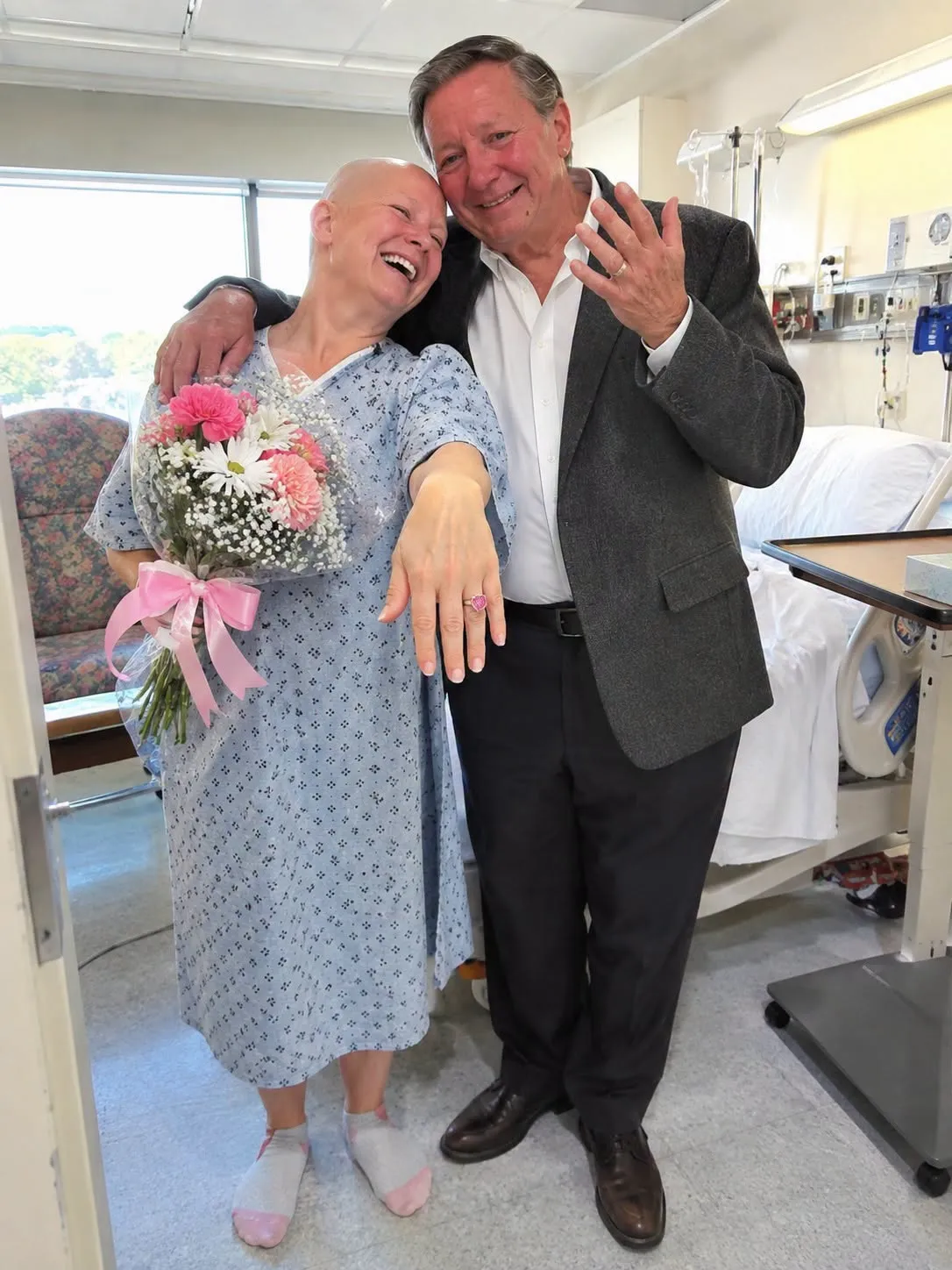
Margaret wore her blue scarf and a pink bed jacket that Denise had found for her.
Furthermore, she’d asked one of the nurses to apply a little lipstick.
When I entered the room wearing my JCPenney suit, her entire face lit up.
“Well, look at you, Reverend,” she said. “No ruffles.”
Carla read from First Corinthians.
Love is patient, love is kind. Love keeps no record of wrongs.
Throughout the reading, Margaret held my hand.
Finally, the moment came to exchange rings.
I removed the little silver band with the pink heart and slipped it onto her finger.
It fit perfectly.
Margaret raised her hand and turned it toward the afternoon sunlight.
Immediately, that ridiculous little pink heart caught the light.
She laughed so hard that the nurses came over to check her monitors.
“Tommy,” she gasped, wiping her eyes. “Tommy Calloway. You bought me a ring from a gumball machine.”
“It was eight dollars,” I explained. “From the flea market on 66.”
“It’s my favorite ring in the entire world.”
Then she looked at me with tears running down her cheeks.
“I’m never taking it off. Not ever.”
Carla continued the ceremony.
“By the power vested in me by the State of Missouri, I now pronounce you husband and wife.”
I leaned down and gently kissed my bride.
It reminded me of the kiss we’d shared beneath the bleachers during the homecoming game in 1979.
However, when I straightened up, I noticed Daniel beside the window.
He was crying silently.
Although he’d turned toward the glass so nobody would notice, I saw him.
Our Precious Days as Husband and Wife
For several precious days, I was finally Margaret’s husband.
I moved a cot into her hospital room, and fortunately, the nurses didn’t object.
Every night, I slept beside her bed.
In the mornings, I read to her from the Psalms. Additionally, I read an Agatha Christie paperback mystery she’d started in Tulsa.
Margaret wanted to finish the book.
However, she fell asleep halfway through most chapters.
Whenever she woke up, she asked the same question.
“Did Poirot catch him yet?”
“Not yet.”
“Good. Don’t let him catch him till I’m awake.”
As the days passed, Margaret spoke less and slept more.
Nevertheless, whenever she was awake, she held my hand.
Sometimes, she studied my face for a long time without speaking.
It seemed as though she was trying to make an important decision.
On the third day, Margaret asked Daniel to retrieve a shoebox from the trunk of her car.
Eventually, he returned carrying a battered Florsheim shoebox secured with rubber bands.
She asked him to place it on the windowsill.
However, she never opened it.
A Conversation in the Middle of the Night
On the fourth day, Margaret woke up at three in the morning.
Meanwhile, I was lying awake on my cot, watching the monitor lights.
“Tommy,” she whispered.
“I’m here.”
“Do you remember what you said? On the steps? Prom night?”
“I said I’d marry you.”
“No.”
She shook her head slightly against the pillow.
“After that. When I asked you why you wanted to be a minister.”
Although I thought about it, I couldn’t remember.
“You said you wanted to spend your life telling people the truth. Even the hard truths.”
Then Margaret reminded me of something else.
“Because the truth is the only thing that ever really sets anybody free.”
For a long moment, she remained quiet.
“I’ve thought about that every day for forty-five years.”
“Margaret,” I asked, “what’s wrong?”
However, she didn’t answer.
Instead, she squeezed my hand and closed her eyes.
A minute later, she was asleep again.
Saying Goodbye to My First Love
Five days after our wedding, Margaret Ellison Pierce Calloway passed away.
It was a Thursday evening in late March.
The hospital window was open, and spring peepers were singing in the creek behind the building.
I held one of Margaret’s hands. Meanwhile, Daniel held the other.
She was still wearing the little silver ring with the pink heart.
Losing her shattered my heart.
I’d spent forty-five years missing her without fully realizing it.
Then I’d been given nineteen precious days with her.
Nevertheless, I remained grateful.
Throughout my ministry, I’d buried many people. Consequently, I’d learned that grief is simply love with nowhere left to go.
I was grateful that fate had brought us together again, even for nineteen days.
We buried Margaret on Monday beneath a large oak tree at Greenlawn Cemetery in Springfield.
According to Daniel, she had specifically requested burial in Springfield rather than beside Walter in Tulsa.
However, I didn’t understand her decision at the time.
The funeral took place at Grace Community at eleven o’clock on a gray morning.
Carla Ruiz officiated because I couldn’t.
Approximately forty people attended.
Among them were former classmates from Central High whom I hadn’t seen in forty-five years.
They had read Margaret’s obituary in the Springfield News-Leader.
Additionally, several friends from Tulsa had driven up that morning.
Daniel’s wife, Jenna, attended with Lily and Sam.
The children sat in the front pew wearing their Sunday clothes and swinging their feet.
The Envelope Daniel Had Been Waiting to Give Me
After the funeral, I stood outside on the church steps in the cold.
I shook hands with everyone, just as I’d done after countless other funerals.
Eventually, the final car left the parking lot.
For a moment, I stood alone.
Then Daniel emerged from the church.
He slowly walked down the steps toward me.
His face was pale, and he nervously kept wetting his lips.
Furthermore, he was holding a sealed envelope so tightly that the paper had creased.
“Tom,” he said, “there’s something you need to know.”
He extended the envelope.
It was a plain white business envelope containing several pages.
Across the front, in Margaret’s familiar handwriting, were three words.
Tommy. Only after.
“You don’t know the whole truth about Mom,” Daniel explained, his voice rough.
Then he told me about the promise he’d made.
“She left this for you. She made me promise to give it to you only after she was gone. Not one minute before.”
I accepted the envelope and studied Daniel’s face.
He looked like a man waiting for a verdict.
“Do you know what it says?” I asked.
Instead of answering, Daniel nodded once.
Then he turned toward the parking lot and the gray sky.
I opened the envelope on the steps of my own church.
Inside were three folded sheets of hospital notepaper.
Margaret’s handwriting was small, slanted, and shaky.
Nevertheless, it was unmistakably hers.
Carefully, I unfolded the pages and began reading.
The first sentence alone nearly caused my knees to buckle.
Tommy, you didn’t find me by accident. I found you.
Unable to remain standing, I sat down on the church steps.
Meanwhile, Daniel sat a short distance beside me and remained silent.
Margaret’s Final Letter
Tommy, you didn’t find me by accident. I found you.
When they told me in January that the cancer was everywhere, I went home. For two days, I sat in Walter’s recliner.
Then I looked you up on the computer. Daniel helped me.
I’d known for years that you were a minister in Springfield. In fact, I’d looked you up before. A dozen times.
However, every time, I closed the computer. I was too afraid.
This time, I made some calls and discovered which hospital you visit.
I asked my oncologist in Tulsa to transfer me to St. Luke’s. I told him it was for a clinical trial.
It wasn’t. It was for you.
Then I asked the nurse for a Methodist chaplain. I knew exactly who she would send.
I’m sorry for the trick. However, I couldn’t call you because I didn’t know how.
Forty-five years is too long to say this on the telephone.
So I’m going to say it here, where I don’t have to watch your face.
Because I’m a coward, Tommy. I’ve been a coward since I was eighteen years old.
When you left for Wheaton in August 1981, I didn’t know I was pregnant.
I found out at the end of September.
I stopped reading.
Slowly, I raised my eyes from the page.
Daniel was sitting beside me with his elbows resting on his knees and his face buried in his hands.
Then I looked back down.
What Happened After I Left for College
I wrote you a letter. Six pages.
I told you everything. I explained that I was scared, that I loved you, and that I didn’t know what to do.
Because I didn’t have a stamp, I gave the letter to my father to mail.
That’s the truth. I didn’t have a stamp.
However, he read it.
Then he burned it in the fireplace in front of me.
He said a deacon’s daughter wasn’t going to marry a delivery driver’s son who would remain in school for seven more years.
According to him, I would ruin both your life and mine.
He said you’d have to quit Wheaton and drive a truck like your father.
Furthermore, he threatened to contact your scholarship committee and tell them what you’d done if I contacted you.
I was eighteen, Tommy.
I believed him.
Walter Pierce was a mechanic who had repaired my father’s Cadillac.
He was ten years older than me, attended our church, and had been sweet on me for a year.
My father went to him. However, I don’t know exactly what he said.
Two weeks later, Walter came to our house and sat with me on the porch swing.
It was the same porch swing where you used to sit.
He asked whether I was in trouble. So I told him the truth. All of it.
Nevertheless, he said he’d marry me.
He promised to raise the baby as his own and never tell anyone.
He said, “Maggie, you don’t have to love me. Just let me take care of you.”
So I called you and told you I was marrying Walter.
Then I hung up before you could hear me cry.
Daniel was born on the eleventh of June, 1982, in Tulsa.
He’s yours, Tommy.
He’s your son.
The Truth That Changed My Entire Life
The paper shook in my hands.
Suddenly, I couldn’t see the words anymore.
I placed the letter on my knee and pressed my hand over my eyes.
Meanwhile, Daniel remained motionless beside me.
After a while, I gathered enough strength to continue reading.
Walter knew. He always knew.
Nevertheless, he loved Daniel like his own blood.
He taught him to fish, repair a carburetor, and tell the truth.
Walter was the best father I’ve ever seen.
However, six years ago, when he was dying, he made me promise him something.
He said, “Maggie, that boy has a right to know who his father is. And that man has a right to know he has a son.”
Then he added, “I raised him, but I didn’t make him. Don’t let me take that to my grave.”
I told Daniel after Walter’s funeral.
He was thirty-eight. Afterward, he didn’t speak to me for four months.
However, I still didn’t tell you.
For six more years, I kept the truth from you.
I kept meaning to tell you, but I was afraid.
I feared you’d hate me. Furthermore, I feared you’d think I’d stolen your son from you.
And I feared you’d be right.
Then the cancer came.
Finally, I knew I was out of time.
Why Margaret Wanted Us to Get Married
Tommy, I asked you to marry me because I wanted Daniel to see it.
Just once, I wanted him to see his mother and father standing together.
I wanted him to see the man I’ve loved my whole life, wearing his only suit and putting a ring on my finger.
Although I couldn’t give him the rest, I wanted to give him that.
It was selfish. I know it was.
However, I’d never once in my life asked for anything for myself.
I asked for this.
Furthermore, I wanted to be your wife. Even for a week.
I wanted to know what it would have been like.
It was everything, Tommy.
It was everything I imagined on the steps of the Shrine Mosque.
The truth is the only thing that ever really sets anybody free.
You told me that when you were eighteen.
Finally, I’m listening.
I’m sorry. I’m so sorry.
I love you. I always did.
Be good to our boy.
Your wife,
Maggie.
P.S. The shoebox on the windowsill is yours. Daniel has it. Don’t let him throw it away. He’ll want to.
Looking at My Son for the First Time
I sat on the steps of Grace Community Methodist Church in my funeral suit.
It was the same charcoal gray JCPenney suit I’d worn at our wedding.
Now, Margaret’s final letter rested in my lap.
Slowly, I turned toward the man sitting beside me.
I noticed his dark hair turning gray around the temples.
Furthermore, I noticed his wire-rimmed glasses, which looked remarkably like mine.
His hands were large and square, with long fingers.
They reminded me of my father’s hands.
Three weeks earlier, Daniel had studied my face as though he were trying to memorize it.
Finally, I understood why.
“You knew,” I said, barely recognizing my own voice. “The whole time. In the hospital.”
Daniel removed his hands from his face.
His eyes were red.
“For six years,” he answered. “Since Dad’s funeral. Walter’s funeral.”
Then he released a broken laugh.
“I don’t even know what to call him now. He was my dad. He’s still my dad.”
“He is,” I replied. “He’ll always be your dad.”
Daniel looked directly at me.
“I looked you up after Mom told me. Six years ago.”
He explained that he’d found my church website.
One photograph showed me wearing a robe and holding a baby during a baptism.
For an entire month, he’d looked at that photograph every night.
Furthermore, he’d driven to Springfield twice.
He sat in the church parking lot on Sunday mornings, watching people enter.
Afterward, he watched me shake their hands at the door.
However, he couldn’t bring himself to come inside.
“Why not?” I asked.
The Questions Daniel Had Carried for Years
“Because I was angry,” Daniel admitted.
Mostly, he was angry with Margaret for keeping the truth from him throughout his life.
Additionally, he was somewhat angry with Walter for going along with it.
However, he was angry with me too.
“Because I thought, what kind of man doesn’t notice his girlfriend disappeared?”
Then he asked another painful question.
“What kind of man doesn’t drive home from Illinois and find out why?”
I couldn’t answer immediately.
After all, I’d asked myself those same questions for forty-five years.
“I didn’t know,” I finally replied. “Daniel, I swear before God, I didn’t know.”
I explained how Margaret had called two days before Thanksgiving and announced she was marrying someone else.
At the time, I believed she’d stopped loving me.
Furthermore, I believed I simply wasn’t good enough.
My voice broke as I continued.
“I sat on the floor of my dormitory hallway until two in the morning.”
Nevertheless, I attended class the following day.
And the day after that.
Eventually, I convinced myself it was God’s will.
Daniel remained quiet for a long time.
“Mom told me that,” he finally said.
Apparently, she’d explained everything during my second hospital visit.
After I left, Margaret cried for an hour.
“She said, ‘He didn’t know, Danny. He never knew. Don’t you dare blame him.’”
We remained seated on the church steps.
Meanwhile, the wind carried several dead leaves across the parking lot.
Then Daniel spoke again.
“There’s something else. Something I need to say before you hear it from somebody else.”
I waited.
Daniel’s Concerns About the Wedding
“When Mom told me she was going to marry you, I was angry,” Daniel admitted.
In fact, he’d been furious.
He told Margaret the idea was crazy because I was practically a stranger.
Then he stopped speaking and looked ashamed.
“I said maybe you were after her money.”
Walter had left Margaret the house in Tulsa, his life insurance, and his retirement savings.
Altogether, the inheritance was worth approximately six hundred thousand dollars.
Daniel had researched Missouri’s inheritance laws.
According to what he’d discovered, a surviving spouse could potentially claim part of an estate despite the terms of a will.
The legal provision was called an elective share.
“I said to her, ‘Mom, you’re about to make some preacher you knew in high school a rich man.’”
“What did she say?” I asked.
“She laughed at me.”
Then Daniel repeated Margaret’s response.
“Danny, that man bought me a ring at a flea market for eight dollars. Does that sound like a man who wants my money?”
Furthermore, Margaret had added something unmistakably characteristic of her.
“If he does try, let him. He’s owed forty-four years of child support. I’ll consider it a down payment.”
I couldn’t help laughing.
However, the sound came out almost like a sob.
That was Margaret.
That was exactly Margaret.
Making an Important Legal Decision
Later that week, I visited an attorney named Harold Bishop.
He’d been a member of my congregation for thirty years.
Additionally, he’d practiced estate law in Springfield since 1982.
His office was on Walnut Street, just two blocks from the house where Margaret had grown up.
There, I told him everything.
Harold listened without interrupting.
When I finished, he removed his reading glasses and rubbed his eyes.
“Tom, Margaret’s will was signed in Tulsa four years ago. Before your marriage.”
According to Harold, the will left everything to Daniel.
However, he explained that Missouri law could allow a surviving spouse who wasn’t provided for in a will to claim an elective share.
He also explained that, for a spouse without shared children, the share could be as much as half the estate.
Then Harold looked across his desk.
“You were married. It was legal. Shirley from the Recorder’s office filed the license.”
According to him, I could pursue a claim if I wanted to.
“I don’t want it,” I answered.
“I know you don’t,” Harold replied.
Nevertheless, he reminded me of something important.
“Daniel doesn’t know that for certain. And it’s going to sit between you two like a stone until he does.”
Harold explained that I could sign a legal document called a disclaimer.
By signing it, I would permanently surrender any claim to Margaret’s estate.
According to his explanation, the document needed to be written, signed, notarized, and filed with the probate court within nine months.
Once filed, it couldn’t be withdrawn.
“Draw it up,” I said.
The Only Things I Wanted From Margaret’s Estate
Harold prepared the document.
On Thursday afternoon, I signed it in his office while his secretary acted as the notary.
The following morning, Harold filed it with the Greene County Probate Court.
Additionally, he mailed a certified copy to Daniel in Tulsa.
I included a one-page letter inside the envelope.
First, I explained that I’d signed the document so Daniel would never have to wonder about my intentions.
Then I told him there were only two things of Margaret’s that I wanted.
One was the silver ring with the pink heart, if he would allow me to retrieve it from the funeral home.
The other was the shoebox from the hospital windowsill.
Daniel called me the evening he received the envelope.
“You didn’t have to do that.”
“Yes, I did.”
For a long moment, he remained quiet.
Then he spoke about the ring.
“She asked to be buried with it. I’m sorry. I should have asked you first.”
I closed my eyes.
“No,” I answered. “No. That’s right. That’s where it belongs.”
However, Daniel still had the shoebox.
He explained that he hadn’t opened it because Margaret had instructed him not to.
Then he paused.
“Can I bring it up this weekend? Will you open it with me?”
Opening Margaret’s Old Shoebox
Daniel arrived on Saturday afternoon with Jenna, Lily, and Sam.
They’d driven three hours from Tulsa that morning.
Together, we sat inside the parsonage living room beside my church.
It was a small, plain room containing a couch from 1994 and a bookshelf filled with theology books.
Meanwhile, Jenna instructed the children to sit on the floor without touching anything.
Daniel placed the battered Florsheim shoebox on my coffee table.
Then he removed the rubber bands and looked at me.
“Together,” I said.
He lifted the lid.
Inside were dozens of old letters.
The envelopes had yellowed with age and carried three-cent, five-cent, and twenty-cent stamps.
Every envelope displayed my handwriting and had been sent from Wheaton, Illinois.
They were all addressed to the same person.
Miss Margaret Ellison.
1412 Walnut Street.
Springfield, Missouri.
Every envelope was unopened.
However, there was more beneath the letters.
At the bottom of the box lay a peach-colored silk flower, flattened and brown around the edges.
It was the corsage I’d given Margaret on prom night in 1981.
Additionally, there was an old photograph with faded colors and curled corners.
It showed two seventeen-year-olds standing on the steps of the Shrine Mosque.
A skinny boy wore a powder blue tuxedo with ruffles.
Beside him stood a red-haired girl in a peach dress with puffy sleeves.
She was laughing so hard that her eyes were closed.
Finally, we discovered a small card that was newer than everything else.
Margaret had written it in her shaky hospital handwriting.
A Message Hidden Among the Letters
Tommy.
These are the letters you wrote me in October and November 1981.
My father kept them from me. He hid them inside his desk.
After he died in 1999, I found them.
I’ve read every one a hundred times.
I’m giving them back to you so you can show your son what kind of man his father was at nineteen.
Read him the one from November 14th.
M.
Daniel searched through the pile until he found the correct letter.
November 14, 1981.
My handwriting looked young, earnest, and slightly clumsy.
Then Daniel began reading aloud.
Jenna and the children listened quietly from the living room.
Dear Maggie,
I don’t know why you won’t write back.
Your mother says you’re busy. Maybe you’ve met someone else.
If you have, I understand. I’ll try to understand.
However, I want you to know something.
Whatever happens, whoever you end up with, wherever you go, I’m going to spend my life trying to be the kind of man you’d be proud to have known.
I’ll be that man whether you’re watching or not.
Because you made me want to be.
Love always,
Tommy.
Daniel stopped reading.
Then he placed the letter on the coffee table, removed his glasses, and pressed his hands against his eyes.
A Question From My Granddaughter
Meanwhile, ten-year-old Lily looked up at me from the floor.
“Are you my grandpa?” she asked.
“Lily!” Jenna exclaimed.
However, I slowly knelt beside the little girl.
My knees weren’t what they used to be, but I wanted to be at eye level with her.
Lily had red hair.
Margaret’s hair.
Furthermore, she wore it in a braid down her back.
“I think I might be,” I answered. “If you’ll have me.”
In April, Daniel decided to take a DNA test.
He explained that it wasn’t because he doubted Margaret’s story.
Instead, he remembered something Walter had always told him.
A good engineer checks his math.
Together, we provided saliva samples in little plastic tubes at my kitchen table.
Then we mailed them away.
Six weeks later, the results arrived by email.
We opened them together during a telephone call, with Daniel in Tulsa and me in Springfield.
Parent and child.
Ninety-nine point nine nine percent.
For a long time, neither of us spoke.
Finally, Daniel broke the silence.
“Well, Walter always said I had somebody else’s ears.”
The Sunday My Family Came to Church
On the first Sunday in May, the Calloway family came to church.
That’s what I’ve started calling them.
Daniel Pierce, Jenna Pierce, Lily Pierce, and Sam Pierce.
Of course, they still carry the Pierce name.
They always will, and they should.
After all, Walter Pierce earned it.
However, in my heart and on the little card I keep inside my Bible, they’re also the Calloway family.
They drove three hours from Tulsa that morning.
At ten fifty-five, they entered Grace Community Methodist and sat in the third pew on the left.
Lily wore a blue dress with her red hair in a braid.
Meanwhile, Sam wore a clip-on tie that he couldn’t stop tugging.
I was standing at the pulpit reviewing my notes when they entered.
After seeing them, I had to look back down for a long time.
My sermon that morning was about the Prodigal Son.
Although I’d written it weeks earlier, I didn’t preach the version I’d prepared.
Instead, I stood at the pulpit of the church I’d served for twenty-six years.
Before me were ninety familiar faces.
However, four of them held a special place in my heart.
I told the congregation about a girl in a peach dress and a boy in a blue tuxedo.
Then I described a letter that had been burned in a fireplace.
Additionally, I told them about a mechanic who sat on a porch swing and offered to care for someone.
“You don’t have to love me. Just let me take care of you.”
I spoke about a son who grew up without knowing the truth.
Meanwhile, his father grew old without knowing it either.
Finally, I told them about a woman who had carried that truth for forty-five years because she was afraid.
The Sermon I Had Waited a Lifetime to Give
“We usually tell the Prodigal Son as a story about the one who left,” I explained.
“However, I’ve been thinking it’s also a story about the one who waited.”
I described the father standing at the end of the road every day, watching for his son.
He never knew whether his child would return.
Then I looked toward the third pew.
“Sometimes we don’t know we’re the one waiting.”
For a moment, I paused.
“Sometimes we’re standing at the end of the road for forty-five years, and we don’t even know who we’re waiting for.”
Then I continued.
“Until one day, God sends him walking up the road toward us. With his wife. And two grandchildren in their Sunday clothes.”
Nobody in the church made a sound.
Old Mrs. Hendricks had taken out her handkerchief in the front row.
Meanwhile, Harold Bishop was staring at the floor.
In the third pew, Daniel had his arm around Jenna.
He was crying.
However, this time, he didn’t try to hide it.
The Two Words I Never Expected to Hear
After the service, I stood beside the church entrance and shook hands as usual.
The Calloway family came last.
First, Jenna hugged me.
Then Sam shook my hand very seriously.
“Good sermon, sir.”
Clearly, his mother had instructed him to say that during the drive.
Meanwhile, Lily wrapped her arms around my waist and refused to let go.
Finally, Daniel stood before me on the church steps.
They were the same steps where he’d handed me Margaret’s envelope seven weeks earlier.
He extended his hand.
I shook it.
However, Daniel suddenly pulled me into a tight embrace.
It was the kind of hug men give when they don’t know what else to do with their arms.
“Thanks, Dad,” he whispered into my shoulder.
He spoke so quietly that I almost didn’t hear him.
Before I could respond, Daniel released me.
Then he walked his family toward their car without looking back.
I think he couldn’t.
I remained on the church steps and watched them drive away.
Afterward, I entered the empty sanctuary and sat in the last pew for a long time.
Returning to Margaret’s Grave
On the second Saturday of May, Daniel and I drove to Greenlawn Cemetery together.
That evening marked forty-five years since Margaret and I attended prom at the Shrine Mosque.
However, Daniel didn’t know that until I told him during the drive.
For a while, he remained quiet.
Then he asked me to tell him about that night.
So I described the peach dress, the blue tuxedo with its ridiculous ruffles, and the corsage.
Additionally, I remembered her father waiting on the porch with a flashlight.
Finally, I told Daniel about the promise I’d made on the steps.
We stood together beneath the large oak tree at Margaret’s grave as the sun began setting.
Her headstone had been installed the previous week.
Daniel had personally chosen the inscription.
However, I hadn’t seen it yet.
Margaret Ellison Pierce Calloway
1963 – 2026
Beloved Mother, Grandmother, and Wife
“The truth will set you free.”
I stood there and read the inscription three times.
“I hope that’s all right,” Daniel said beside me.
He explained that he’d discussed the last name and the verse with Jenna.
She believed those were the words I would have wanted.
“It’s perfect,” I replied, my voice barely working. “It’s exactly right.”
Then Daniel reached into his jacket pocket.
He removed something small and extended his open palm toward me.
The Ring With the Pink Heart
It was a ring.
A little silver band with a tiny pink enamel heart.
For several seconds, I stared at it.
“I thought she was buried with it.”
“She was,” Daniel explained. “This is a different one.”
Then he almost smiled.
The previous weekend, he’d driven to the flea market on Route 66.
Fortunately, the older man with the jewelry case was still there.
Daniel had introduced himself and explained who he was.
Surprisingly, the jewelry seller remembered me.
“He said a preacher in a gray suit came in at closing time.”
According to the man, I’d spent forty minutes choosing an eight-dollar ring.
Furthermore, he’d remembered that I almost cried when I paid for it.
Daniel looked down at the little ring resting in his hand.
“He had one more. Same kind. Pink heart.”
Apparently, the jewelry seller had been saving it.
He believed somebody would eventually return for it.
Then Daniel held the ring toward me.
“I want Lily to have it,” he explained. “When she’s older. When she goes to prom.”
Furthermore, he wanted his daughter to understand where the ring came from.
Her grandmother, her grandfather, and a promise someone had kept forty-five years late.
I accepted the ring and held it in my palm.
The ridiculous little pink heart caught the last of the evening light.
It reminded me of its twin catching the afternoon sunlight through a hospital window.
Margaret had laughed so hard that the nurses came running.
“You keep it,” I said, pressing the ring back into Daniel’s hand.
“Until she’s ready. You give it to her, Daniel. Not me.”
“Why not you?”
“Because you’re her father. That’s your job.”
Then I reminded him of the man who had raised him.
“Walter taught you how to do it.”
I closed Daniel’s fingers around the ring.
“And because I want to be standing right next to you when you do.”
The Letter Margaret Had Kept for 27 Years
We remained beside Margaret’s grave until darkness settled around us.
Two men stood side by side.
A father and son who had first met beside a dying woman’s hospital bed.
We didn’t say much because we didn’t need to.
Eventually, Daniel reached into his other pocket and removed a folded piece of paper.
He unfolded it and used the light from his phone so I could read it.
It was my letter from November 14, 1981.
I’m going to spend my life trying to be the kind of man you’d be proud to have known.
I’ll be that man whether you’re watching or not.
“She kept it on her nightstand in Tulsa,” Daniel explained.
After discovering the hidden letters, Margaret had kept this particular one beside her bed for twenty-seven years.
Daniel remembered seeing it whenever he visited.
However, he’d never known what it was.
Carefully, he folded the letter and returned it to his pocket.
“I’m going to keep it on mine.”
Then Daniel looked directly at me.
“She was watching, you know. The whole time.”
According to him, Margaret had followed every sermon I posted online.
Furthermore, she’d looked at every photograph on the church website.
“She knew exactly what kind of man you turned out to be.”
Daniel swallowed before continuing.
“She just couldn’t tell you she was proud. Because then she’d have had to tell you everything.”
I looked toward Margaret’s headstone in the darkness.
The truth will set you free.
“She told me,” I replied.
Then I finally understood the meaning behind those precious days.
“At the end. That’s what the wedding was, Daniel. That was her telling me.”
A Promise That Became the Beginning of Something Beautiful
We drove home through the dark Ozark hills with the windows down.
Meanwhile, the sweet smell of honeysuckle drifted into the car.
Daniel planned to spend the night at the parsonage on my old couch from 1994.
The following morning, he would return to Tulsa, to his wife, his children, and his life.
However, he promised to bring them back in two weeks for Sunday dinner.
Then he said they’d return the Sunday after that.
As often as I would have them.
I told Daniel I’d have them every Sunday for the rest of my life.
Forty-five years earlier, on the steps of the Shrine Mosque, I’d made a promise to a girl in a peach dress.
Eventually, I kept that promise inside a hospital room.
I wore my only suit and gave her a ring from a flea market.
Forty-five years late.
I thought that was the end of the story.
It turns out it was the beginning.
Because some promises don’t end when you keep them.
They just keep growing, quietly, the way a family grows, the way the truth does, once somebody is finally brave enough to let it out into the light.
Related Articles
My New Husband Hung His Father’s Deer Head Over My Fireplace — Then His Mother Arrived With an Unexpected Surprise
My Daughter Died During Childbirth — Ten Years Later, a Stranger at Her Grave Revealed a Hidden Truth
My Parents Chose My Adopted Brother Over Me for 10 Years — Five Years After I Left Home, They Suddenly Needed My Help