
After a long and exhausting day at work, I finally came home in the evening hoping to relax and get some sleep.
But as I approached my bed, something unusual immediately caught my attention.
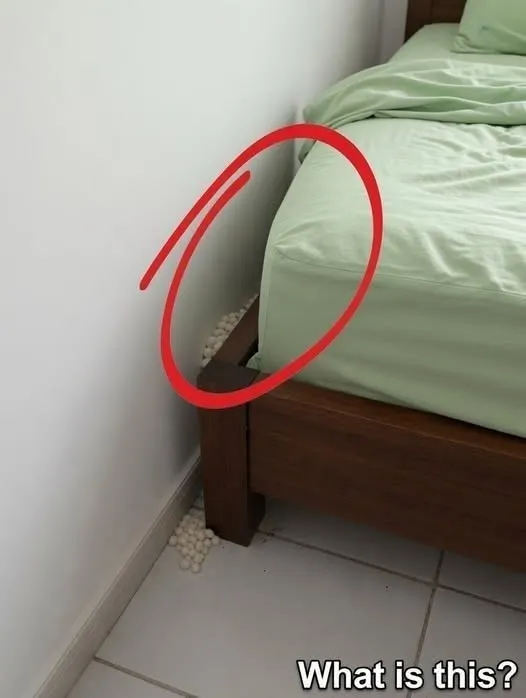
There were several small white objects gathered near the side of the bed.
For a moment, I had no idea what I was looking at, and the sight honestly frightened me.
Once I calmed down, I moved closer and examined them carefully. They looked almost like tiny white eggs, but I still couldn’t determine exactly what they were.
So what could these mysterious objects actually be?
Could They Be Lizard Eggs?
One possible explanation is that they could be eggs from a small house lizard or gecko.
Geckos are commonly found inside homes in many parts of the world. They often hide behind furniture, inside wall gaps, near ceilings, and in other quiet places where they are unlikely to be disturbed.
When a female gecko is ready to lay eggs, she usually searches for a protected location with fairly stable conditions.
The space beside or behind a bed could potentially provide some of those conditions.

Why Would a Lizard Choose an Area Near a Bed?
One possible reason is temperature.
Reptiles depend heavily on the surrounding environment to regulate heat. Their eggs also develop using warmth from their surroundings rather than being incubated by the parent.
Furniture, walls, mattresses, and other enclosed areas can sometimes maintain a slightly more stable temperature than exposed parts of a room.
Another reason could be shelter.
The narrow space between a bed and a wall is usually dark, quiet, and difficult for larger animals to reach. These characteristics may make it seem like a protected hiding place.
Most people also do not regularly move heavy furniture, meaning the area may remain undisturbed for long periods.
Darkness and Hidden Spaces Matter
Small reptiles often prefer concealed locations when laying eggs.
An exposed area would leave eggs vulnerable to predators and changing environmental conditions.
Behind furniture, however, there may be very little light and almost no regular movement.
From the perspective of a small lizard, that kind of location may resemble the cracks, rocks, tree bark, and narrow hiding places they would naturally use outdoors.
Humidity Could Also Play a Role
Moisture is another factor that can influence where reptiles leave their eggs.
Eggs can lose moisture if their surroundings become excessively dry.
Areas behind large pieces of furniture may sometimes have less airflow than the rest of the room, potentially creating slightly different humidity conditions.
That does not necessarily mean a bedroom is an ideal nesting area, but it could help explain why a reptile might choose a hidden indoor location.
But There Is One Important Problem
Although lizard eggs may sound like a reasonable explanation at first, the appearance of the objects raises some doubts.
Most common house geckos do not lay dozens of eggs at once.
Depending on the species, a female often lays only one or two eggs during a single nesting event.
Gecko eggs also tend to have a firm, chalky appearance and are usually somewhat oval rather than perfectly round.
In many cases, they may also be attached to a wall, surface, or hidden crevice.
A large group of nearly identical white spheres would therefore be unusual.
Could Several Lizards Have Used the Same Spot?
It is possible.
Some gecko species are known to use communal nesting locations, meaning several females may deposit their eggs in the same protected area over time.
If the same hidden location remained safe and undisturbed, eggs could potentially accumulate.
However, even in that situation, the objects would usually show some natural differences in size, texture, and shape.
If every sphere looks almost perfectly identical, another explanation becomes more likely.
They Might Not Be Eggs at All
There is also a strong possibility that the objects are manufactured materials.
Small white foam beads are commonly found inside beanbags, cushions, pillows, packaging, toys, and certain types of furniture.
If one of those items has a tiny tear or opening, the beads can slowly escape and collect underneath or beside furniture.
At first glance, a pile of white foam pellets can easily resemble a nest of tiny eggs.
This becomes even more likely when the objects are perfectly spherical, lightweight, and nearly identical.
How Can You Tell the Difference?
A closer examination may provide the answer.
Real reptile eggs generally have a shell with some texture. They may feel firm, chalky, or slightly leathery depending on the species.
Natural eggs are also unlikely to be perfectly identical.
Foam or plastic beads, on the other hand, tend to be extremely light and uniform.
You should also inspect nearby pillows, cushions, mattresses, stuffed furniture, beanbags, or packaging for a small hole where filling material could be escaping.

Look for Other Signs of Lizards
If geckos actually live in the room, there may be additional clues.
You might occasionally see them moving along walls or ceilings, especially at night.
Small droppings can sometimes appear near windows, corners, lamps, or other areas where insects gather.
Certain gecko species may also produce small chirping or clicking sounds during the evening.
Because geckos feed on mosquitoes, flies, moths, and other insects, homes with plenty of insects may naturally attract them.
Are House Geckos Dangerous?
For most people, common house geckos are not considered a serious threat.
They generally avoid humans and prefer escaping rather than confronting people.
In fact, they can sometimes be helpful because they feed on insects that enter the home.
Even so, discovering unusual objects beside your bed can understandably be unsettling, especially when you do not immediately know where they came from.
The Most Likely Explanation
If these objects are truly eggs, a hidden space near the bed could have attracted a lizard because it offered darkness, warmth, shelter, and limited disturbance.
However, if there are many perfectly round white spheres of almost exactly the same size, they may be more likely to be foam or plastic filling rather than lizard eggs.
The easiest way to find out would be to inspect one object closely and check nearby furniture for damaged fabric or leaking filling.
Sometimes something that initially looks frightening has a surprisingly simple explanation.