
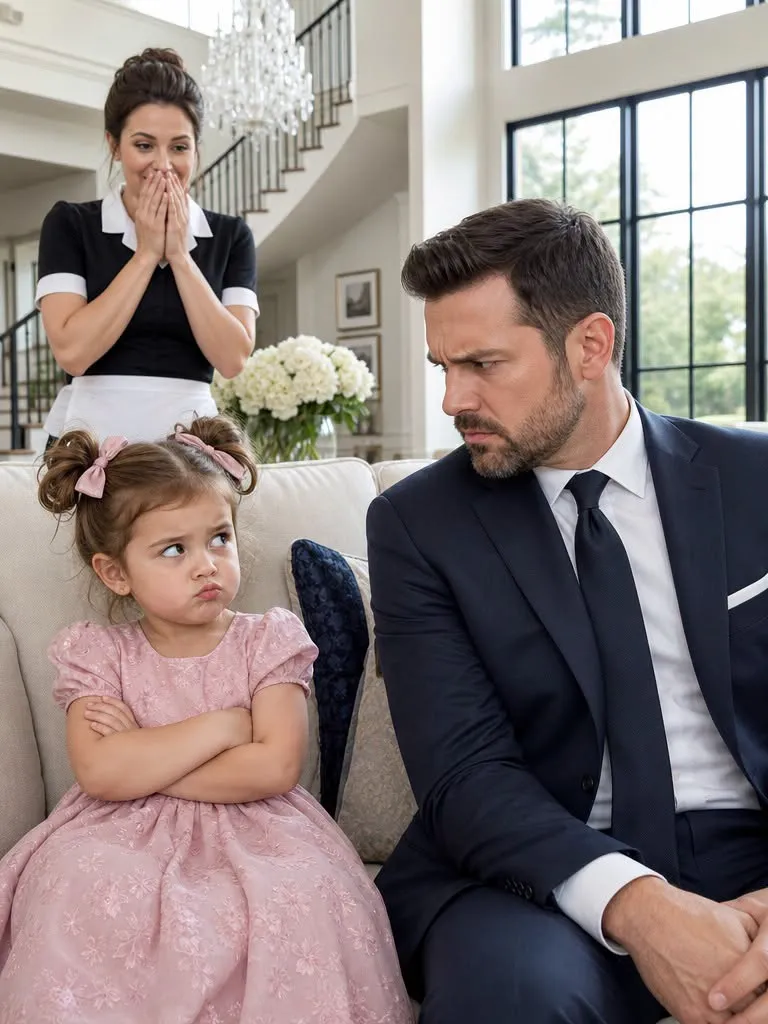
The coffee mug nearly slipped from my hand when I heard my three-year-old daughter talking inside Mr. Callow’s private office.
My name is Marissa Fenwick.
I was thirty-three, a widow, and the mother of a little girl named Poppy.
For almost nine months, I had worked as a housekeeper in a large private home outside Franklin, Tennessee.
My employer, Harrison Callow, was forty-seven and owned several commercial construction companies across the Southeast.
People rarely raised their voices around him.
They did not need to.
Harrison had a way of becoming completely still when something displeased him. Somehow, that quiet expression made grown executives straighten their jackets and think carefully before speaking.
There was also one rule every employee understood.
Nobody entered Harrison Callow’s office without permission.
That morning, my daughter apparently decided the rule did not apply to her.
The Morning Poppy Broke the Rule
At 5:30 a.m., my babysitter called.
She was sick and could not watch Poppy.
My mother lived two hours away, and I could not afford to miss another shift.
Therefore, I had no choice.
I brought Poppy with me.
I set her up in a small sitting room near the laundry area with crayons, crackers, juice, and her stuffed rabbit.
Then I crouched in front of her.
“Stay right here until Mommy comes back, okay?”
She nodded seriously.
“Then ice cream?”
I smiled.
“Then ice cream.”
Apparently, a promise involving ice cream was not enough to keep a three-year-old in one room.
At 9:15 a.m., I returned.
The room was empty.
My heart dropped.
I checked the kitchen.
Then the hallway.
Then the breakfast room.
Finally, I heard Poppy’s tiny voice coming from the one room I desperately hoped she had not entered.
Harrison’s office.
I hurried down the hallway.
The door was half open.
Inside, Poppy stood directly in front of Harrison’s enormous walnut desk.
Four adults were staring at her.
Harrison sat behind the desk.
His assistant, Warren Pike, stood beside a bookshelf with a tablet in his hand.
Two members of the household security team stood near the windows.
Nobody moved.
Then Poppy frowned.
She pressed her lips together.
She folded her arms across her chest.
Finally, she raised her chin.
My stomach dropped.
She was copying Harrison.
Perfectly.
One security officer stared at the floor.
Warren looked as though he had forgotten how to breathe.
Slowly, Harrison turned toward the doorway.
He saw me.
“Marissa.”
I rushed inside.
“Mr. Callow, I’m so sorry. My sitter canceled. I thought she would stay downstairs. I promise this will never happen again.”
Harrison pointed toward Poppy.
“She’s yours?”
“Yes.”
I was already preparing myself to lose my job.
Instead, Harrison looked back at my daughter.
Then something happened that I never expected.
He stood.
He walked around his desk.
Then he crouched until he was at Poppy’s eye level.
Harrison frowned.
He folded his arms.
He raised his chin.
He copied her expression exactly.
Poppy burst into laughter.
Warren covered his mouth.
One of the security officers turned toward the window to hide his smile.
Then Harrison Callow laughed too.
In all the months I had worked there, I had never heard him laugh.
Finally, he stood.
“She can stay.”
I blinked.
“Excuse me?”
He pointed toward the rug beside his bookcase.
“Put her things there. At least we’ll know where she is.”
At the time, I thought it was simply a funny morning.
I had no idea it would lead me to a secret involving my late husband.
The Little Girl Who Changed the House
After that day, something changed.
Whenever my childcare arrangements failed, Harrison allowed me to bring Poppy.
He never admitted that he liked having her around.
However, a box of crayons soon appeared beside the bookcase.
Then came children’s books.
After that, someone added a small white table.
A few weeks later, there was even a basket filled with toys.
I never asked who bought them.
Harrison never explained.
Poppy treated his office like her personal kingdom.
Sometimes she drew while he worked.
Other times, she lined up stuffed animals beneath the window.
Occasionally, she looked at Harrison, made his famous serious face, and waited for him to copy her.
Those moments were strange.
For a few seconds, Harrison no longer looked like the intimidating businessman everyone feared.
He simply looked human.
For a while, I wondered if we had all misunderstood him.
Then, one rainy afternoon in November, I found the photograph.
The Photograph Behind the Bookshelf
I was dusting the shelves behind Harrison’s desk when an old hardcover book shifted.
Something fell behind it.
A photograph.
I picked it up.
Harrison looked younger in the picture, perhaps in his late thirties.
He was standing at a construction site wearing a hard hat.
Beside him stood another man.
The second man was smiling.
My hands began to shake.
I knew that smile.
I had fallen in love with it.
I had married it.
Two years earlier, I had stood beside a grave and tried to understand how I would raise our daughter without it.
The man standing beside Harrison was my husband.
Graham Fenwick.
Then I heard the office door open.
“Marissa.”
I turned around.
Harrison saw the photograph in my hand.
His expression changed immediately.
I stared at him.
“Why do you have a picture of my husband?”
Harrison stepped inside.
Then he closed the door.
For the first time since I had met him, Harrison Callow looked uncertain.
“Because Graham worked for one of my companies.”
I stared at him.
“He told me he worked for a subcontractor.”
Harrison nodded.
“Technically, he did. The subcontractor was part of a larger group connected to one of my companies.”
My fingers tightened around the photograph.
Then I asked the question I had been afraid to ask.
“Were you there the day of the accident?”
Harrison did not answer.
His silence told me everything.
“Tell me what happened.”
He walked toward the window.
For several seconds, he said nothing.
Then he turned around.
“The official report didn’t tell you everything.”
My chest tightened.
For two years, I had believed a structural failure had killed Graham.
A terrible workplace accident.
Nothing more.
But Harrison’s expression told me there was more.
Much more.
What Graham Had Discovered
Harrison sat down.
“Your husband had been reporting problems with materials arriving at the site.”
I frowned.
“What kind of problems?”
“Parts that didn’t match approved specifications. Missing inspection records. Serial numbers connected to different suppliers.”
I stared at him.
“Why didn’t anyone tell me?”
His voice became quieter.
“Because Graham had started documenting the problems himself.”
I felt anger rising beneath my confusion.
“What happened that morning?”
Harrison looked down at the desk.
“Graham noticed something wrong with a temporary structure on the east side of the project.”
He paused.
“I was walking toward it.”
My breathing slowed.
“And?”
Harrison looked directly at me.
“Your husband pulled me back.”
I could barely speak.
“What are you saying?”
“I’m saying Graham probably saved me from being seriously injured.”
The room suddenly felt smaller.
“You knew this entire time?”
“I knew what he did for me. I didn’t know everything he had discovered until later.”
Then another thought hit me.
“You hired me.”
Harrison lowered his eyes.
I laughed bitterly.
“So this job was charity?”
His head came up.
“No.”
“Then what was it?”
He hesitated.
“I recognized your last name when your application reached the household manager.”
I said nothing.
Harrison continued.
“I wanted to make sure Graham’s wife and daughter were okay without forcing myself into your lives.”
My anger returned.
“You don’t get to quietly rearrange someone’s life because you feel guilty.”
Harrison nodded.
“I know.”
Before I could answer, the door opened.
Warren stepped inside.
His face was pale.
“Harrison, we have a problem.”
Harrison stood immediately.
“What happened?”
Warren glanced at me.
“Someone has been asking about Graham Fenwick’s records.”
I froze.
“What records?”
Warren looked at Harrison.
“A notebook. Possibly documents he kept before the incident.”
I shook my head.
“I don’t know anything about a notebook.”
Harrison’s expression hardened.
Then he asked a question that pushed everything else from my mind.
“Where’s Poppy?”
The Empty Room
I ran downstairs.
Poppy was not in the sitting room.
The back door near the garden was partly open.
Her crayons were scattered across the floor.
My heart stopped.
“Poppy!”
Security staff rushed through the house and grounds.
I ran from room to room calling her name.
Then one of Harrison’s security officers returned carrying a small yellow ribbon.
I recognized it immediately.
It belonged to Poppy.
My knees weakened.
Harrison caught my arm.
“Marissa, stay with me.”
I pulled away.
“My daughter is missing because of something connected to your company.”
He did not argue.
He did not defend himself.
Instead, Warren rushed toward us with his tablet.
A nearby traffic camera had captured a dark SUV leaving the road behind the property shortly after Poppy disappeared.
Authorities were contacted immediately.
As Harrison’s security team shared information with investigators, he turned toward me.
“Did Graham leave anything you never understood?”
For a moment, I could not think.
Then I remembered.
The metal lockbox.
It had been sitting on the top shelf of my closet for almost two years.
Graham had kept receipts and work documents inside it.
However, I had never found the key.
“There’s a box.”
Harrison’s eyes narrowed.
“Where?”
“At my house.”
“Do not touch it until investigators see it.”
Minutes later, Warren received another update.
The SUV had been spotted near an industrial property outside Murfreesboro.
Law enforcement was already moving toward the location.
At that moment, I finally understood something terrifying.
Whatever Graham had discovered had not disappeared with him.
Someone was still afraid of it.
Poppy Was Found
Poppy was located inside an office at the industrial property.
When authorities finally allowed me through, she ran toward me.
“Mommy!”
I dropped to my knees and wrapped my arms around her.
She was frightened.
But she was unharmed.
I kissed her cheeks until she pushed against me.
“Mommy, too tight.”
I laughed and cried at the same time.
The investigation soon uncovered connections between the property and a regional supplier called Ridgeline Structural Materials.
Its president, Malcolm Voss, had done business with several companies involved in Graham’s old construction project.
Investigators also became extremely interested in the metal lockbox sitting in my closet.
Three days later, with investigators and an attorney present, we opened it.
The key had been hidden inside one of Graham’s old work jackets.
Inside the box was exactly what someone had apparently been looking for.
A black notebook.
Receipts.
Photographs.
Delivery records.
Material numbers.
Inspection dates.
Names.
And page after page of Graham’s handwriting.
I recognized it immediately.
The Evidence Graham Left Behind
Graham had documented differences between the construction materials approved on paper and the materials that actually arrived at several worksites.
Some replacements appeared cheaper than the certified products listed in official records.
There were also seventeen separate entries involving safety concerns.
Then I found one page written shortly before Graham’s death.
The message was not dramatic.
That somehow made it even harder to read.
Graham had written that he planned to keep copies of everything because too many workers depended on somebody paying attention.
I slowly closed the notebook.
For two years, I had believed Graham had simply been in the wrong place at the wrong time.
Then I learned he had saved Harrison.
Now I understood something even bigger.
My husband had been trying to protect people he barely knew.
Graham’s Name Was Finally Heard
The investigation lasted for months.
There was no magical ending.
Instead, there were interviews.
Audits.
Attorneys.
Former workers who were initially afraid to speak eventually came forward.
Old inspection reports were reviewed.
Financial records were compared.
Delivery documents were examined.
Several people eventually provided information that supported what Graham had written in his notebook.
His records became part of a larger investigation into possible improper material substitutions, inaccurate paperwork, and questionable business practices surrounding several construction projects.
Malcolm Voss also faced serious legal consequences connected to Poppy’s disappearance.
Seven months later, I attended a formal hearing.
Harrison sat several seats away.
Behind us were reporters and former construction workers.
An official began reading names connected to the investigation.
Then I heard one that made everything else disappear.
“Graham Fenwick.”
Two words.
That was all.
I covered my mouth.
For two years, Graham’s name had mostly appeared on paperwork connected to death and loss.
Now his name was connected to the records he had preserved and the safety concerns he had refused to ignore.
I cried quietly.
Not because justice could bring my husband home.
Nothing could.
I cried because one day Poppy would be old enough to hear the truth about her father.
He had noticed something was wrong.
He had been afraid.
And he had kept going anyway.
A Different Beginning
Several months later, I stopped working as Harrison’s housekeeper.
He helped establish a nonprofit program supporting families affected by serious workplace accidents.
Then he offered me an administrative position.
I accepted on one condition.
“I don’t want special treatment.”
Harrison raised an eyebrow.
“You realize you’re negotiating against yourself.”
I crossed my arms.
“Then pay me what the position is actually worth.”
For the first time that morning, he smiled.
“Now you’re negotiating properly.”
Poppy continued invading Harrison’s office whenever she visited.
By the time she turned four, she had a larger table, two shelves filled with books, and a wooden box containing rocks she considered priceless treasures.
One afternoon, I found Harrison standing beside the window while Poppy built a tower on the carpet.
I finally asked him something I had wondered about for months.
“Why did you let her stay that first morning?”
He looked toward Poppy.
“Because she made fun of me.”
I laughed.
“Most people wouldn’t consider that a qualification.”
He smiled.
Then his expression became more serious.
“That wasn’t really the reason.”
I waited.
Harrison looked toward my daughter.
“Everyone who walked through that door either wanted something from me or was nervous around me.”
He nodded toward Poppy.
“She looked at me and decided my angry face was funny.”
As if she knew we were talking about her, Poppy looked up.
She frowned.
Pressed her lips together.
Folded her arms.
Then she raised her chin.
Harrison stared at her.
A second later, he copied the expression.
Poppy collapsed into giggles.
I laughed too.
For a moment, the office felt lighter.
The Truth Graham Left Behind
There were still days when I missed Graham so deeply that I could barely explain the feeling.
Nothing Harrison did could erase what Poppy and I had lost.
Nothing could bring Graham home.
However, I eventually understood something about closure.
Closure does not always mean forgetting.
Sometimes it means finally learning the entire story.
Graham never came home.
But the truth he protected did.
One day, when Poppy is old enough to understand, I will open that black notebook.
I will show her his handwriting.
I will tell her what he discovered.
Most importantly, I will tell her what kind of man her father was.
He was not famous.
He was not powerful.
He was simply a worker who noticed something was wrong and refused to look away.
Sometimes courage does not look dramatic.
Sometimes it looks like keeping notes.
Saving copies.
Speaking up.
Protecting strangers.
And sometimes the truth survives because one ordinary person decides that doing the right thing matters, even when nobody is watching.