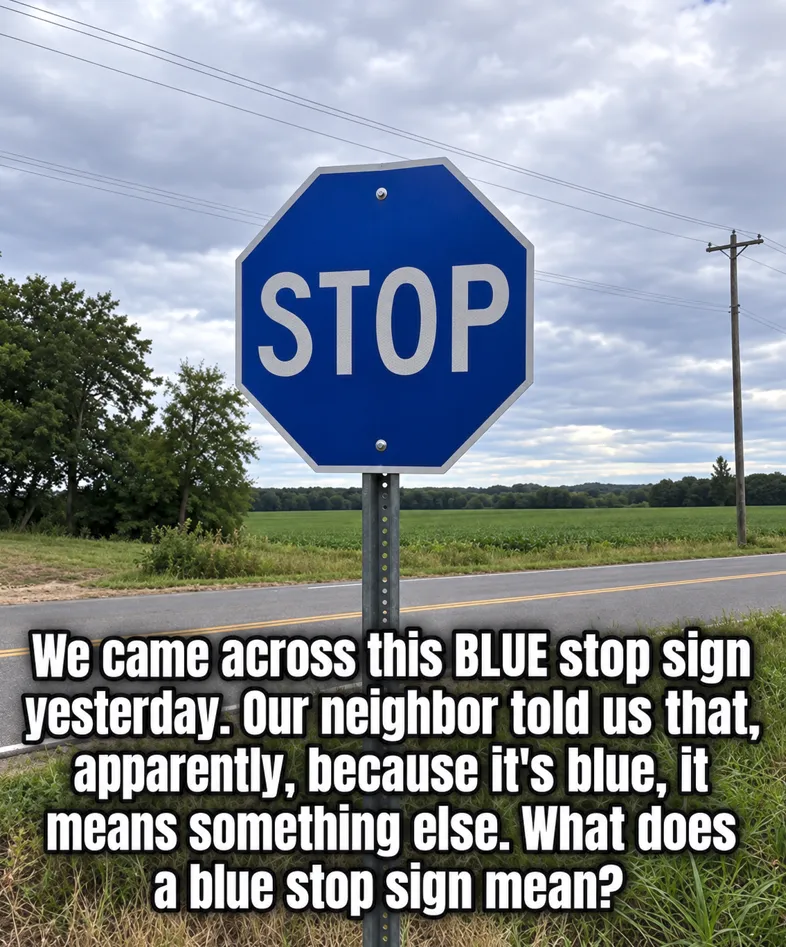
Imagine driving through a quiet neighborhood, parking complex, or business property when something unusual catches your attention.
At first, it looks exactly like a familiar stop sign. It has the same octagonal shape and the same clear instruction.
However, instead of red, the sign is blue.
Naturally, this unusual color raises several questions. Is the sign legal? Does it carry official authority? Are drivers required to stop?
Blue stop signs are uncommon, but they can serve a practical purpose. You might encounter them on private property, where owners sometimes install nonstandard traffic signs.
However, their legal status depends on the location and applicable traffic laws.
Understanding these signs can help drivers avoid confusion and make safer decisions.
Why Do Blue Stop Signs Look So Unusual?
Most drivers recognize traditional stop signs almost instantly.
After years of driving, the connection becomes automatic. A red octagon means drivers must stop.
However, a blue stop sign interrupts that familiar visual pattern.
Your brain recognizes the shape and the word STOP. Yet the unexpected color creates uncertainty.
As a result, drivers may hesitate or question whether the sign carries any authority.
This reaction highlights why consistent traffic signs are important.
Drivers often have only seconds to recognize a warning or instruction. Therefore, familiar shapes and colors make roads easier to navigate.
Even a small design change can create unnecessary confusion.
Where Can You Find Blue Stop Signs?
Blue stop signs may appear on privately managed properties rather than ordinary public streets.
For example, drivers might encounter them in the following locations:
- Gated residential communities
- Apartment complexes
- Private parking lots
- Business parks
- Corporate campuses
- Industrial facilities
- Privately maintained roads
- Large commercial developments
These properties often contain complicated traffic patterns.
For instance, vehicles may enter from several directions. Meanwhile, pedestrians may walk between buildings or cross parking areas.
Additionally, parked vehicles can limit visibility near intersections.
Property managers may install signs to organize traffic and reduce potential conflicts.
However, private ownership does not automatically exempt a road from official traffic-sign standards.
Why Would Someone Install a Blue Stop Sign?
Traditional stop signs follow established design standards.
In the United States, official STOP signs use a red background, white lettering, and an octagonal shape.
However, some privately installed signs have different appearances.
A property owner might select blue to distinguish an internal sign from standard roadway signs.
Alternatively, the unusual design might come from a custom manufacturer or decorative installation.
There is no single explanation for every blue stop sign.
Nevertheless, when a blue octagonal sign displays the word STOP near an intersection, its intended message is usually clear.
Drivers approaching that location are being instructed to stop.
Still, its unusual appearance does not establish whether the sign meets official traffic regulations.
Why Official Traffic Standards Matter
The Federal Highway Administration establishes national traffic-control standards through the Manual on Uniform Traffic Control Devices (MUTCD).
Under these standards, official STOP signs have a recognizable red-and-white design.
Importantly, certain privately owned roads that remain open to public travel must also follow applicable traffic-control requirements.
Therefore, a private road does not automatically permit nonstandard regulatory signs.
These requirements help drivers recognize instructions consistently, regardless of who owns the roadway.
Are Blue Stop Signs Legal in the United States?
The answer depends on where the sign appears and which laws apply.
A blue stop sign does not match the standard design for an official STOP sign under the MUTCD.
However, that does not automatically answer every legal question.
Local laws, road ownership, public access, and enforcement rules can affect a sign’s status.
For example, a private industrial facility might use internal signs to manage employee vehicles.
Meanwhile, a privately owned road open to public travel may have different legal requirements.
As a result, drivers should not assume every blue stop sign has the same regulatory authority.
More importantly, an unusual color does not eliminate the need to drive carefully.
Even when a sign is nonstandard, the intersection may still present genuine safety risks.
Why Ignoring a Blue Stop Sign Can Be Dangerous
Imagine approaching a blue stop sign inside a large parking complex.
You notice the unusual color and assume the sign has no authority.
Consequently, you continue driving without stopping.
However, another driver approaching the same intersection expects vehicles to stop.
A third vehicle might also enter from a nearby lane.
Suddenly, several drivers are following different expectations.
This confusion can increase the risk of a collision.
Stopping at a clearly marked conflict point can help prevent several problems:
- Low-speed vehicle collisions
- Pedestrian accidents
- Parking-lot crashes
- Confusion about right-of-way
- Unexpected conflicts between vehicles
Furthermore, parking areas often have limited visibility.
Pedestrians may emerge between parked cars, while drivers may reverse without seeing approaching traffic.
Therefore, approaching unfamiliar intersections cautiously is always important.
A few seconds of attention can prevent a serious accident.
What Should Drivers Do When They See One?
The safest practical response is straightforward.
Approach carefully and stop when it is safe to do so.
You do not need to determine the sign’s complete legal status while approaching an intersection.
Instead, focus on your surroundings.
Follow these simple precautions:
- Slow down as you approach the sign.
- Come to a complete stop at a safe, appropriate location.
- Look left and right for approaching vehicles.
- Check nearby sidewalks and pedestrian crossings.
- Watch for cars leaving parking spaces or driveways.
- Proceed only when the intersection is clear.
Additionally, avoid sudden braking if doing so would create an immediate danger.
Your response should remain predictable and controlled.
Remember that stopping does not automatically give you the right-of-way.
You must still check for approaching traffic before moving forward.
What If Another Driver Ignores the Sign?
Unfortunately, not every driver will respond to an unusual sign in the same way.
Some may stop immediately. Others might slow down without stopping.
Meanwhile, a few drivers may ignore the sign completely.
Therefore, never assume surrounding vehicles will behave exactly as expected.
Watch their speed and movements carefully.
If another vehicle appears unlikely to stop, allow it to pass rather than forcing your way into the intersection.
Furthermore, avoid relying entirely on eye contact with another driver.
Visible signals can help, but they do not guarantee that someone will yield.
Defensive driving means preparing for unexpected behavior.
Why Are Standard Stop Signs Red?
The familiar red stop sign serves an important purpose.
Traffic engineers use standardized shapes and colors to communicate instructions quickly.
For example, the octagonal shape makes a STOP sign recognizable even when viewed from an unusual angle.
Its red background also reinforces the message that drivers must stop.
Together, these design features support faster recognition.
However, changing the background to blue removes part of that familiar visual signal.
Drivers may understand the word STOP while questioning the meaning of its color.
As a result, nonstandard signs can introduce confusion.
This is one reason official traffic-control systems emphasize consistent designs.
Can Private Roads Use Different Traffic Signs?
Private roads may have their own traffic-management arrangements.
However, the rules depend on how those roads are used.
A restricted industrial roadway may operate under different conditions from a private street open to public traffic.
For example, shopping-center access roads can be privately owned while remaining accessible to ordinary drivers.
In such cases, applicable traffic-control standards may still apply.
Therefore, ownership alone does not determine whether a blue stop sign is appropriate.
Property managers should follow relevant laws and standards when installing traffic-control devices.
Don’t Assume a Blue Stop Sign Is Decorative
Because blue stop signs are unusual, some people may mistake them for novelty signs.
However, appearance alone cannot reveal their purpose.
Instead, examine where the sign stands.
Does it face approaching vehicles at an intersection?
Are pedestrians crossing nearby?
Does another roadway enter from the side?
Could cars emerge from a hidden driveway or parking area?
If so, the location may require additional caution.
Furthermore, a sign positioned near moving traffic deserves more attention than a decorative sign mounted on a building.
Always consider the surrounding road conditions.
Even a nonstandard sign can warn drivers about a genuine hazard.
Are All Blue Stop Signs the Same?
Not necessarily.
Their purpose can vary depending on the property and installation.
For instance, one might appear inside a gated apartment complex.
Another could direct vehicles within a commercial parking structure.
Meanwhile, an industrial facility might use similar signs as part of its internal safety procedures.
Some blue signs may even serve decorative purposes rather than regulate traffic.
Therefore, drivers should avoid making assumptions based solely on color.
The sign’s placement, wording, surrounding traffic, and applicable laws all matter.
When uncertainty remains, prioritize safe driving rather than guessing about enforcement.
What Should Drivers Remember About Blue Stop Signs?
You do not need to memorize every possible explanation for these unusual signs.
Instead, remember one important principle:
An unusual color does not automatically make a traffic instruction unimportant.
If a blue octagonal sign says STOP at a potential traffic conflict point, approach it cautiously.
Stop safely, check for other road users, and continue only when the way is clear.
Additionally, remember that a blue background does not make the sign an official MUTCD-compliant STOP sign.
Its legal authority can depend on the road and local regulations.
Therefore, safety and legal status are related but separate questions.
Drivers should consider both without allowing uncertainty to distract them.
The Bottom Line
Blue stop signs attract attention because they challenge one of the most familiar patterns in driving.
Most motorists immediately associate stop signs with red.
However, a blue octagonal sign creates an unexpected visual contrast.
Such signs may appear on private properties, parking facilities, or restricted roads.
Their purpose can vary, and they do not match the standard design of official American STOP signs.
Nevertheless, the surrounding intersection may still present real traffic risks.
For that reason, the safest approach is to slow down, stop when safe, check your surroundings, and proceed carefully.
Ultimately, safe driving matters more than the unusual appearance of a sign.
A few seconds of caution can make a significant difference.
Have you ever seen a blue stop sign in real life? Tell us where you spotted it. Also, share this article with someone who might be surprised to learn these signs exist.