I bought the Christmas ham the week after Thanksgiving.
By December 10, I’d already extended the dining room table. I’d also washed and ironed Grandma Inga’s good tablecloth before folding it over a chair.
Meanwhile, my youngest daughter, Solveig, made place cards from construction paper for everyone.
Mom’s place card had a gold star on it.
She’d been living in the nursing home in town since August, when she broke her hip on the cellar stairs.
At eighty years old, she’d walked down those stairs thousands of times carrying baskets of canning jars.
However, that afternoon, her foot missed the third step.
She lay on the cellar floor for most of the afternoon. Eventually, my husband, Stig, and I arrived with sweet corn and heard her calling.
After surgery in the city, Mom spent three weeks in rehabilitation.
Unfortunately, her doctor determined that she couldn’t return to a house with stairs and nobody to help her.
Therefore, she moved into Lakeview Lutheran Home, where her bedroom window overlooked the parking lot.
Throughout the fall, I’d planned one special evening.
Christmas Eve supper at our farm, surrounded by all eight of her grandchildren.
I’d received permission from the director of nursing back in November.
Moreover, Mom had written the date on her wall calendar in ink.
A Christmas Eve Snowstorm
Shortly after two that afternoon, the snow began blowing sideways.
I stood at the kitchen window and watched the machine shed gradually disappear.
We’d received eight inches of light, dry snow the previous day. However, the northwest wind had picked up nearly every flake.
By three o’clock, the radio announced that county roads were closed.
Meanwhile, the announcer began reading the long list of canceled church services.
At 3:10, an aide from the nursing home called.
Her name was Paloma, and she’d cared for Mom since her first week at Lakeview.
“Corliss, I wanted you to know. Inga’s been by the front door in her coat since noon,” she explained.
“She’s got her purse on her lap. She won’t come away for coffee.”
I closed my eyes.
“I talked to Darlene, the nurse on duty today. She says your mother can still go if family can transport her safely.”
“I’m supposed to say that part twice.”
“I heard it.”
“She keeps asking what time it is,” Paloma added.
Unfortunately, our farm pickup was sitting in a repair shop in town with a damaged transmission.
The replacement part wouldn’t arrive until after New Year’s.
Meanwhile, my front-wheel-drive sedan could barely climb our driveway during a wet spring.
Stig’s brother also had our loader tractor at his place.
Consequently, I called the only person in our family with a four-wheel-drive pickup.
My brother, Kurtis.
My Brother’s Unexpected Response
Kurtis owned a three-quarter-ton pickup with a plow mount on the front.
Furthermore, he lived only four blocks from the nursing home. He could practically walk there in his slippers.
He answered on the fifth ring.
In the background, I could hear a football game.
“Kurt, the roads are closed out here. Mom’s sitting at Lakeview’s front door in her coat.”
“Can you bring her out? Supper’s at six. You could stay. Britt and the kids are already here.”
For several seconds, he remained silent.
Finally, he answered.
“Corliss, it’s not worth thirty dollars of gas and a ditch.”
“Have you looked outside? She can have Christmas next week. It’s the same ham.”
“She’s been sitting there since noon.”
“Then somebody ought to tell her to sit somewhere else.”
His voice remained flat and reasonable.
“I’m not hauling an eighty-year-old woman with a pinned hip through that. If I put her in the ditch, then what?”
Apparently, he’d already made up his mind.
“Next week. I’ll bring her myself.”
Before I could respond, he hung up.
I sat there with the phone resting in my lap.
Meanwhile, Britt’s three children and my five were arguing over a board game in the next room.
I could hear Britt reminding someone to share.
The Distance Between Kurtis and Mom
Deep down, I understood why my brother had refused.
Kurtis hadn’t walked through the nursing home’s doors once since August.
Furthermore, he’d missed Mom’s birthday in October, when the staff placed a paper crown on her head.
He hadn’t attended her care conference either.
Years earlier, Dad had named him power of attorney. Consequently, Kurtis handled Mom’s bills through the mail and telephone.
Yet he lived only four blocks away.
He couldn’t stand seeing her inside that building.
In fact, Britt had told me as much in September, while staring at the floor.
The snow had simply given him another reason to stay away.
I’d known my brother for fifty-two years. Therefore, I understood him better than most people.
Nevertheless, understanding his behavior didn’t make it right.
There was nobody else to call.
Moreover, there was no point arguing with either my brother or the weather.
Nine miles of snowdrifts separated my kitchen from the nursing home’s front door.
At the other end, my mother was waiting with her purse on her lap.
So I went outside to the machine shed.
Taking Our Old John Deere Into the Snow
Our tractor was a 1991 John Deere with a green cab.
Stig and I had purchased it used the year after we married.
Its heater worked whenever it felt like working. Additionally, it had a small folding buddy seat beside the driver’s seat.
Every one of our children had ridden there at some point.
The tractor weighed approximately eight tons.
I’d never seen snow stop it.
Meanwhile, Stig followed me into the shed while pulling on his gloves.
He’d seen my expression in the kitchen and hadn’t asked a single question.
“I’ll drive,” he offered.
“I’ll drive. I need you for the lifting.”
For a moment, he studied my face.
Stig is a large, quiet man. Over the years, he’s learned when to leave me alone.
Without arguing, he zipped up his insulated coveralls.
I put on my chore coat and the red knit cap Mom had made for me.
Then I climbed into the tractor.
Stig followed, folding himself onto the buddy seat with his knees nearly touching his chin.
As we drove out of the shed, Britt stood beside the back door holding a dish towel.
I lowered the window slightly.
“We’re going after Mom. Don’t hold supper, but don’t start without her.”
She nodded.
However, she didn’t ask where Kurtis was.
Britt had driven their three children to our farm at noon, before the roads closed.
Afterward, she’d spent the afternoon peeling potatoes.
Not once that day did she mention her husband.
Nine Miles Through the Snowstorm
I drove approximately twelve miles per hour.
Under those conditions, that was as fast as I dared travel.
Snowdrifts blocked every low section of the road. In some places, they stretched across both lanes and stood three feet deep.
Nevertheless, the tractor pushed through them, sending snow pouring over the hood.
Between the drifts, the wind had swept the gravel completely bare.
Unfortunately, I couldn’t see the ditches.
Everything around us appeared to be the same color.
Therefore, I followed the fence posts along the Engebretson property, keeping them a steady distance from my right wheel.
Whenever the posts disappeared, I used the power poles as landmarks.
Meanwhile, Stig pressed his hand against the cab window behind my shoulder and watched the left side.
Twice, he told me to move over slightly.
Both times, I followed his instructions.
That was practically all the conversation we had.
Around the fourth mile, the tractor’s heater stopped working.
First, my toes became numb. Eventually, I could barely feel my fingers inside my chore gloves.
I remembered Dad, who’d farmed with an open tractor until 1974.
Sometimes, he’d come inside at night with ice covering his eyebrows.
Then I thought about Mom’s calendar.
Admittedly, I also thought a few things about my brother that I wouldn’t repeat in church.
Arriving in Town
The journey took almost fifty minutes.
When we passed the grain elevator at the edge of town, the streetlights were already on.
Each light appeared as a fuzzy yellow ball through the blowing snow.
Nothing else was moving.
I drove our eight-ton farm tractor straight down the middle of Second Avenue.
However, nobody was outside to witness it.
Suddenly, the nursing home’s illuminated glass doors appeared through the snow.
I pulled beneath the entrance canopy, parked as close as possible, and set the brake.
Paloma was waiting for us.
She wore blue scrubs beneath a winter parka.
With one hand, she held an empty wheelchair against the wind. Meanwhile, her other arm supported my mother.
Mom was standing.
She wore her good wool coat and a scarf tied beneath her chin.
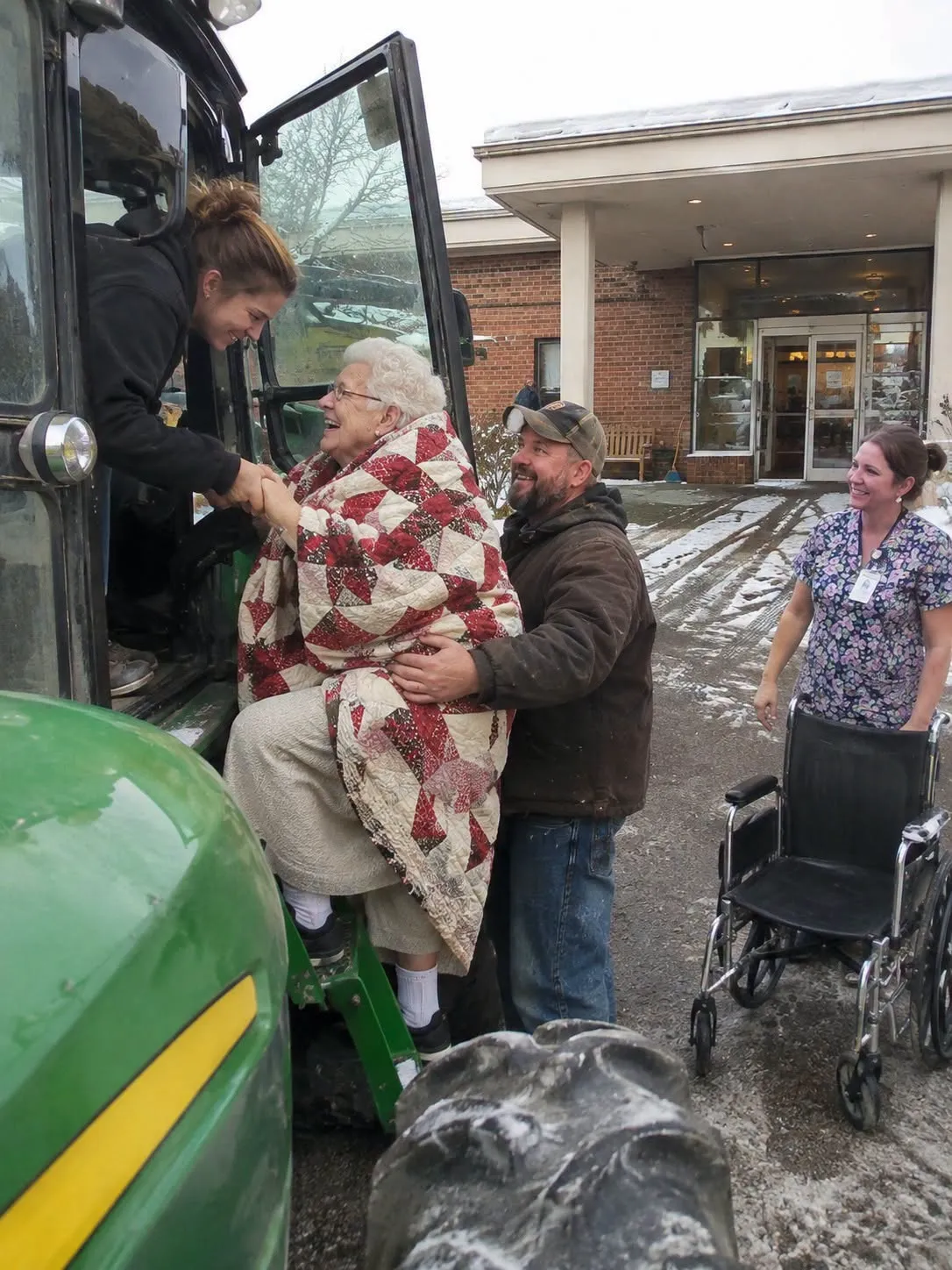
Additionally, Paloma had wrapped her in a red-and-white quilt from somebody’s bed.
Mom looked incredibly small inside it.
Nevertheless, her face was turned upward toward the tractor.
I opened the cab door and leaned down, still wearing my red knit cap.
“Hi, Mom.”
“Well,” she replied. “Look what my girl drove to town.”
Paloma laughed out loud.
Signing Mom Out of the Nursing Home
Paloma had a clipboard tucked beneath her arm.
She passed it up to me.
It contained the sign-out sheet residents used whenever they left the building.
After removing my glove, I wrote my name and telephone number with fingers that could barely close.
Under “time out,” I wrote 4:22 PM.
Another line requested the method of transportation.
I wrote one word.
“Tractor.”
Meanwhile, Paloma shouted over the wind.
“Darlene wants her back tonight if the roads open, and tomorrow morning if they don’t.”
“Her evening pills are in the bag. I’ll hand it up.”
Next came the difficult part.
Four steep steps led into the tractor’s cab, with a grab bar on either side.
Mom used a walker and had a pin in her hip.
Furthermore, she hadn’t climbed anything higher than a curb since August.
Stig climbed down past me and positioned himself beneath her.
He placed one arm around her waist and the other behind her knees.
Then he lifted her as carefully as he’d lift a newborn calf.
I took both her hands.
Although they were cold and dry, they were still strong.
“One step, Mom.”
She placed her good foot on the step.
Meanwhile, Stig raised her.
“Then the next.”
An Audience Behind the Glass Doors
Behind the nursing home’s glass doors, the entire front hallway was watching.
Wheelchairs were lined up two deep.
Among the residents was a man with an oxygen tank. Nearby, a woman in a pink robe pressed both hands against the window.
Someone had even brought the cook out from the kitchen.
Finally, Mom’s head cleared the tractor’s doorframe.
Everyone inside began clapping.
Although I could see their hands moving, the wind was too loud to hear them.
Mom settled into the buddy seat and held onto the grab bar.
Afterward, I tucked the quilt around her legs.
Stig climbed back inside and squeezed himself onto the cab floor behind us.
His back rested against the rear window, with the door closed against his shoulder.
The tractor wasn’t designed to hold three people.
Nevertheless, we made room for all three of us.
A Memory From 1966
When I turned the headlights toward Main Street, Mom started laughing.
It was her genuine laugh, the one that made her shoulders shake.
I hadn’t heard it since summer.
“I haven’t ridden in a tractor since 1966,” she explained.
“The year I married your dad. He took me around the section in his father’s Farmall to show me what I was getting into.”
“What did you think?”
“I thought it was awfully loud. I married him anyway.”
Throughout the nine-mile journey home, she held onto the grab bar.
However, she never once asked whether we’d make it.
Fortunately, the wind had weakened slightly.
I could follow my previous tracks for most of the journey, although snow was already filling them.
Meanwhile, Stig watched the left side through the space between our shoulders.
Somewhere beyond the Engebretson property, I realized Mom was humming.
She hummed “Silent Night” from beginning to end.
Then, approximately a mile later, she started again.
Christmas Eve at the Farm
At half past five, our yard light appeared through the darkness.
Every window in the house was illuminated.
Before I switched off the tractor’s engine, eight grandchildren came running through the back door.
Some were wearing only socks on their feet.
Three of those children belonged to Kurtis.
My oldest son, Anders, was nineteen and built like his father.
Together, he and Stig helped Mom down from the tractor.
Then they carried her across the yard inside the quilt.
She waved from their arms like a queen.
Meanwhile, Britt held the door open.
We sat down for supper at six.
I placed Mom at the head of the table, where Dad used to sit.
In front of her was Solveig’s place card with the gold star.
Mom looked around at the ham, the lefse, the candles, and the eight faces surrounding her.
For a moment, she seemed unable to speak.
Finally, she folded her hands.
An Empty Chair at the Table
Mom began with the short Norwegian table prayer she’d said throughout my entire life.
Afterward, she added something in English.
She thanked God for warm kitchens and a good daughter.
Additionally, she thanked Him for a son-in-law with a strong back.
Stig’s ears immediately turned red.
Then she thanked Him for “a son who will come around.”
Britt lowered her eyes toward her plate.
Meanwhile, her twelve-year-old son, Tyler, looked at his mother.
Then he glanced toward the empty chair I’d deliberately placed on the far side of the table.
Its place card read UNCLE KURTIS in green marker.
Nobody commented.
Mom simply said “Amen” and asked for the potatoes.
It was a wonderful supper.
Moreover, it was wonderfully loud.
Mom ate two helpings of ham and repeated the story about Dad’s Farmall for the grandchildren.
Throughout the meal, Solveig remained pressed against her grandmother’s arm.
Twice, however, I noticed Mom looking toward the back door.
Both times, she looked away and asked someone another question.
Unexpected Headlights in the Yard
At eight o’clock, I was cutting the pies.
I’d just started slicing the second one, a sour cream raisin pie.
It was Kurtis’s favorite.
Despite everything, I’d made it anyway.
Suddenly, our dog began barking from the back step.
He sounded exactly as he did whenever an unfamiliar vehicle entered the yard.
Then headlights swept across the kitchen ceiling.
Mom lowered her fork.
We heard boots on the back step.
A moment later, the door opened.
My brother stepped onto the mat.
Snow covered his pants up to his knees. Moreover, his face was raw from the wind, and ice clung to his mustache.
In one hand, he carried Mom’s folded aluminum walker.
In the other, he held a white pharmacy bag.
First, he looked at Mom.
She was sitting at the head of the table in her good blouse, surrounded by eight grandchildren.
It was the first time he’d seen her in four months.
Kurtis opened his mouth.
However, nothing came out.
I watched his jaw move as he struggled to find words.
My brother could talk about a football game for an entire hour.
Nevertheless, he stood on my kitchen mat unable to say anything.
His eyes filled with tears.
Finally, he turned toward me and lifted the walker.
Apparently, speaking to me was easier.
“You forgot this,” he said.
His voice cracked.
“And her pills. Paloma called the house. They were sitting by the door.”
The Bag I’d Forgotten
I looked at the pharmacy bag.
During the confusion with the clipboard and getting Mom into the tractor, I’d forgotten it.
Paloma had promised to hand it up.
However, once Mom reached the steps, none of us remembered.
Inside the bag were Mom’s heart medication and blood thinner.
Her eight o’clock dose was already late.
“Kurtis Alan,” Mom called from the head of the table.
“Take your boots off. You’re melting on your sister’s floor.”
Something immediately changed in his shoulders.
He bent down and began unlacing his boots.
It took him a long time.
When he finally stood up, his children gathered around him.
Tyler hesitated briefly before joining them.
Meanwhile, Mom patted the empty chair beside the green place card.
Kurtis walked around the table in his wool socks and sat down.
She reached over, placed her hand against his cold cheek, and left it there.
“There you are,” she said.
“Ma.”
That was the only word he managed.
Then he placed his hand over hers.
I set a piece of sour cream raisin pie in front of him.
Britt poured him coffee and briefly rested her hand against the back of his neck.
Meanwhile, all the children started talking at once.
I gave Mom her medication with a glass of water.
Afterward, I stood at the kitchen sink with my back toward everyone.
I was still angry.
However, I didn’t want Mom to see that anger on Christmas Eve.
A Conversation Outside in the Cold
Unfortunately, the roads remained closed.
At nine o’clock, Darlene called and told us to keep Mom until morning.
Therefore, we prepared the bed in the downstairs sewing room.
Meanwhile, all eight grandchildren gathered in the living room to sing for her.
They performed the three Christmas carols they remembered best.
During the second verse of the final song, Mom fell asleep in Stig’s recliner.
The red-and-white quilt rested across her knees.
Eventually, Anders carried her to bed.
Without being asked, Kurtis went outside to bring in more firewood.
I pulled on my coat and followed him.
He stood beneath the lean-to beside the woodpile with empty arms.
By then, the snow had stopped.
Furthermore, the wind had completely disappeared.
The temperature was dropping into the deep, quiet cold that follows a winter storm.
“How long did it take you?” I asked.
“An hour and a half. I buried it to the axles by Engebretson’s and had to shovel out.”
He kicked a piece of oak.
“I followed your tracks. They were about gone.”
“Thirty dollars of gas.”
He flinched.
“I know what I said.”
“She sat at that door for four hours, Kurt. In her coat.”
“I know it.”
When he turned around, he looked ten years older beneath the yard light.
What Kurtis Had Seen at Lakeview
“Paloma called and said somebody had to come get the pills. I was the only family in town.”
He paused.
“I stood on that sidewalk for twenty minutes.”
Although he’d driven past the nursing home every day since August, he’d never stepped onto its walkway.
“Then I went in.”
He wiped his nose with his glove.
“It smells like the school lunchroom in there. They’ve got her name on the door on a little card.”
Moreover, he discovered his children’s drawings pinned to Mom’s bulletin board.
Britt had been taking them there without his knowledge.
I remained silent.
“Her bed was made. Her slippers were under it.”
He stopped speaking.
Then he looked toward his pickup.
“Come here. I want to show you something.”
Together, we crossed the yard.
He opened the passenger door and reached behind the seat.
Then he pulled out a plastic hardware store bag.
It had been sitting there so long that dust covered it.
He handed it to me.
The Hardware Store Receipt
Inside the bag were two steel handrail brackets, still attached to their cardboard packaging.
Additionally, there was a box of three-inch screws.
A folded receipt lay at the bottom.
I held it beneath the pickup’s interior light.
The date was July 19.
The total was $23.47.
“She asked me in June to put a rail on the cellar stairs,” Kurtis explained.
“She said she didn’t like carrying jars downstairs with nothing to hold on to.”
He’d agreed to help her.
Furthermore, he’d purchased the brackets and prepared an oak handrail in his garage.
“I was going to do it that weekend.”
However, the fair came along.
Afterward, he became busy building a deck for the Olsons.
His voice gave out before he continued.
“She fell on the ninth of August. That sack has been riding behind my seat ever since.”
I stood in the cold holding twenty-three dollars’ worth of hardware.
Immediately, I thought about Mom lying on the cellar floor.
Then I pictured Kurtis writing checks to the nursing home every month from four blocks away.
“She’s never said one word about a handrail,” I told him.
“She wouldn’t. That’s what I can’t stand.”
He leaned his forehead against the pickup’s doorframe.
“I can’t sit in that room and have her be nice to me.”
I’d wanted to remain angry.
After all, I’d felt justified throughout the afternoon.
I’d also earned that anger during nine miles of driving with frozen toes.
Nevertheless, I couldn’t hold onto it while holding that hardware bag.
I returned the receipt to the bag and placed it on his passenger seat.
“Come inside,” I said.
“There’s something else, isn’t there? You’ve had a look on you all fall.”
The Financial Burden Kurtis Had Been Carrying
After everyone went to sleep, we sat at my kitchen table.
Kurtis returned to his pickup and retrieved a manila folder.
Then he opened it beneath the kitchen light, between the pie plates.
He’d written everything in his neat, square carpenter’s handwriting.
Medicare had covered Mom’s rehabilitation period before those payments stopped.
Since the middle of September, Lakeview had been billing her privately.
The monthly cost was $9,200 for her room and care.
Furthermore, pharmacy expenses were billed separately.
When Mom entered the nursing home, she’d had approximately $71,000 in her savings account at Security State Bank.
Kurtis showed me the December statement.
Only $38,400 remained.
“Her Social Security covers some. Your land rent covers some.”
Since Dad’s death, Stig and I had rented the home quarter from Mom for $14,000 annually.
However, those payments barely covered the remaining expenses.
“I’ve run it every way I know,” Kurtis explained. “She’s out of savings by May.”
“And then what?”
“Then it’s the house or the quarter.”
He’d already consulted Joan Lindquist, the attorney on Main Street who’d handled Dad’s estate.
She’d explained Medicaid eligibility and which assets might be counted.
Unfortunately, Kurtis admitted that he hadn’t understood half of it.
What he had understood, however, was that Dad’s farmland was the family’s remaining valuable asset.
And Stig and I were farming it.
A Responsibility He Never Shared
Kurtis rubbed his eyes with the heels of his hands.
“I’ve been lying awake since October trying to find a way that doesn’t end with me selling the ground out from under my own sister.”
I studied the columns of figures.
He’d even included the forty dollars Mom spent each month on her hair appointment.
“Why didn’t you tell me?”
“Because you’d have sold your cows to cover it.”
He knew I’d have taken out a second mortgage without telling him.
Then he closed the folder.
“I’ve got power of attorney. Dad gave it to me. I figured it was mine to carry.”
“That isn’t what it’s for, Kurt.”
I explained that the responsibility allowed him to sign checks.
However, it didn’t mean he had to carry every burden alone.
He didn’t answer.
Meanwhile, the furnace switched on.
From the sewing room down the hallway, I could hear Mom snoring softly.
For the first time since summer, she was sleeping inside my house.
Considering Another Possibility
“What if she didn’t go back?” I asked.
Kurtis looked up.
“Not tomorrow. She has to go back tomorrow. I signed a sheet.”
Instead, I suggested that we consider bringing her home permanently in the spring.
The sewing room was on the ground floor.
Furthermore, the bathroom was only eight feet away.
I began thinking aloud.
We’d need a ramp at the back entrance, bathroom handrails, and a wider doorway.
“She needs help getting dressed, Cor,” Kurtis reminded me. “She needs somebody at night.”
“I’ve got five kids and a husband.”
Additionally, there was an agency in town that provided home health aides.
Surely, I thought, it couldn’t cost $9,200 every month.
“You don’t know what it costs.”
“No. I don’t. Neither do you.”
Then I pushed the folder toward him.
“But you can build a ramp.”
For several moments, he considered the idea.
He turned his coffee cup around a few times.
“I can build a ramp,” he finally answered.
We didn’t reach a decision that evening.
After all, we were exhausted.
More importantly, it wasn’t a decision we could make without Mom.
Therefore, on Christmas morning, we asked her.
Mom Had Her Own Conditions
Mom sat at the kitchen table wearing my robe.
Her hair was flat on one side, and she was eating lefse with butter and sugar.
Kurtis explained the financial situation.
Furthermore, he showed her the bank statement.
I hadn’t expected him to do that.
Nevertheless, I felt proud of him.
Mom put on her reading glasses and followed the columns with one finger.
“Nine thousand dollars,” she said. “For that room.”
“Your father and I bought the home quarter for less.”
“That’s about the size of it, Ma.”
“And nobody thought to mention this to me. It’s my money.”
She looked over her glasses at Kurtis before turning toward me.
“I broke my hip. I didn’t lose my arithmetic.”
Kurtis began explaining that he hadn’t wanted to worry her.
However, she raised her hand.
“I’ll tell you what I want, and then you two can fight about how.”
First, she didn’t want Arvid’s farmland sold while a grandchild might still want to farm it.
Secondly, she wanted to live somewhere she could hear children.
Finally, she didn’t want to become a burden to me.
She removed her glasses.
“If I come here, I pay my way. Room and board, out of my own check, the same as I’d pay those people.”
She suggested having Joan prepare a proper written agreement.
“Mom, you’re not paying me rent.”
“Then I’m not coming.”
With that, she returned to her lefse.
Unexpectedly, Kurtis laughed.
It sounded almost like a cough.
However, it was the first genuine laugh I’d heard from him since August.
Mom looked pleased with herself.
Returning to Lakeview on Christmas Day
By afternoon, the snowplows had cleared the roads.
Therefore, Kurtis drove Mom back to Lakeview in his four-wheel-drive pickup.
He carried her outside himself and secured her seat belt.
Meanwhile, I followed in Britt’s car with the walker.
When Kurtis pulled beneath the nursing home’s canopy, he remained inside the pickup.
For approximately two minutes, he sat there with the engine running.
Eventually, he stepped outside and walked around to Mom’s door.
He opened it and helped her through the glass entrance.
Paloma was sitting at the reception desk.
When she noticed who was holding Mom’s arm, she looked past them toward me.
Then she raised her eyebrows.
I signed the resident sheet.
Time in: 2:40 PM.
Throughout all those months, Kurtis had never seen the place where family members signed.
Now, he visits every Tuesday after work.
According to Britt, he still sits inside his pickup for ten minutes before entering.
Sometimes, it takes fifteen.
Nevertheless, he goes inside.
He brings Mom a maple long john from the bakery, and together they work on the crossword puzzle.
Visiting remains difficult for him.
However, he does it anyway.
Preparing for an Uncertain Future
I won’t pretend that everything has been settled.
In January, Kurtis and I met with Joan Lindquist while Mom joined us by speakerphone.
Afterward, I left with a headache and a legal pad filled with questions.
Meanwhile, the home health agency sent someone to evaluate my house.
Her estimate was lower than Lakeview’s monthly cost.
Unfortunately, it was still higher than I’d hoped.
Initially, Mom would need approximately four hours of assistance each day.
Stig believes we can manage it.
Nevertheless, I sometimes lie awake wondering whether I’ve promised more than I can handle.
It’s March now.
The savings account continues shrinking by $9,200 on the first day of every month.
Furthermore, Kurtis and I haven’t completely repaired our relationship.
He apologized for his thirty-dollar comment in his own way.
In January, he filled my fuel barrel and refused to accept payment.
I’ve mostly forgiven him.
However, some days I remember Mom waiting beside that nursing home door in her coat.
Whenever that happens, I have to go outside and do chores.
Making Room for Mom
During the final week of February, Kurtis built a ramp at my back entrance.
He used treated lumber and made the slope exceptionally gentle.
A marble would barely roll down it.
The following Saturday, he widened the sewing room doorway.
Last weekend, he began working on the bathroom.
Mom came out for the day to supervise.
This time, Kurtis drove her himself.
She sat on a kitchen chair in the hallway with the red-and-white quilt across her lap.
According to Paloma, the nursing home had finally given up trying to get that quilt back.
Kurtis brought a six-foot oak handrail.
It was sanded as smoothly as a tabletop.
He’d originally cut it the previous July.
Then he reached into a dusty hardware store bag and removed the two steel brackets.
With a pencil behind his ear and a level in his other hand, he positioned the first bracket beside the bathtub.
“A little higher,” Mom instructed.
He moved it upward.
“That’s crooked.”
“It’s not crooked, Ma. I’ve got a level on it.”
“Then your level’s crooked. Bring your end up.”
He raised his end another eighth of an inch.
Then he looked at me over his shoulder.
I looked at the ceiling.
Finally, he marked the wall and picked up his drill.
Related Articles
My Husband Kissed My Best Friend on a Flight to Denver — Neither of Them Knew I Was Watching[s]
My Stepmother Refused to Take My Son to the Hospital in Her $64,000 Buick, So His Teenage Sister Stepped In
My Sister-in-Law Refused to Deliver My Son’s Insulin, So I Walked Four Miles Through an Ice Storm