The school called at ten that morning.
I was standing at my kitchen window, staring at my car. It had slid backward down our hill the previous evening. Now, it sat crooked at the bottom, covered in an inch of ice.
“Mrs. Lindqvist, it’s Pauline Fitch, the school nurse.”
My stomach dropped before she could say another word.
When your child has type 1 diabetes, a call from the school nurse immediately makes you nervous. Even a routine question about a field trip can cause that reaction.
“Caleb’s fine right now,” she reassured me. “He’s sitting right here with a book. However, I’ve got a problem, and I need your help.”
An Unexpected Call From the School Nurse
Pauline explained the situation plainly.
Caleb had arrived at her office at 9:45 for his usual blood sugar check. His reading was 214, which was high for him but not immediately alarming.
However, he needed his usual mealtime insulin before lunch.
Unfortunately, his insulin pen wasn’t in his backpack. Therefore, Pauline had checked the locked drawer containing his backup pen.
The date on its label revealed that it had been open for thirty-three days.
“It’s only good for twenty-eight days once it’s opened,” Pauline explained. “I can’t use it on him. I’m sorry. I should have caught it last week, and that’s on me.”
“What time is lunch?”
“Third grade eats at 12:10. He can’t eat without his dose, Amber. And with his current number, he can’t simply skip lunch.”
Immediately, I knew where his insulin pen was.
I could picture it as clearly as the car outside my window. It was sitting on Heidi’s kitchen counter, inside its little blue zippered pouch.
Right beside his cereal bowl.
How Caleb Left His Insulin Behind
Caleb had spent the previous night at his aunt’s house.
Unfortunately, the freezing rain had arrived several hours earlier than predicted.
When I tried driving down our hill to collect him after school, the car slid sideways. Then it went backward, leaving me unable to continue.
Heidi is my husband’s sister. She lives three miles from us along the county road, just one mile outside town.
She owns a four-wheel-drive truck. Additionally, she watches Caleb every afternoon from 3:30 until I finish working at the feed store.
Because of the weather, she’d kept him overnight and driven him to school that morning.
Caleb was only nine. However, we’d already taught him how to manage his breakfast insulin dose.
After taking it at Heidi’s kitchen counter, he’d placed the pouch beside his cereal bowl. Then he’d gone looking for his other mitten.
“I know where it is,” I told Pauline. “Give me a few minutes.”
A Replacement I Couldn’t Afford
First, I called the pharmacy. I wanted to explore every reasonable option.
Mr. Tollefson answered the phone himself.
Fortunately, he had the insulin pens in stock. However, we’d already filled Caleb’s prescription on January 3.
Our insurance would reject another claim because it was too soon for a refill. Consequently, I’d have to pay the full price again.
I knew exactly how much that would cost.
Nils’s health insurance through the co-op had a deductible that reset every January.
Just three weeks earlier, I’d stood at that pharmacy counter and paid $340 for a box of insulin pens.
I’d charged it to our credit card. Even afterward, I’d felt sick about the expense for two days.
“I’d run it over to the school myself, Amber,” Mr. Tollefson explained. “But I’m alone in the store, and I can’t lock up. Can anybody come get it?”
Unfortunately, that brought me back to the same problem.
So I called Heidi.
“Can you run his pen over?” I asked. “It’s on your counter beside his bowl.”
“The school’s backup has expired, and he can’t eat lunch without it. It’s only one mile.”
For several seconds, she didn’t answer. Meanwhile, I could hear her television playing in the background.
“I’m not taking my truck out on that ice twice for a boy who should have remembered.”
For a moment, I honestly thought we’d lost the connection.
“He’s nine, Heidi.”
“Then he’ll remember next time.”
With that, she hung up.
A Mother With Few Options
I stood in my kitchen, still holding the phone.
Then I called my husband.
Nils drives a fuel truck for the co-op. Unfortunately, he was stranded at a truck stop 130 miles west of us.
The highway had closed in both directions, and he’d been there since midnight.
“She said what?”
He sounded as though he’d been sleeping in his truck.
After I repeated Heidi’s words, he went quiet.
Then he promised to call her himself.
He tried reaching his sister twice. However, she didn’t answer either call.
When he called me back, his voice sounded unusually tense. I’d only heard him speak that way a few times during our twelve years together.
“I’m so sorry. I can’t get there. They’ve got the gates down on the interstate.”
“I know you can’t.”
“What are you going to do?”
I looked outside again.
Freezing rain continued falling steadily. Meanwhile, our nearest neighbor with a truck, Arne Bakken, was spending the winter in Arizona.
He wouldn’t return until March.
Calling the sheriff didn’t seem appropriate to me. The deputies already had serious accidents to deal with that morning.
Besides, I couldn’t imagine how I’d explain the situation.
“I’m going to go get it,” I told Nils.
“Amber, it’s four miles. It’s glare ice.”
“Three miles to Heidi’s. Then one more into town.”
By then, I was already opening the hallway closet.
“It’s ten-fifteen. I can make it.”
Nils didn’t argue. He knew me well enough to understand that I’d made my decision.
“Wear my boots,” he said instead. “The black ones. Yours don’t have any tread.”
Preparing for the Walk
I pulled on Nils’s black chore boots, which were two sizes too large for me.
To keep my feet from sliding around, I stuffed his wool socks into the toes.
Next, I pulled my red knit hat over my ears. I also put on my tan feed store work coat and my heaviest mittens.
Finally, I slipped my phone into an inside pocket to keep it warm.
Before leaving, I stopped at the door.
For a moment, I tried imagining what I’d say to Heidi when I arrived.
However, nothing seemed right.
So I stepped outside.
Four Miles Through the Ice Storm
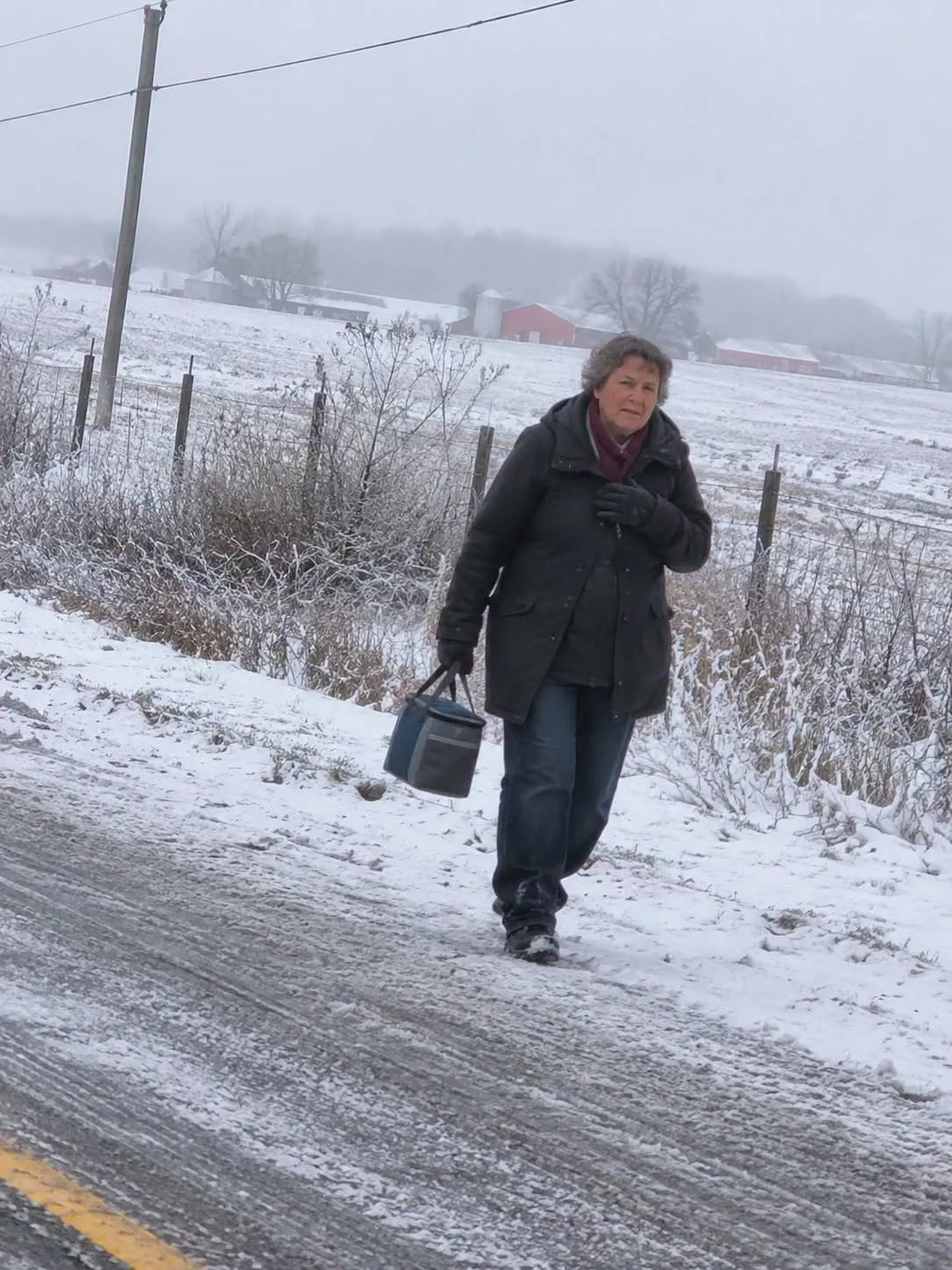
Within six steps, I discovered just how slippery the road was.
Both feet slid out from underneath me. Fortunately, I caught myself on the mailbox.
Even the gravel had a layer of ice thick enough to skate on.
Therefore, I moved onto the shoulder and walked through the frozen grass beside the ditch. The grass stems poked through the ice, giving my boots something to grip.
Every fence wire was covered in ice as thick as my thumb. Likewise, the trees were completely coated.
The entire countryside looked gray and shiny.
Apart from rain ticking against my coat, everything was quiet. Occasionally, I heard a branch cracking somewhere in a nearby shelterbelt.
Throughout those first three miles, I didn’t encounter a single car.
To maintain my pace, I sang “It Is Well” under my breath.
My grandmother used to sing that hymn while washing dishes.
Whenever I finished the verses I remembered, I started again.
Eventually, I couldn’t feel my chin. Instead of singing, I began humming.
The long walk also gave me plenty of time to think about Thanksgiving.
Although I didn’t want to revisit that memory, I couldn’t help myself.
The Family Tension Behind Heidi’s Words
Heidi was forty-six and had never married.
For six years, she’d cared for their mother, Ruth, in that house. She’d supported her through strokes and eventually helped her manage life in a wheelchair.
Meanwhile, Nils and I were building our life together and raising a baby.
After Ruth passed away, her will left Heidi the house. Nils inherited forty acres of land on the hill.
According to the lawyer, the inheritance was approximately equal in value.
However, Heidi didn’t see it that way.
She’d never said so directly. Nevertheless, the resentment was something you could feel whenever we shared a room.
When Caleb started kindergarten, Heidi began watching him after school.
She was good to him in her own brisk way. Although she never requested payment, she frequently reminded me that she was helping for free.
If I arrived ten minutes late, she’d mention the time.
Additionally, I’d noticed that she allowed Caleb to eat whatever she had in the cupboard.
Whenever I tried explaining carbohydrate counting, she dismissed my concerns.
“Mom lived on pie and made it to eighty-one,” she’d say.
The Thanksgiving Conversation
While clearing the Thanksgiving table, I’d suggested paying Heidi for the after-school care.
I offered her sixty dollars a week.
“I’d rather pay you than owe you,” I’d explained.
My intention was to make our arrangement clearer and more comfortable.
However, Heidi understood my words differently.
She thought I considered myself too good for her help. Furthermore, she believed I was trying to turn her into a paid employee.
Without another word, she set down the gravy boat.
She didn’t speak to me again that day.
Two months had passed since that conversation. Although we’d remained polite, the tension hadn’t disappeared.
Nevertheless, she continued watching Caleb every afternoon.
Reaching Heidi’s House
Near the township line, I reached a culvert where the grass disappeared for approximately ten feet.
There was only a steel pipe and a concrete apron, both dangerously slippery.
Suddenly, my feet slid out from underneath me.
I landed hard on my left hip and elbow. The impact knocked the wind out of me.
For a moment, I lay on my side with freezing rain falling against my face.
Part of me wanted to stay there.
However, I forced myself back onto my feet.
My hip hurt badly. After checking that my phone wasn’t broken, I continued walking.
At 11:20, I finally reached Heidi’s house.
By then, my mittens had frozen stiff. Consequently, I had to knock using the side of my fist.
Heidi opened the door approximately four inches.
She wore her cardigan, and I could smell coffee coming from inside.
First, she looked at my face. Then she examined my coat, which was glazed with ice.
Finally, her eyes settled on the boots I was wearing.
She studied them for a long moment.
Of course, she recognized her brother’s boots. She’d given them to him herself.
However, she didn’t invite me inside.
Instead, she disappeared briefly and returned with the little blue pouch.
She handed it through the gap in the storm door.
“There,” she said. “Now you don’t owe me anything.”
Immediately, I recognized the bitterness from our Thanksgiving conversation.
She’d been holding onto that sentence for two months. Now, she’d finally said it to a woman standing outside with ice in her eyelashes.
One More Mile
Several responses came to mind.
After all, I’d spent three miles thinking about what I might say.
However, Caleb was waiting on a cot just one mile away. His lunch was scheduled for 12:10, and I didn’t have time for an argument.
“Thank you for keeping it safe,” I replied.
Heidi closed the door.
Her clean red truck sat in the driveway. Its block heater cord was plugged into the side of the garage.
I believed it would have started immediately.
Nevertheless, I still had another mile to walk.
I unzipped my coat and placed the insulin pouch against my chest. Because insulin must not freeze, I didn’t trust the outside pockets.
Holding my arm across the pouch, I continued toward town.
Unfortunately, the final mile was flat and exposed. By then, the wind had become stronger.
I couldn’t feel my cheeks anymore.
Instead of singing, I counted power poles, just as I had during childhood school bus rides.
Eventually, the town’s water tower appeared through the gray landscape.
Next came the grain elevator.
Finally, I spotted the brick corner of the elementary school. Its flag was frozen against the pole.
I crossed the parking lot by holding onto the bumpers of the teachers’ cars.
At 11:40, I pulled open the school’s front door.
Finally Reaching Caleb
The secretary immediately stood up behind her glass partition.
I must have looked terrible.
Meanwhile, Pauline was already walking down the hallway in her cardigan and sensible shoes.
She was a tall, gray-haired woman who’d worked as the school nurse for twenty-six years. She rarely made a fuss about anything.
Without speaking, she took the blue pouch from my hand.
Then she turned toward her office.
I followed, leaving wet footprints across the tile floor.
Caleb was sitting on the cot with a library book about sharks.
When he looked up and saw my face, he started crying.
“Mom, your cheeks are so red.”
He scrambled off the cot and placed both warm hands against my cheeks.
Initially, I couldn’t feel his touch. Then the sensation returned, and it hurt.
Nevertheless, I wrapped my arms around him.
“I forgot it,” he cried. “I’m sorry. I forgot it on the counter.”
I told him that was what counters were for. More importantly, I reassured him that it wasn’t his fault.
Meanwhile, Pauline checked the insulin pen and its label.
She measured his blood sugar again and recorded the result.
At 11:46, she administered his dose and entered the time in her log.
I watched the clock throughout the process.
At 12:10, Caleb joined his classmates for lunch.
He carried his tray into the cafeteria, just like the other twenty-two children. Then he ate his chicken and noodles.
Since that day, I’ve often thought about how ordinary that moment was.
And how much it meant to me.
The School Nurse Asked an Important Question
After Caleb left, I sat down on the cot because my legs could barely support me.
Pauline closed the office door.
Then she knelt in front of me and began removing Nils’s boots.
Although I tried stopping her, she ignored my protests.
Water poured out of the boots.
After placing them beside the heater, she removed the wool socks and my own socks underneath.
Next, she examined my toes, cheeks, and nose using a small flashlight.
“Frostnip,” she said. “Not frostbite. You were about fifteen minutes from the other one.”
She wrapped a blanket around me. Additionally, she brought coffee from the teachers’ lounge.
The mug read WORLD’S OKAYEST TEACHER.
“How far did you walk?”
“Four miles. About.”
Pauline sat back on her heels.
“Whose counter was the pen on?”
I explained that it had been at Heidi’s house.
Because Pauline asked, I also described our telephone conversation. I repeated Heidi’s words exactly as she’d said them.
Furthermore, I mentioned the truck in her driveway and its plugged-in heater cord.
Pauline listened without showing any expression.
Then she retrieved Caleb’s file and opened it to the yellow emergency contact card I completed every August.
“Is Heidi on here?”
“She’s the first name after Nils and me,” I explained. “She’s the one he goes to every day.”
For a long moment, Pauline stared at the dripping boots.
The heater ticked quietly. Meanwhile, I could hear the children in the lunchroom.
Finally, she picked up her office telephone and dialed.
A Conversation Heidi Wasn’t Expecting
“Heidi Lindqvist? This is Pauline Fitch, at the elementary.”
I could hear Heidi’s voice, although I couldn’t understand her words.
“No, he’s fine. He’s eating his lunch,” Pauline continued.
“I’m calling because I have his mother in my office with her feet in a blanket.”
Her voice remained perfectly calm.
“I’ve got your brother’s boots drying by my radiator. I thought you ought to know they got here.”
Silence followed.
“I’ve been a school nurse for twenty-six years, Heidi. I sat two rows behind you at your mother’s funeral.”
“I’m not calling to scold you. However, your name is on this child’s emergency card, right beneath his parents’ names.”
“I need to find out whether it belongs there.”
Heidi responded, and Pauline listened carefully.
“I understand the roads are bad. I drove in on them at six-thirty.”
“However, I need to know whether you understand what that pen is.”
She paused again.
“No. It isn’t like forgetting his lunch money.”
Then Pauline explained the potential medical consequences of Caleb not receiving his prescribed insulin.
She spoke plainly, just as she’d explained the expired backup pen to me.
Her explanation lasted approximately five sentences. Moreover, she didn’t leave out the possibility of hospitalization.
I’d heard those same warnings from doctors three years earlier, during the week Caleb received his diagnosis.
Nevertheless, hearing them explained to my sister-in-law felt different.
When Pauline finished speaking, Heidi remained silent.
A Difficult Question for Me, Too
“Has anyone ever sat down and shown you how any of this works?” Pauline asked more gently.
After listening to Heidi’s answer, she glanced toward me.
“I see. Well, that’s something we can fix.”
“Thursday, three-thirty, my office. I’ll show you how to check his number and what to do with it.”
Pauline also explained that Heidi could decline the invitation.
However, if she did, Pauline would recommend removing her from Caleb’s emergency contact card.
Ultimately, that decision would belong to me.
After listening once more, Pauline thanked Heidi and ended the call.
“What did she say?” I asked.
“She said nobody ever showed her.”
Pauline closed Caleb’s file.
“She said you gave her a sheet of paper once and told her not to give him juice. Is that true?”
Initially, I wanted to deny it.
However, I stopped myself and thought about the question.
During Caleb’s first year after his diagnosis, I’d been terrified of allowing anyone else to manage his care.
Before dropping him off, I always checked his blood sugar. Likewise, I handled his evening insulin dose myself after collecting him.
I’d only asked Heidi to keep his pouch in his backpack and call me if he looked pale.
In reality, I’d never properly taught her anything.
I’d convinced myself that she wouldn’t listen. Nevertheless, part of the problem was that I didn’t trust her to do things correctly.
And Heidi had understood that perfectly well.
“It’s mostly true,” I admitted.
Pauline nodded without commenting.
Instead, she turned the boots so their other sides faced the heater.
An Unexpected Arrival at the School
The school district announced an early dismissal at 1:30.
Unfortunately, buses wouldn’t be running their usual hill routes.
The principal, Mr. Dahl, told me Caleb and I could remain in the library for as long as necessary.
Meanwhile, I was trying to figure out where we’d spend the night.
Our hill remained impossible to navigate. Additionally, Nils was still stranded behind the closed interstate gates.
At 1:25, I stood beside the school’s front windows in my stocking feet.
Suddenly, a familiar red truck turned into the pickup lane.
It moved slowly in four-wheel drive with its hazard lights flashing.
After stopping beside the curb, the driver left the engine running.
It was Heidi.
However, she didn’t get out.
She kept both hands on the steering wheel and stared straight through the windshield.
Caleb spotted the truck immediately.
“Aunt Heidi’s here.”
He didn’t sound surprised at all. To him, his usual 3:30 pickup had simply arrived a little early.
I pulled on Nils’s boots, which were now warm but still damp.
This time, I carried the blue insulin pouch myself.
After opening the passenger door, I lifted Caleb onto the middle of the seat.
Then I climbed inside.
The heater was roaring, but nobody spoke.
“Your hill’s no good,” Heidi finally said, still looking through the windshield.
“You’ll have to stay at mine.”
“All right.”
What Had Happened That Morning
Heidi drove the entire mile at approximately ten miles per hour.
Her knuckles were white against the steering wheel.
When we approached the stop sign connecting the school road to the county road, she began braking a hundred feet early.
Then she slowly approached the intersection and looked carefully to the left.
“We slid through that this morning,” Caleb suddenly told me.
“The propane truck honked at us. Aunt Heidi said a bad word.”
Heidi’s jaw tightened.
Immediately, I looked at her over Caleb’s head.
“We went right through it,” she admitted quietly.
“I had my foot to the floor, and it just kept going. He missed us by about a car length.”
She swallowed.
“I had your boy in the seat.”
After taking Caleb to school, she’d returned home. However, she couldn’t stop her hands from shaking.
“I was still sitting at the table with my coat on when you called.”
I didn’t know what to say.
“That’s not an excuse,” she continued. “I’m only telling you where I was.”
She pulled into her driveway and switched off the engine.
“I couldn’t face that stop sign again. And I was too proud to say so.”
“So I said the other thing.”
A Different Conversation at Heidi’s Kitchen Table
Inside her kitchen, Caleb’s cereal bowl remained exactly where he’d left it.
A ring of dried milk covered the bottom.
Apparently, Heidi hadn’t touched it all day.
Without looking at me, she placed it in the sink.
Then she made grilled cheese sandwiches.
When Caleb checked his blood sugar at the kitchen table, Heidi did something different.
Instead of leaving to fold laundry, she stayed and watched him.
“What does that number mean?” she asked.
Caleb explained it in his patient little teaching voice.
Clearly, he was pleased that she’d asked.
Later, after he’d fallen asleep in the spare room, Heidi and I sat at the kitchen table.
A pot of coffee stood between us.
By then, my hip had stiffened so badly that I could barely bend.
When Heidi noticed me wince, she got up.
She returned with a bag of frozen peas wrapped in a dish towel and placed it beside me without speaking.
“Pauline Fitch about took my head off,” she finally said.
“She didn’t raise her voice.”
“She didn’t need to.”
Heidi turned her coffee cup slowly.
“I didn’t know that about the hospital. About how fast it goes.”
She’d assumed Caleb’s diabetes was similar to her mother’s condition. Ruth had taken medication and watched how many desserts she ate.
“It’s a different kind,” I explained. “His body doesn’t make any insulin at all.”
“Well, I know that now.”
For a moment, Heidi remained quiet.
Understanding Each Other
“You never told me a thing, Amber,” she continued.
“You’d hand him over with his little bag like I was the coat check.”
She reminded me that she’d cared for her mother for six years.
During that time, she’d administered every pill and turned Ruth every two hours.
“And you didn’t think I could learn to count a slice of bread.”
“I was scared of anybody doing it but me.”
“I know you were. I took it as you looking down on me.”
She pushed a crumb across the table with her finger.
“And then you offered me sixty dollars a week.”
“I didn’t mean it how it sounded.”
“It sounded like you wanted to be able to fire me.”
After considering her words, I realized there was some truth in them.
“I think I wanted to be able to tell you how to do it without you getting your back up.”
I explained that paying someone made it easier to establish expectations.
However, when a family member was doing you a favor, the situation felt different.
You often felt obligated to accept whatever help they offered.
Unexpectedly, Heidi almost smiled.
“That’s about the size of it,” she said.
Neither of us offered a formal apology.
Nevertheless, Heidi admitted she’d had no business speaking to me the way she had at her door.
Likewise, I admitted I’d had no business treating her like the coat check.
We left the conversation there.
Then I went to sleep in her mother’s old bedroom.
Nils Finally Returned Home
The following afternoon, Nils returned.
The interstate gates had opened at noon, allowing him to drive straight through.
Before attempting our hill, however, he stopped at his sister’s house.
From Heidi’s front window, I watched them standing beside her truck.
Although I couldn’t hear their conversation, I could see Nils speaking with his hands inside his jacket pockets.
Heidi responded and eventually pointed toward the road, in the direction of that stop sign.
Nils shook his head.
He’s the most even-tempered man I know. Nevertheless, I watched him say something short that made Heidi look toward the ground.
Then he placed his hand against the back of her neck for a moment.
It was the same gesture he often made with Caleb.
Afterward, he came inside to collect us.
“What did you tell her?” I asked once we were in the car.
“That I love her and that it’d better never happen again.”
He glanced toward me.
“And that she’s still not getting Mom’s forty acres.”
Then he added, “That last part was a joke. She didn’t laugh much.”
Learning How to Care for Caleb
On Thursday at 3:30, Heidi arrived at Pauline’s office.
I know because I was there, too, sitting on the cot during my break from the feed store.
Pauline had arranged a practice kit and an orange on her desk.
First, she demonstrated how to read Caleb’s glucose meter.
Next, she explained what the numbers meant and showed Heidi how the insulin pen worked.
She also had Heidi practice writing the date on a new label.
Meanwhile, Heidi wore her reading glasses and took detailed notes on a steno pad.
Her handwriting was the same neat, square handwriting she used in her checkbook.
Surprisingly, she asked more questions than I’d asked during the first month after Caleb’s diagnosis.
Pauline also prepared an updated health plan for Caleb’s school file.
The principal and I both signed it.
The four-page document clearly identified who was responsible for checking the backup insulin pen’s date and how often.
Additionally, it listed Heidi as a trained caregiver, with her signature beneath Pauline’s.
Pauline placed her own initials beside the line concerning the twenty-eight-day limit for Caleb’s backup pen.
She didn’t have to do that.
Nevertheless, I recognized it as her way of apologizing.
The Unexpected Pharmacy Bag
One problem still remained.
Caleb needed a new backup insulin pen at school.
The expired one had already gone into the sharps container.
Unfortunately, Mr. Tollefson had explained that our insurance wouldn’t cover another prescription until the middle of February.
I didn’t have another $340 available.
Consequently, I was considering asking the credit card company to increase my limit.
The following Monday, I stopped by Pauline’s office.
A white pharmacy bag was sitting on her desk.
Inside was a new insulin pen, still sealed.
The receipt had been stapled to the bag.
It showed a payment of $340.00, made by check.
However, what caught my attention was the name printed on the check line.
H. Lindqvist.
That evening, I drove to Heidi’s house to collect Caleb.
This time, my own checkbook was inside my coat.
“I owe you for the pen,” I said when she opened the door.
“No, you don’t.”
She was drying a pan.
“That one’s for him. It hasn’t got anything to do with you and me.”
“Heidi.”
“Put your checkbook away, Amber. I mean it.”
She hung the dish towel on the oven door.
“You can owe me for one thing. One.”
“Then we’ll be square, and you can quit keeping track, and so can I.”
Finally, I put my checkbook away.
I’m still not sure we’re square.
Perhaps that isn’t even the right word for what happened between us.
Nevertheless, I put it away.
A Family Relationship That Slowly Changed
Heidi and I aren’t particularly close.
I don’t know whether we ever will be.
She still mentions the time whenever I’m late. Likewise, she still believes I worry too much about Caleb.
Last week, she told me I was raising him to be nervous.
In response, I told her that was rich coming from someone who brakes a hundred feet before a stop sign.
For a moment, the conversation could have gone either way.
Instead, she snorted and handed me Caleb’s backpack.
Meanwhile, the bruise on my hip remained purple and green for three weeks. It stretched from my hipbone almost to my knee.
Every evening, Caleb asked to see it until it finally faded.
He’s decided that my walk was ten miles rather than four.
That’s how he tells the story at school. Eventually, I stopped correcting him.
Nils also bought me a pair of strap-on ice cleats from the hardware store.
They cost nineteen dollars.
Now, they hang on a nail beside our back door.
Fortunately, I haven’t needed them yet.
An Ordinary Evening With a Different Meaning
During the first week of February, our car finally made it up the hill again.
That evening, I drove to Heidi’s house at a quarter to six.
She came outside wearing her cardigan and carrying a covered dish.
Apparently, she’d made too much food.
After stepping toward the car, she passed the dish to me across the hood.
“He was 131 at four o’clock,” she said.
“He had an apple and peanut butter. I wrote it on the pad.”
“Thank you.”
“The pen’s in the front pocket of his bag. I checked it myself.”
Caleb came down the steps behind her with one mitten on and climbed into the back seat.
Related Articles
My Husband Kissed My Best Friend on a Flight to Denver — Neither of Them Knew I Was Watching[s]
My Stepmother Refused to Take My Son to the Hospital in Her $64,000 Buick, So His Teenage Sister Stepped In
My Brother Refused to Spend $30 on Gas to Bring Mom Home for Christmas, So I Drove Our Tractor Through a Snowstorm