
PART 2 — THE WORD SHE ASKED ME TO KEEP
For the next several days, I treated Irene’s cardboard box like something dangerous.
I did not destroy anything.
But I stopped rereading the letters.
Every attempt ended with me trying to interrogate a woman who could no longer answer.
Even ordinary memories became complicated.
A vacation photograph.
An anniversary card.
The dent in Irene’s favorite chair.
Suddenly, I found myself calculating whether each memory happened before or after she discovered the truth.
It felt as though our life had secretly been divided into two marriages.
Neither one had legally existed.
What disturbed me most was how normal Irene had remained after learning what happened.
Forty-six years earlier, our youngest child was still in elementary school.
Irene made lunches.
She attended parent conferences.
She paid bills.
She sat beside me on the couch every night.
And through all of it, she carried a secret that could have changed our family with one conversation.
Then I remembered something.
Not long after our fortieth anniversary, Irene and I had been washing dishes.
Out of nowhere, she asked me a strange question.
“Robert, if somebody kept something from you because they were afraid of losing you, would the reason matter?”
I barely looked at her.
I was rinsing a plate.
“Depends what they kept from me.”
She gave me a distracted smile.
“That’s not much of an answer.”
“Then ask me a less mysterious question.”
She never did.
At the time, I assumed she was thinking about one of our children or something involving a friend.
Now I could picture those unfinished letters hidden upstairs.
Irene had come close enough to confession to test the ground beneath her.
The memory did not comfort me.
It made me wish I had put down the plate.
Beloved Wife
Mr. Geller called later that week.
The cemetery needed final approval for Irene’s grave marker.
The inscription was simple.
Her name.
The dates of her birth and death.
Then two words Irene and I had chosen years earlier.
Beloved Wife.
I stared at those words until they began to look unfamiliar.
Finally, I called Mr. Geller.
“Remove ‘Wife.’ Just use her name and dates.”
There was a pause.
“If that’s what you want, Robert.”
His careful tone irritated me.
“You think I’m being cruel?”
“No.”
“You knew her. You must have an opinion.”
Mr. Geller remained quiet for several seconds.
“My opinion isn’t the one Irene asked me to protect.”
My frustration returned.
“There you go again.”
His voice stayed calm.
“Robert, she didn’t ask me to make you forgive her.”
That stopped me.
I sat down at the kitchen table.
“What did she ask you to do?”
“Make sure you knew the truth after she died.”
I laughed without humor.
“So she chose the only moment in sixty years when I couldn’t ask her a question.”
Mr. Geller did not disagree.
Before the call ended, I asked when Irene first came to see him.
He explained that several years earlier, she became worried our legal marriage status could create problems after her death.
Therefore, she wanted her estate organized carefully.
She wanted her wishes documented even if our original marriage was never legally recognized.
“Was she protecting me financially?”
“She was making sure her property passed according to her wishes. She also didn’t want you discovering the truth through some impersonal probate problem.”
That did not excuse Irene.
However, it changed the shape of her secrecy.
She had not been planning to leave me.
There was no second family.
There was no hidden relationship.
Instead, she had spent years trying to control the consequences of a truth she was still too frightened to tell me.
Forty-Six Years of Silence
After the call, I opened the box again.
This time, I read Irene’s unfinished letters in order.
The earliest drafts focused on Thomas and the legal mistake.
The later letters focused more on why she remained silent.
By the final drafts, she barely mentioned her first marriage.
Instead, she wrote about shame.
At first, Irene convinced herself that telling me immediately would destroy our family.
So she decided to wait until the children were older.
When the children reached high school, she worried a crisis between their parents would disrupt their lives.
When they left for college, she convinced herself there was no reason to reopen something that had already been legally corrected.
Then more years passed.
Eventually, she became frightened I would see our entire life as a fraud.
Twenty years became thirty.
Thirty became forty.
Meanwhile, the secret became heavier.
The practical solution had always been almost absurdly simple.
We could have gone to a courthouse.
That was the part I could not forgive for her.
One afternoon, Penelope came over with groceries.
She noticed Irene’s wedding ring still sitting beside mine.
She said nothing about it.
Instead, while putting milk into the refrigerator, she told me my other children knew something serious was wrong.
“You should tell them before they invent something worse.”
I looked at her.
“What could they possibly invent that’s worse than this?”
Penelope gave me a tired smile.
“We’re your children. Give us ten minutes.”
We called them that evening.
I told the story without changing the dates.
Their mother had been married before me.
She genuinely believed she was divorced when we had our wedding.
Fourteen years later, she discovered the mistake.
Her first marriage was legally ended.
Then, for forty-six more years, Irene knew we had never corrected ours.
My son stayed silent for so long that I wondered if the call had disconnected.
Finally, he spoke.
“Does this change anything about us?”
The question surprised me.
I had been so consumed by what the discovery meant to me that I had not considered what our children might fear.
“No.”
I explained that Irene had arranged the estate carefully.
Nothing about the paperwork changed who they were.
Then my younger daughter asked something harder.
“Does it change how you see Mom?”
I looked toward Irene’s empty chair.
“Yes.”
“How?”
I thought for a moment.
“I think your mother was more frightened than I ever understood.”
I swallowed.
“And I wish she trusted me enough to let me decide whether the truth was something I could survive.”
Then my son asked the question nobody else wanted to say aloud.
“Do you still think of her as your wife?”
I looked toward the facedown wedding photograph.
“Yes.”
After a moment, I added something else.
“That doesn’t mean I’m finished being angry with her.”
We talked for nearly two hours.
None of our children defended Irene’s decision.
However, none of them wanted to reduce their mother to the worst thing she had hidden.
They remembered Irene teaching them to drive.
Sitting beside them through fevers.
Saving every school photograph.
Mailing birthday cards early because she never trusted the postal service.
I listened.
Every one of those memories was still true.
Now another truth simply had to exist beside them.
The Choice Irene Never Let Me Make
The following morning, Penelope drove me to the cemetery office.
The revised marker was waiting.
It showed Irene’s name and dates.
Nothing else.
The space underneath looked larger than I expected.
I thought about the first time Irene called herself my wife.
I remembered the Christmas cards she signed from both of us.
I remembered strangers asking who I was.
She always answered the same way.
“My husband.”
Then I remembered our wedding day.
The roadside diner.
The cheap hamburgers.
Irene stealing half my french fries because she had ordered only a hamburger to save money.
And then I thought about the courthouse she could have taken me to forty-six years earlier.
It would have required one afternoon.
A few signatures.
And one terrible conversation.
Maybe I would have shouted.
Maybe I would have walked outside.
Maybe I would have needed several days before I could speak to her calmly.
But I knew myself well enough to understand what I eventually would have done.
I would have married her again.
That was the possibility Irene had been too frightened to test.
The cemetery employee looked at me.
“Is the revised inscription correct?”
I stared at the empty space.
Then I shook my head.
“No.”
Penelope looked over.
I pointed toward the original wording.
“Put ‘Beloved Wife’ back.”
Penelope studied me.
“Are you sure?”
“No.”
Her faint smile told me that answer sounded more like me than certainty would have.
I picked up the original proof.
My thumb moved beneath the word Wife.
“She lied to me, Penny.”
“I know.”
“I’m not pretending she didn’t. And I’m not forgiving forty-six years because I found some sad letters.”
Penelope nodded.
I looked down at the paper again.
“But I’m also not giving a clerical record the power to tell me those sixty years didn’t happen.”
Penelope reached across the desk and covered my hand with hers.
Keeping the word Wife was not forgiveness.
Removing it would not punish Irene either.
She was beyond punishment.
The inscription belonged to the life I had actually lived.
A courthouse record could not change who had sat beside me through those sixty years.
One Final Message
Several weeks later, Mr. Geller came to the house one final time.
We reviewed Irene’s estate arrangements at the same table where I had opened her first letter.
I learned she had carefully arranged her property so the legal irregularity would not become one final burden for me or our children.
There was no hidden fortune.
No second family.
No final betrayal waiting beneath another pile of papers.
Before leaving, Mr. Geller returned the cardboard box.
Then he stopped.
“Irene asked me to tell you one more thing if you ever asked whether she expected forgiveness.”
I looked at him.
“Did she?”
He shook his head.
“No. She said she had waited too long to deserve an easy answer.”
For once, that sounded like the Irene I knew.
I carried the box upstairs.
I did not destroy the letters.
They belonged to our history, even the parts I hated.
Someday, our children might want to understand that their mother had been capable of loving someone deeply and still behaving cowardly.
Both things could be true.
The Ring
One month after Irene’s funeral, I woke before sunrise.
I went downstairs.
Without thinking, I opened the cupboard and reached for two coffee mugs.
My hand stopped.
Irene’s mug was still there.
White ceramic.
Faded blue rim.
A tiny crack beside the handle.
I had bought it during a road trip twenty years earlier because Irene complained every hotel coffee cup was too small.
She had used it almost every morning since.
For a moment, I could still picture how she wrapped both hands around it on cold mornings.
I left her mug on the shelf.
Then I made one cup.
In the living room, our wedding photograph was still facedown on the mantel.
I had passed it every morning.
I kept telling myself I would decide what to do with it once I understood Irene.
Standing there with my coffee, I finally accepted something.
There would never be an explanation complete enough to make sixty years simple again.
I picked up the photograph.
Then I turned it over.
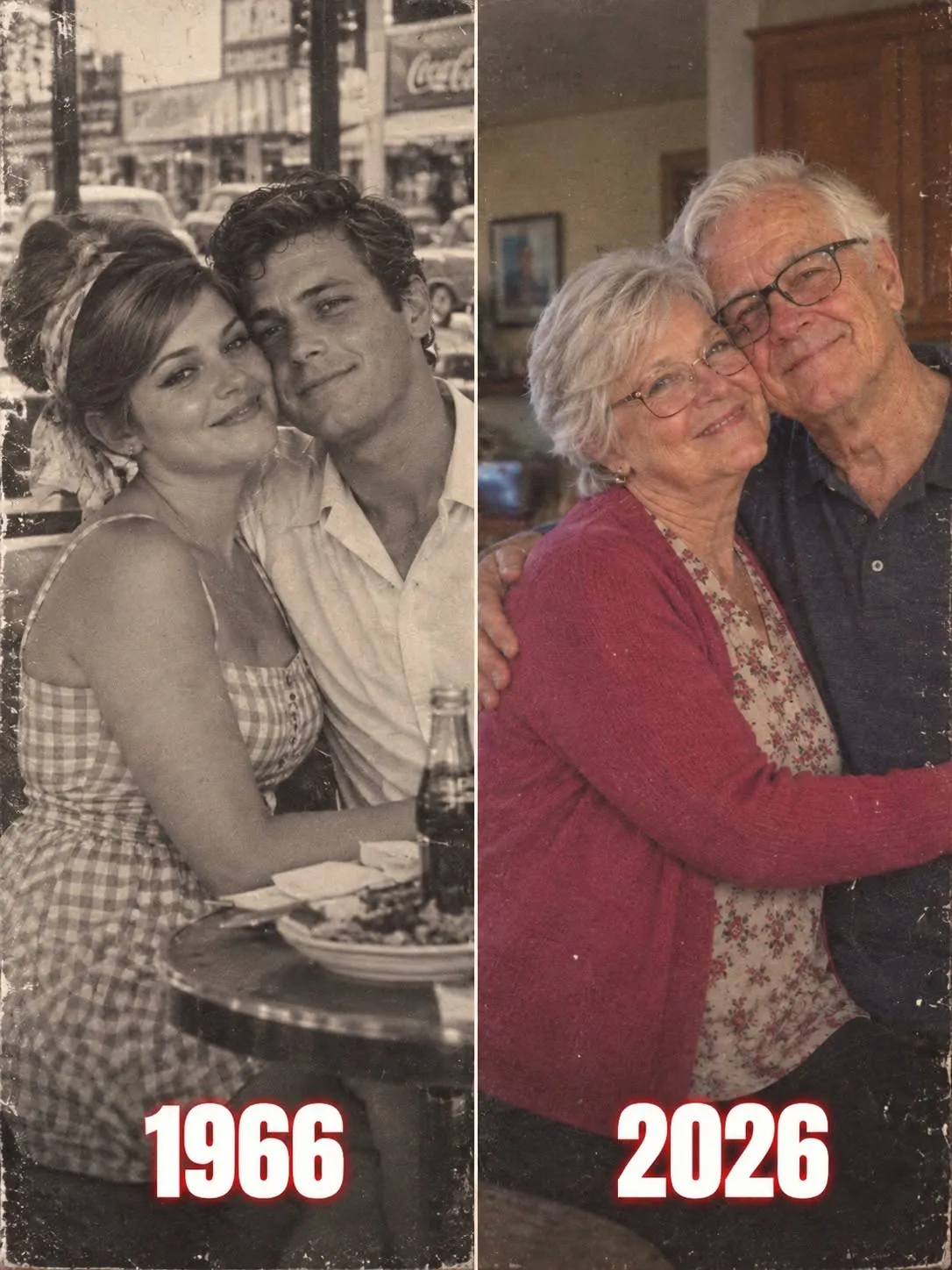
There we were in 1966.
Irene wore her white dress covered in blue flowers.
I wore the suit borrowed from my brother.
We were young enough to believe loving someone and knowing someone were the same thing.
I remembered what Irene whispered immediately before the photograph was taken.
“You’d better come home to me.”
I had.
For sixty years.
I placed the photograph upright.
Then I went upstairs.
My wedding ring was still beside Irene’s.
I picked it up.
The ring could not prove our marriage had been legal.
Removing it could not prove our life had been meaningless either.
It was simply the ring Irene had placed on my finger before I went overseas.
I wore it when our children were born.
I wore it when my parents died.
I wore it when we paid off our house.
And I wore it when I held Irene’s hand during the final hours of her life.
I slipped the ring back onto my finger.
When I returned downstairs, morning light had reached Irene’s empty chair.
I sat beside it.
For the first time, I allowed two truths to exist at the same time.
Irene had loved me.
And Irene had lied to me.
Neither truth erased the other.
I looked toward her chair.
“I’m still angry with you.”
The house remained quiet.
But for once, that silence did not feel like another argument I had lost because Irene was no longer there to answer.
I did not need to invent the explanation she might have given.
I did not need to forgive her simply because grief made anger uncomfortable.
I drank my coffee while sunlight moved slowly across the floor.
The wedding photograph remained upright on the mantel.
My ring stayed on my finger.
And at the cemetery, Irene’s stone would still carry two words.
Beloved Wife.
Not because her secret no longer mattered.
Not because forty-six years of silence had suddenly become acceptable.
But because I refused to let that secret become the only true thing about us.
Irene had made her choice forty-six years earlier.
This one was mine.