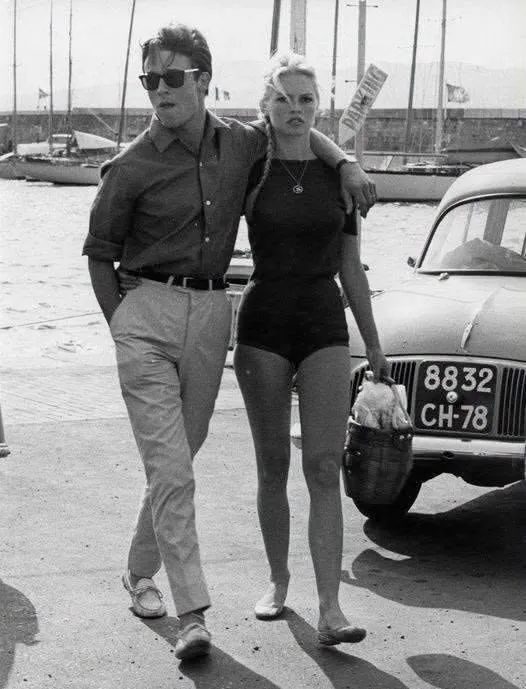
In the summer of 1958, Brigitte Bardot represented much more than the traditional image of a movie star. She symbolized freedom, beauty, rebellion, and a generation challenging established social conventions.
With her tousled blonde hair, expressive eyes, and effortless elegance, Bardot had become one of the world’s most recognizable women. Wherever she appeared, cameras followed, admirers gathered, and conversations turned toward her extraordinary influence.
Her impact reached far beyond cinema. She influenced fashion, popular culture, and changing attitudes toward femininity.
Among the places most closely associated with her legendary image was Saint-Tropez. This small French Riviera town was transforming from a quiet fishing village into an international destination.
Artists, actors, wealthy travelers, and fashionable visitors increasingly gathered along its Mediterranean coastline.
Against this beautiful backdrop, Bardot became associated with one of the most fascinating romantic chapters of her life.
Her relationship with actor Jacques Charrier attracted enormous public attention. Their romance reflected the glamour of postwar France and the growing fascination with celebrity relationships.
However, behind the photographs and fashionable appearances was a more complicated human story.
Bardot was navigating extraordinary fame, intense scrutiny, romantic expectations, and the difficult distinction between her private identity and public image.
Their marriage, the birth of their son, and their eventual separation revealed challenges that glamorous photographs could never fully explain.
To understand their story, we must look beyond the beautiful images. Their relationship offers insight into 1950s France, modern celebrity culture, and the personal cost of international fame.
Brigitte Bardot: The Woman Who Changed French Cinema
Before becoming an international sensation, Brigitte Bardot was a young Parisian with ambitions beyond conventional expectations.
Born in Paris on September 28, 1934, she grew up in a relatively comfortable family environment.
During childhood, Bardot trained in ballet. This experience helped develop the posture, movement, and physical expressiveness that later distinguished her screen performances.
From Ballet Training to Fashion Modeling
Bardot first entered the public eye through modeling.
Her appearance attracted attention in French fashion publications. Consequently, she became known for a distinctive style that differed from traditional Hollywood glamour.
Her appeal was difficult to explain through appearance alone.
She possessed expressive features, a distinctive smile, and a relaxed way of carrying herself. Her blonde hair, often styled with casual softness, became particularly recognizable.
Moreover, she could appear elegant without seeming excessively formal.
These qualities attracted photographers and filmmakers interested in a more natural screen presence.
A New Image of Modern Femininity
During the 1950s, cinema was experiencing significant cultural changes.
Audiences increasingly embraced emotionally complicated characters who challenged traditional social expectations.
Bardot’s appearance and personality aligned with this changing atmosphere.
Although other actresses had challenged conventional femininity before her, Bardot made that challenge internationally visible.
Her screen image suggested that women could be sensual, playful, independent, and unpredictable.
However, this representation also attracted criticism from traditional commentators.
Some audiences celebrated her as a symbol of liberation. Others considered her public image a challenge to established values.
This contradiction became central to her cultural importance.
By the late 1950s, Bardot was among Europe’s most discussed actresses.
Young women copied her hairstyles, fashion magazines examined her clothing, and photographers documented even ordinary public appearances.
Her success reflected more than individual beauty or talent.
Instead, it revealed a society exploring new attitudes toward youth, sexuality, fashion, and personal independence.
The Film That Made Brigitte Bardot an International Star
One of Bardot’s most important career milestones came with the 1956 film And God Created Woman.
Directed by Roger Vadim, the film helped establish her international reputation.
Its portrayal of an unconventional young woman challenged many moral expectations of the period.
A Character Who Refused to Follow Traditional Rules
Bardot portrayed Juliette Hardy, a beautiful and impulsive young woman whose independence created tension within her community.
Juliette did not behave like a conventional film heroine.
Instead, her desires frequently conflicted with the expectations of those around her.
The character’s independence, emotional complexity, and unconventional behavior made the film controversial.
Nevertheless, the controversy helped attract international attention.
Audiences became fascinated by Bardot’s natural movement and distinctive screen presence.
Her performance appeared unusually free compared with the carefully controlled acting styles associated with many earlier stars.
How the Film Transformed Her Career
The success of And God Created Woman introduced Bardot to a much wider international audience.
Although her acting career was already developing, this film transformed her into a cultural phenomenon.
Roger Vadim, Bardot’s first husband, understood the qualities that made her compelling on screen.
His direction emphasized her youthful energy, natural movement, and unconventional charm.
Furthermore, the film’s southern French setting strengthened her association with the Mediterranean lifestyle.
Sunlit landscapes, relaxed surroundings, and coastal scenery created a memorable visual atmosphere.
The French Riviera appeared as more than a filming location.
It represented sunshine, leisure, sensuality, and freedom from conventional restrictions.
Consequently, Bardot became closely associated with this image of Mediterranean glamour.
By 1958, she was no longer simply a promising actress.
She had become an international symbol whose influence extended well beyond cinema.
Saint-Tropez: From Fishing Village to Glamorous Destination
The French Riviera had attracted wealthy travelers and artists for generations.
However, Saint-Tropez developed a particularly strong cultural identity during the late 1950s.
Located along the Mediterranean coast, the town was traditionally associated with fishing and maritime life.
Its harbor, narrow streets, pastel-colored buildings, and surrounding beaches offered a distinctive atmosphere.
Unlike Paris or established luxury resorts, Saint-Tropez appeared less formal.
The Transformation of a Mediterranean Town
Following World War II, growing numbers of artists, writers, filmmakers, and fashionable travelers discovered Saint-Tropez.
Its natural beauty and relaxed atmosphere attracted visitors seeking an alternative to traditional urban sophistication.
The town offered outdoor cafés, picturesque boats, beautiful beaches, and Mediterranean sunshine.
Moreover, visitors could experience luxury without the strict social expectations associated with more formal destinations.
This combination became increasingly attractive to celebrities.
Brigitte Bardot played an important role in popularizing the town’s international image.
Her presence connected Saint-Tropez with youthful glamour and relaxed elegance.
How Bardot Helped Define Saint-Tropez
Bardot’s style differed from the formal elegance associated with aristocratic society.
She often appeared in simple summer clothing, with loosely arranged hair and an unguarded expression.
Nevertheless, these casual appearances attracted extraordinary attention.
Photographers found the Riviera particularly appealing.
Bright sunlight reflected across the water, while white buildings contrasted with the Mediterranean sky.
The harbor provided a beautiful background for images of actors and fashionable visitors.
However, Saint-Tropez became more than an attractive location.
It developed into a setting where celebrity images could be created and circulated internationally.
A simple walk through town could become a photograph reproduced in newspapers and magazines.
Consequently, distant audiences felt they were witnessing moments from celebrities’ private lives.
For Bardot, Saint-Tropez became inseparable from her public identity.
The town appeared to represent independence, sensuality, youth, and personal freedom.
Over time, Bardot became one of its most enduring cultural symbols.
Jacques Charrier: The Actor Who Entered Bardot’s Life
While Bardot enjoyed extraordinary international recognition, Jacques Charrier was developing his own acting career.
Born in Metz, France, on November 6, 1936, Charrier pursued professional ambitions within French entertainment.
He studied at the École nationale supérieure des arts et techniques du théâtre in Paris.
His career developed during a period of renewed international interest in French cinema.
Two Actors With Different Levels of Fame
Charrier did not possess the same international recognition as Bardot.
Consequently, their different levels of fame became an important feature of their public relationship.
Entering a romance with an internationally recognized actress presented unusual challenges.
Every appearance could attract photographers. Meanwhile, ordinary personal decisions could become subjects of public speculation.
Charrier also risked having his professional identity overshadowed by Bardot’s celebrity.
However, he remained an actor with his own ambitions and experiences.
Their relationship developed between two individuals, not simply between a famous actress and an admirer.
Nevertheless, entertainment coverage frequently focused on Bardot.
As a result, Charrier became widely associated with their marriage.
Why Their Relationship Fascinated the Public
Their romance attracted attention because audiences wanted to understand Bardot’s private life.
People wondered who she would marry and whether extraordinary fame could coexist with a stable relationship.
Additionally, photographs offered glimpses of the couple’s public appearances.
These images encouraged curiosity about their personalities and private experiences.
However, the answers were never as simple as the photographs suggested.
Their relationship developed under pressures that most ordinary couples never experience.
The difference between public fascination and private reality would become increasingly important.
A Romance Under Constant Public Attention
By the time Bardot and Charrier’s relationship attracted widespread interest, she was already accustomed to intense public scrutiny.
Her appearance, clothing, and romantic life regularly became subjects of discussion.
Although such attention could strengthen her professional influence, it also made personal boundaries difficult to maintain.
The Romantic Image of a Famous Couple
Photographs of Bardot and Charrier evoke the romantic atmosphere of late-1950s France.
They belonged to a generation associated with modern cinema, fashionable destinations, and changing attitudes toward relationships.
For admirers, they represented youth and romance.
For entertainment journalists, they offered a compelling celebrity story.
Meanwhile, photographers saw opportunities to capture the glamour associated with the French Riviera.
However, a couple’s public image rarely tells the complete story.
A photograph captures only one instant.
It may show two people smiling, standing together, or enjoying a sunny afternoon.
Nevertheless, it cannot reveal their private conversations, concerns, or emotional difficulties.
What Celebrity Photographs Cannot Reveal
Bardot’s public image emphasized openness, natural beauty, and personal freedom.
Consequently, audiences sometimes believed they understood her simply by looking at photographs.
Yet appearing relaxed does not mean someone is free from pressure.
A person can smile publicly while experiencing uncertainty or emotional stress privately.
Bardot and Charrier’s relationship existed within this contradiction.
Their romance was real, but outsiders constantly interpreted it through their own expectations.
Furthermore, growing attention made separating private experiences from public narratives increasingly difficult.
This distinction remains important when examining celebrity relationships today.
The Glamour of 1958: Fashion, Sunshine, and Freedom
The year 1958 represents a distinctive period in postwar popular culture.
Europe was experiencing significant economic and social changes following World War II.
Consumer culture expanded, international travel became accessible to more people, and cinema reached increasingly diverse audiences.
Fashion also began reflecting changing attitudes.
Traditional elegance remained influential. However, younger generations increasingly preferred clothing that expressed individuality and comfort.
Bardot’s Effortlessly Elegant Style
Brigitte Bardot embodied many of these developments.
Her clothing often appeared simple, comfortable, and spontaneous.
Rather than relying exclusively on elaborate outfits, she favored styles that emphasized movement.
Her ballet background also contributed to her recognizable posture.
Additionally, her hairstyles and casual summer clothing helped establish a distinctive public image.
Against the Mediterranean landscape, her appearance suggested that glamour did not require formal gowns or expensive jewelry.
Sometimes, a simple dress, sunglasses, or loosely arranged hair created an equally memorable impression.
Her Influence on Women’s Fashion
Women across Europe and beyond began imitating elements of Bardot’s appearance.
Fashion magazines circulated her photographs and discussed her distinctive style.
As a result, she became an influential model of modern femininity.
Her impact extended beyond individual clothing choices.
She helped popularize the idea that casualness itself could appear sophisticated.
This approach remains familiar in contemporary fashion.
Modern campaigns frequently celebrate natural movement, relaxed styling, and effortless elegance.
Although Bardot did not create this aesthetic alone, she became one of its most recognizable representatives.
When photographed with Charrier, her appearance strengthened the romantic mythology surrounding their relationship.
The couple seemed to inhabit a world where cinema, fashion, romance, and leisure existed together.
However, that glamorous image concealed the challenges of maintaining privacy under extraordinary public attention.
What a Photograph Can Tell Us About Their Relationship
Historical photographs of Brigitte Bardot and Jacques Charrier preserve a connection to an important cultural period.
Their clothing, expressions, posture, and surroundings reveal details about the era’s visual atmosphere.
Additionally, these images illustrate the growing importance of celebrity photography.
They also demonstrate how Saint-Tropez became associated with modern glamour.
Why Photographs Never Tell the Complete Story
A photograph should not serve as definitive evidence of a relationship’s emotional reality.
Two people standing close together may appear happy.
However, that image cannot establish whether their relationship was effortless.
Similarly, a smile cannot prove that someone experienced uninterrupted happiness.
A relaxed pose also reveals little about private concerns or responsibilities.
This distinction matters when examining historical celebrity relationships.
Public photographs generally preserve visually appealing moments.
They rarely document ordinary disagreements, responsibilities, compromises, or uncertainties.
Consequently, historical images can encourage romanticized interpretations of the past.
The Reality Behind Beautiful Images
Photographs of actors beside the Mediterranean can make the late 1950s appear almost perfect.
Sunlight, fashionable clothing, and beautiful scenery create an impression of timeless elegance.
Nevertheless, the people pictured experienced ordinary human challenges.
They pursued careers, maintained family relationships, and made difficult personal decisions.
Bardot and Charrier’s relationship demonstrates why photographs require historical context.
Their marriage became an important chapter in both their biographies.
However, images of the couple enjoying the Riviera cannot fully explain that relationship.
These photographs remain valuable cultural documents.
Their significance lies partly in showing how romance, celebrity, and visual culture intersected during a changing period in French society.
Marriage in 1959: A New Chapter for Brigitte Bardot
Brigitte Bardot and Jacques Charrier married on June 18, 1959.
Their wedding attracted considerable attention because Bardot had already achieved international fame.
At the same time, her professional career continued developing.
Marriage introduced new responsibilities and expectations into an already demanding life.
Marriage Under the Spotlight
For admirers, the wedding reinforced Bardot’s glamorous public image.
Her romantic life seemed almost as fascinating as her film career.
However, marriage involved more than a fashionable public event.
Both individuals needed to manage the emotional and practical realities of sharing their lives.
Bardot’s circumstances were particularly complicated.
Her acting career required professional commitments, travel, and public appearances.
Meanwhile, intense media attention made protecting ordinary personal experiences difficult.
Charrier also maintained professional ambitions and his own identity as an actor.
Consequently, their marriage brought together two careers and two personalities under unusual circumstances.
The Challenges of Celebrity Marriage
Relationships can begin with genuine affection and excitement yet encounter difficulties over time.
For entertainment professionals, demanding schedules and public expectations can create additional pressures.
Long periods apart may complicate communication.
Similarly, competing career priorities can affect shared plans.
These challenges do not automatically end relationships.
Nevertheless, they make mutual understanding and privacy especially important.
Bardot and Charrier’s marriage developed within this demanding environment.
Their relationship therefore deserves consideration beyond the glamorous narrative presented in entertainment magazines.
Like other marriages, it involved personal circumstances that outsiders could never completely understand.
The Birth of Their Son and Life Behind the Headlines
On January 11, 1960, Brigitte Bardot gave birth to her son, Nicolas-Jacques Charrier.
Motherhood introduced a major change during a period of extraordinary professional recognition.
The birth attracted considerable public attention.
However, this attention also demonstrated the difficulty of experiencing personal events under constant media scrutiny.
Motherhood During International Fame
Becoming a parent can involve joy, uncertainty, physical adjustment, and significant responsibilities.
These experiences can be demanding even when families enjoy privacy and strong support.
For Bardot, celebrity expectations added further complications.
The public often assumed that a famous woman should experience motherhood in a particular way.
However, individual experiences of parenthood vary considerably.
Bardot later spoke openly about the difficulties she experienced during this period.
She also discussed her complicated feelings toward motherhood.
Her reflections challenged idealized assumptions about maternal fulfillment.
Nevertheless, those statements reflected her individual experience rather than a universal judgment about parenting.
The Responsibilities of Family Life
The birth of Nicolas-Jacques meant Bardot and Charrier’s relationship now involved raising a child.
Their personal decisions would therefore affect their family as well as themselves.
Additionally, their circumstances became more complicated than a romance between two actors.
The public sometimes assumes that wealth, beauty, and fame protect individuals from emotional difficulties.
However, these advantages cannot eliminate the complexities of family life.
Bardot’s experience demonstrates the limitations of such assumptions.
Her family’s history also deserves thoughtful treatment.
Although famous people’s personal circumstances may become subjects of historical discussion, the individuals involved still deserve dignity and privacy.
Fame and the Difficult Search for Privacy
One of the central challenges of Bardot’s life involved maintaining privacy while being treated as a public symbol.
Illustrated magazines and celebrity photography expanded rapidly during the twentieth century.
Consequently, photographs of famous individuals could circulate internationally.
Even ordinary moments could become public entertainment.
How Celebrity Photography Changed Public Life
A photograph taken during a quiet afternoon might appear in magazines read by thousands of strangers.
This created a new relationship between celebrities and audiences.
Readers could feel personally connected to actors they had never met.
Meanwhile, interviews and entertainment columns encouraged audiences to believe they understood celebrities’ personalities.
Bardot became one of the clearest examples of this phenomenon.
Her clothing attracted attention, her hairstyles inspired imitation, and her romantic relationships generated widespread curiosity.
Such attention strengthened her influence.
However, it also placed considerable pressure on her private life.
The Contradiction of Being a Symbol of Freedom
Bardot’s public appeal depended partly on her image of independence.
Audiences admired her as a carefree, beautiful, and unconventional woman.
Yet the more famous she became, the harder it was to move through ordinary life unnoticed.
This created an important contradiction.
She represented freedom publicly while facing increasing restrictions on her privacy.
Even ordinary decisions could attract interpretations unrelated to her intentions.
For Bardot and Charrier, maintaining a private relationship under these circumstances became particularly challenging.
Their romance was not simply a personal bond.
It also became a subject of constant public curiosity.
Consequently, the glamorous image seen by audiences could differ considerably from the couple’s lived experiences.
Why Brigitte Bardot and Jacques Charrier Divorced
Brigitte Bardot and Jacques Charrier eventually separated.
Their divorce was finalized in 1962.
Although their marriage lasted only a few years, it became a significant chapter in Bardot’s biography.
The Complexity Behind Their Separation
Celebrity stories often encourage audiences to search for one dramatic explanation when relationships end.
However, marriages usually involve multiple circumstances.
Personal differences, changing priorities, unmet expectations, and emotional difficulties can accumulate over time.
Bardot maintained a demanding professional career.
Meanwhile, Charrier had his own ambitions and personal needs.
Their responsibilities as parents added another dimension to their relationship.
Additionally, the extraordinary attention surrounding Bardot formed part of their daily environment.
Nevertheless, photographs and public accounts cannot reconstruct every private conversation that influenced their separation.
It would therefore be misleading to attribute the divorce entirely to one circumstance without reliable evidence.
Romance and Long-Term Compatibility
Two people can experience genuine affection without remaining compatible throughout their lives.
They may share meaningful experiences and sincerely hope to build a future together.
However, circumstances and personal expectations can change.
The end of a marriage does not erase the importance of the relationship.
Nor does it prove that earlier moments of affection were insincere.
For Bardot and Charrier, their marriage became one chapter in lives that continued separately.
Its historical importance lies in understanding the human complexities behind a relationship often portrayed through glamorous celebrity imagery.
Bardot’s Lasting Influence on Fashion
Brigitte Bardot’s cultural influence extended far beyond her romantic relationships.
She became one of the defining fashion figures of the 1950s and 1960s.
Her style combined traditional femininity with a relaxed and informal attitude.
The Hairstyles and Clothing That Defined Her Image
Bardot’s hairstyles became widely recognizable.
Her loose blonde hair, soft volume, and characteristic fringe inspired countless imitations.
Additionally, the Bardot neckline became closely associated with her name.
This clothing style leaves the shoulders exposed and remains familiar in modern fashion.
She also appeared in striped tops, simple dresses, fitted trousers, ballet flats, and casual summer clothing.
These choices helped create the impression of effortless elegance.
Rather than emphasizing rigid formality, her clothing often allowed freedom of movement.
Her appearance seemed especially suited to the Mediterranean lifestyle.
Fashion as a Symbol of Independence
In Saint-Tropez, casual clothing and natural surroundings created an alternative image of glamour.
Bardot’s appeal was not merely visual.
Her appearance became associated with independence and individuality.
She suggested that women could be attractive without following every conventional expectation.
Her public image combined sensuality, confidence, and unpredictability.
However, the cultural image did not represent every aspect of her personality.
Photographers, filmmakers, designers, and magazines helped shape the version of Bardot that audiences recognized.
Nevertheless, her personal style contributed substantially to that image.
Her influence continued inspiring designers and photographers long after her greatest period of cinematic fame.
For many people, Bardot remains an enduring reference point for French Riviera fashion.
The French Riviera and the Rise of Celebrity Culture
Bardot’s connection with Saint-Tropez illustrates how celebrities can influence the identity of a location.
A destination may become internationally famous through both its natural beauty and its association with recognizable individuals.
Saint-Tropez offered picturesque scenery, Mediterranean beaches, bright sunshine, and a beautiful harbor.
Celebrities added stories that attracted international attention.
How Famous Visitors Changed Saint-Tropez
Photographs of actors, artists, and fashionable travelers transformed the Riviera into a symbol of luxury and leisure.
The town increasingly represented freedom, romance, and relaxed sophistication.
Bardot’s presence strengthened these associations.
Her international fame helped connect Saint-Tropez with a lifestyle admired far beyond France.
Additionally, illustrated magazines allowed images of the destination to circulate internationally.
Readers could imagine themselves visiting the same beaches and cafés as their favorite celebrities.
Consequently, geography and celebrity fantasy became closely connected.
The Birth of a Lasting Cultural Image
Saint-Tropez gradually became more than a Mediterranean town.
It represented an idealized lifestyle where beauty, relaxation, and freedom appeared naturally connected.
This relationship between famous individuals and destinations continues today.
Film festivals, luxury resorts, restaurants, and fashionable locations often attract visitors through celebrity associations.
However, during the 1950s, illustrated magazines made this process especially visible.
Bardot and Charrier belonged to this cultural transformation.
Their photographs preserved its glamour, even though their private relationship was more complicated than the public image suggested.
The Difference Between Public Image and Private Identity
Brigitte Bardot’s life raises an enduring question about celebrity culture.
Can a public image ever fully represent the individual behind it?
Audiences knew Bardot through films, photographs, interviews, and entertainment reporting.
However, each source revealed only selected aspects of her personality.
How the Public Came to Know Bardot
Her films presented fictional characters.
Photographs emphasized particular expressions, outfits, and surroundings.
Meanwhile, interviews captured what she chose to communicate at specific moments.
Together, these materials created an internationally recognizable image.
Nevertheless, a person is always more complicated than the photographs and stories representing them.
Bardot could appear glamorous while experiencing ordinary frustration.
She could represent freedom on screen while facing restrictions in private life.
Similarly, she could symbolize independence without escaping public expectations.
These contradictions do not necessarily make her image false.
Instead, they reveal the limitations of reducing a human being to a cultural symbol.
Why Historical Context Matters
The same distinction applies to Bardot’s relationship with Charrier.
Photographs showed moments selected for public circulation.
However, they could not explain the emotional realities of their marriage.
Their relationship is best understood through documented events and an awareness of historical uncertainty.
People naturally search for meaning in photographs.
This tendency becomes especially strong when images belong to a nostalgic period.
Nevertheless, historical interpretation requires caution.
A smile should not automatically prove happiness.
Likewise, later difficulties should not suggest that an entire relationship was destined to fail.
Human relationships contain experiences that photographs cannot preserve.
Why Their Photographs Still Fascinate Audiences
Images of Brigitte Bardot and Jacques Charrier continue attracting attention decades after their relationship.
Part of this fascination comes from Bardot’s lasting cultural recognition.
She became one of the defining faces of twentieth-century popular culture.
Consequently, photographs from her early fame remain historically interesting.
The Appeal of Celebrity Romance
Audiences have always shown curiosity about famous actors’ relationships.
These romances combine familiar human emotions with extraordinary public circumstances.
Bardot and Charrier’s marriage offered precisely this combination.
They were two actors whose lives became connected during a remarkable period of international recognition.
Their photographs also preserved the atmosphere of the late-1950s French Riviera.
Summer holidays, Mediterranean sunlight, fashionable clothing, and celebrity leisure all contributed to their appeal.
The Power of Nostalgia
Historical photographs allow viewers to imagine life in another era.
Hairstyles, clothing, automobiles, architecture, and social settings create a sense of entering the past.
Even people unfamiliar with Bardot’s films may appreciate the atmosphere these images communicate.
However, their greatest interest may lie in the contrast between visual simplicity and historical complexity.
A photograph of two people together can appear timeless.
Nevertheless, their relationship belonged to a particular social environment with distinct pressures and expectations.
Understanding that context makes the photographs more meaningful.
They remain beautiful cultural artifacts, but their significance extends beyond appearance.
Looking Back at 1958 From a Modern Perspective
Modern audiences often remember the 1950s through fashion, classic cinema, elegant automobiles, and distinctive photography.
The French Riviera occupies a particularly glamorous place in this historical imagination.
Brigitte Bardot remains central to that image.
Her appearance influenced the visual language of the period.
Additionally, her film roles contributed to changing conversations about femininity and personal freedom.
The Social Expectations of the 1950s
Despite its glamorous imagery, the late 1950s was not an uncomplicated period.
Women faced significant expectations concerning marriage, motherhood, respectability, and public behavior.
Famous women could receive admiration for their beauty while facing criticism for unconventional personal choices.
Bardot experienced these contradictions.
She was celebrated for representing freedom.
However, her private life frequently attracted judgments based on traditional assumptions.
Her romantic relationships became public narratives.
Similarly, her experiences as a wife and mother received intense attention.
Why Her Story Remains Relevant Today
Modern celebrity culture has changed considerably.
Nevertheless, famous individuals still struggle to maintain personal boundaries.
Social media has accelerated the circulation of photographs, opinions, and speculation.
Consequently, separating public identity from private experience can become even more difficult.
Bardot’s experience therefore remains relevant beyond French cinema history.
Her story contributes to broader discussions about celebrity, gender expectations, privacy, and the personal consequences of fame.
Brigitte Bardot’s Legacy Beyond Her Romantic Life
Although Bardot’s relationship with Jacques Charrier remains an important biographical chapter, her legacy extends much further.
Her influence on cinema was substantial.
Her performance in And God Created Woman helped establish a screen image that challenged conventional expectations of femininity.
Additionally, her fashion choices inspired generations of designers, photographers, and admirers.
From International Actress to Animal Welfare Advocate
Bardot stepped away from acting in the early 1970s.
She subsequently devoted much of her public life to animal protection.
In 1986, she established the Brigitte Bardot Foundation.
Through this organization, she became widely associated with animal welfare advocacy.
This represented a significant change in her public identity.
The actress once celebrated primarily for beauty and cinematic presence became known for her commitment to animal protection.
A Complex and Controversial Public Legacy
Bardot’s later public life also included controversial political statements and positions that attracted criticism.
Therefore, a balanced understanding of her legacy requires acknowledging more than her artistic achievements.
Her biography includes professional success, cultural influence, personal difficulties, animal welfare advocacy, and contentious public views.
Historical figures rarely fit neatly into one category.
Reducing Bardot to a romantic photograph would overlook this complexity.
Nevertheless, images from her younger years remain valuable historical documents.
They preserve the period when her public image helped reshape international perceptions of French cinema and Riviera glamour.
Her marriage to Charrier belongs within this broader history.
It was an important personal chapter, but it never represented the entirety of her life.
Conclusion: The Human Story Behind a Timeless Photograph
Brigitte Bardot and Jacques Charrier remain associated with an extraordinary period in French popular culture.
Their relationship developed while Bardot was experiencing remarkable international fame.
Consequently, their public appearances became part of the glamorous mythology surrounding the French Riviera.
Saint-Tropez provided a memorable setting for this image.
Its Mediterranean scenery, relaxed atmosphere, and growing celebrity reputation created an impression of freedom and elegance.
Bardot’s beauty, personality, and cinematic success made her one of the defining symbols of that world.
Her performance in And God Created Woman had already established her international reputation.
Meanwhile, her influence continued spreading through fashion, photography, and changing cultural attitudes.
Charrier entered her life during this remarkable period.
Their marriage, the birth of their son, and their eventual separation revealed the personal complexities hidden behind glamorous photographs.
More Than a Beautiful Image
Photographs of the couple remain compelling because they preserve a moment when romance, cinema, and celebrity culture intersected.
However, their historical importance extends beyond visual beauty.
They remind us that public images reveal only fragments of individual lives.
Behind the elegant clothing and Mediterranean sunshine were two people navigating ambitions, responsibilities, and changing circumstances.
Bardot’s story ultimately reaches far beyond her relationship with Charrier.
She helped redefine the image of the modern screen actress, influenced international fashion, and became a prominent animal welfare advocate.
Her connection with Saint-Tropez remains an enduring part of her cultural identity.
Meanwhile, her marriage offers insight into the personal challenges experienced by someone whose public image had become larger than life.
The Lasting Meaning of Their Story
Looking back today, audiences can appreciate the beauty of the period without assuming that photographs reveal everything.
These images preserve the sunlight, fashion, and romantic atmosphere of a remarkable historical moment.
Nevertheless, the lives behind them remind us that famous individuals experience the same fundamental complexities as everyone else.
Love, family, professional ambition, and personal identity remain difficult to balance, regardless of public recognition.
Ultimately, Brigitte Bardot and Jacques Charrier’s story is more than a tale of French Riviera glamour.
It reminds us that behind every timeless photograph lies a genuine human story.
And sometimes, understanding that story makes the photograph even more remarkable.
Related Articles

Wealthy Woman Refused to Leave One Turkey for a Sick Boy — Then Her Father Walked Into the Store

I Farmed Beside My Dad for 22 Years, but He Left All 400 Acres to My Brother — Then Planting Season Changed Everything

My Husband Had a Vasectomy, but Two Months Later, I Found Out I Was Pregnant